A delayed subway line becomes more than a construction problem
In the United States, transit delays often become shorthand for bigger frustrations: a commuter rail extension that slips behind schedule, a light-rail project that runs over budget, a bus network that no longer matches where people actually live and work. In South Korea, where modern transit systems are often held up as a point of national pride, the stakes can feel especially high when a major rail opening is delayed. That is the situation now facing residents of Cheongna International City, a fast-growing district in Incheon, west of Seoul, where local officials are scrambling to respond to a delay in the planned extension of Seoul Subway Line 7.
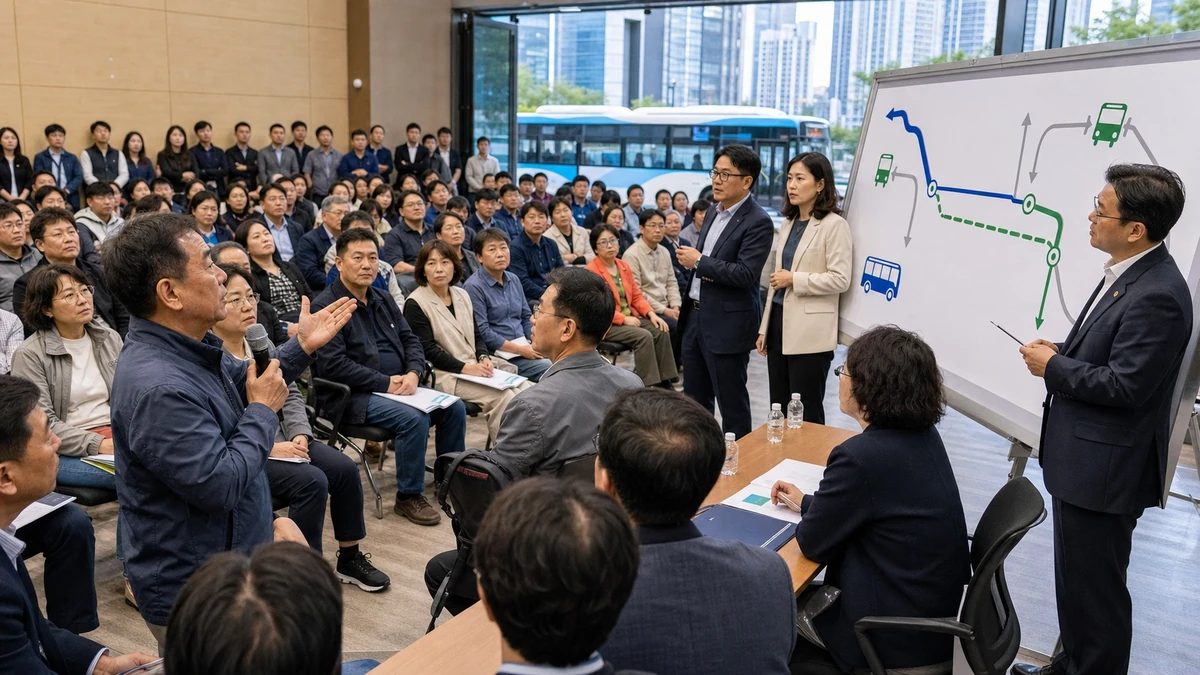
According to South Korean media reports, Incheon city officials held a public meeting Tuesday at the Cheongna 3-dong Administrative Welfare Center to share the latest on the delayed project and discuss ways to reduce the burden on residents. More than 200 people attended, including Incheon Mayor Park Chandae, lawmakers, district officials and local residents. The gathering was not framed simply as a technical briefing on rail construction. Instead, it became a broader discussion about how a city should respond when a long-promised infrastructure project fails to arrive on time.
That distinction matters. For residents, a subway line is not just a ribbon-cutting photo opportunity or a line on a transit map. It shapes work commutes, school runs, grocery trips, hospital visits and weekend plans. A delay is measured not only in months on a project calendar, but in missed transfers, longer bus rides, extra time away from family and rising uncertainty about daily routines. In that sense, the debate in Cheongna is less about one line of track than about the quality of urban life in one of South Korea’s most densely connected metropolitan regions.
South Korean cities are often admired abroad for their speed, order and infrastructure capacity. Americans who have visited Seoul or nearby Incheon are often struck by the extent of the subway system, the frequency of service and the relative ease of moving between neighborhoods and cities. But that efficiency depends on constant coordination. When one piece of the network is delayed, local officials are under pressure to prove that government can still function in a practical way for the people who depend on it every day.
That was the message behind the Incheon meeting: the city says it is not treating the delay as a problem to be confined within the walls of a construction office. Instead, officials are promising to inspect the project closely, determine the cause of the delay and at the same time adjust bus service and broader transportation links so residents are not left waiting for rail service with no short-term relief.
Why Cheongna matters in the Seoul metro area
To many readers outside Korea, Cheongna may not be a familiar place. It is part of Incheon, a major port city and transportation hub that borders Seoul and is home to Incheon International Airport, the country’s main gateway to the world. Over the past two decades, parts of Incheon have been developed as large-scale planned communities meant to absorb growth from the greater Seoul metropolitan area. Cheongna International City is one of those districts, built with the promise of housing, business space, schools, parks and modern transportation connections.
The “International City” label can sound abstract in English, but in South Korea it often signals a master-planned urban district designed to attract investment, global business and relatively affluent residents. These developments are marketed as future-oriented communities with wide roads, apartment towers, commercial zones and improved access to regional transit. For families who move there, transportation is not an afterthought. It is central to the entire value proposition.
That helps explain why the extension of Seoul Subway Line 7 carries such symbolic and practical weight. Although the project is located in Incheon, Line 7 is part of the broader Seoul subway network, the sprawling system that underpins economic life in the capital region. An extension into Cheongna would do more than add stations. It would pull the district more tightly into the orbit of jobs, schools and services across the metro area. In the Seoul region, a direct rail connection can significantly influence commuting times, housing demand and even the social status of a neighborhood.
Americans can think of this in terms of a suburb promised a long-awaited commuter rail station or a major subway extension that would finally connect a growing development to the urban core. Until that connection opens, residents often depend on buses, cars or awkward transfers. The difference in South Korea is that high-capacity public transit is so deeply woven into everyday life that expectations for reliable delivery are especially strong. A delay, therefore, can feel like a breach not only of convenience but of trust.
Cheongna residents are not simply asking when the trains will begin running. They are asking how the city intends to manage the gap between the planned future and the frustrating present. That is why Tuesday’s meeting drew local politicians, administrators and residents into the same room. The issue is no longer just engineering. It has become political, social and deeply personal.
What officials discussed, and why the response goes beyond rail
The most notable feature of the meeting was not merely that city officials acknowledged the delay publicly. It was that they discussed a response strategy extending beyond the rail project itself. Incheon officials and participants reviewed possible increases in bus service, route adjustments and stronger links to wider regional transportation systems. In effect, the city signaled that if the train cannot arrive on schedule, the transportation network around it must be reshaped to compensate.
That may sound obvious, but it marks a meaningful shift in emphasis. Public agencies often treat delayed infrastructure projects as isolated technical matters: contractors are reviewed, timetables are revised and the public is told to wait. Incheon’s approach, at least for now, appears to recognize that residents cannot put their daily lives on hold while officials sort out construction problems behind the scenes.
Adding bus service is the most straightforward response. More buses can help absorb demand and reduce crowding. But quantity alone does not solve a mobility problem. If buses do not go where commuters actually need to go, or if schedules do not line up with work and school hours, the practical benefit may be limited. That is why route adjustments were also discussed. Changing the path buses take can be just as important as increasing how many vehicles are on the road.
Officials also talked about wider regional transit connections, an important point in a metropolitan area where many trips cross city boundaries. For Cheongna residents, travel is not limited to movement within one neighborhood. A commute may involve multiple jurisdictions, transfers between bus and rail, or longer trips toward Seoul’s business districts. A transportation fix that ignores those broader patterns may look adequate on paper while failing in real life.
In American terms, imagine a suburb waiting on a delayed rail extension while city officials respond by adding a handful of local buses that never connect efficiently to the regional network. Riders might still face long overall travel times, confusing transfers and unreliable links to major job centers. Incheon appears to be trying to avoid that kind of half-measure by discussing transportation as a connected system rather than a set of separate lines and agencies.
The meeting also reflected a broader principle of urban governance: people experience infrastructure holistically. A resident does not care which agency controls which portion of the route nearly as much as whether the full trip works. A smooth transfer can make a long journey manageable. A broken connection can make an otherwise well-funded transit network feel dysfunctional. By bringing buses, route design and regional links into the same discussion as rail construction, Incheon officials implicitly acknowledged that reality.
A Korean model of consensus politics is now on display
Another important element of the city’s response is the creation or activation of what Korean officials describe as a “public-private-political consultative body.” That phrase can sound awkward in English, but the concept is straightforward. It refers to a forum that includes residents, government agencies and elected officials, allowing them to share information and coordinate responses.
In South Korea, this kind of consultative structure is a common administrative tool. It reflects a style of governance that often mixes technocratic planning with public meetings and negotiated coordination among institutions. The goal is not just to gather complaints, but to create a mechanism through which grievances, project data and policy options can be translated into concrete action. In theory, it narrows the gap between the people who build systems and the people who live with the consequences when those systems fall short.
Mayor Park reportedly described the Cheongna Line 7 extension as the top priority issue of his administration and pledged to identify the cause of the delay through an audit or equivalent review. He also promised to focus the city’s energy on practical solutions through the consultative body. That dual-track response, investigating what went wrong while also addressing residents’ immediate problems, is politically shrewd and administratively necessary.
Still, the value of such a body will depend on whether it can do more than convene meetings. Residents will want to know whether complaints raised in the room lead to revised bus schedules, clearer public updates, accountability for delays and better coordination between city and regional agencies. In many democracies, consultative panels can become symbolic gestures if they are not backed by decision-making authority or a clear process for implementation.
For American audiences, the closest parallel may be a joint task force that includes city officials, transit agencies, elected representatives and neighborhood stakeholders after a major infrastructure setback. These groups can be effective when they are used to align fragmented institutions around immediate deliverables. They can also disappoint when they function mainly as a pressure-release valve without producing visible changes on the ground.
In Cheongna, the political optics matter because the affected residents are not distant observers. They are the people who will board the buses, make the transfers and endure the longer travel times. That gives the consultative process a practical test: Can it convert public frustration into targeted improvements before confidence erodes further?
The real issue is time: how people live while waiting
Behind the policy language and construction updates lies a more intimate reality. Delays in urban transit projects are fundamentally about time. Not the abstract time tracked in project charts and procurement documents, but the daily time households spend getting children to school, traveling to work, shopping for groceries or visiting family. In dense urban societies, transportation is often the infrastructure that determines whether a day feels manageable or exhausting.
That is particularly true in South Korea, where long work hours, intense school schedules and high commuter volumes place a premium on predictability. Even small increases in transit time can have outsized effects on family routines. A missed transfer may mean arriving late to work. A longer bus route can reduce time spent with children. A less reliable commute can complicate after-school pickups, private tutoring schedules or medical appointments. These are not secondary issues. They are central to how people evaluate whether a city is serving them.
The Korean reporting on the meeting underscored that point by emphasizing transportation as a “living” issue, one closely tied to everyday quality of life. That framing is useful for international readers because it moves the story away from bureaucratic jargon and toward what residents actually experience. A delayed station opening is not meaningful simply because it alters a transportation plan. It matters because it changes how long it takes to live an ordinary life.
There is also a psychological dimension. Planned communities like Cheongna are often built around future promises: better access, shorter commutes, more convenience, rising property values and a seamless connection to metropolitan opportunity. When the transportation link at the heart of that promise is delayed, residents may feel that the timetable of their lives has been pushed back as well. The issue becomes one of predictability. People can adapt to inconvenience if they understand the rules of the system; they become far more frustrated when those rules keep shifting.
This is why the city’s handling of communication may prove almost as important as the eventual engineering fix. Residents tend to tolerate bad news better than vague news. Clear explanations of what caused the delay, what is being done to address it and what interim options are available can help preserve public trust. Silence or mixed signals can deepen resentment, even if the physical project eventually moves ahead.
In that respect, the public meeting itself was significant. Holding it in a neighborhood administrative center rather than a distant government office placed the discussion in the community most directly affected. It suggested a willingness, at least symbolically, to bring government to the people rather than forcing residents to absorb decisions from afar. Whether that symbolism turns into effective policy will be the next question.
What this says about South Korea’s urban growth model
The Cheongna transit dispute also highlights a broader tension in South Korea’s development model. The country has earned global praise for delivering large-scale urban infrastructure quickly and efficiently. But fast growth creates its own risks. New districts can be built around assumptions of future connectivity that leave residents exposed if major links are delayed. In other words, the very ambition that produces sleek planned communities can also magnify the consequences when one crucial piece falls behind.
This is not unique to Korea. Cities around the world struggle with the gap between development timelines and infrastructure timelines. Housing often arrives before transit capacity is fully in place. Commercial growth outpaces roads or rail. Political leaders celebrate groundbreaking ceremonies years before residents see practical benefits. What makes the Korean case noteworthy is how intensely transit is integrated into metropolitan life and how high public expectations are for coordinated execution.
Cheongna’s situation illustrates that urban growth cannot be measured solely by new buildings or investment brochures. It must also be measured by the dependability of the systems that allow residents to move through the city. In the Seoul metropolitan area, rail lines are not decorative amenities. They are core arteries of economic and social participation. When one is delayed, it exposes the extent to which modern city life depends on invisible coordination between construction schedules, bus networks, regional planning and political accountability.
For U.S. readers, the story may resonate as a reminder that successful transit is not just about getting big projects approved. It is also about the less glamorous work of integration: making sure buses feed into rail, agencies share information, and short-term service plans are adjusted when long-term projects falter. In that sense, Incheon’s problem is globally familiar even if the local institutions and terminology are distinctly Korean.
It also offers a counterpoint to the stereotype that East Asian infrastructure systems operate with flawless precision. The reality is more human and more complicated. Even highly capable transit states face delays, political pressure and the challenge of keeping public trust when promised timelines slip. What distinguishes a strong system is not the absence of problems, but the quality of the response when problems occur.
What residents will be watching next
For now, the facts established at the meeting are limited but important. Incheon has publicly shared the existence of the delay with residents. It has promised closer inspection of the construction site and a formal effort to identify the cause. It has signaled that it will not wait for the rail issue alone to be resolved before considering bus increases, route adjustments and stronger regional transit links. And it has placed the issue within a joint consultative framework involving residents, government and politicians.
The harder part comes next. Residents will be looking for timelines, not just assurances. They will want to know which bus routes might change, how quickly extra service can be deployed, whether regional transfer points will be improved and how often the city plans to provide public updates. They will also want some sense of accountability. If an audit finds specific causes for the delay, the public will expect those findings to lead to more than a press statement.
The credibility of the city’s response will depend on balance. If officials focus only on assigning blame for the delay, residents may feel abandoned in the meantime. If they focus only on stopgap measures, they may appear to be accepting a lower standard rather than fixing the core problem. The city’s own framing suggests it understands this dilemma: cause-finding and immediate inconvenience relief must move in parallel.
That is the challenge confronting Incheon now. A delayed subway extension has turned into a public test of whether a rapidly developed urban district can be governed in a way that feels responsive, transparent and grounded in everyday experience. For the families of Cheongna, the issue is not abstract. It is counted in commuting minutes, transfer stress and the daily question of how to get from one obligation to the next.
For the rest of South Korea, and for international observers who often look to the country as a model of modern urban infrastructure, the episode is a useful reminder. Transit systems are not judged solely by the elegance of their maps or the scale of their ambitions. They are judged by whether people can rely on them when plans go wrong. Incheon has now acknowledged that reality in public. The next measure of success will be whether residents can feel the difference on the street, at the bus stop and on the clock.
Comments
Post a Comment