South Korea’s Inland Heat Belt Nears 103 Degrees, Offering an Early Warning About Life in Extreme Summer
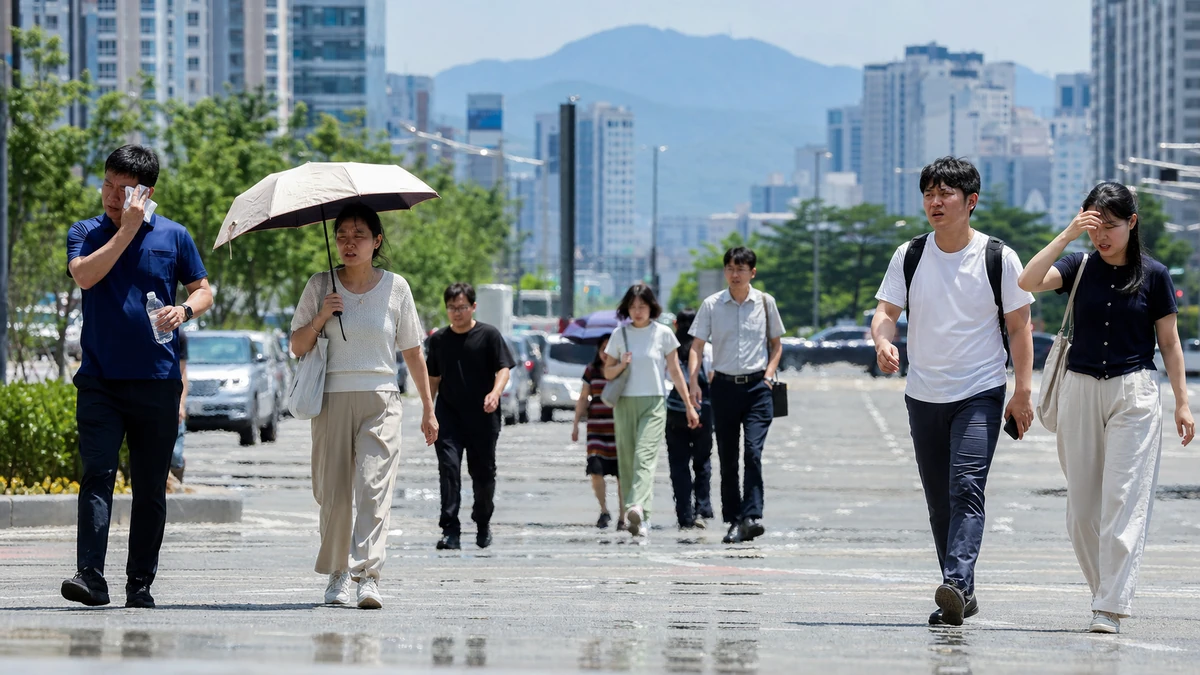
A dangerous summer signal in one of South Korea’s hottest regions
South Korea’s southeastern interior is getting an early and punishing preview of summer at its most severe. Authorities issued the year’s first heat wave warning for parts of Daegu and North Gyeongsang Province on Saturday as temperatures surged far beyond what many residents would consider ordinary midsummer weather. By about 2 p.m., Daegu had climbed to 38.2 degrees Celsius, or about 100.8 degrees Fahrenheit, while an observation point in nearby Gyeongsan reached 39.4 Celsius, roughly 102.9 Fahrenheit — close enough to 104 that the distinction matters less than what it means for people trying to move through the city.
For American readers, Daegu is often described as one of South Korea’s hottest major cities, a basin-like inland urban center in the country’s southeast where summer heat can become especially oppressive. If Seoul, the capital, is often the international face of South Korea, Daegu is a reminder that the country’s climate can vary sharply by region. Think of it less like a uniformly temperate East Asian country and more like a place where local geography matters: a nation small enough to drive across in hours, but varied enough that one metro area can feel more like an oven than another on the same day.
The Korea Meteorological Administration’s regional office in Daegu said the warning took effect at 11 a.m. for parts of Daegu and several areas of North Gyeongsang, including Pohang, Gyeongsan, Yeongcheon and parts of Gyeongju. Forecast highs for the broader Daegu-North Gyeongsang area had been set at 29 to 36 Celsius, but the actual readings in some places exceeded the upper edge of that range. That gap matters because weather forecasts are not just about numbers on paper; they shape weekend routines, travel decisions, outdoor work and whether families decide to stay home, head to air-conditioned malls or make for the coast and riverside parks.
In the United States, a temperature that brushes 103 degrees might evoke Phoenix, Las Vegas or a brutal day in Texas. But South Korea’s heat can carry a different texture. It often comes with heavy humidity, dense urban development and a street-level intensity amplified by pavement, traffic and tightly packed buildings. In Daegu, where shimmering heat visibly rose from the roads on Saturday, the weather was not merely uncomfortable. It was something residents had to actively plan around.
Why this heat wave warning matters beyond the thermometer
In South Korea, a heat wave warning is more than a dramatic weather label. It is a public safety alert tied not only to temperature but to perceived heat, known in English as heat index or apparent temperature. Under meteorological guidance commonly used in the country, a warning is issued when the highest apparent temperature is expected to exceed 35 Celsius for at least two consecutive days, or when major damage is anticipated from the heat. A lower-tier heat advisory is used when apparent temperatures are expected to top 33 Celsius for at least two days or when serious impacts are still possible.
That distinction is important for readers outside Korea because the Korean article’s central point is not simply that it was hot. It is that the region crossed a threshold where daily life starts to reorganize itself around risk. When the official high is one thing and pavement-level reality feels hotter, people do not just complain; they change their behavior. The warning issued Saturday signaled the start of that shift.
It also carried seasonal symbolism. This was the first heat wave warning of the year for the affected parts of Daegu and North Gyeongsang. In practical terms, that means residents are moving from anticipating summer to managing it. Americans know this moment too, whether it is the first excessive heat warning in the Midwest or the first week when New Yorkers start timing errands around subway platform temperatures. In South Korea, that transition can be especially abrupt because heat, humidity and high-density urban life converge quickly.
By late morning Saturday, what might have begun as an ordinary summer weekend had become a different sort of day entirely. Families planning outings, workers crossing town, older residents heading to markets and young people meeting friends all had to reconsider the same basic questions: When should we go out? How far will we walk? Where can we cool down? Those are not trivial lifestyle calculations. In an intense heat event, they can become health decisions.
Daegu’s geography helps explain why the city can feel unforgiving
To understand why Daegu stands out in Korean weather coverage, it helps to know something about the city itself. Daegu is South Korea’s fourth-largest city, a major industrial and transportation hub with a long reputation for hot summers. Koreans often refer to it as one of the country’s “furnaces,” a shorthand born of experience rather than branding. Its inland location and surrounding topography can trap heat in ways familiar to anyone who has spent time in valley cities elsewhere in the world.
On Saturday, the article’s most vivid scene came from Gongpyeong Intersection in central Daegu, where shimmering heat rose visibly from the road surface. That image does the work of a thousand statistics. Americans who have watched the air ripple above blacktop in Arizona parking lots or on Southern highways know exactly what it signals: the ground itself has become part of the heat source. Every step outdoors becomes more draining because the sun is not the only enemy. The street radiates heat upward, buildings hold it and the body struggles to cool itself.
What makes urban heat distinct is that it is experienced not only at destination points but in transit. A person may spend just a few minutes walking from a bus stop to an office, apartment tower or department store, but those few minutes can define the entire outing. In a dense Korean city, where walking and public transit are central to daily life, that matters enormously. A short errand in spring or fall can become a punishing trek in July, especially around midday.
That is one reason the warning area itself matters. Meteorological authorities did not issue a blanket notice for every corner of the wider region; they specified central Daegu, southern Dalseong and parts of nearby North Gyeongsang. To an outsider, those distinctions may sound bureaucratic. In reality, they reflect a practical truth: heat can vary notably even within one metropolitan zone. One neighborhood may bake harder than another. One satellite city may run closer to 103 while another stays a few degrees lower. In a heat wave, those differences can affect everything from commute timing to whether outdoor events proceed as planned.
The weekend changed as residents looked for shade, water and air conditioning
One of the clearest themes in the Korean reporting is that the heat did not simply make people miserable; it changed the rhythm of the weekend. That is a useful frame for American readers because it gets beyond the cliché of “summer weather.” A city under heat stress does not stop functioning, but it starts to function differently.
In Korea, the word “piseo” refers to escaping the heat, often by heading to cooler places such as beaches, valleys, mountains, riversides, shopping complexes or other air-conditioned destinations. The closest American equivalent might be the way families in the South pile into cars for the mall during a dangerous heat spell, or the way city residents seek out movie theaters, libraries or public cooling centers. It can mean vacation, but it can also mean something more ordinary: finding any tolerable place to spend the hottest part of the day.
That appears to be what happened across Daegu and neighboring areas. As the temperatures climbed toward 100 and beyond, leisure choices naturally tilted toward heat avoidance. Instead of asking what would be most fun outdoors, residents were more likely to ask what would be survivable and comfortable. A picnic can wait. A long walk through a shopping district can be postponed. An outing can be shifted to the evening. The heat does not erase recreation so much as rewrite its terms.
There is a broader social point here. In many American cities, extreme heat is increasingly recognized as a public issue that affects productivity, transit, health care and the use of public space. South Korean cities are confronting the same reality. Heat waves change not only how people feel but how urban life is scheduled. Public plazas become less welcoming. Roads become physically harsher environments. Time outdoors is rationed. Errands cluster around mornings, evenings and indoor stops in between.
For a country known internationally for its hyper-efficient cities, fast trains and bustling street life, these adaptations are especially striking. South Korean urban culture is famously active: cafes stay busy, shopping districts fill up, and weekend travel between neighboring cities is routine. Daegu and North Gyeongsang form a closely connected living region where people commute, shop and socialize across city lines. Saturday’s weather underscored that residents increasingly need hyper-local information, not just a generic note that “the southeast is hot.” If you are leaving Daegu for Gyeongju, or Gyeongsan for Pohang, the exact conditions at your destination may shape your decisions as much as the conditions at home.
The numbers were uneven, but the regional message was the same
Although Gyeongsan’s 39.4 Celsius reading drew the most attention, it was hardly alone in enduring extreme heat. Around the same time, Goryeong reached 36 Celsius, Pohang 36.4 and Gyeongju 37, while Daegu itself was at 38.2. Those differences may appear modest at first glance, but they illustrate why localized weather reporting matters.
In the United States, people in large metro areas have learned to pay attention to neighborhood-scale differences in storm flooding, wildfire smoke or snow accumulation. Heat deserves the same treatment. A few degrees can change a worksite’s safety conditions, the viability of a youth sports practice or the comfort of a tourist district. When the upper end of the range is already dangerous, even small departures from forecast expectations can have outsized effects.
There was also variation within Gyeongsan’s own reported observation points, a reminder that weather data are collected from different instruments and locations. That does not undermine the reality of the heat; if anything, it reinforces the point that what residents feel depends on exactly where they are standing. A station beside built-up surfaces may read differently from one in another setting. For policymakers and ordinary citizens alike, that means broad regional averages are useful but insufficient. The lived experience of heat is local.
That localism is becoming one of the defining characteristics of climate-era weather reporting. The question is no longer simply whether a region is hot. It is which streets, which transit routes, which neighborhoods and which hours of the day become hardest to navigate. In South Korea, where apartment towers, expressways and commercial corridors sit close together, these micro-differences can be felt quickly and intensely.
Saturday’s readings also highlight a familiar modern-weather story: forecasts remain essential, but real-time conditions can outrun expectations. Authorities had projected a daytime high range of 29 to 36 Celsius for Daegu and North Gyeongsang. Yet some observation points pushed well beyond that upper bound. That kind of overshoot complicates planning, particularly on a weekend when families and travelers are already in motion.
A glimpse of how climate stress is reshaping daily urban life
The deeper significance of the Daegu-North Gyeongsang heat wave is not that one city got hot one weekend. It is that ordinary life in a technologically advanced, highly urbanized society is being reorganized around more frequent and more intense heat. That trend is visible across continents, from Europe’s summer heat emergencies to record-breaking conditions in the American Southwest. South Korea, despite its relatively small size and advanced infrastructure, is not exempt.
Heat is often called the silent weather killer because its danger is easy to underestimate. Unlike typhoons, floods or blizzards, it does not always produce dramatic visuals beyond wavering roads and flushed faces. But extreme heat can strain older adults, outdoor workers, children, people with chronic illness and anyone exposed too long without hydration or cooling. The risk becomes especially acute in cities, where concrete and asphalt store daytime heat and release it slowly after sunset.
That is part of what made Saturday’s first warning of the year noteworthy. Once a heat warning arrives, the concern is not just what the thermometer says at 2 p.m. It is what happens across a long afternoon, into the evening and, potentially, over consecutive days. Hot days followed by warm nights can prevent the body and the built environment from resetting. Air conditioners work harder. Power demand rises. Sidewalks stay hostile longer. Sleep becomes more difficult. Public health risk accumulates.
South Korea has spent years refining emergency messaging around weather, and the warning system reflects that effort. But warnings alone do not cool a city. Residents adapt in practical ways: carrying umbrellas for shade, delaying departures, seeking underground shopping arcades, visiting cafes or libraries, and limiting midday outdoor movement. For outsiders, some of those choices may sound routine. In fact, they are evidence of a population adjusting to heat as a structuring force in daily life.
There is also a cultural dimension. Korea’s highly social urban weekends often involve movement between neighborhoods, meals out, shopping, strolling and family visits. When heat reaches this level, the city’s social geography subtly changes. Popular outdoor areas thin out. Indoor venues gain appeal. The timing of meetups shifts. In that sense, the weather becomes an invisible editor of city life, cutting some scenes short and extending others.
What the Daegu heat wave tells the rest of the world
For global readers, the story out of Daegu and North Gyeongsang is not only about Korea. It is about what extreme heat looks like in a modern city where most systems still function, trains still run and people still try to keep weekend plans — but all of it takes more effort and more caution. That is increasingly the face of summer in many parts of the world.
By 11 a.m., authorities had issued the year’s first heat wave warning for parts of the region. By roughly 2 p.m., some areas were flirting with 40 Celsius. That compressed timeline is striking. It shows how quickly meteorological information can turn into lived reality and how little time there may be between warning and adaptation. For residents, the adjustment is immediate: rethink the route, postpone the outing, seek shade, shorten the walk, find water, find air conditioning.
The image of heat shimmer rising from a Daegu intersection and the reading of 39.4 Celsius in Gyeongsan tell the same story from different angles. One is visual, one numerical. Together they show that heat is not experienced as an abstract regional statistic. It is felt on the road, between buildings, on the walk to lunch, in the choice to stay indoors or head for a cooling spot. It is a weather event, but also a social event, one that redistributes people across time and space.
For Americans trying to understand the Korean summer beyond K-pop, food tourism and the polished urban imagery often exported abroad, this is an important piece of context. South Korea’s cities are sophisticated and resilient, but they are not insulated from the same climate pressures facing cities in the United States and elsewhere. Daegu’s scorching weekend is, in that sense, both local news and a familiar global warning: the hottest hours of summer are becoming less exceptional, more disruptive and harder to dismiss as just another warm day.
And that may be the clearest takeaway from Saturday. The story is not simply that a few places in southeastern Korea got close to 103 degrees Fahrenheit. It is that in a region where people live, commute and spend their weekends across connected cities, heat at that level changes the basic grammar of daily life. It decides when people move, where they gather and what counts as a reasonable outing. In an age of intensifying summers, that kind of change is no longer a footnote to the forecast. It is the forecast’s real meaning.
Comments
Post a Comment