A campus disciplinary case with global implications
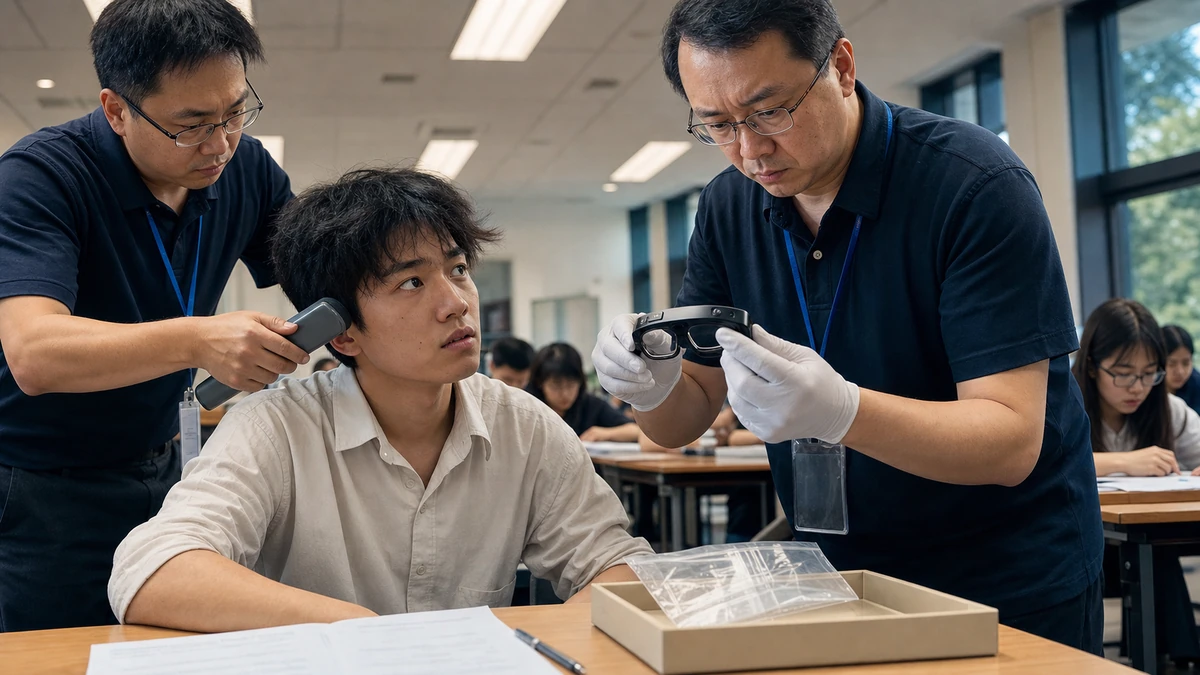
A university in southern China says it caught students using AI-equipped smart glasses to cheat during final exams, a case that may sound like a campus rules violation on the surface but points to a much bigger problem facing schools around the world. South China Agricultural University in Guangzhou recently said it detected cheating involving artificial intelligence smart glasses during undergraduate final exams and dealt with the matter severely, according to Chinese media reports cited by Yonhap News Agency.
The details are striking not because they involve an old-fashioned crib sheet or hidden cellphone, but because they show how quickly the technology of cheating is changing. Proctors reportedly used metal detectors to inspect students’ glasses and even the area around their ears, a sign that exam security is moving beyond backpacks, pockets and desk drawers to include wearable devices that can blend into everyday life. In other words, the exam room is starting to look more like an airport checkpoint than the quiet, paper-and-pencil setting many Americans still associate with academic testing.
For U.S. readers, the closest analogy may be the ongoing shift schools have already faced with smartphones, smartwatches and, more recently, generative AI tools such as ChatGPT. For years, teachers and testing officials worried that a phone in a hoodie pocket or a smartwatch on a wrist could give a student an unfair edge. Smart glasses raise that concern to another level. Unlike a phone, they do not have to be taken out. Unlike a smartwatch, they are positioned directly in a person’s line of sight. And unlike traditional cheat notes, they may potentially connect the wearer to real-time information or even outside assistance.
That is what makes this story more than a local disciplinary notice from one Chinese university. It is an early illustration of a question schools from Beijing to Boston will have to answer: In an era when AI can be embedded in objects as ordinary-looking as eyeglasses, how do institutions preserve trust in exams designed around the assumption that students are working alone?
Why this matters so much in China’s exam culture
To understand why Chinese universities and education authorities are reacting so aggressively, it helps to understand the place exams hold in Chinese society. Much like the SAT, ACT, Advanced Placement tests and college admissions process in the United States, major exams in China can shape a student’s educational future. But the pressure is often even more concentrated. A single test can carry outsized weight in determining admission opportunities, scholarship prospects and, by extension, long-term mobility.
The best-known example is the gaokao, China’s national college entrance exam, often described as one of the world’s most competitive standardized tests. In American coverage, the gaokao is frequently compared to a high-stakes combination of the SAT and college admissions season rolled into one. Families plan around it. Entire communities pay attention to it. For many students, it is treated not simply as a test but as a life-defining hurdle.
Against that backdrop, cheating is not viewed only as individual misconduct. It can be seen as a threat to the legitimacy of the system itself. If one student uses hidden technology to pull in answers, then every honest student is effectively competing on unequal terms. That is especially sensitive in societies where exams are tied to the idea of meritocracy, the belief that hard work and academic performance should determine opportunity.
The recent university case in Guangzhou comes just after heightened concern in China over what local reports have described as “high-tech cheating” following major entrance exams last month. That timing matters. When education systems are already on alert, a case involving AI-enabled wearable devices is likely to be treated not as an isolated offense but as evidence of a broader vulnerability. In that sense, the university’s public notice appears to serve two purposes at once: punishing those involved and sending a warning to others.
There is also a symbolic dimension to the reported use of metal detectors. It suggests that the focus of exam monitoring is evolving. For years, school enforcement centered on paper notes, hidden textbooks and later mobile phones. Now the concern extends to devices integrated into clothing and accessories, the kinds of products the consumer tech industry markets as seamless, stylish and nearly invisible. The very design logic that makes wearables attractive in daily life also makes them difficult to detect in a test setting.
The double life of AI in education
The Guangzhou case highlights one of the central tensions of the AI era: the same technology celebrated as a tool for learning can become a liability when the moment shifts from instruction to evaluation. In a classroom, AI may help students brainstorm ideas, summarize readings, translate difficult material or review concepts at their own pace. In an exam hall, those same capabilities can undermine the basic premise that a student is demonstrating individual knowledge and reasoning.
That is the double life of generative AI in education. Schools across the United States have already been wrestling with it. Some districts initially tried blanket bans on AI chatbots. Others moved toward more flexible policies, allowing certain uses for tutoring, outlining or editing while restricting AI-generated submissions. Colleges have revised honor codes, rewritten syllabi and experimented with more handwritten work, oral exams and in-class assessments.
What smart glasses change is not the ethical dilemma so much as the physical reality of enforcement. A chatbot on a laptop can at least be blocked, monitored or forbidden in a controlled environment. A phone can be collected before an exam starts. But wearable devices shrink the distance between student and machine. When the tool is on the body, distinguishing ordinary behavior from misconduct becomes much harder.
That matters because smart glasses do not need to look futuristic to be disruptive. To many people, “smart glasses” may still conjure science-fiction imagery or niche gadgets. But the technology is increasingly being pushed into mainstream consumer culture, often with an emphasis on convenience. Depending on the model, such devices may include cameras, audio functions, visual displays, voice interaction and links to AI assistants. Even if a pair looks close to ordinary prescription frames, its potential capabilities can transform the exam room’s assumptions.
The core issue is context. A device designed to provide hands-free access to information may be useful for navigation, translation, note-taking or accessibility in everyday life. But on a closed-book exam, convenient access to outside information is precisely the problem. The Guangzhou case underscores a point educators around the world are coming to grips with: AI itself is not inherently the offense. The offense lies in using AI tools in contexts where they destroy fair conditions for everyone else.
A new kind of surveillance in the test room
The reports from China are also notable for what they reveal about the future of exam supervision. If proctors are now checking glasses frames and the area around students’ ears, the line between ordinary monitoring and invasive screening may become harder to draw. The practical challenge is obvious: as devices get smaller, lighter and less visible, institutions that want to stop misuse may feel pressure to intensify searches.
That development raises familiar concerns for American audiences. U.S. schools and universities have long faced debates over how much surveillance is too much, whether through metal detectors, locker searches, monitoring software on school-issued laptops or remote-proctoring tools that scan eye movement and room noise during online exams. Supporters argue such measures protect fairness and academic integrity. Critics warn they can create anxiety, invade privacy and treat students as suspects by default.
The same tension appears to be emerging in East Asia’s exam systems. On one hand, schools have a legitimate interest in maintaining confidence in test results. On the other, turning the exam hall into a space of intense bodily inspection could change the culture of education in ways that many students and families find troubling. A student who wears prescription glasses, hearing devices or other assistive equipment may reasonably worry about being singled out or scrutinized more closely.
There are also practical limits. Elite or well-funded institutions may be able to deploy metal detectors, train proctors and update rules frequently. Not every school can. If anti-cheating enforcement becomes dependent on increasingly sophisticated screening, then disparities in resources could produce disparities in exam security. That would be an uncomfortable irony: efforts to preserve fairness might themselves become uneven.
Beyond logistics, there is a philosophical question. How far can exam surveillance expand before the model of assessment itself needs rethinking? If schools must inspect eyewear, ears, sleeves, jewelry and other personal items in ever greater detail, the costs of preserving traditional closed-room exams may rise sharply. At some point, institutions may decide it is more sustainable to redesign assessments than to keep escalating the search process.
Not just China: A regional warning sign
This is not only a mainland China issue. The summary of the Korean report notes that a similar cheating case involving smart glasses was detected last month during an admissions exam at National Taiwan University, one of Taiwan’s most prestigious schools. That matters because it suggests the problem is not confined to one campus, one local policy gap or one political system. It is appearing across different educational settings in East Asia, a region known for highly competitive testing cultures and rapid adoption of consumer technology.
For international readers, the regional pattern is the real story. Whether the setting is a university final in Guangzhou or an entrance exam in Taipei, the same basic challenge is emerging: assessment systems built for a pre-wearable era are being tested by devices that can quietly erase the boundary between memory and machine. The issue is likely to spread further as AI hardware becomes cheaper, more common and more socially acceptable to wear.
American schools should not assume they are insulated. The United States may not have a single national exam with the cultural weight of the gaokao, but it does have plenty of high-stakes environments: college entrance testing, professional licensing exams, certification tests, bar exams, medical boards and competitive admissions processes. Anywhere the reward for success is large and the rules depend on independent performance, technology-enabled cheating will be tempting to some people.
There is also a broader cultural point. East Asian education systems are often depicted in American coverage as unusually exam-driven, but the underlying anxiety is universal. Parents want fairness. Students want to believe they are competing on equal terms. Universities want credentials that mean something. Employers want to trust what a degree or test score represents. When technology makes hidden assistance easier, that social compact starts to fray.
The Guangzhou case is therefore less a curiosity from abroad than a preview. It shows what happens when schools encounter the next generation of consumer electronics before they have fully updated the norms, procedures and ethics needed to govern them.
What schools may have to change next
If the lesson from this case were simply “ban smart glasses,” it would be too narrow. Most schools already prohibit unauthorized electronic devices in exams. The harder challenge is crafting rules and assessment methods that keep pace with fast-moving hardware. That means clearer definitions, better communication and a willingness to rethink how learning is measured.
First, institutions will likely need more specific policies. A general ban on “electronics” may no longer be enough if students do not know whether it covers internet-connected glasses, AI earbuds, smart rings or other emerging wearables. Schools may have to list categories of prohibited devices, explain why they are restricted and state plainly what consequences follow violations. Consistency matters. Rules that are vague or unevenly enforced invite confusion and disputes.
Second, educator training will become more important. Proctors cannot enforce policies they do not understand. If staff members are unfamiliar with the appearance and functions of wearable tech, they may miss it entirely or overreact in ways that create unnecessary conflict. Training does not require turning teachers into cybersecurity specialists, but it does require basic technological literacy.
Third, exam design itself may need updating. Some educators argue that the best long-term response to AI cheating is not more aggressive policing but different kinds of assessments. Oral exams, in-class writing, project-based evaluation, iterative drafts and open-book formats that test analysis rather than recall are among the options often discussed. Those approaches are not immune to misuse, but they can make simple answer retrieval less decisive.
That conversation is already happening in the United States, where professors have increasingly asked whether a take-home essay still measures what it once did when AI systems can draft readable prose in seconds. The same logic applies to wearable devices. If a test’s main function is to reward the rapid recall of discrete facts, then a connected device becomes especially disruptive. If the test instead emphasizes explanation, synthesis or live reasoning, outside assistance may be less useful or easier to detect.
At the same time, schools have to be careful not to define the problem so broadly that any interaction with AI becomes suspect. Students will enter workplaces where AI tools are common. Education cannot simply pretend those tools do not exist. The challenge is drawing a principled line between learning with technology and being unfairly replaced by it during evaluation.
The larger question: What does fair testing look like in the AI age?
In the end, the smart-glasses case at South China Agricultural University matters because it compresses a global debate into a single, vivid scene: a proctor scanning around a student’s glasses and ears, looking for hidden technology in a room meant to certify human effort. It is a moment that captures both the promise and the disruption of AI. The same innovations that can make information more accessible can also weaken the trust that educational systems depend on.
For American readers, the story is not primarily about whether Chinese universities are being too strict or too alarmed. It is about how quickly assumptions can become outdated. Only a few years ago, the central concern in classrooms was whether students might glance at a phone under the desk. Now the concern is whether the device is built into the frames on their face.
That shift should prompt a broader conversation, not just among school administrators but among parents, technologists, policymakers and students themselves. How much monitoring is acceptable in the name of fairness? What kinds of knowledge should exams measure when answers are increasingly machine-accessible? And how can institutions preserve credibility without turning every test into a technological cat-and-mouse game?
The answers will vary by country and by school, but the pressure is shared. China’s latest case, along with the similar report from Taiwan, suggests the era of AI-enabled wearable cheating is no longer hypothetical. It is here, and education systems are improvising in response. Metal detectors and stricter inspections may be the immediate fix. They are unlikely to be the final one.
The deeper task is rebuilding a common understanding of what counts as honest work in a world where intelligence, or at least the appearance of it, can be outsourced to tools that are increasingly invisible. That is not only a Chinese problem or an East Asian problem. It is fast becoming a global one. And if schools do not define the boundaries clearly, the marketplace will do it for them, one gadget at a time.
Comments
Post a Comment