A South Korean City Turns to Drones to Fight Mosquitoes, Framing Summer Pest Control as Frontline Public Health
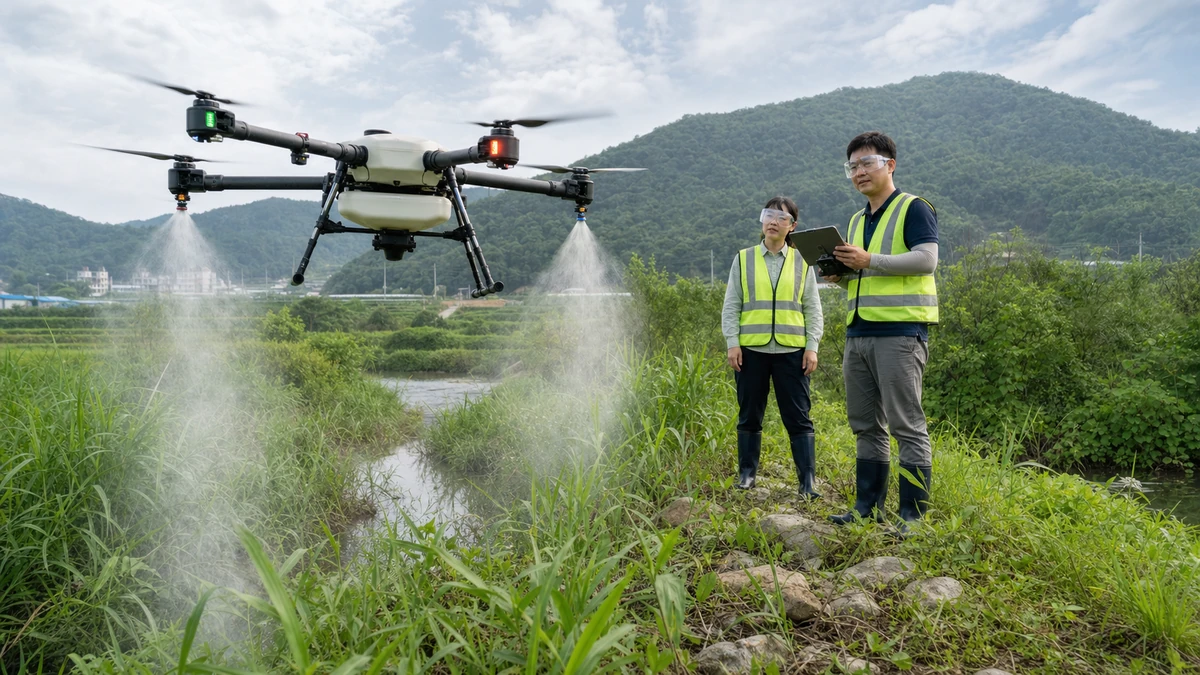
A high-tech answer to a familiar summer problem
For many Americans, mosquitoes are the soundtrack of summer — an annoyance that comes with backyard barbecues, Little League games and evening walks by the water. But public health officials in South Korea are asking residents to think about mosquitoes less as a nuisance and more as a health threat that deserves the same kind of organized, local response cities bring to storm cleanup or food safety inspections.
That is the logic behind a new program in Pocheon, a city northeast of Seoul, where the local public health office said it will deploy drones for mosquito control for the first time this year. The goal is to prevent mosquito-borne illnesses, including malaria, while reaching hard-to-access areas that traditional spraying methods often miss.
The move, announced by the Pocheon City Health Center, reflects a broader public health mindset in South Korea: everyday quality-of-life issues are often treated as part of the health system, especially when they overlap with infectious disease prevention. In this case, officials are targeting riversides, parks, drainage channels, brush-covered areas and farmland edges — places where standing water and humidity can create ideal breeding conditions for mosquito larvae.
What makes the effort stand out is not simply the use of drones, though that alone gives the program a distinctly 21st-century feel. It is the city’s emphasis on attacking mosquito populations early, before they mature into swarming adults, and doing so with what officials describe as environmentally friendly microbial larvicides. In other words, this is not just about fogging streets after residents begin complaining about bites. It is about interrupting the mosquito life cycle at the source.
In American terms, the strategy may sound familiar to anyone who has watched local mosquito abatement districts in states like Florida, Texas or California combine surveillance, larvicide treatment and aerial spraying during peak season. But in South Korea, where dense urban neighborhoods, mountain terrain, river systems and agricultural zones can sit close together, the logistical challenge is different. Pocheon’s approach suggests local governments are looking for precision tools that can handle that complicated geography.
Officials said drones will help close what they called “blind spots” in disinfection and pest control — areas that are difficult to reach by truck or on foot. That framing matters. The city is not presenting drones as a flashy gadget, but as a practical fix for a known weakness in traditional field operations.
Why mosquito control counts as health news
To readers outside Korea, a city announcement about mosquito spraying might sound more like a municipal services brief than a public health story. But the line between the two is thinner than it appears. Mosquitoes are vectors, meaning they transmit disease from one host to another, and public health agencies around the world treat vector control as a first layer of disease prevention.
Pocheon’s health office specifically linked the drone program to preventing mosquito-borne infections such as malaria. That may surprise some American readers who associate malaria mainly with tropical regions abroad. But South Korea has dealt with locally transmitted vivax malaria for years, particularly in areas near the heavily fortified border with North Korea. While the country is not facing the scale of malaria seen in parts of Africa or South Asia, the disease remains a recurring seasonal concern in some northern regions.
That context helps explain why a city would elevate mosquito management beyond simple comfort. In public health terms, lowering the mosquito population can reduce the chance of disease spread, especially during the warm, wet months when breeding accelerates. The effort also intersects with climate-related concerns. As hotter summers, heavier rains and more erratic weather patterns reshape local environments worldwide, mosquito seasons can lengthen and breeding habitats can expand.
Americans have seen versions of this concern in the spread of West Nile virus, dengue alerts in Florida and Texas, and recurring warnings about Eastern equine encephalitis in parts of the Northeast. Public health officials have long argued that by the time residents notice a serious mosquito problem, they may already be behind. The most effective interventions often happen earlier and out of view: in storm drains, retention ponds, ditches and overgrown waterside areas.
That is one reason the Pocheon announcement is more significant than it may initially appear. It speaks to a preventive model of public health — the idea that protecting residents’ health begins in the environments where they live, walk, exercise and work. A mosquito problem near a riverside trail, a public park or a farming area is not only a matter of inconvenience. It can also become a health risk if left unmanaged.
The city’s emphasis on “a healthy and pleasant environment,” as described by officials, may sound like standard government language. But in practice, it points to a view of health that extends beyond clinics and hospitals. It includes outdoor spaces, neighborhood infrastructure and the condition of the local environment itself.
Why drones, and why now?
Pocheon’s decision to use drones grows out of a simple operational reality: trucks cannot go everywhere, and people cannot safely or efficiently inspect every overgrown or waterlogged space by hand. Vehicle-based spraying works best where roads allow access. Ground crews can cover smaller sites, but dense vegetation, narrow drainage corridors, embankments and farmland perimeters can slow them down or leave patches untreated.
Drones offer a way to bridge those gaps. They can be deployed quickly over broad areas and navigate spaces that are awkward or risky for workers to enter on foot. In a city like Pocheon, which includes a mix of urban neighborhoods, parks, waterways and rural edges, that flexibility is valuable. Rather than replacing existing mosquito control operations, the drones are intended to supplement them.
That distinction is important because it gets at the practical purpose of the technology. Cities around the world have adopted drones for everything from bridge inspections to wildfire monitoring, sometimes with more hype than results. What Pocheon is describing is more targeted: using drones where conventional mosquito-control tools are less effective. Officials are essentially making the case for precision access rather than spectacle.
The city also argues that drones can improve the efficiency of emergency response after heavy rains or flooding. That is a notable point. Post-flood conditions often create a surge in standing water, which can quickly become mosquito habitat. At the same time, those same conditions can make roads impassable or certain zones unsafe for field crews. Aerial treatment by drone could allow faster intervention in the aftermath of a storm, when mosquito populations may be poised to spike.
For American readers, the comparison might be to how local authorities use drones after hurricanes to assess damage, identify stranded residents or inspect washed-out infrastructure. Here, the same basic advantage — quick access when ground conditions are difficult — is being applied to disease prevention. It reflects a broader shift in local governance, where small unmanned aircraft are becoming routine municipal tools rather than novel experiments.
South Korea has been especially quick to adopt new technology in public administration, from digital civil services to smart-city systems. The drone initiative fits within that larger culture of practical tech adoption. But its success will likely depend less on the aircraft themselves than on how well the city identifies breeding hotspots, times the treatments and integrates drone operations into a broader mosquito-control strategy.
Targeting larvae instead of chasing adult mosquitoes
One of the most important details in the Pocheon plan is easy to overlook: the city is focusing heavily on larval control. That means treating mosquitoes before they become flying adults. Public health experts often prefer this approach because it attacks the problem earlier, when mosquito populations are concentrated in breeding sites rather than dispersed across an entire neighborhood.
Anyone who has tried to swat mosquitoes on a humid summer evening knows how difficult it is to get ahead once adult populations explode. Spraying to kill adult mosquitoes can provide visible, immediate relief, and it may reassure residents who want to see action. But it can also be a reactive measure. If breeding sites remain active, new mosquitoes will continue to emerge.
Pocheon says it plans concentrated larval control using microbial agents described as eco-friendly. Although the city did not provide an extensive technical breakdown in the summary released publicly, microbial larvicides are commonly used in mosquito abatement because they are designed to target mosquito larvae in water. The appeal is that they can reduce mosquito numbers at an early stage while limiting broader environmental disruption when applied correctly.
This fits a well-established principle in vector control: managing the beginning of the breeding cycle often produces better long-term results than focusing only on the insects people can already see. It is the difference between cleaning up a flooded basement at the source of the leak and repeatedly mopping the floor after the water spreads.
The choice also reflects the kinds of places Pocheon is targeting. Riversides, drainage channels, brushy wet zones and agricultural edges are exactly the kinds of environments where larvae can thrive before residents notice a surge in adult mosquitoes. By concentrating on these sites early in the season, the city hopes to reduce mosquito populations before they peak.
There is also a communications challenge embedded in this approach. When cities invest in larval control, the results may be less obvious to the public than a truck rolling down the street with visible fog. Residents may not see the treatment happen, and if mosquito numbers remain noticeable, they may assume officials are doing too little. That means the public health case has to be explained clearly: prevention is often most effective before a problem becomes dramatic.
In that sense, Pocheon’s announcement is as much about public education as it is about operations. The message is that mosquito control is not merely a response to bites. It is a science-based effort to reduce disease risk by breaking the breeding cycle early.
The Korean local health system behind the program
To understand why this kind of program is being led by a city health center, it helps to know a little about how local public health works in South Korea. Municipal health centers, known as public health offices or health centers, play a significant role in preventive care, health promotion and infectious disease response. They are not just vaccination sites or paperwork offices; they are core parts of local health administration.
That means a city like Pocheon can treat mosquito management as part of its public health mission rather than leaving it solely to a sanitation or parks department. In the Korean system, that alignment can make preventive campaigns more centralized and easier to frame around health outcomes. The same local office concerned with disease surveillance and community health education may also be involved in field-level prevention efforts like mosquito control.
Pocheon itself is an instructive setting for such a policy. Located in Gyeonggi Province, the broad region surrounding Seoul, it is close enough to the capital region to be part of a heavily populated corridor, yet it also contains rural and semi-rural landscapes, waterways and agricultural land. That mixture creates exactly the kind of environment where mosquito control is both important and logistically complicated.
South Korea’s summers are also intensely humid, with monsoon rains that can rapidly change local conditions. Drainage areas, riverbanks and low-lying vegetation can become ideal mosquito habitat in a short period of time. For local governments, that means public health planning is deeply seasonal. Heat illness, food poisoning, water safety and insect-borne disease all become part of the summer governance agenda.
From an American perspective, there is an interesting contrast here. In the United States, mosquito control is often handled by specialized abatement districts, county agencies or regional public works departments, depending on the state. In South Korea, the institutional setup may place the issue more squarely within the umbrella of health administration. The practical effect is that a story about mosquito spraying can land in the public conversation not as routine maintenance, but as a direct disease-prevention policy.
That does not mean every local Korean initiative becomes a national trend. Pocheon’s program is local, not a sweeping central government decree. But that is part of what makes it notable. It shows experimentation at the municipal level, where officials are trying to solve a common public health problem with new tools adapted to local terrain.
What “eco-friendly” mosquito control means — and what it does not
Whenever governments announce pesticide or spraying programs, questions about environmental impact are never far behind. Pocheon appears to be aware of that concern, emphasizing the use of microbial, environmentally friendly agents in its larval control efforts. In a city landscape that includes parks, streams and farmland, the balance between disease prevention and environmental stewardship is a central issue.
For readers in the United States, this debate will sound familiar. Communities regularly wrestle with how aggressive mosquito control should be, especially when aerial or broad-area spraying is involved. Some residents prioritize maximum suppression of mosquito populations; others worry about effects on pollinators, waterways and overall ecosystem health. The most credible public health programs often succeed by being transparent about what is being applied, where, why and with what safeguards.
Pocheon’s messaging suggests it is trying to position the program as targeted and science-based rather than blanket chemical spraying. That distinction matters. Using larvicides in breeding sites is generally a different strategy from large-scale adult mosquito spraying after outbreaks or surges. The city is essentially arguing that smart, early intervention can be both more effective and less disruptive than waiting until the problem is larger.
Still, “eco-friendly” is a broad label, and any such program will ultimately be judged by implementation. Residents will want to know whether the selected treatment areas are appropriate, whether the substances used are safe in the local environment, and whether the program is reducing mosquito populations without unintended consequences. Those are the kinds of questions public trust depends on, in Korea just as in the United States.
The city health office, in remarks summarized publicly, said the drone program is intended to complement the limits of conventional methods while creating a healthier and more comfortable living environment for residents. That framing makes clear the political and public-facing goal: the program is meant to improve daily life, not simply showcase technology or expand spraying for its own sake.
In practice, the most persuasive measure of success will be whether residents see fewer mosquitoes in common outdoor spaces and whether the city can demonstrate sustained management of breeding hotspots over the course of the summer. If the program does that while minimizing environmental disruption, it may become a model for other local governments in Korea.
Public health still starts at home
Even as Pocheon rolls out drones and larval control, city officials are not suggesting that public measures alone can eliminate mosquito risk. Like health departments everywhere, they are operating on the assumption that community behavior still matters. Public spraying and environmental management can reduce exposure, but individuals and households remain part of the equation.
That includes removing standing water from containers around homes, paying attention to poor drainage, using insect repellent during outdoor activities and wearing protective clothing when mosquitoes are active. These are familiar recommendations in the United States, and they are no less relevant in South Korea. The city’s effort is best understood as a community safety net — one that works better when residents also take basic precautions.
This is especially true in places like parks and riverside trails, where people exercise, stroll and gather during the summer. When local governments reduce mosquito populations in these public spaces, they do more than lower infection risk. They make ordinary outdoor life less stressful. That quality-of-life dimension is not trivial. A city where residents feel more comfortable using parks and walking paths is, in a small but real way, a healthier city.
There is a larger lesson here as well. Public health often becomes most visible during crises — pandemics, heat waves, flood disasters. But much of its real work happens quietly, through preventive measures designed to stop small problems from becoming large ones. Pocheon’s drone program fits that pattern. It is not a dramatic medical breakthrough. It is a local attempt to make summer safer by managing environmental risk before it turns into illness.
That is also why the story may resonate beyond Korea. Mosquito-borne diseases are not confined to one region, and local governments around the world are looking for better ways to respond to changing climate conditions, shifting insect habitats and public demand for safer outdoor spaces. A drone flying over a riverside in Pocheon may seem far removed from a suburban county in the American South or a coastal city in southern Europe. But the underlying challenge is shared: how to use technology, science and local administration to reduce disease risk where people actually live.
For now, Pocheon’s initiative remains a municipal experiment, and its true value will be determined by results rather than rhetoric. But the principle behind it is clear. In an era when public health threats can emerge from the smallest overlooked places — a drainage ditch, an overgrown embankment, a pocket of stagnant water after a storm — even a modest city program can offer a glimpse of how prevention is evolving. Sometimes that evolution does not begin in a laboratory or a national ministry. Sometimes it begins with a drone, a patch of wet brush and a city deciding that summer mosquitoes are not just annoying, but a problem worth solving early.
Comments
Post a Comment