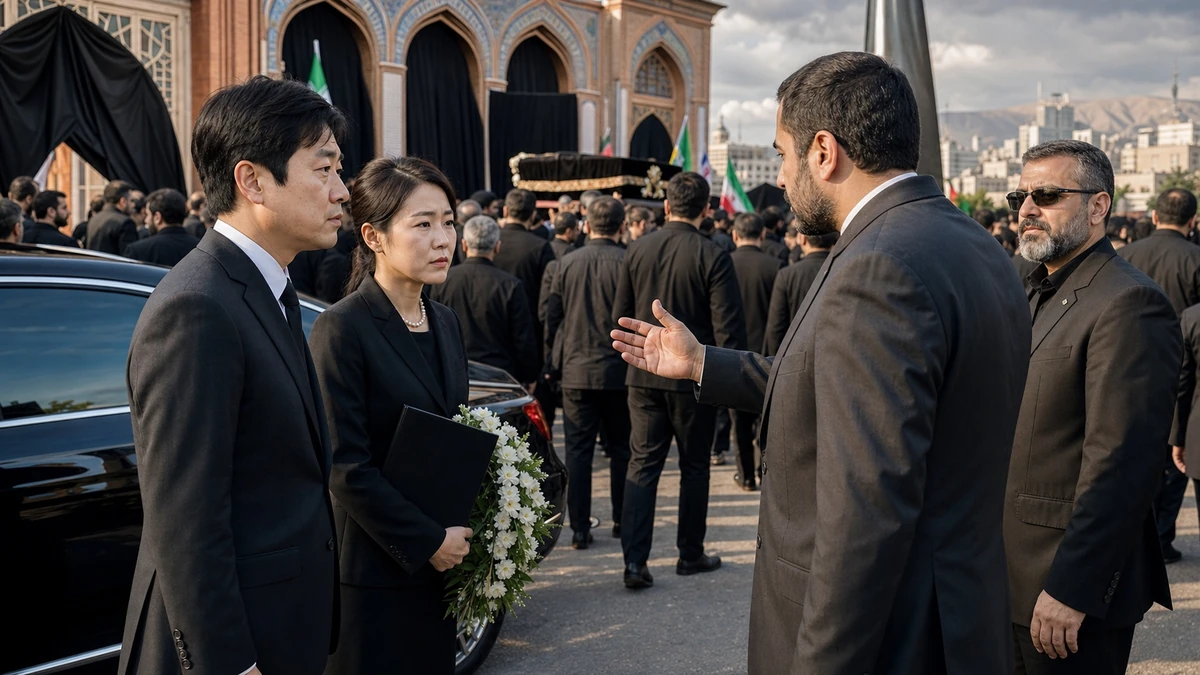
A diplomatic slight, or a procedural scramble?
South Korea said it did not officially attend a funeral ceremony in Tehran after Iran first invited Seoul and then later informed South Korean officials that attendance would be difficult, according to accounts from South Korean diplomatic officials relayed by Yonhap News Agency. On its face, that may sound like a minor scheduling wrinkle at a large state event. In diplomacy, though, funerals are rarely just funerals.
For American readers, the easiest comparison may be to the careful choreography surrounding the funeral of a former president, queen or pope. The public sees mourning. Diplomats see seating charts, guest lists, access routes, security clearances and the rank of every representative in the room. Who gets invited, who shows up, who is represented by an ambassador rather than a head of state, and who is quietly left off the final list can all send signals without anyone issuing a formal statement.
That is why this episode has drawn attention in Seoul. According to the South Korean account, Iran invited South Korea to the funeral, and the South Korean mission prepared to attend at the embassy or diplomatic post level. Then, at a late stage, Iranian officials reportedly told Seoul that attendance by the Korean mission would be difficult because of venue-related issues or other logistical constraints. South Korea therefore did not officially attend the funeral held in Tehran on the 4th, local time.
There are only a few facts publicly confirmed so far, and they matter. South Korea says it did not officially attend. South Korean officials say Iran initially extended an invitation and later said attendance would be difficult. And South Korea’s Foreign Ministry has described the sequence in narrow, procedural terms rather than as a political dispute. Beyond that, much remains unclear, and responsible reporting requires keeping that distinction in view.
That caution is especially important in a case like this, where even small protocol changes can quickly be overread as a strategic message. There may be a political meaning. There may also be none beyond the realities of managing a high-security state ceremony in a tightly controlled environment. For now, what is notable is not a dramatic rupture but the fact that an invitation was extended, preparations were underway, and a last-minute reversal left South Korea absent from an event where presence itself carried symbolic weight.
Why funerals are part of diplomacy
In Washington, state funerals and memorial ceremonies are often treated as moments of national unity. Internationally, they are also diplomatic stages. Unlike a summit, where the agenda is public and the purpose is explicit, funeral diplomacy works through symbolism. The messages are often encoded in protocol: the level of representation, whether a bilateral conversation takes place on the sidelines, where officials sit, how they are greeted and even whether their names appear on a formal attendance list.
That makes invitations and cancellations unusually sensitive. A canceled trade meeting can sometimes be explained away as a scheduling conflict. A withdrawn or curtailed funeral invitation is harder to separate from political meaning because these events are so steeped in hierarchy and ritual. Diplomats spend careers reading such signals. So do journalists who cover foreign ministries.
South Korea appears to have approached the event as a matter of standard diplomatic courtesy. In Korean foreign policy practice, attendance by a local mission, rather than by a cabinet minister or president, is a common way to register respect without overcommitting politically. That distinction is worth explaining for readers unfamiliar with how Seoul handles sensitive overseas events. A government can acknowledge a major foreign ceremony through its embassy or consulate while preserving flexibility on the broader relationship.
In other words, South Korea was not preparing a high-profile political endorsement. It was reportedly preparing to participate at the mission level, through its diplomatic presence on the ground. In the language of protocol, that is meaningful but measured. It says: We recognize the occasion. We are maintaining official channels. But we are not necessarily elevating the relationship beyond that.
When even that level of attendance falls through after an invitation has been offered, the optics change. The issue becomes not only absence, but the character of that absence. There is a significant diplomatic difference between a country declining from the outset and a country preparing to attend, only to be told at the last moment that it can no longer do so. The end result may look identical in a photograph or on a roster, but the diplomatic interpretation is not the same.
What South Korea is saying — and not saying
The South Korean government’s explanation has been strikingly restrained. According to officials cited in the South Korean press, the government was invited, intended to attend through its mission, and then was told by Iran that attendance by the mission would be difficult because of venue conditions or related constraints. There has been no public accusation from Seoul, no official protest made public and no open attempt to turn the episode into a larger bilateral controversy.
That restraint is part of the story. When foreign ministries choose careful language, they are often trying to prevent a manageable protocol issue from snowballing into a broader diplomatic dispute. The phrase about venue conditions is especially telling. It relays Iran’s explanation without endorsing it, disputing it or speculating about hidden motives. In diplomatic communications, that kind of wording can be a way of preserving space: space for both sides to move on, space to avoid a public escalation, and space to acknowledge uncertainty when the full picture is not available.
For American audiences, it may help to think of this as the foreign policy equivalent of a company saying a senior executive missed an event because of “logistical issues.” The phrase may be accurate. It may also be deliberately narrow, chosen because everyone involved prefers not to litigate the matter in public. Governments use that kind of language all the time, especially when they want to keep future channels open.
South Korea also has reasons to avoid overreacting. Seoul’s diplomacy often emphasizes balance, especially in regions where its direct interests are real but secondary to larger security relationships. Iran is not one of South Korea’s core treaty allies or top strategic partners, but it is not irrelevant either. Energy markets, sanctions environments, regional stability and consular considerations all factor into how South Korea manages the relationship. In that context, making a major issue out of a funeral protocol dispute may bring more costs than benefits.
At the same time, Seoul’s measured explanation preserves an important point: this was not, by its account, a case of South Korea deciding on its own to stay away. That nuance matters because foreign policy observers in Korea closely track whether the government is being shut out, signaling distance, or simply exercising caution. By clarifying that an invitation came first, the government appears to be protecting itself from the impression that it snubbed Iran or that diplomatic channels had broken down before the ceremony.
The larger context: South Korea’s careful Middle East balancing act
South Korea’s foreign policy is often discussed in American media through the lens of North Korea, the U.S. alliance, China or Japan. But Seoul also has a long history of navigating the Middle East with pragmatic caution. That balancing act can be easy to miss from afar because it rarely produces the kind of headline-grabbing moments associated with summitry in Washington, Beijing or Pyongyang. Still, it is an important part of how South Korea operates as a mid-sized global power.
Iran occupies a particularly complicated place in that picture. For years, South Korea and Iran maintained working economic ties, especially in energy. Those ties became more constrained as U.S.-led sanctions tightened and as the broader security climate around Iran grew more fraught. Seoul has had to manage the relationship while also staying aligned with Washington, its indispensable security ally. That can create awkward spaces where South Korea seeks to keep communication channels open without appearing to drift from the larger international framework shaped by sanctions, regional conflict and U.S. policy.
That is one reason the reported invitation matters. Even if nothing substantive was supposed to happen at the funeral beyond formal respects, an invitation suggests that diplomatic channels were functioning. It places South Korea inside the protocol universe of the event, not outside it. The later notice that attendance would be difficult suggests how quickly those channels can become constrained, whether for political, logistical or security reasons.
It also underscores something Americans sometimes underestimate about South Korea: it is not merely a regional actor focused on East Asia. Seoul increasingly operates across a wide global map, from development aid in Africa to trade negotiations in Europe to diplomatic and security interests in the Middle East. So when South Korean officials are invited to or excluded from a major state event in Tehran, that is not just a local detail. It reflects the broader reach of Korean diplomacy and the complicated environments in which it now works.
None of that means this funeral episode marks a new turning point in Iran-South Korea relations. The public facts do not support a sweeping conclusion. There is no announced policy shift, no visible sanctions-related breakthrough, and no declared bilateral rupture. But the episode does offer a small, revealing glimpse into the way diplomatic relations are actually lived: through invitations, credentials, access, rank and timing as much as through speeches and treaties.
How protocol can become international news
To readers outside diplomatic circles, it may seem strange that a story this procedural would attract attention. But in international affairs, process is often substance. A last-minute change in access can matter because it hints at who was prioritized, who was deprioritized and how event organizers chose to manage a politically sensitive gathering. The decisions may be mundane. They may also be deliberate. Without fuller evidence, it is impossible to say which is the case here.
That uncertainty is exactly why professional caution is needed. It is tempting, especially in the age of social media and instant geopolitical commentary, to assign motive quickly. Was the reversal a message to Seoul? Was it linked to relations with Washington? Did other countries face similar constraints? Was it genuinely about space and security? The available information does not answer those questions. Any confident claim beyond the reported sequence would go beyond what has been established.
Still, even a narrow account can illuminate a broader truth: funerals are one of the few international settings where symbolism is concentrated and compressed. You do not need a formal communique to send a signal. A guest list can do it. A seating plan can do it. An invitation followed by a late-stage restriction can do it too, even if no one involved is willing to say so outright.
For South Korea, which is often highly attentive to diplomatic optics, these distinctions carry weight. Seoul’s foreign policy establishment is deeply conscious of status, protocol and precedent, in part because South Korea has spent decades expanding its international standing from aid recipient to major economy, cultural powerhouse and active diplomatic player. In that context, being invited matters. Being unable to attend after preparing to do so matters too.
Americans can understand this instinctively if they think about how Washington tracks attendance at a presidential inauguration, a state funeral at the National Cathedral, or a papal funeral attended by dozens of world leaders. News coverage immediately zooms in on who came, at what level, and what side meetings took place. The same logic applies here, even if the countries involved and the regional context are different.
Reading the limits of the available facts
One of the most important journalistic tasks in a story like this is separating what is known from what is inferred. What is known, based on South Korean officials’ account, is relatively limited: there was an invitation; South Korea considered or prepared for mission-level attendance; Iran later said attendance would be difficult, citing venue-related reasons; and South Korea did not officially attend the funeral in Tehran.
What is not known publicly is just as important. There is no confirmed public evidence, at least from the information now available, that Iran intended the reversal as a political rebuke. There is no confirmed public evidence that South Korea lodged a formal complaint or altered its policy toward Iran in response. There is no confirmed public evidence placing this episode inside a larger bilateral dispute. And there is no basis, from the publicly described facts alone, to treat it as proof of either a diplomatic collapse or a strategic realignment.
This boundary between fact and interpretation is especially important in Korean political coverage because even small foreign policy episodes can be quickly drawn into domestic argument. South Korean politics is intensely competitive, and foreign policy symbolism often becomes fodder for partisan debate. But this case, at least as publicly described, is not fundamentally about party politics in Seoul. It is about state-to-state protocol and the ambiguity that often surrounds it.
For readers in the United States and elsewhere, the lesson is not that every missed ceremony masks a hidden geopolitical drama. The lesson is more modest and more useful: in diplomacy, ceremonial spaces are consequential, and even seemingly technical decisions can carry meaning. The smart reading is neither cynicism nor naivete. It is disciplined attention to what happened, who said what, and what remains unverified.
That is also why the South Korean government’s own framing matters. By sticking closely to procedural facts, Seoul appears to be signaling that it does not want to inflate the incident beyond what can be supported. In diplomatic language, that often amounts to a message of its own: we noticed, we are documenting the sequence, but we are not yet turning this into a confrontation.
A small window into Korea’s global diplomatic role
If there is a broader takeaway from this episode, it is that South Korea is no longer a country whose diplomatic presence can be understood solely through the Korean Peninsula. Events in Tehran, Brussels, Riyadh or Nairobi can all become part of Seoul’s foreign policy story because South Korea’s interests, relationships and obligations now extend far beyond Northeast Asia.
That wider role can produce episodes that seem small in isolation but revealing in aggregate. An invitation to a politically sensitive state funeral in the Middle East indicates that South Korea is seen as a relevant diplomatic participant. A subsequent notice that attendance would be difficult shows how fragile and contingent that participation can be. Between those two points lies the real story: not a dramatic clash, but the everyday uncertainty of modern diplomacy.
There is also a specifically Korean dimension here. South Korea’s rise as a global cultural force through K-pop, film, television and consumer brands has made the country more familiar to American audiences. But cultural visibility does not always translate into understanding of Korea’s diplomatic posture. Seoul is a treaty ally of the United States, yes, but it is also a country that routinely manages complicated relationships with governments across political systems and regions. It often does so with a premium on protocol, caution and flexibility.
That helps explain why a funeral invitation and reversal can become news. In a highly formalized diplomatic environment, these are not trivial administrative details. They are part of how states recognize one another, calibrate distance and preserve channels. Sometimes those choices reflect grand strategy. Sometimes they reflect crowded rooms, security bottlenecks and last-minute recalculations. Often, outsiders do not know which is which until much later, if ever.
For now, the most defensible conclusion is also the simplest one. South Korea says it was invited to an important state funeral in Tehran, prepared to attend through its mission, and then was told it could not do so because of constraints cited by the host side. That sequence does not prove a fresh rupture. It does, however, highlight the sensitivity of diplomatic protocol and the way small ceremonial changes can take on outsized importance in international affairs.
In diplomacy, a single invitation card can say a great deal. So can the moment it is effectively taken back.
Comments
Post a Comment