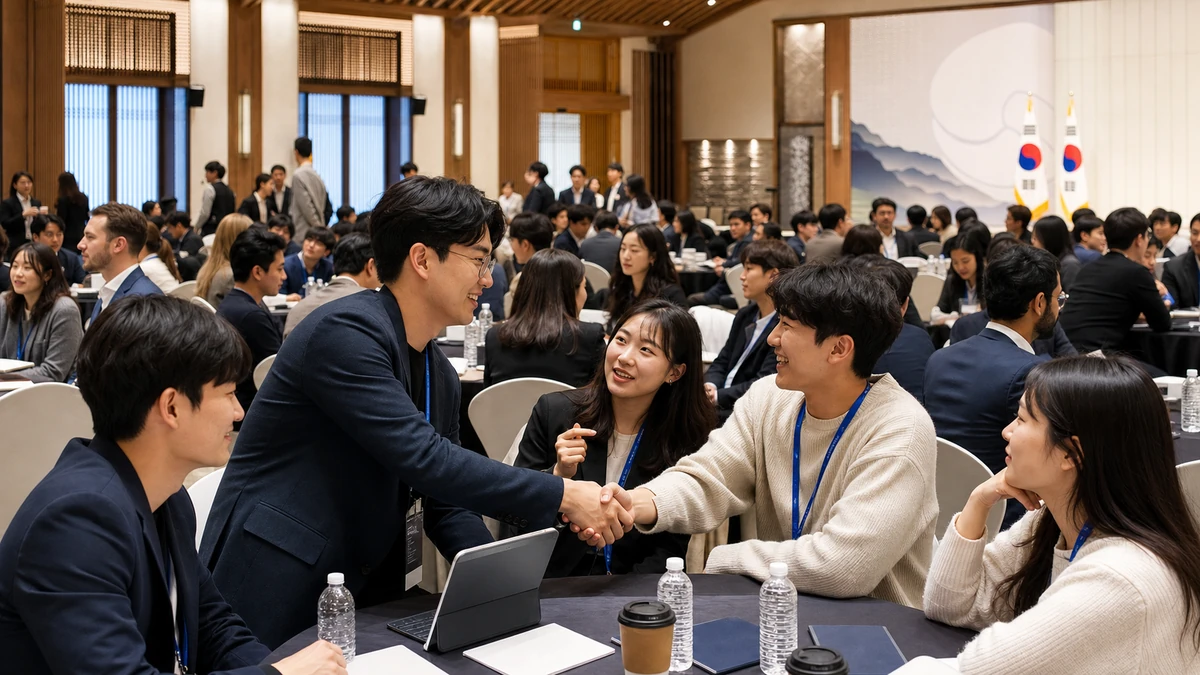
A global networking push takes shape in provincial South Korea
In South Korea, major economic stories often center on Seoul, the greater capital region or the giant conglomerates known as chaebol, the family-controlled business groups that dominate everything from electronics to shipbuilding. But a gathering that wrapped up this week in the southeastern city of Andong pointed to another version of Korea’s global ambitions, one rooted not in corporate boardrooms in the capital but in regional governments, diaspora ties and young entrepreneurs trying to build the next stage of growth.
The event, called the 2026 Gyeongbuk-Global Next Generation Leaders Connect Forum, brought together 90 participants from 21 countries, according to organizers and reporting from Yonhap News Agency. The group included 60 overseas Korean young leaders, 22 young chief executives from North Gyeongsang Province and eight university students from South Korea. Their mission was less about signing splashy deals on the spot and more about something harder to quantify but increasingly important in a global economy: building durable networks across borders.
For American readers, the easiest comparison may be a state-level economic development summit that mixes startup founders, diaspora professionals, students and public officials, all with an eye toward long-term trade, investment and talent pipelines. But the Korean version carries distinct features shaped by the country’s geography, demographics and development model. South Korea remains highly concentrated in and around Seoul, and provincial regions have spent years searching for ways to keep young talent, attract outside partners and avoid being left behind in a capital-heavy economy.
That is what makes this forum noteworthy. It was held not in Seoul or Busan, but in Andong, a city better known to many Koreans for its deep ties to Confucian tradition, preserved folk culture and regional cuisine than for international business diplomacy. In choosing Andong, organizers appeared to send a message: South Korea’s future growth strategy is not only about what happens in glass towers in the capital. It is also about whether smaller cities and provinces can insert themselves into global networks and create opportunities for the next generation close to home.
The forum’s theme, “Gyeongbuk Embracing the World, Next-Generation Leadership Opening the Future,” reflected that broader effort. Organizers said the event was designed to help younger leaders active around the world build connections beyond national borders and share their experience, vision and values. In plain English, the pitch was simple: relationships are economic assets, especially for regional businesses trying to understand foreign markets they cannot navigate alone.
Why Andong matters in this story
To understand the significance of the location, it helps to know what Andong represents in South Korea. The city sits in North Gyeongsang Province, often shortened in English to Gyeongbuk, and serves as the home of the provincial government. For many outsiders, Andong is associated with tradition: the Hahoe Folk Village, Confucian academies, mask dances and a style of heritage tourism that highlights Korea’s premodern past. It is the kind of place Americans might imagine on a cultural itinerary rather than a startup map.
That contrast is part of the story. In the United States, economic development efforts increasingly involve cities outside the traditional coastal power centers pitching themselves as places where innovation, talent and quality of life can intersect. Think of how states such as Tennessee, Colorado or North Carolina market themselves not just as cheaper alternatives to New York or California, but as ecosystems with their own identities and international potential. Gyeongbuk appears to be making a similar argument inside South Korea’s far more centralized landscape.
By hosting foreign-based Korean young leaders and local entrepreneurs in Andong, provincial officials and organizers were effectively turning a city known for cultural continuity into a platform for economic outreach. That does not mean Andong is suddenly becoming the next Asian startup hub. It does mean local leaders are trying to use place, identity and relationships strategically, rather than waiting for opportunity to flow outward from Seoul.
For international observers, the scene also highlights a broader shift in how countries court growth. Not every important economic initiative begins with a factory groundbreaking or a billion-dollar investment pledge. Sometimes it begins with matchmaking: who meets whom, which students gain exposure to international business norms, and which regional founders get direct access to people who understand consumers, regulations and partnership culture in other countries.
That may sound abstract, but in an era when small companies can scale globally faster than ever, those first connections can matter enormously. A startup founder in provincial Korea may need advice on how American buyers think about branding, how Southeast Asian distributors build trust, or how European partners approach compliance and sustainability. Those are not questions that can always be answered by market reports alone. They are often answered through people.
The role of the Korean diaspora, explained for a U.S. audience
One of the most important Korean terms in this story is “jaeoe dongpo,” usually translated as overseas Koreans or the Korean diaspora. The phrase refers broadly to people living outside South Korea who maintain cultural, familial or economic ties to Korean identity. That can include Korean Americans, Koreans in Europe, business leaders in Southeast Asia, descendants of earlier migration waves and younger professionals who built careers abroad but remain connected to Korea in practical ways.
For U.S. readers, it may help to think of the Korean diaspora as both a community and an informal international infrastructure. Much as Indian, Chinese, Jewish, Irish or Armenian diaspora networks have often played roles in trade, philanthropy, technology or investment, overseas Koreans can function as bridges between countries. They often understand both local business culture where they live and the cultural instincts of Korean partners. That dual fluency can be especially valuable for younger companies that lack deep global experience.
At this forum, the 60 overseas young leaders were presented not simply as symbolic guests but as potential connectors. They bring knowledge of multiple markets, consumer habits, legal environments and relationship-building norms. A founder in Gyeongbuk looking to explore exports, overseas partnerships or foreign branding does not just need a translation of product labels. They need insight into how their product story will land in Los Angeles, Singapore, Berlin or Toronto, and what kind of trust-building is expected before business actually happens.
That is where diaspora leaders can be unusually effective. They often know how to interpret Korea to the world and the world back to Korea. In business terms, they can reduce friction. In cultural terms, they can prevent avoidable misunderstandings. In strategic terms, they can help local companies see overseas markets not as distant, monolithic targets but as specific ecosystems with their own rules and opportunities.
That is also why the forum’s emphasis on networking should not be dismissed as empty conference language. In many cross-border ventures, especially for smaller firms, the network is the first asset. Before a contract, before an investment round, before a memorandum of understanding, there is usually a trusted introduction or an honest conversation about what will and will not work. Organizers appear to be betting that if Gyeongbuk can create enough of those exchanges, concrete economic outcomes could follow later.
What young entrepreneurs in regional Korea are up against
The 22 young chief executives from Gyeongbuk who took part in the forum represent another major piece of the story. South Korea has worked hard in recent years to encourage entrepreneurship, but the playing field is uneven. Talent, capital, media attention and elite networks remain heavily concentrated in the Seoul metropolitan area. For founders outside the capital region, getting noticed can be as difficult as developing the product itself.
That challenge will sound familiar to many Americans. A startup in Arkansas, Ohio or New Mexico may have an innovative idea but still struggle to secure the same access to investors, mentors and institutional attention available in Silicon Valley, New York or Boston. Regional ecosystems can thrive, but they often need deliberate support and wider channels of connection. Gyeongbuk’s forum looks like one attempt to create those channels by linking provincial business leaders with international peers and diaspora professionals.
The value of that approach lies in what young companies actually need when they think about expansion. Language is only one barrier. They also need to understand what kinds of products resonate in particular markets, how distribution relationships are built, how local consumers judge quality and credibility, and which cultural assumptions could help or hurt a brand. A founder can spend months researching those questions from a distance and still miss key nuances that an experienced local contact would recognize immediately.
That is especially true in a world where even a small consumer-facing business must think globally from the start. Whether the product is food, beauty, software, education technology or advanced manufacturing, the founder has to grasp not only regulations and logistics but also the emotional and cultural language of a market. What story persuades a buyer? What design choices signal trust? What partnership model feels credible? Those are human questions as much as technical ones.
By putting local CEOs in direct conversation with people who have lived and worked across different countries, the forum aimed to give them access to that human intelligence. No specific investment deals, export agreements or joint ventures were announced in the material provided, and it is important not to overstate the immediate outcome. But in many cases, the first measurable success of an event like this is simply that the right people met under conditions designed for ongoing contact rather than one-off ceremony.
What provincial government strategy looks like in South Korea
The forum was led by the Gyeongsangbuk-do Overseas Advisory Committee, with participation from prominent provincial officials including Gov. Lee Cheol-woo, Economic Vice Gov. Yang Geum-hee and committee chair Seo Jeong-bae at the opening ceremony. That official presence matters. It suggests the gathering was not merely a private networking event or alumni-style reunion, but part of a broader provincial strategy to strengthen economic links through people-to-people connections.
In the American system, readers might compare that to a governor’s office, a state commerce department and a diaspora business council joining forces to convene founders and internationally connected young professionals. The point is not just optics. Government endorsement can signal seriousness, help sustain follow-up and integrate the event into broader priorities such as trade promotion, regional branding, workforce development and startup support.
For Gyeongbuk, the stakes are substantial. Like many regions outside South Korea’s capital area, it faces pressure from demographic decline, youth outmigration and the structural pull of Seoul. Young people often leave provincial areas for better educational and career prospects, and local governments are under pressure to prove that opportunity can exist beyond the capital corridor. Building international networks is one way to make that case.
It also reflects a more pragmatic understanding of how growth works in a mid-sized, export-oriented economy. Regional governments cannot simply rely on domestic demand or hope that large conglomerates will solve every local challenge. They need talent, information, access and partners. A network of overseas Koreans and globally active young leaders can serve as a low-cost but potentially high-value tool in that effort.
None of this guarantees economic payoff. Forums are easy to stage and harder to translate into durable results. The true test will come later: whether introductions lead to pilot projects, whether students stay engaged, whether local founders find market mentors abroad, and whether the provincial government builds a repeatable platform rather than a one-time photo opportunity. Still, the design of the event shows a sophisticated understanding of an important reality: in a global economy, connectivity itself is a form of infrastructure.
Why this matters beyond Korea
To outside readers, especially in the United States, the event may seem modest compared with blockbuster headlines about semiconductor plants, AI investment or billion-dollar export contracts. But this is exactly why it deserves attention. It offers a quieter view of how globalization works on the ground in 2026: not only through giant corporations and national governments, but through local ecosystems that are trying to stitch themselves into broader flows of people, trust and opportunity.
There is also a broader Korean story here. South Korea’s global reputation has grown dramatically through the Korean Wave, or Hallyu, the term used to describe the international spread of Korean popular culture, including K-pop, film, television, beauty and food. But cultural reach does not automatically translate into balanced regional development. A province like Gyeongbuk still has to figure out how to convert national visibility into local economic openings for its own young people.
That helps explain the emphasis on next-generation leadership. In the U.S., policymakers often talk about creating talent pipelines. This forum can be seen as part of Korea’s version of that effort, but with an international twist. The eight university students who attended were not just passive observers. Their presence suggests that organizers are thinking several years ahead, exposing future workers and founders to cross-border thinking before they enter the labor market or launch businesses of their own.
The 21-country footprint matters as well. This was not framed as a bilateral exchange with one strategic partner. It was a multi-market gathering, bringing together people with experience in different languages, business customs and consumer environments. That diversity can be particularly valuable for a region that does not want to depend too heavily on one foreign market or one type of industry.
From a geopolitical angle, the forum also reflects how middle powers such as South Korea increasingly compete by being agile, networked and globally literate. National strength today is not measured only by military alliances or industrial output. It is also measured by the density of connections that allow people, ideas and companies to move across borders efficiently. In that sense, a networking forum in Andong is part of a much bigger picture.
The real takeaway: networks are now economic capital
If there is one phrase that captures the significance of the forum, it is the one highlighted in Korean coverage: networks are assets. That may sound obvious in Silicon Valley or on Wall Street, where access and relationships have long been treated as a form of currency. But it carries special weight in regional South Korea, where local leaders are searching for practical ways to plug smaller ecosystems into the wider world.
The event in Andong did not produce a headline-grabbing contract, at least not from the information currently available. What it produced was something more foundational: a structure in which overseas Korean young leaders, provincial entrepreneurs and students could meet, compare notes and begin imagining shared futures. For a region trying to expand beyond the gravitational pull of Seoul, that is not a minor achievement.
It also underscores an important lesson for American readers watching Asia’s economic evolution. Not every meaningful development comes in the form of a giant infrastructure project or a high-level diplomatic summit. Sometimes the more revealing story is a room full of younger people from many countries discussing what growth will require next: cultural fluency, trusted partners, cross-border literacy and a willingness to think beyond the old center-periphery model.
Andong, with its reputation as a guardian of Korean tradition, may seem like an unlikely place for that conversation. But perhaps that is exactly the point. South Korea is showing that heritage cities and regional capitals do not have to choose between preserving identity and chasing global relevance. They can try to do both, using culture as a foundation and international networks as a bridge.
Whether Gyeongbuk can turn this year’s forum into sustained economic gains remains to be seen. But the message from Andong is already clear enough: in South Korea’s next chapter, the contest for growth will not be decided only in Seoul. It will also be shaped in places willing to connect local ambition with global relationships, one introduction at a time.
Comments
Post a Comment