At a Korean Film Festival, Isabelle Huppert Says Han Kang’s Fiction Opened a Door to South Korea’s Democratic Trauma
A French screen icon arrives in Bucheon — and the conversation goes far beyond movies
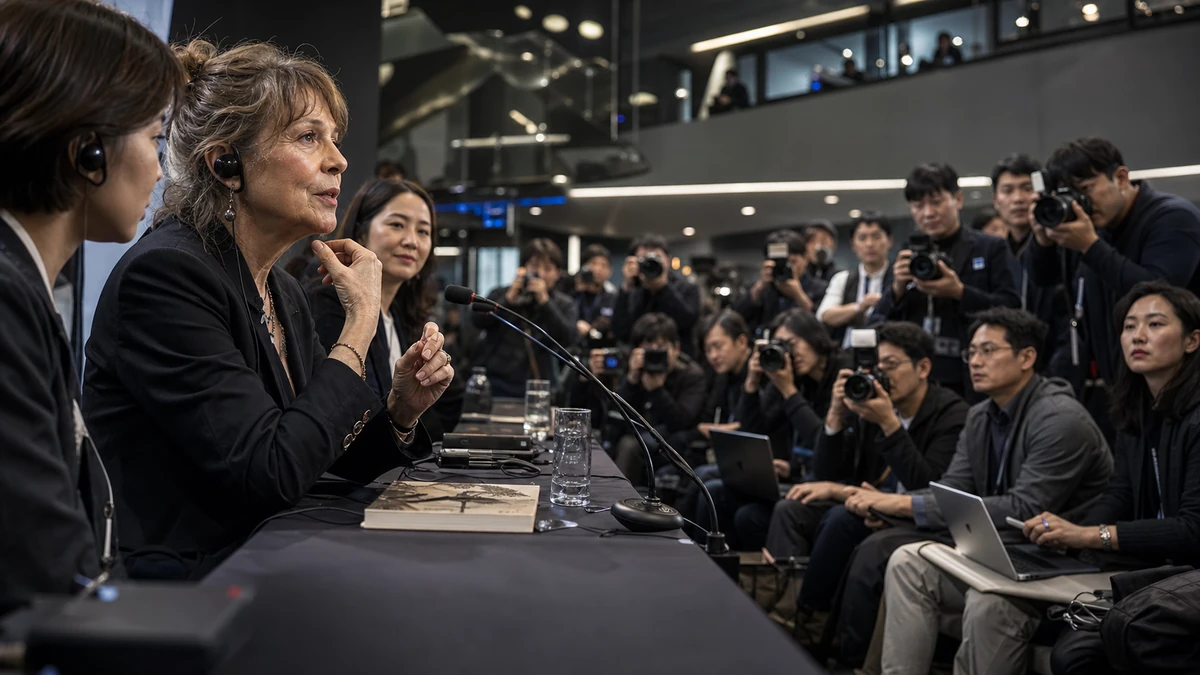
When Isabelle Huppert took the stage at a news conference in Bucheon, South Korea, this week, the headline could have been a familiar one: a celebrated European actor visiting an international film festival to promote a new project. Huppert, after all, is one of the most decorated performers in world cinema, a star whose career has moved easily between arthouse prestige and daring, sometimes unsettling, roles. She was in Bucheon for the 30th Bucheon International Fantastic Film Festival, known widely as BIFAN, where she appeared in connection with the film Blood Countess.
But what made the moment resonate in South Korea was not simply the arrival of a Cannes and Venice award winner at a genre-focused festival outside Seoul. It was what Huppert chose to talk about. According to South Korean media reports from the event, she said she came to understand the Gwangju Democratization Movement through the work of Han Kang, the South Korean novelist whose writing has become a major point of entry for international readers trying to understand the emotional and historical terrain beneath contemporary Korean culture.
For American readers, that may sound like an unusual path into history: not through a textbook, documentary or museum exhibit, but through literature. Yet that is part of what makes Huppert’s remarks so significant. They offer a reminder that the Korean Wave — often shorthand in the United States for K-pop, hit TV dramas and Oscar-winning films — is not only about entertainment exports or streaming success. It is also about how Korean literature, theater and historical memory are increasingly circulating across borders, shaping how global audiences encounter South Korea as more than a pop-culture powerhouse.
In Bucheon, Huppert was not speaking abstractly. She said she had been reading Han’s work and would soon join Korean actor Lee Hye-young for a reading in France of Han’s novel We Do Not Part at the Avignon Festival, one of the world’s premier performing arts events. In other words, the connection she described is already moving from page to stage: a Korean text, interpreted by a French actor and a Korean actor together, for an international audience in one of Europe’s most storied cultural settings.
That alone would be enough to signal how far Korean writing has traveled. But Huppert’s specific reference to Gwangju gave the moment additional weight. It suggested that Korean literature is not simply gaining prestige abroad; it is also carrying difficult chapters of South Korean history into new languages and artistic spaces.
Why Gwangju still matters — in Korea and beyond
To understand why Huppert’s comment drew attention, it helps to understand what the Gwangju Democratization Movement means in South Korea. In May 1980, in the southwestern city of Gwangju, citizens rose up against the military government amid a brutal political crackdown. Troops were deployed, civilians were killed, and the event became one of the defining traumas of modern Korean history. In the decades since, Gwangju has come to symbolize both state violence and democratic resistance.
For Americans, one rough comparison might be to places and events that condense a nation’s moral reckoning into a single name: Selma, Kent State, Birmingham, perhaps even the Edmund Pettus Bridge as a stand-in for a larger struggle. The analogy is not exact, and Korea’s political history is its own. But the point is that Gwangju is not simply a historical footnote in South Korea. It is a site of memory, grief and civic identity, one that continues to shape public life, art and politics.
Many international audiences, however, first learn about Gwangju not in a classroom but through culture. That can include films, translations of Korean fiction, museum programs, or conversations sparked by major Korean artists. Han Kang has been central to that process. Though she is perhaps best known in the English-speaking world for The Vegetarian, her body of work has also engaged directly with violence, mourning, memory and the afterlife of political trauma. Her internationally acclaimed novel Human Acts, in particular, is closely associated with the Gwangju uprising and its human consequences.
So when Huppert said Han’s fiction helped her learn about the Gwangju movement, she was pointing to something larger than a personal reading experience. She was describing how literature can function as historical witness across borders. A reader in France, the United States or anywhere else may come to Korean history not through diplomatic timelines or military archives, but through the interior, intimate language of a novel.
That matters because historical understanding often begins with emotional recognition. Statistics and chronology explain what happened; art can make a reader feel why it mattered. In the case of Gwangju, that distinction is especially important. South Korea today is globally visible as a democracy, a technological leader and a cultural exporter. Works like Han’s insist that beneath that success lies a hard-won political history, one shaped by censorship, authoritarianism and public sacrifice.
Han Kang’s global reach is changing the map of Korean culture
In the United States, the Korean Wave is still often framed through highly legible symbols: BTS topping charts, Parasite winning the Academy Award for best picture, Squid Game becoming a streaming sensation, beauty brands expanding in American stores, and Korean food becoming a mainstream part of urban dining culture. All of that is real, and all of it has helped shift South Korea’s place in the global imagination.
But literature often moves differently. It is slower, quieter and less immediately visible than music or television. Its influence tends to unfold over years, through translations, book clubs, university syllabi, prize circuits and the advocacy of other artists. That is one reason Huppert’s remarks in Bucheon deserve attention. They show Korean cultural influence operating through a channel that does not depend on blockbuster numbers or viral momentum.
Han Kang’s international recognition has accelerated that process. Her work has become a touchstone for readers outside Korea who are searching for something deeper than trend-driven familiarity. If K-pop and Korean drama have introduced millions of people to Korean language, style and emotion, writers like Han have offered a path into the country’s moral and historical interior. Her fiction asks readers to confront silence, violence, bodily autonomy, memory and loss — themes that resonate globally while remaining rooted in specifically Korean experiences.
That Huppert said she sought out novels such as We Do Not Part and The Vegetarian after Han’s Nobel recognition underscores how literary prestige still matters in opening doors. Prize culture can sometimes seem insular, especially in the English-speaking media ecosystem, but it has practical consequences. It changes what gets translated, what gets programmed at festivals, what gets picked up by actors and directors, and what enters the global conversation. One writer’s breakthrough can ripple outward into theater, publishing, film adaptation and international collaboration.
What is striking here is not simply that a French actor read a Korean novelist. It is that the reading appears to have generated a chain of connection: from Nobel attention to personal discovery, from personal discovery to historical understanding, and from historical understanding to a public performance at Avignon. That is how cultural exchange often works at its deepest level — not as a single headline event, but as a slow accumulation of encounters that eventually reshape what audiences think they know about a country.
Bucheon’s role in a larger cultural shift
For people outside South Korea, the name Bucheon may not carry the instant recognition of Cannes, Venice, Sundance or Toronto. But in Asian cinema circles, the Bucheon International Fantastic Film Festival has long had a distinct identity. Located in Gyeonggi Province, just outside Seoul, Bucheon has built its reputation around genre cinema: horror, fantasy, science fiction, thrillers and formally adventurous work that may not fit the mold of more traditional prestige festivals.
That focus matters. In the United States, genre festivals are sometimes treated as niche spaces for fans, industry insiders or cult audiences. But in many countries, they are also serious laboratories for international exchange, where new forms, new voices and unexpected collaborations can emerge. Bucheon has increasingly become one of those spaces, a venue where global artists and Korean audiences meet on terms that are more experimental and less rigidly hierarchical than at some older festivals.
Huppert’s appearance at BIFAN reflects that evolution. She is not the kind of star one would automatically associate with a festival dedicated to fantastic cinema, and that is precisely why her presence is telling. It signals that Bucheon is functioning as more than a domestic showcase or a fan event. It is a cultural platform where film, literature and theater can intersect, and where conversations extend beyond a single title being screened.
That may be one of the most interesting developments in contemporary Korean cultural life. South Korea’s international profile is no longer concentrated only in Seoul, nor only in a few obvious commercial sectors. Regional festivals, performing arts centers and literary institutions are increasingly part of the infrastructure through which Korean culture speaks to the world. A festival press conference in Bucheon can now become a place where a French actor discusses Korean literature, a Korean actor, and one of the most painful episodes in Korea’s modern history — all while promoting a film.
In that sense, the setting is part of the story. It suggests that Korean cultural diplomacy today is not necessarily orchestrated through official state messaging or top-down branding campaigns. Sometimes it happens through the ordinary rhythms of festival life: a screening, a panel, a press conference, an actor reflecting on what she has read. Those moments can reveal as much about a country’s soft power as any streaming rankings or tourism campaign.
Huppert’s Korean ties did not begin this week
Although this was Huppert’s first appearance at the Bucheon festival, her relationship with South Korea is not new. She has already built a substantial artistic connection to Korean filmmakers and audiences, most notably through her work with director Hong Sang-soo. Huppert appeared in Hong’s In Another Country and has participated in multiple collaborations with him, becoming one of the highest-profile European actors to work repeatedly in contemporary Korean cinema.
For American audiences less familiar with Hong, he is a prolific and influential South Korean auteur whose films often revolve around conversation, repetition, desire, awkwardness and the small humiliations of everyday life. He occupies a place in global cinema closer to directors celebrated on the festival circuit than to commercial multiplex names. Huppert’s willingness to work in that space has long suggested that her interest in Korea is not superficial or opportunistic. It comes from sustained artistic engagement.
That history gives her Bucheon remarks a credibility they might not otherwise have had. She was not parachuting into Korea for a one-off appearance and offering generic praise. She was speaking as someone whose relationship with Korean art has unfolded over time, across film and theater as well as literature. Reports also note that she performed in South Korea in 2024, appearing in a stage production at Seongnam Arts Center. That background matters because it frames her latest comments not as a celebrity sound bite, but as part of a longer exchange.
There is also something revealing in the medium-crossing nature of that exchange. In the United States, cultural coverage often separates industries cleanly: film over here, books over there, theater somewhere else, each with its own beats, awards and audience. What Huppert’s trajectory in Korea suggests is a more fluid ecosystem, one in which a film actor can move into theater, discover a novelist through international recognition, then bring that novelist’s work back onto a European stage in partnership with a Korean actor.
That kind of movement is especially meaningful at a moment when Korean content is often flattened abroad into a handful of marketable categories. Huppert’s case points to another reality: the global life of Korean culture is increasingly intermedial. Stories migrate from novels to performances, from historical memory to cinematic conversation, from local festivals to European stages. The significance lies not just in the fame of the participants but in the texture of the exchange itself.
What an Avignon reading says about the next phase of the Korean Wave
The upcoming reading of We Do Not Part at the Avignon Festival may sound modest compared with a film premiere or a chart-topping album release. Yet in some ways it captures the next phase of Korea’s global cultural footprint more precisely than any blockbuster metric could. Avignon is one of the most prestigious performing arts festivals in the world, a place where theater, text and interpretation matter enormously. A Korean novel being read there by Huppert and Lee Hye-young is not just a symbolic gesture. It is an endorsement of Korean literature as material worthy of serious performance, translation and international attention.
For American readers, it may help to think of Avignon as occupying a cultural role somewhere between the seriousness of the Brooklyn Academy of Music, the historic aura of a major Shakespeare festival, and the global prestige of top European arts institutions. A reading there carries a level of imprimatur that extends well beyond the immediate event.
It also says something about how stories travel now. For years, the most visible forms of Korean global expansion were audiovisual: music videos, TV dramas, films and later streaming series. Those forms remain central. But literature, especially when activated by performers, can move differently. It invites slower attention. It asks audiences to listen, not just consume. It can foreground silence, grief and memory in ways that are hard to sustain in commercial spectacle.
That is one reason Huppert’s mention of Gwangju is so important. If Korean culture abroad is entering a more mature phase, it will not only export style and sensation. It will also export difficult memory. That includes the memory of dictatorship, protest, massacre, division and unresolved grief. The ability of a culture to circulate its pain as well as its pleasure is one sign that it is being understood in fuller terms.
South Korea’s global story has often been told as a triumphant narrative: rapid economic growth, democratic consolidation, technological innovation and cultural influence. All of that is true. But no modern nation gets to that point without scars. Han’s work has become one of the vehicles through which those scars are made legible abroad. Huppert’s reading life, and now her public comments, show how that process can reach even the highest levels of international artistic culture.
More than a celebrity quote, a sign of deeper exchange
It would be easy to reduce this episode to an elegant quote from a famous actor at a film festival. That would miss what is most revealing about it. Huppert’s remarks in Bucheon point to a broader shift in how Korean culture is being received internationally. The world is no longer engaging South Korea only through catchy hooks, gripping thrillers or export-friendly aesthetics. It is also engaging with Korean historical consciousness, literary seriousness and the unresolved emotional residue of the country’s modern past.
That does not happen automatically. It requires translators, publishers, festival programmers, actors, scholars and audiences willing to meet a work halfway. It requires institutions like BIFAN and Avignon that can create space for unexpected intersections. And it requires artists like Huppert, who have the standing to direct attention toward a text, a history or a collaboration that might otherwise remain within specialist circles.
There is also a lesson here for American cultural coverage. In the United States, discussions of international culture can swing between two extremes: exoticizing the unfamiliar or absorbing it too quickly into a familiar commercial narrative. Korean culture, perhaps more than any other non-English-language cultural force of the past decade, has challenged both habits. It has arrived at scale, but it has also retained layers that demand explanation. Terms like the Korean Wave can be useful shorthand, but they can obscure the fact that what is waving outward now includes not just idol groups and dramas, but books about mourning, historical violence and democratic memory.
In that sense, Bucheon offered a small but meaningful snapshot of where things stand in 2026. A French actor known for some of Europe’s most exacting cinema appears at a Korean genre festival, speaks about a Korean novelist, references a defining Korean democratic trauma, and prepares to share a Korean text on a major French stage with a Korean actor. That is not just cultural crossover. It is a map of how artistic influence travels in the 21st century: across forms, across languages, across histories.
For South Korea, it is another sign that its cultural power is deepening, not merely widening. And for international audiences, it is an invitation to look beyond the familiar entry points. The story of Korea in the world is no longer only the story of what entertains us. It is also the story of what teaches us how another society remembers, grieves and speaks to itself — and, increasingly, to everyone else.
Comments
Post a Comment