Before the Crowds Arrive, a South Korean Beach City Makes a Point: Summer Tourism Starts With Cleanup
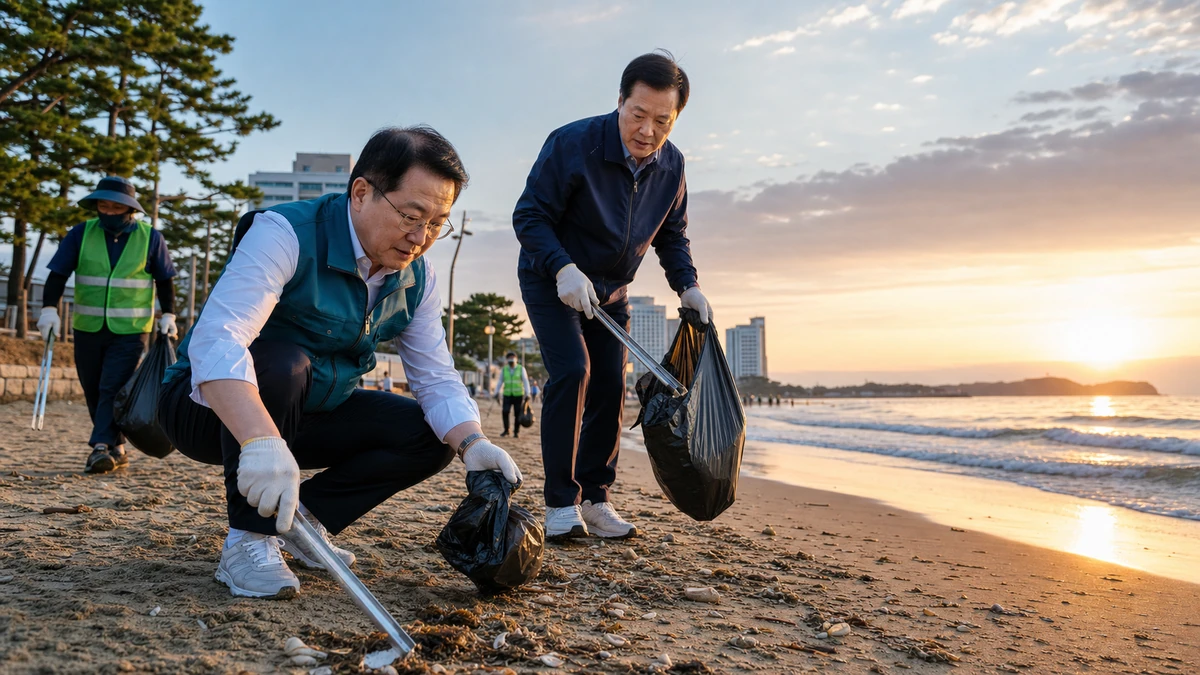
A predawn photo op — and a message about how tourism really works
Long before umbrellas go up, snack stands get busy and families spread towels across the sand, one of South Korea’s best-known beach destinations began its summer season with a much less glamorous ritual: picking up trash.
On the opening day of Gyeongpo Beach in Gangneung, a city on South Korea’s east coast, Mayor Kim Jung-nam and City Council Chairman Heo Byeong-gwan joined cleanup crews before sunrise, moving through roughly 1 kilometer — about six-tenths of a mile — of shoreline from the entrance near Gangmun Bridge to Gyeongpo Central Plaza. According to South Korean media reports, the two local leaders not only inspected the site but also took part directly in collecting everyday litter and listened to workers in the field.
That might sound like a modest local-government event, the kind of small civic scene that rarely travels far beyond city limits. But in a country where summer beach season is both a major leisure tradition and a serious economic engine, the symbolism is easy to read. Before tourists set foot on the sand, Gangneung wanted to show what kind of welcome it intends to offer: orderly, clean and visibly managed.
For American readers, it may help to think of the opening of a Korean beach season as something closer to a formal public launch than simply a warm weekend when people happen to show up. In South Korea, major beaches often have official opening dates, coordinated staffing plans, sanitation schedules, safety measures and municipal oversight that become especially visible during peak travel months. The start of the season is not just about weather. It is also about whether the city is ready.
That helps explain why the mayor and the head of the city council appeared at dawn for a sanitation operation. This was not only an environmental gesture. It was a statement about governance, public service and first impressions in a place that draws roughly 2 million visitors a year.
Why Gyeongpo matters in South Korea’s summer travel map
Gyeongpo Beach is not just any strip of sand. It is one of the best-known beaches on South Korea’s East Sea coast — the body of water Koreans call the East Sea and many international maps label the Sea of Japan. The beach sits in Gangneung, a city familiar to many Koreans as a classic summer destination and increasingly known to international travelers who venture beyond Seoul and Busan.
Gangneung occupies a place in the South Korean imagination that may be easiest for Americans to understand by comparison to a regional favorite beach town that combines natural scenery with strong cultural identity — somewhere that is both a leisure destination and a civic brand. It is accessible from the Seoul metropolitan area, making it a realistic getaway for city dwellers, but it also has its own distinct rhythm. The area is known for its coastline, nearby lake, walkable tourist zones and a mix of local businesses that depend heavily on seasonal traffic.
Gyeongpo’s annual visitor total — around 2 million people, according to the provided figures — places it among the country’s major beach sites. In practical terms, that means sanitation is not a cosmetic issue. It is core infrastructure. A beach receiving that kind of volume is not judged only by its waterline or skyline; it is judged by the entire visitor experience, from how clean the promenade feels to how orderly the public spaces look when the first wave of tourists arrives.
South Korea’s domestic travel culture places a high premium on destinations that feel well organized. That includes basics Americans also care about on beach vacations: clear walking paths, clean bathrooms, manageable traffic, litter control and a sense that someone is paying attention. But in South Korea, where high population density and compressed peak travel periods can intensify crowding, those operational details are even more visible. On a busy summer day, a beach can go from serene to overrun quickly.
That is why the image of local leaders picking up trash at sunrise carries weight beyond the immediate scene. It says that the city understands what tourists will notice first — and what residents and merchants have to live with all season long.
What the cleanup says about Korean local politics
There is another layer to the event that may be less obvious to readers outside Korea. The appearance of the mayor alongside the chair of the city council matters because it brings together the executive and legislative faces of local government. In the American system, a mayor and a city council speaker or president showing up together for a beach-opening sanitation effort would suggest that a seasonal tourism challenge is being treated not as a narrow department concern, but as a citywide priority. The same logic applies here.
In the Korean context, reports described the outing as the pair’s first “minsaeng” move. That Korean term does not translate neatly into a single English word, but it broadly refers to bread-and-butter public concerns: the everyday issues that affect ordinary people’s quality of life. It can include prices, housing, transport, sanitation, safety and the visible responsiveness of government. Politicians across South Korea frequently use the language of “minsaeng” to signal that they are focused on practical problems rather than abstract rhetoric.
Trash pickup at a beach may seem humble compared with ribbon-cuttings, festivals or major development announcements. Yet that is precisely why it fits the “minsaeng” frame. This kind of work touches tourists, local shop owners, city workers and residents all at once. A dirty beach does not remain a beach problem for long. It becomes a business problem, a public image problem and eventually a governance problem.
By showing up before the crowds, the mayor and council chairman were effectively embracing a familiar but potent political lesson: the public often judges government competence through small, highly visible services. Not everyone follows budget debates or zoning hearings. Nearly everyone notices when a tourist district is dirty on opening day.
There is also an implicit message to the bureaucracy. When top officials appear at dawn and participate in physical work, even briefly, they validate the importance of frontline labor that is often overlooked. Sanitation workers, maintenance crews and beach management staff may not headline tourism campaigns, but they are among the people most responsible for whether those campaigns hold up in real life.
The first impression economy
The Korean summary of the event emphasizes a simple but powerful idea: the opening-day dawn cleanup helped shape the “first impression” of Gangneung’s summer tourism season. That phrase may sound like public-relations language, but it captures something real about destination management in the social media era.
Travelers now form opinions instantly and broadcast them just as quickly. A pristine shoreline, an orderly plaza and a clean pedestrian route can become content that reinforces a city’s image. Overflowing bins, scattered bottles and neglected corners can do the opposite. For a destination that competes not only with other Korean beaches but also with international options, the gap between a good first impression and a bad one has economic consequences.
American tourist towns know this too. Whether it is a boardwalk on the Jersey Shore, a spring-break beach in Florida or a lakeside getaway in Michigan, visitors tend to remember not just the scenery but the conditions under which they experienced it. Was it clean? Was it easy to walk? Did it feel cared for? Scenic beauty may attract the first visit; competent operations help secure the second.
In Gangneung’s case, the timing is especially important. The first morning of the beach season functions as a kind of public threshold, the moment a city moves from preparation to performance. Once tourists arrive in force, every flaw becomes harder to hide and more expensive to fix. A predawn cleanup is therefore not simply maintenance. It is a preventive strategy.
The 1-kilometer route covered by the officials and workers also matters. In beach tourism, a kilometer is not an abstract measurement. It is the distance a family might stroll, the space where couples take photos, the corridor that connects the shoreline to surrounding businesses. If that stretch looks neglected, visitors do not compartmentalize the problem. They internalize it as part of the destination itself.
That is one reason basic urban management often has outsized influence on tourism branding. Travel campaigns can promise atmosphere. Operations determine whether the promise feels credible.
Beyond K-pop and Seoul: another side of South Korea for foreign visitors
For many English-speaking readers, South Korea still arrives through a handful of familiar entry points: K-pop, Korean dramas, beauty products, tech companies and the hypermodern image of Seoul. Those reference points are real, but they can flatten the country into a single metropolitan story. News like this offers a more grounded picture of what South Korean life and travel look like outside the capital.
Gangneung is part of that broader story. It is a coastal city where tourism intersects with ordinary municipal concerns, seasonal labor and local identity. It is also the kind of place international visitors increasingly seek out as South Korea broadens its appeal beyond headline attractions. Travelers who have already done the palace tours, food markets and shopping districts in Seoul may look for regions that feel more local and less scripted. East Coast beach towns, with their mix of scenery and civic order, fit neatly into that shift.
Gyeongpo Beach in particular can be understood as a gateway to a different Korean travel experience — one rooted in open coastline rather than dense city streets. The appeal lies partly in geography. Gangneung offers a setting where beach, lake and urban amenities sit close together, making it possible to move between relaxation, dining and city access without much friction. For short-term visitors, especially those used to carefully planned itineraries, that convenience matters.
But this is also where cultural explanation is useful. In South Korea, public spaces are often expected to function with a level of order and maintenance that reflects directly on local government. Cleanliness is not merely aesthetic. It is a marker of whether systems are working. That expectation helps explain why a garbage-collection scene can register as meaningful public news.
It also helps explain why the story is not being framed as trivial. In some news ecosystems, a mayor helping with cleanup could be dismissed as pure optics. In South Korea, it can still be seen that way by skeptics, of course, but it also fits into a broader civic language of hands-on responsiveness. The act has value because it takes place at the point where public image, daily life and local economy meet.
The invisible labor behind a beach day
One of the most revealing aspects of the Gangneung story is how plainly it highlights labor that tourists are not usually meant to think about. A beach day is often sold as effortless. The sand is clean, the paths are clear, the plaza looks welcoming and the scene appears natural, almost automatic. In reality, none of that is automatic.
Someone empties the bins before they overflow. Someone clears bottles and food packaging from public areas. Someone checks whether the walking route is presentable before visitors start filming, shopping and posting. A city’s tourism identity rests partly on this choreography of early-morning work that most people never see.
That is true in South Korea and in the United States alike. The difference may be that Korean local governments are often more explicit in publicly staging, or at least documenting, that labor at key seasonal moments. The message is straightforward: tourism does not begin when visitors arrive. It begins when workers do.
There is also a civic humility to that framing, whether intentional or not. Instead of launching the season with a slogan-heavy ceremony alone, the city’s visible first act was a cleanup round. That suggests an understanding that reputation is built not only through promotion but through maintenance. And maintenance, by definition, is repetitive, unglamorous and essential.
For places that depend on tourism, especially seasonal tourism, that lesson is universal. Visitors may spend money on hotels, coffee, seafood, rentals and souvenirs, but the decision to stay longer, return next year or recommend a destination to friends often comes down to basics. Clean public space is one of those basics. So is the sense that local officials grasp that point.
The provided materials do not offer a broader set of economic statistics, but the logic is clear enough. A beach that welcomes 2 million visitors is tightly bound to the fortunes of nearby businesses. If the physical environment deteriorates, the damage does not stop at aesthetics. It ripples outward through consumer behavior and local confidence.
Why a small story can still say something big
This is not a story about a billion-dollar development plan, a celebrity ambassador or a record-breaking festival. It is a story about a summer morning, a stretch of coastline and a few local officials handling trash bags before the public arrives. Yet that smallness is part of what makes it revealing.
Big tourism narratives often emphasize spectacle: the beach concert, the drone show, the luxury resort, the social media campaign. But ordinary visitors tend to experience a place through smaller realities. Is the route from the bridge to the central plaza clean? Does the beach feel ready? Does the city seem attentive before problems become obvious?
Gangneung’s opening-day cleanup answers those questions with a gesture that is easy to understand even across cultures. A city famous for summer travel decided that the season should begin not with celebration alone but with preparation. That sends a practical message to residents, tourists and business owners alike: scenic beauty is not enough. A destination has to be run well.
For American readers trying to understand modern South Korea beyond the usual pop-culture shorthand, this is a useful scene. It shows a local government thinking about tourism not as a billboard but as a system. It shows the Korean concept of “minsaeng” playing out in a concrete setting. And it shows how deeply the country’s travel industry depends on mundane, disciplined public service.
In the end, Gyeongpo Beach’s opening-day cleanup may not be remembered by the tourists who arrive later for sunrise photos, seafood dinners or a weekend by the East Sea. Most will simply encounter a cleaner shore and move on. But that, in a way, is the point. The best-managed tourist experiences often hide the work that makes them possible.
Before South Korea’s summer beach crowds began another season at one of the country’s signature coastal destinations, Gangneung put that hidden work in plain view. It was a reminder that travel memories are shaped not only by where people go, but by what cities do before they get there.
Comments
Post a Comment