
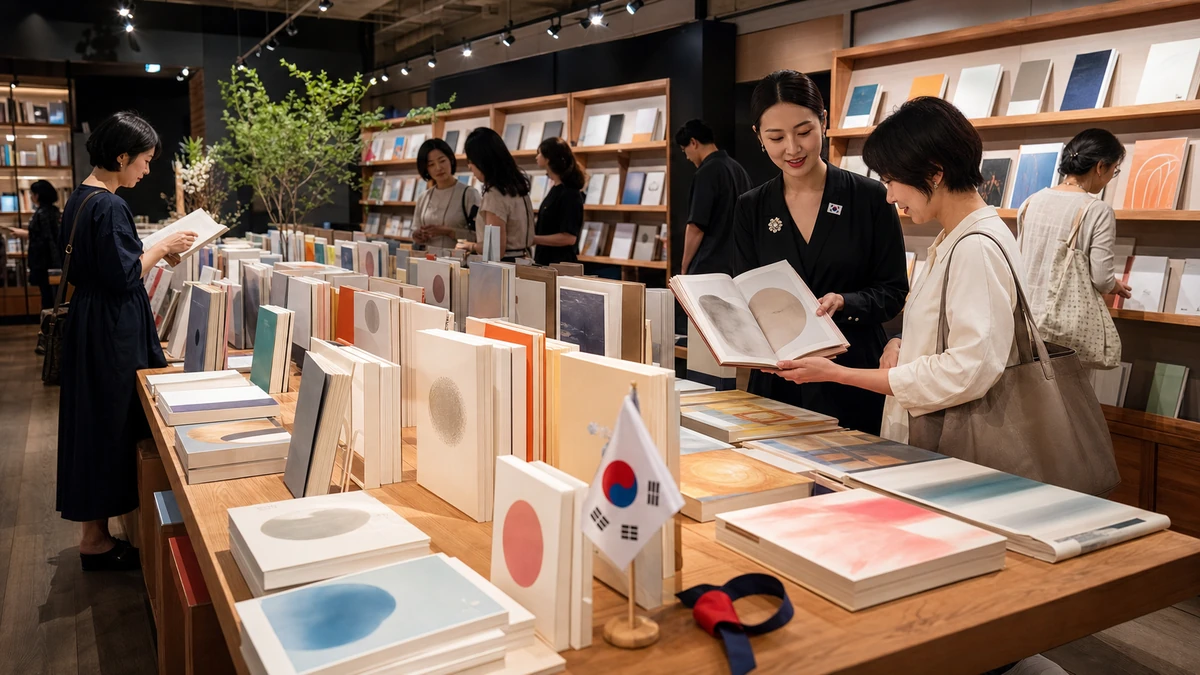
A new chapter for the Korean Wave in Japan
The global rise of South Korean culture has usually arrived overseas with a beat, a binge or a beauty trend. For many Americans, the phrase “Korean Wave” — or hallyu, the term used to describe the international spread of Korean popular culture — brings to mind BTS, "Parasite," "Squid Game" or Korean skin care stocked at Sephora. But in Tokyo this month, the spotlight is shifting to a quieter export: books.
The Korean Cultural Center in Japan, which operates under the South Korean Embassy in Tokyo, said it is holding the first “K-Book in Tokyo” event from Friday through July 23 in partnership with the Publication Industry Promotion Agency of Korea. The program is taking place at two sites: the Korean Cultural Center and Daikanyama Tsutaya Books, a well-known Tokyo bookstore whose sleek, design-forward layout has made it a destination for readers as well as tourists.
The event is meant to introduce Japanese readers to Korean literature and publishing at a moment when interest in Korean books has been steadily growing in Japan. Organizers said the exhibition at the Korean Cultural Center features about 100 books, including Korean literary works and picture books that have been translated into Japanese and have drawn attention locally. The programming also includes book talks, underscoring that the event is not just a retail display but a broader cultural exchange built around conversation, interpretation and reading.
That may sound modest in an era dominated by streaming platforms and viral fandoms. Yet the symbolism is significant. Music and television can travel instantly across borders, often requiring little more than subtitles and an algorithm. Books move more slowly. They require translation, editorial investment, shelf space, marketing and, above all, a reader’s time. When translated Korean books begin to win attention in a neighboring market like Japan, it suggests the Korean Wave is deepening, not just widening.
For American readers, there is an easy comparison. If K-pop was Korea’s equivalent of the British Invasion — sudden, youth-driven and impossible to ignore — then the spread of Korean books abroad may be closer to how Japanese literature, Scandinavian crime fiction or Latin American novels gradually built serious readerships in the United States: one translation, one bookstore table, one book-club recommendation at a time.
Why Tokyo matters
The location of the event matters almost as much as the books themselves. Japan is not just another overseas stop on a promotional tour. It is South Korea’s closest major neighbor, a cultural peer and, at times, a historical rival. The two countries share deep economic ties and a vast amount of pop-cultural traffic, but they also carry a difficult history shaped by Japan’s colonial rule over the Korean Peninsula from 1910 to 1945, along with recurring political disputes that still affect diplomacy today.
That complicated backdrop makes cultural exchange between South Korea and Japan especially meaningful. A book exhibition may seem worlds away from headline-grabbing disputes over trade, wartime memory or regional security. But cultural institutions in both countries have long understood that literature can create a different kind of contact — less theatrical than a summit, less commercial than a chart-topping single, but potentially more intimate. Reading another country’s fiction is, in a sense, agreeing to spend hours inside its emotional weather.
There is also a practical reason Tokyo carries weight. Japan remains one of the world’s major publishing markets, with a deeply rooted reading culture, strong bookstore infrastructure and a long tradition of translated literature. A translated Korean novel that finds a place in Tokyo is not simply being displayed in an embassy lobby for symbolic effect. It is entering one of Asia’s most sophisticated book ecosystems, where readers browse seriously, publishers track trends closely and literary taste can travel across generations.
The choice to stage the program across two very different venues reflects that dual purpose. The Korean Cultural Center is an official outpost of public diplomacy. Like the Alliance Francaise, Instituto Cervantes or Germany’s Goethe-Institut, it is designed to promote language, arts and national culture abroad. A bookstore such as Daikanyama Tsutaya, by contrast, is where literary culture becomes part of everyday consumer life. One site explains Korean books. The other lets readers encounter them the way they encounter any other novel or children’s title: while browsing, comparing covers and deciding what to take home.
That distinction is important. When a country’s books are presented only in a state-sponsored setting, they can remain framed as cultural artifacts — worthy, educational, perhaps a little distant. When they are placed in a bookstore’s literature section, they become candidates for pleasure, curiosity and impulse. In other words, they stop being merely “Korean books” and start competing as books, period.
From subtitles to translation
The heart of the Tokyo event is translation. Organizers said the exhibition includes about 100 Korean literary works and picture books that have been translated into Japanese. That fact may seem obvious — Japanese readers need Japanese editions — but it points to a larger truth about how literature crosses borders.
Translation is not the same as subtitling a TV drama or dubbing a movie. It is slower, more interpretive and more dependent on institutional support. A translator must make thousands of decisions about tone, cultural reference, rhythm and voice. A publisher must decide that the book is worth acquiring, editing, designing and distributing. Booksellers must believe there is a readership for it. In that sense, every translated book is the product of a chain of faith.
For Korean literature, that chain has become increasingly robust in recent years. International recognition for Korean authors has helped, as has the broader visibility of Korean culture worldwide. But literary momentum is rarely built on prestige alone. It also depends on whether readers in another language community feel that the stories speak to them, whether through family tension, generational conflict, social pressure, loneliness, ambition or love — themes that travel even when specific customs do not.
That is part of what makes the Tokyo exhibition notable. It does not present only one breakout author or a narrow canon of critically acclaimed fiction. According to the organizers, the display spans literary works and picture books, suggesting a broader view of what Korean publishing can offer. For adults, literature may provide a window into Korean society, from urban isolation to class anxiety to changing gender roles. For younger readers and families, picture books can lower the linguistic barrier, relying on image and mood as much as text. That variety broadens the possible audience.
In the American market, translated fiction still occupies a relatively small slice of overall book sales, despite periodic surges of interest. Japan, by contrast, has long had a more established place for translated works in mainstream reading culture. That makes Japan an especially revealing test case for Korean books abroad. If Korean titles can become familiar to Japanese readers — not as a passing novelty but as part of the regular literary landscape — it may signal a model for how Korean publishing could expand in other countries as well, including the United States.
The bookstore as cultural bridge
One of the most telling elements of “K-Book in Tokyo” is its presence inside Daikanyama Tsutaya Books, particularly in the store’s literature area. To Americans, the closest comparison might be staging a foreign literature showcase at a place that combines the cultural cachet of an independent bookstore with the design sensibility of a museum gift shop and the foot traffic of a lifestyle destination. Daikanyama Tsutaya is known not only for selling books but for curating them, which gives the placement added significance.
Bookstores are not neutral spaces. They tell readers, often silently, what belongs. A novel placed in a front-facing display acquires visibility that a spine-out copy never will. A national literature featured in a dedicated exhibition can still feel niche; a title integrated into the broader literature section begins to feel normalized. That appears to be part of the logic behind the Tokyo event. The Korean Cultural Center can provide context, but the bookstore can provide habit. It is where discovery becomes routine.
That matters because one of the longstanding challenges for translated literature is moving beyond “eventization.” A country becomes briefly fashionable, a literary prize triggers a spike in attention, or a geopolitical moment sparks curiosity. Then the spotlight shifts. Sustainable readership requires repetition. Readers need to encounter books from that country again and again until the category stops feeling foreign and starts feeling familiar.
For Korean cultural exports, this is a noteworthy turn. South Korea has become remarkably adept at global cultural branding, and the label “K-” now attaches easily to music, drama, film, food, beauty and fashion. But publishing does not scale in the same way as pop entertainment. There is no exact literary equivalent of a viral dance challenge. Books demand stillness. They are slower to circulate and harder to convert into mass phenomenon. Yet that slowness can also be a strength. A reader who spends several days with a novel has a different relationship to a culture than someone who streams a show over a weekend.
That is why the bookstore setting matters so much. It suggests a strategy for the next phase of cultural influence: not simply exporting spectacles, but embedding stories in the ordinary rituals of reading. If K-pop opened the door and Korean television invited audiences inside, Korean literature may be what encourages them to stay long enough to understand the house.
What Japanese readers may be finding in Korean literature
Organizers said the event comes at a time of steadily growing interest in Korean literature and publications in Japan. The summary of the Korean report does not identify specific titles or offer sales figures, so any broader conclusions should be cautious. Still, the larger trend raises an obvious question: Why now?
Part of the answer is proximity. South Korea and Japan are geographically close, economically intertwined and deeply aware of one another’s media. For Japanese readers, Korean literature can feel both nearby and distinct — close enough to be legible, different enough to be intriguing. Social issues explored in Korean fiction, including competition, educational pressure, precarious work, family obligation and the tension between tradition and modernity, may resonate in Japan even when the cultural details differ.
There is also the influence of the wider Korean Wave. A reader who came to Korea through a Netflix drama, an Oscar-winning film or a favorite idol group may be more willing to pick up a novel, essay collection or picture book from the same cultural orbit. This kind of spillover matters. In the United States, for example, international film often drives interest in translated fiction, while television adaptations can revive entire backlists. Cultural ecosystems feed one another.
At the same time, books offer something pop culture sometimes cannot: interiority. They allow readers to linger over thought, memory and contradiction. A Korean novel can reveal not just what Korean society looks like from the outside, but what it feels like from within. For neighboring countries like Japan, that may be especially compelling. Familiar headlines about politics and regional tension are one thing; the emotional texture of everyday life is another.
Picture books add a separate dimension. Their inclusion in the Tokyo exhibition is more than a family-friendly gesture. Picture books often travel well across cultures because visual storytelling can soften the barrier of language. They can introduce motifs, humor and sensibilities that differ from Western children’s publishing traditions while remaining immediately accessible. For parents, teachers and librarians, they can serve as an entry point to a national literature that might otherwise feel specialized.
In that sense, the 100-book display represents more than quantity. It signals range. It suggests Korean publishing is not being reduced to a single style, one celebrity author or a handful of export-ready titles. Instead, it is being presented as a living field with multiple genres, age groups and reading experiences. That is an important distinction for any country seeking long-term literary presence abroad.
Book talks and the value of explanation
The Tokyo program also includes book talks, according to the Korean Cultural Center. No details were provided in the summary about participants or themes, but the format itself is telling. In translated literature, conversation can be as important as display.
For readers encountering another country’s books, context matters. A discussion can illuminate why a certain novel landed in Korea when it did, how a translator approached untranslatable expressions, or what social debates shaped a work’s reception. It can also help readers understand customs that might otherwise pass by unnoticed. In Korean culture, for example, age hierarchy, speech levels, family obligation and educational expectations often shape character dynamics in ways that are obvious to Korean readers but less so to outsiders. A skilled book talk can bridge that gap without flattening the work into anthropology.
That is especially relevant for American and other English-speaking audiences trying to understand why Korean books are gaining traction abroad. Literature does not travel simply because it is foreign or fashionable. It travels when readers are given enough access — linguistic, emotional and cultural — to make the encounter meaningful. Events like book talks create that access. They invite readers not just to consume a product, but to join a conversation.
There is a parallel here with how Korean film and TV have been discussed in the United States. Early international coverage sometimes treated Korean entertainment as an exotic craze. Over time, the conversation matured. Critics began to engage the work on its own merits while also explaining the social conditions behind it: housing pressure, class stratification, militarized history, family expectations, hypercompetitive schooling. Korean literature may now be entering a similar phase in neighboring markets. The point is no longer just that Korean books are arriving, but that they are worth talking about in depth.
That may ultimately be one of the event’s most durable contributions. Exhibitions end. Store displays rotate. But a reader who attends a thoughtful discussion can leave with a framework that lasts longer than any poster campaign. The question shifts from “What should I read?” to “Why does this literature matter?”
A quieter form of diplomacy
The first edition of “K-Book in Tokyo” is, on one level, a modest cultural event: a limited-run program, two Tokyo venues, around 100 translated books and a set of talks designed to connect readers with Korean publishing. But on another level, it captures something larger about the current moment in East Asian cultural exchange.
South Korea has become one of the world’s most visible cultural exporters, and much of that success has been driven by industries built for rapid circulation — music, film, television and digital media. Books operate on a different timetable. They are slower, less scalable and less likely to generate overnight fandom. Yet precisely because of that, they often represent a deeper kind of cultural arrival. When readers in another country begin spending sustained attention on your novels, essays and picture books, they are engaging not only with your entertainment but with your language, memory and imagination.
In Tokyo, that engagement is unfolding through a blend of public diplomacy and market presence. The Korean Cultural Center offers the official frame. The bookstore offers everyday legitimacy. Together, they suggest a model in which cultural institutions and publishing bodies do more than advertise national content; they create conditions under which readers can discover it naturally.
There is also something quietly hopeful in that. South Korea and Japan do not need more reminders of their political differences; those are well documented and regularly debated. What literature offers is another register of contact — one that does not erase history but allows people to meet through stories rather than slogans. A reader browsing a translated Korean novel in Tokyo is not resolving geopolitics. But that reader is participating in a small act of attention across a border, and such acts can accumulate.
For Americans watching the evolution of the Korean Wave, the lesson may be this: the next frontier is not necessarily louder. It may be slower, more literary and less immediately visible on social media. But it could prove just as consequential. Pop culture can make a country famous. Books can make it understood.
If “K-Book in Tokyo” succeeds, its real impact may not be measured by a short burst of foot traffic or a temporary display in a fashionable bookstore. It may be measured in what happens afterward: a Japanese reader buying a translated Korean novel on a whim; a parent discovering a Korean picture book; a bookseller deciding Korean titles deserve a more permanent shelf presence; a translator or publisher sensing that the audience is there. Those are incremental shifts, but that is often how literary influence grows.
The event’s title calls this the first edition, suggesting a beginning rather than a culmination. Whether it becomes a recurring platform remains to be seen. But as a snapshot of where Korean culture is headed internationally, it is revealing. The Korean Wave is no longer only about what the world watches and listens to. Increasingly, it is also about what the world reads.


0 Comments