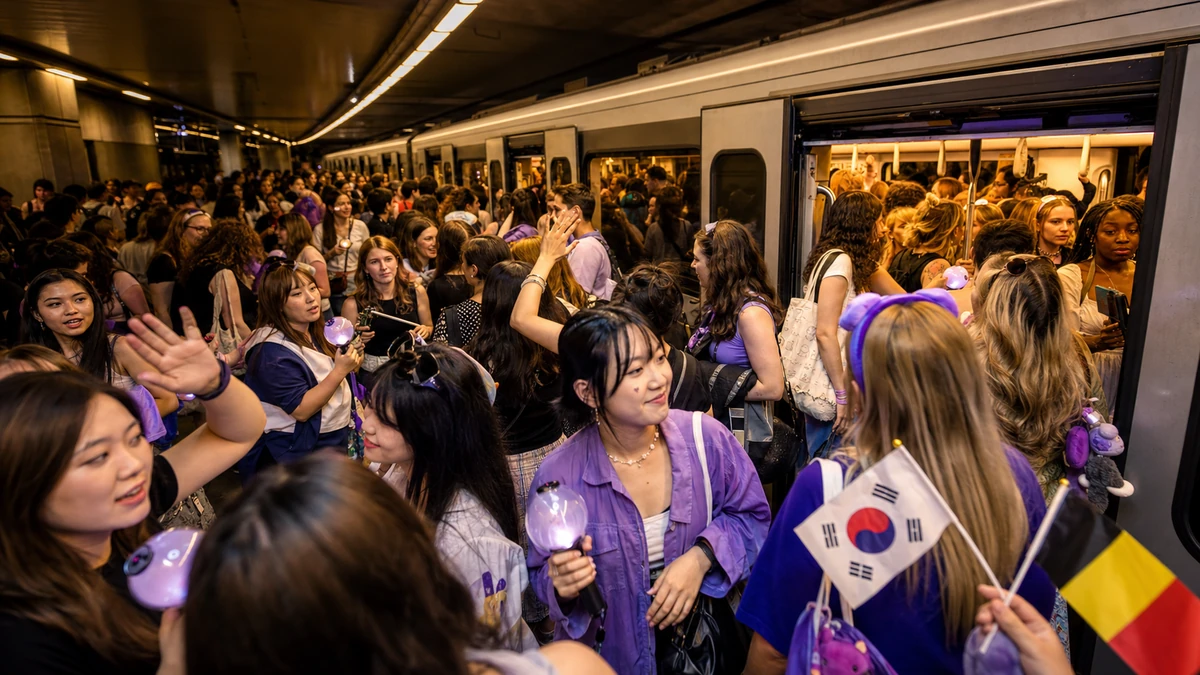
A concert that started long before the stadium lights came up
For most arena and stadium concerts, the show begins when the house lights dim and the first note hits. For BTS in Brussels, the performance appears to have started much earlier — underground, on packed subway platforms, in overheated train cars and along the route to King Baudouin Stadium, where the South Korean group held its first-ever concert in Belgium.
According to local reporting cited by South Korea’s Yonhap News Agency, crowds of fans heading to the venue on Tuesday overwhelmed parts of Brussels’ Metro system, particularly on Line 6 toward Heysel, the station closest to the stadium. Posters announcing the concert hung in the station. Platforms filled with fans. Trains arrived already crowded, and some regular riders reportedly had to let multiple trains pass because there was simply no room to board.
That kind of scene would be notable for any major global act. But in South Korea, where BTS is both a music group and a symbol of the country’s cultural reach, the images carried a deeper significance. This was not just another overseas tour stop. It was evidence that even after years at the center of the global pop conversation, BTS still has the power to mobilize a massive, highly organized, emotionally invested audience in the physical world — not just online, where fan culture is often measured in streams, views and hashtags.
For American readers, one useful comparison might be the way Taylor Swift’s Eras Tour temporarily reshaped traffic patterns, hotel bookings and local transit in U.S. cities, or how Comic-Con can overtake downtown San Diego. But BTS has long occupied a somewhat different lane: a pop act whose following is both intensely local and unmistakably international, with fans crossing language barriers and national borders while sharing a common identity.
In Brussels, that shared identity had a name familiar to anyone who has followed K-pop’s rise over the past decade: ARMY, the official fandom name for BTS supporters. On the day of the concert, ARMY was not simply a digital community. It was visible in clothing, accessories, signs, conversations and movement through the city itself.
Why this mattered beyond one night in Belgium
At first glance, a sold-out or crowded stadium show in Europe might seem routine for an artist of BTS’ scale. Yet the group’s first concert in Belgium carried particular symbolic weight. “Firsts” matter in pop culture because they mark the moment when long-distance fandom becomes local reality. For Belgian fans who may have spent years traveling to Paris, London or other major cities to see Korean acts, a home-country concert is more than a date on a tour schedule. It is recognition.
That helps explain why South Korean entertainment media treated the Brussels scene as more than fan-service imagery. The underlying story was about cultural staying power. K-pop’s global expansion is often discussed through numbers: Billboard rankings, YouTube views, Spotify streams, chart debuts and social media engagement. Those metrics are real and important, but they can also feel abstract. Crowded subway platforms are harder to dismiss. They show what popularity looks like when it leaves the screen and enters city infrastructure.
Brussels is also not just any European city. It is widely known to Americans as the de facto capital of the European Union, a multilingual political and administrative center more commonly associated with NATO meetings, policy briefings and diplomacy than with scenes of fan frenzy. That contrast makes the images more striking. On this day, one of Europe’s best-known seats of bureaucratic power was briefly reorganized around a Korean pop concert.
There is also a geographic and cultural point here. K-pop’s growth in the West was once framed as a novelty — a niche import, a digital curiosity or a youth trend clustered in a few coastal cities. Stories like the one from Brussels suggest that phase is long over. BTS does not arrive as a curiosity. The group arrives as an institution, capable of generating the kind of concentrated demand that forces transit systems, venue operators and city workers to adjust in real time.
That is one reason this event resonated in South Korea. BTS has often functioned there as proof that Korean-language pop music can travel without being fundamentally remade for Western audiences. A subway system under strain in Brussels is, in that sense, a kind of cultural barometer. It suggests that Korean pop no longer needs to be translated into something else before it can move a crowd.
The subway became part of the show
One of the more revealing details from the reporting involved Brussels public transit operator STIB, whose employees were managing the rush of concertgoers. According to Yonhap’s account, one transit staffer told a citizen, in effect, that service had already been doubled because of BTS, and yet the system was still this crowded.
That offhand explanation may be the single most vivid detail in the story. It captures how a pop concert can become a city-management issue, not in the sense of crisis but in the sense of scale. Transit agencies plan for sporting events, festivals, political demonstrations and holiday surges. To hear that a K-pop concert triggered expanded subway service — and still exceeded expectations — says something concrete about demand.
Americans who have tried to catch a train after a Yankees playoff game, a Beyoncé stadium date or a major convention will recognize the pattern. The event spills beyond the venue. Sidewalks become queues. Stations become holding pens. Ordinary commuting rhythms give way to a temporary mass migration. In Brussels, BTS appears to have produced exactly that effect.
What makes the K-pop version distinctive is that the audience often arrives visibly unified. Fans were described as filling subway cars in BTS-themed outfits and carrying related merchandise. In K-pop culture, those details matter. Light sticks, branded apparel and symbolic accessories are not simply souvenirs. They function as signals of belonging, helping strangers identify one another instantly as part of the same community. That creates an atmosphere different from the average concert commute. The trip itself becomes social, performative and emotionally charged.
Even the discomfort described in the reporting — sweltering train cars, sweaty faces, tight crowds — appears to have been folded into the experience rather than treated as a deterrent. Anticipation seemed to override inconvenience. That, too, is familiar to anyone who has watched highly organized fan communities operate. Hardship, within limits, can become part of the memory: the long line before the doors open, the scramble for transit, the collective countdown before the event starts.
In that sense, the Brussels Metro was not just a means of transportation. It was the opening act, a moving pre-show where the collective energy of the fandom became legible to the city around it.
Understanding ARMY and the mechanics of K-pop fandom
To readers less familiar with Korean pop culture, the term “ARMY” may sound like branding, but it refers to one of the most influential fan communities in modern music. BTS fans adopted the name years ago, and since then ARMY has become shorthand for an extraordinarily networked global fandom — one that can organize streaming campaigns, charity drives, birthday projects, fan translations and cross-border meetups with striking efficiency.
In the United States, fandoms have long had organizing power, from Deadheads following the Grateful Dead to Swifties driving album sales and ticket demand. What makes K-pop fandom distinctive is the degree to which participation is often both digital and ritualized. Fans do not simply consume music; they learn fan chants, collect photo cards, coordinate outfits, trade information in real time and often treat live events as gatherings of a dispersed but deeply connected community.
The Brussels concert offered a textbook example of that dynamic in public space. Fans from different countries and language backgrounds were reportedly moving together toward the same destination, joined less by nationality than by cultural fluency in BTS. That matters because K-pop’s skeptics have sometimes assumed that language would impose a ceiling on its global growth. Yet scenes like this suggest the opposite: the music may be Korean, but the emotional grammar is widely understood.
That does not mean cultural context disappears. In fact, part of K-pop’s appeal lies in its specificity. BTS emerged from South Korea’s highly competitive idol system, where artists are often trained for years in singing, dancing, media performance and multilingual communication before debuting. Over time, BTS distinguished itself not just through polished performance but through songwriting, conceptual albums and a public narrative that emphasized youth, ambition, vulnerability and self-reflection.
For many global fans, especially younger ones, that combination was key. BTS was not simply exporting catchy songs. The group was offering a participatory culture. To be ARMY often means more than liking a catalog; it means entering a social ecosystem with its own references, etiquette and shared emotional history.
That is why a crowd on the way to a stadium can be culturally significant. The people in those train cars are not just customers en route to a performance. They are participants in a transnational identity that has been built over years across fan forums, translation accounts, livestreams, music videos, social media posts and previous tours.
Brussels shows how K-pop has moved from trend to civic reality
The larger takeaway from the Belgium concert is not merely that BTS remains popular. It is that K-pop has matured into a force that cities must plan around. That may sound obvious to people in Seoul, Los Angeles or Tokyo, where major concerts routinely trigger logistical adjustments. But each new city that experiences this at scale adds another layer to K-pop’s normalization as a global live-entertainment powerhouse.
In policy-heavy Brussels, that normalization took the form of altered transit demand. A city known for multilingual governance and international institutions had to make room, however briefly, for the rhythms of a Korean fandom. There is something revealing in that juxtaposition. Pop culture is often treated as a softer, secondary form of influence compared with politics or economics. Yet on a practical level, it can be just as effective at reorganizing urban behavior, at least for a day.
South Korea has spent years building what is often called “soft power” — the ability to shape global perceptions through culture rather than coercion. Korean dramas, films, beauty brands, food and music have all contributed. Americans who watched “Parasite” win the Oscar, streamed “Squid Game” on Netflix or stood in line for Korean fried chicken have already seen pieces of that story. BTS has been one of the clearest embodiments of it, translating Korean cultural production into worldwide recognition without losing its identity.
The Brussels scenes suggest that this influence is no longer measured only in prestige or visibility. It is measurable in foot traffic, train frequency, crowd management and the temporary reordering of public space. That may sound mundane, but in some ways it is the surest sign of cultural integration. A phenomenon becomes real when institutions have to account for it.
There is also a cautionary note embedded in the story. Expanded transit service still was not enough to prevent overcrowding. For cities hosting major international acts, especially those with unusually mobilized fan bases, transportation planning and wayfinding become part of the concert experience. If K-pop tours continue to grow in reach, organizers and local officials may need to think about them less as standard concerts and more as complex urban events, akin to championship games or global conventions.
None of that detracts from the enthusiasm. If anything, it underscores it. The fact that city systems bend under the weight of demand is one reason these events carry emotional and symbolic force. The crowd becomes visible not only to itself, but to everyone else.
What this says about BTS in 2026
In the ever-accelerating music industry, longevity is hard. Viral success is easy to measure and even easier to lose. That is why the Brussels concert matters in a broader career sense for BTS. The group has been one of the defining pop acts of the 21st century, but every major artist eventually faces questions about whether peak cultural influence can be sustained. Packed transit lines in Belgium are not a complete answer, but they are a persuasive clue.
They suggest that BTS still commands a fan culture with enough density and devotion to turn a first-time appearance in a relatively small European market into a citywide event. That is not nostalgia. It is active demand. It indicates that the bond between artist and audience remains powerful enough to travel, gather and fill physical space on short notice.
There is a temptation, especially in Western entertainment coverage, to treat international pop phenomena as waves that crest and recede once novelty fades. BTS has repeatedly challenged that framework. The group’s career has not been built only on breakthrough moments in American media or on chart milestones that made headlines years ago. It has been sustained by fandom habits, emotional continuity and the slow expansion of a global audience that sees BTS not as a fleeting import but as part of its own cultural life.
That helps explain why a first concert in Belgium could carry such charge. For longtime fans, it was a delayed arrival — proof that geographic distance had finally narrowed. For observers, it was another reminder that BTS remains unusually effective at making far-flung audiences feel directly addressed.
And for the city of Brussels, at least for one sweltering concert commute, it meant the daily logic of public transportation gave way to something more communal and more cinematic: strangers recognizing one another through merchandise and dress, trains packed with anticipation, and a stadium drawing people together across languages for a shared ritual built around a Korean group with global reach.
That is the deeper story here. Not simply that BTS played Belgium for the first time, but that the event demonstrated what K-pop looks like when it fully inhabits a city. It is heard in multiple languages, seen in fan-made signals, felt in the crush of public transit and measured in the decisions institutions make to accommodate demand. In Brussels, the concert was inside the stadium. The phenomenon was everywhere else, too.
A global genre, a local city, a shared language of fandom
There is a reason stories like this continue to travel well beyond entertainment pages. They speak to how culture moves in the 2020s: not in a one-way flow from traditional Western capitals outward, but through networks of fans who adopt, remix and localize what they love. A Korean act can transform the mood of a Belgian commute and still feel immediately legible to readers in Chicago, Atlanta or Los Angeles who have seen their own cities overtaken by the gravity of a major event.
What happened in Brussels was, on one level, simple. A hugely popular group played a stadium show, and a lot of people showed up. But on another level, it was a snapshot of the present state of global culture. Language boundaries mattered less than shared reference points. National identity mattered less than fan identity. And the old distinction between online popularity and real-world impact looked increasingly outdated.
For years, critics asked whether K-pop’s global rise was durable or merely algorithmic. A crowded Metro platform in Brussels does not settle every debate, but it offers a vivid answer of its own. Fandom that can double train service and still overflow the system is not theoretical. It is embodied, visible and organized. It takes up space.
That is why this first Belgium concert stands out. It was not simply a milestone for BTS or a long-awaited night for local fans. It was a reminder that in today’s music economy, the strongest artists do not just sell songs or tickets. They create temporary worlds — on the internet, in the marketplace and, sometimes, on a subway line headed toward a stadium on the edge of town.
In Brussels, BTS did exactly that.
Comments
Post a Comment