A Former South Korean Culture Official Brings AI Jazz to Switzerland, Signaling a New Frontier Beyond K-pop
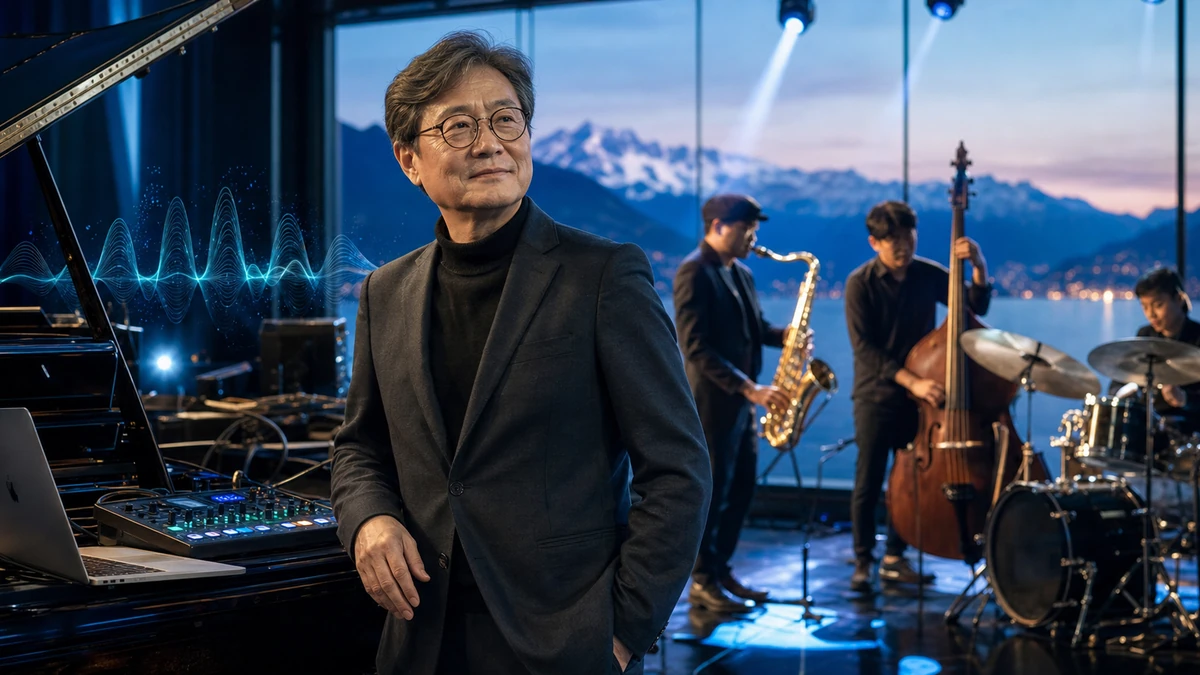
From Seoul’s Cultural Bureaucracy to an AI Jazz Stage in Switzerland
For many Americans, news about South Korean music tends to arrive through a familiar pipeline: a K-pop chart milestone, a sold-out stadium tour, a breakout Netflix drama soundtrack, or maybe an Oscar-winning filmmaker who pushes Korean culture into the U.S. mainstream. This story comes from a different corner of that cultural universe. It is not about an idol group, a streaming hit or a talent show sensation. It is about a retired South Korean government official, a lifelong music obsessive, and a jazz composition made with artificial intelligence that has landed in the semifinals of a global AI jazz competition in Montreux, Switzerland.
The composer is Yong Ho-seong, a former first vice minister at South Korea’s Ministry of Culture, Sports and Tourism, one of the country’s most influential cultural policymaking bodies. According to South Korean media reports citing Yonhap News Agency, a song he created using music-generation AI, titled “Frozen Edge,” has been selected as one of 15 semifinalists in “AI Love Jazz,” a global contest being held in Montreux. The semifinal round is scheduled for July 9 and 10 local time.
On its face, that may sound like a niche item in the growing avalanche of AI-and-the-arts headlines. But in South Korea, where cultural production is not only a creative field but also a major export industry and a point of national identity, the story carries unusual symbolism. Yong is not a newcomer chasing virality. He spent more than three decades inside the state machinery that helped shape modern Korean cultural policy. Now, after retiring from public office, he is stepping into the role of creator himself, using the very kind of technology that is increasingly reshaping music, education and entertainment.
That transition — from senior policymaker to experimental AI music-maker — is what makes the news notable. It suggests that the changes brought on by generative AI are not confined to Silicon Valley engineers, startup founders or bedroom producers. They are reaching deep into the institutions that once regulated, funded and promoted culture from above. In South Korea, where government, entertainment and technology often intersect more visibly than they do in the United States, that shift may be especially telling.
Just as important, the accomplishment should not be overstated. “Frozen Edge” has not won the competition. The confirmed fact is that it has advanced to the semifinal round. But even without a trophy, Yong’s appearance in an international AI music contest broadens the conversation around Korean cultural influence. It is a reminder that the Korean Wave — known globally by the Korean term “Hallyu,” meaning the global spread of South Korean popular culture — is no longer just about polished idol groups and prestige television dramas. It is also about experiments at the intersection of art, policy, literature and technology.
Why Montreux Matters, Even Outside the Main Festival
The location matters here. Montreux is not just another picturesque European town hosting a tech-minded arts event. For music fans, it is a place loaded with jazz history. The Montreux Jazz Festival, founded in 1967 on the shores of Lake Geneva, has long carried a near-mythic status, something like Newport or Monterey in the American imagination — a destination whose name alone signals seriousness, legacy and international prestige. Over the decades, it has hosted icons from Ella Fitzgerald and Nina Simone to Miles Davis, Prince and David Bowie.
The AI competition in question is described as a separate event timed to coincide with the Montreux festival period, not an official part of the main festival lineup. That distinction is important. It would be misleading to present the contest as though a former South Korean vice minister were suddenly headlining one of the world’s top jazz festivals. Still, the symbolism of Montreux remains powerful. To stage an AI jazz contest there is to place machine-assisted creativity in one of the genre’s most tradition-soaked settings.
That creates an almost deliberate tension. Jazz, for many listeners, is one of the most human of musical forms — rooted in improvisation, touch, timing, phrasing and conversation between players. It is a music built as much on what cannot be fully notated as on what can. AI, by contrast, is frequently described in the language of data, modeling, automation and prediction. Put those two together in Montreux, and the result is not just a contest but a cultural provocation: Can a genre so associated with spontaneity and personality make room for algorithmic assistance without losing its soul?
That question is not unique to Korea or Switzerland. American musicians, record labels, software companies and copyright lawyers are wrestling with the same issue. But Yong’s presence in the semifinal field is notable because it places a Korean entrant — and an unusually high-profile one at that — inside an early global experiment in defining what AI music performance might look like in public. In a media landscape where South Korean music stories abroad are often reduced to K-pop metrics, this is a reminder that Korean participation in global music culture also includes jazz, literary adaptation and technological experimentation.
It also underscores a broader trend: The most interesting AI arts stories are often not about fully automated replacement, but about hybrid forms of authorship. In those cases, the artist is not erased by the software. Instead, the software becomes part of the artist’s process — something between an instrument, a compositional assistant and a provocation. That seems to be the frame through which Yong’s work is being understood in South Korea.
A Career Civil Servant With a Deep Music Life
Yong’s biography is central to why this story has resonated. He is 59 and belongs to a generation of elite South Korean civil servants who came of age in a system where the national bureaucracy played a major role in the country’s rapid modernization. He passed South Korea’s highly competitive state civil service exam in 1991 and joined the culture ministry in 1993, when it was still known by an earlier name. He remained in public service for more than 30 years, retiring last year after serving as first vice minister, a senior leadership role roughly comparable to a deputy-level cabinet post beneath the minister.
For American readers, the Ministry of Culture, Sports and Tourism may require some explanation. Unlike in the United States, where arts policy is often more diffuse and fragmented, South Korea’s culture ministry sits at the center of government efforts related to arts funding, content industries, tourism promotion, sports and aspects of media strategy. It has been deeply involved in the policy ecosystem that supported the rise of the Korean Wave, including sectors such as film, television, music, gaming and cultural exports.
So when someone with Yong’s résumé begins composing with AI after retirement, it reads as more than a retirement hobby. It looks like a person who spent decades overseeing the institutional side of culture now testing the tools reshaping culture from the inside. That alone would make for an intriguing second act. But reports in South Korea suggest the move is not as abrupt as it might seem.
Yong has long been known as a serious music enthusiast. He reportedly plays drums, has worked as a music critic and has amassed a collection of more than 10,000 records. In other words, the through-line here is not that a bureaucrat suddenly discovered melody after leaving office. It is that a lifelong music devotee, who happened to spend his working life in government, is finally devoting more energy to making music himself.
That distinction matters because it makes his AI experiment feel less gimmicky and more grounded. In the United States, public skepticism around AI-generated art often centers on the idea that software allows people with little artistic investment to flood the field with imitation. Yong’s story suggests a different model: a deeply invested listener and cultural insider using AI as a new tool in a long-standing artistic life. Whether one finds the results compelling is another matter. But the seriousness of the attempt is harder to dismiss.
From SM’s Educational Orbit to an International Semifinal
After retiring in August 2023, Yong did not simply begin prompting software at home in isolation. According to Korean reports, he completed an AI composition course at SM Universe, an educational institution affiliated with SM Entertainment. For audiences outside Korea, SM Entertainment is one of the foundational companies of the K-pop industry — a major agency and production powerhouse that helped shape the idol system and produce stars known across Asia, the United States and Europe.
That detail opens another window into how South Korea’s entertainment industry is evolving. In the American pop imagination, a company like SM is usually associated with trainee systems, hit songs, synchronized choreography and highly managed celebrity branding. But the existence of AI-related educational programs linked to that ecosystem hints at a broader industry infrastructure — one that includes not just artists and executives, but training pipelines where creativity and technology increasingly overlap.
Yong’s path reflects that overlap. Instead of staying in the policy world and merely commenting on AI’s influence, he appears to have entered a learning environment connected to one of Korea’s most recognizable entertainment brands, studied the tools, and then applied them to his own work. In that sense, his story is also about education. It suggests that AI music in Korea is being approached not only as software to consume, but as a skill set to study, refine and potentially professionalize.
That may resonate with Americans who have watched art schools, business schools and tech programs increasingly blur their boundaries. Just as universities in the United States now offer courses that combine storytelling with coding, or music production with machine learning, South Korea appears to be developing its own educational pathways for creators navigating the next phase of entertainment technology. Yong’s current teaching roles — at graduate programs in art, business and technology management — reinforce that picture. He is reportedly teaching at Chung-Ang University, Hanyang University and Sogang University, spanning disciplines that suggest a career now situated at the junction of culture, industry and innovation.
In practical terms, that means AI composition is not just a novelty in this case. It sits within a wider conversation about how future cultural workers are trained. In South Korea, where entertainment is a strategic industry as well as an art form, that conversation may carry particular weight.
Shakespeare, Sonnets and a Persona Called Dr. Dragon
“Frozen Edge” is not a standalone curiosity. It is part of a larger project that may be the most unexpected element of the entire story. Yong has said he is working under the stage name “Dr. Dragon” to reinterpret all 154 of Shakespeare’s sonnets as songs. He has reportedly completed more than 50 tracks so far, with “Frozen Edge” among them.
That premise alone sounds like the kind of cross-disciplinary concept that would spark interest in both literary and music circles: a retired Korean culture official using AI to transform Shakespearean sonnets into songs, one of which advances in a jazz competition in Switzerland. It is globalized culture in a particularly 21st-century key — English Renaissance poetry, Korean cultural administration, AI-assisted composition and an international jazz setting colliding in a single creative project.
For American and other English-speaking readers, Shakespeare requires little introduction, but the sonnet form may be worth briefly revisiting. A sonnet is a tightly structured 14-line poem, often associated with formal meter, rhyme and concentrated emotional argument. Shakespeare’s sonnets, which have been studied in English classrooms for generations, move through themes of love, desire, time, beauty, jealousy and mortality. To rework them into songs is hardly unprecedented. Composers have long adapted canonical texts. What is distinctive here is the use of music-generation AI as part of the process and the choice to build a large-scale serialized project around it.
The available reporting does not provide detailed information about the sound of “Frozen Edge” — its arrangement, lyrics, tempo or vocal treatment — nor does it spell out precisely how the AI tool was used in the compositional chain. That is an important limit. Without hearing the track or seeing the workflow, it would be premature to make sweeping claims about artistic method. But the conceptual frame is clear enough to be meaningful. This is not just an effort to generate random tracks with a novelty premise. It is an organized body of work anchored in a recognizable literary canon.
There is something culturally revealing in that choice. Korea’s global culture story is often told in terms of speed, trend cycles and digital virality. Yong’s Shakespeare project points in another direction: toward a slower, more archival and more literary form of experimentation. It suggests that AI in music need not always be about making the next earworm. It can also be used to revisit inherited texts, test new interpretive frameworks and ask what happens when old language meets new machinery.
That does not settle the debate over authorship, of course. If a human selects the text, defines the concept, shapes the prompts, curates outputs and refines arrangements, who is the composer? If AI proposes melodies or harmonic structures, is it functioning like an instrument, a collaborator or a statistical engine masquerading as creativity? Those questions remain unresolved globally, and Yong’s project does not answer them. But it does place them in a concrete, culturally rich setting rather than an abstract policy paper.
What This Says About Korea’s Next Cultural Chapter
South Korea’s cultural rise over the past two decades has often been narrated through blockbuster success: BTS topping U.S. charts, “Parasite” winning the Academy Award for best picture, “Squid Game” becoming a global streaming phenomenon. Those milestones are real and significant. But they can also flatten the country’s creative ecosystem into a handful of export categories. Stories like Yong’s complicate that picture in productive ways.
They show that Korea’s cultural scene is not only broad but increasingly layered. The same national ecosystem that produces idol trainees and streaming dramas also includes veteran policy officials, graduate classrooms, AI composition programs, literary adaptation projects and experimental jazz contests in Europe. That mix may not command the same scale of fandom as K-pop, but it reflects a more mature and diversified creative environment.
It also highlights how South Korea tends to metabolize technology quickly. This is a country with world-class digital infrastructure, a highly connected consumer base and a history of rapidly incorporating new tools into everyday life and cultural production. In entertainment, that has already meant sophisticated use of social media, virtual performance formats, fandom platforms and data-informed marketing. AI music may be a more controversial frontier, but it fits a broader pattern in which Korean creators and institutions do not wait long to engage with emerging technologies.
At the same time, Korea’s embrace of technology has rarely been purely technocratic. It is often filtered through systems of education, branding, training and state-supported cultural strategy. Yong’s story sits at the center of that pattern. He embodies several worlds at once: government insider, educator, music collector, critic and now creator. His semifinal placement in Switzerland will not, by itself, define the future of AI music. But it does illustrate the kind of hybrid figure who may become more visible in the next era of global entertainment — someone fluent not only in art, but also in policy, institutions and technical change.
For Americans trying to understand where the Korean Wave goes from here, that may be the bigger takeaway. The next chapter may not be only louder, glossier or more internationally dominant. It may also be weirder, more interdisciplinary and more deeply shaped by questions the United States is confronting too: how to educate creators in the age of generative AI, how to preserve human artistry while using machine tools, and how to decide what counts as authorship when culture is increasingly made through collaboration between people and software.
A Small Event With Outsized Symbolism
There is always a temptation, especially in global culture coverage, to inflate any cross-border milestone into a grand turning point. This story does not need that kind of hype. “Frozen Edge” is one of 15 semifinalists in a new AI jazz contest, not a chart-topping smash or a major institutional prizewinner. The available facts remain limited, and the final competition outcome has not been established. Caution is warranted.
Still, modest events can carry outsized symbolic weight when they reveal a deeper shift. In this case, the shift is visible in the arc of one person’s career. A man who spent more than 30 years helping administer South Korea’s cultural apparatus has, in retirement, placed himself on the creative side of a rapidly changing debate. He studied AI composition, built a substantial literary music project, and brought one of those tracks into an international contest set in a city synonymous with jazz history.
That image alone says something about the present moment. It suggests that generative AI is no longer a peripheral subject for the arts. It is becoming part of the vocabulary through which cultural veterans, institutions and emerging creators test their relevance. It also suggests that Korea’s cultural story is entering a more complicated phase — one where the boundaries between policymaker and artist, educator and experimenter, local industry and global cultural dialogue are becoming more porous.
For English-speaking readers, especially those whose mental map of Korean music begins and ends with K-pop, Yong’s semifinal run offers a useful corrective. South Korea’s creative landscape is larger, stranger and more intellectually varied than the export headlines often imply. There is room in that landscape for idol juggernauts and Shakespeare projects, for stadium pop and AI jazz, for entertainment conglomerates and retired vice ministers with 10,000 records and a new digital toolkit.
Whether “Frozen Edge” advances further in Montreux remains to be seen. But even at the semifinal stage, the song has already done something noteworthy. It has opened a small but revealing window onto the next evolution of Korean culture — one where technology is not just optimizing distribution or amplifying fandom, but entering the creative process itself, and where some of the people exploring that shift are not disruptors from outside the system, but veterans who helped build the system in the first place.
Comments
Post a Comment