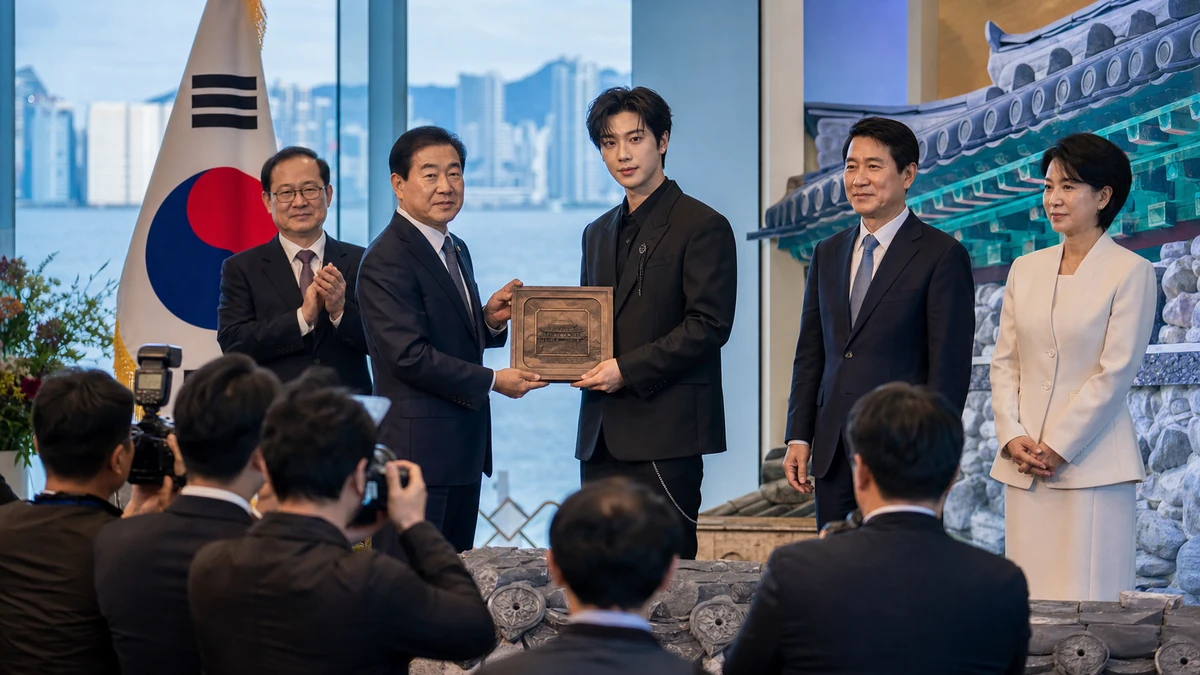
A K-pop icon steps onto a different kind of stage
G-Dragon, one of the most recognizable figures in South Korean pop culture, has been appointed promotional ambassador for the 48th session of the UNESCO World Heritage Committee, a major international gathering set to take place this month in the southern port city of Busan. The announcement, made by South Korea’s Cultural Heritage Administration, places the artist born Kwon Ji-yong in a role that has less to do with album releases or arena concerts and more to do with cultural diplomacy, public messaging and the preservation of sites considered important to all of humanity.
For readers in the United States, the move may sound unusual at first: Why would a pop star known for fashion, swagger and chart-topping music be tapped to help represent a meeting about cultural heritage? But in South Korea, where popular culture has become one of the country’s most effective forms of soft power, the decision is easier to understand. K-pop stars are no longer seen only as entertainers. They are often treated as global cultural messengers whose influence stretches into fashion, philanthropy, politics and national branding.
In that sense, G-Dragon’s appointment says as much about the evolution of South Korea’s cultural strategy as it does about the artist himself. It reflects a country that has learned to leverage the enormous reach of its entertainment industry to draw attention to broader public causes. Just as the Olympics routinely recruit superstar athletes to embody national aspirations, South Korea is using one of its best-known music figures to help spotlight an event that might otherwise remain largely confined to diplomats, historians, archaeologists and policy specialists.
The UNESCO World Heritage Committee is the body that reviews issues tied to the protection and management of the world’s most significant cultural and natural sites. Think of landmarks such as the Grand Canyon, the Acropolis, the Pyramids of Giza or Independence Hall in Philadelphia. These places are not simply tourist attractions. They are treated as part of a shared human inheritance. South Korea’s decision to hand part of that message to a K-pop star underscores just how expansive the Korean Wave — often called Hallyu — has become.
And it signals something else as well: K-pop’s power is no longer limited to getting fans to stream a song, buy concert tickets or wear a brand. It can also be used to guide public attention toward institutions and values that might otherwise feel distant from everyday pop culture.
Why this UNESCO meeting matters in South Korea
This year’s World Heritage Committee session carries special significance in South Korea because it is the first time the country has hosted the gathering. That matters symbolically. South Korea has spent decades transforming its international image, evolving in the American imagination from a war-torn nation and manufacturing hub into a democracy with major global influence in technology, film, television, beauty, cuisine and music. Hosting the UNESCO meeting allows Seoul to showcase another part of that identity: its role as a steward of culture and history.
The host city, Busan, is also a meaningful choice. Americans who know South Korea often picture Seoul first, but Busan is central to the country’s story. It is South Korea’s second-largest city, a major port and a place that blends commerce, film, tourism and history. During the Korean War, Busan served as a critical refuge and wartime stronghold. Today it is known internationally for the Busan International Film Festival, beaches, seafood markets and a cosmopolitan energy that distinguishes it from the capital. Holding the UNESCO committee session there lets South Korea present itself not only through its political center but through a city associated with international exchange.
For South Korean officials, the event is about more than logistics. It is a chance to emphasize the country’s cultural heritage on a global stage. South Korea is home to UNESCO-listed sites ranging from royal tombs and Buddhist temples to historic villages and archaeological areas. But heritage diplomacy can be difficult to popularize. It lacks the instant, built-in audience of a hit drama on Netflix or a stadium-filling music act. That is where celebrity enters the picture.
By appointing G-Dragon, officials are effectively trying to bridge two worlds: the specialized realm of international heritage policy and the mass global audience that follows Korean entertainment. It is a strategy familiar to anyone who has watched public institutions enlist stars to humanize their mission. In the United States, it is common for actors, athletes or musicians to partner with campaigns on voting, climate or public health. South Korea is doing something similar, but with a distinctly Korean asset: the transnational pull of K-pop fandom.
That symbolism becomes even stronger because this is not just any celebrity. G-Dragon is one of the defining figures of modern K-pop, a performer whose name still carries weight across Asia, North America and Europe. His presence instantly broadens the meeting’s visibility beyond policy circles and into the highly networked digital ecosystems where fan communities share, translate and amplify news in real time.
Why G-Dragon is more than just another celebrity choice
To American readers who may know BTS or Blackpink more readily than BigBang, it is worth explaining G-Dragon’s place in Korean pop history. He emerged as a central member of BigBang, one of the acts that helped lay the foundation for K-pop’s global expansion before the genre became a full-fledged mainstream force in the United States. If BTS helped break down the front door of the American music market, artists like G-Dragon helped build the house that made that breakthrough possible.
He has long been seen as more than an idol in the narrow sense of the term. In South Korea, the word “idol” refers to a pop performer produced through the country’s highly organized entertainment industry, often involving years of training in singing, dancing, media skills and foreign languages. But G-Dragon carved out an identity that blurred the lines between idol, songwriter, producer, fashion figure and cultural tastemaker. His influence has extended into luxury branding, street style and contemporary art in ways that set him apart even in a crowded field.
That broader reputation appears to be central to why he was chosen. South Korea’s Cultural Heritage Administration described him as an artist whose influence reaches beyond K-pop into the wider world of culture and the arts. In other words, the government was not simply picking a famous face. It was choosing someone whose image carries a certain artistic credibility and whose public persona suggests creative range rather than pure commercial appeal.
That distinction matters because world heritage is not entertainment, and any attempt to connect the two runs the risk of feeling gimmicky. Selecting a figure known for experimentation, visual identity and cross-disciplinary influence may help reduce that risk. G-Dragon’s brand has often been associated with reinvention and symbolism, traits that can translate more naturally into a campaign about memory, legacy and cultural value than a standard celebrity endorsement might.
His appointment also reflects a reality that entertainment executives and government officials in Seoul both understand well: fandom today is not passive. Fans do not just consume content; they circulate narratives. They subtitle videos, explain context, build communities and connect an artist’s activities to wider conversations about identity and values. A single announcement involving a star like G-Dragon can travel globally in hours, reaching audiences that would never otherwise read a UNESCO agenda.
The meeting point between K-pop and cultural diplomacy
If this development feels like an expansion of K-pop’s job description, that is because it is. Over the past decade, South Korean popular culture has become one of the country’s most effective diplomatic assets. Governments around the world have long recognized the value of soft power — the ability to shape perceptions and relationships through attraction rather than coercion. The United States has Hollywood, pop music and Silicon Valley mythology. Britain has the monarchy, the BBC and Premier League soccer. South Korea has increasingly turned to K-pop, television dramas, film, food and beauty culture as its most persuasive international calling cards.
What makes this case especially striking is that it links pop influence to a very specific public-good message: the preservation and sharing of cultural heritage. That is a step beyond simple nation branding. It suggests that the government sees K-pop not just as a lucrative export, but as a platform that can make complex global issues more accessible.
There is a practical logic to that. The World Heritage Committee can sound remote or bureaucratic to the average person, especially younger audiences. Even the phrase “world heritage” may evoke postcards and school textbooks more than urgent civic relevance. But attach that concept to an artist with an enormous global fan base, and the subject becomes easier to enter. Fans may start by asking why G-Dragon is involved. In the process, they may also learn what the committee does, why heritage sites become endangered, and why international cooperation matters.
That kind of translation — not linguistic translation, but cultural translation — is one of the central functions of modern celebrity diplomacy. The star helps convert an abstract issue into a story people are willing to click on, discuss and remember. In the Korean context, where fans often follow not only a performer’s releases but also their charitable, artistic and social activities, the fit can be especially effective.
There is also a broader message here about South Korea’s self-presentation to the world. For years, the country’s rise in soft power has been described largely through the language of exports: hit songs, prestige television, Oscar-winning cinema, skincare products and smartphone technology. This appointment suggests a more layered image. South Korea is not only selling culture; it is also positioning itself as a guardian and interpreter of culture, capable of convening international conversations about what humanity preserves and why.
The significance of G-Dragon’s peace-centered public image
Another reason this appointment stands out is the way officials framed it. Alongside his artistic reach, South Korea’s heritage authorities pointed to G-Dragon’s efforts to support public-interest culture and social causes through art. That includes his involvement with the Just Peace Foundation, a nonprofit initiative he established after donating royalties in 2024. The foundation’s name combines the ideas of justice and peace, giving his public profile an explicitly civic dimension.
That detail is not incidental. UNESCO’s work is rooted in the idea that education, science and culture contribute to peace. Heritage preservation is not simply about protecting old buildings or scenic landscapes. It is about safeguarding the record of human civilization, strengthening mutual understanding and resisting the erasure that can come through war, neglect, development pressure or political conflict. By highlighting G-Dragon’s association with peace and public service, South Korean officials are linking his personal brand to UNESCO’s institutional values.
In the American context, celebrity philanthropy can sometimes be met with skepticism, especially when it appears heavily managed or disconnected from substantive work. That skepticism exists in South Korea, too. But in this case, the messaging appears designed to show that the appointment is not merely about fame for fame’s sake. It is meant to suggest a continuity between the artist’s public commitments and the broader theme of collective stewardship.
There is also an important cultural point here. In South Korea, public figures are often expected to embody a social role that extends beyond their profession. That expectation can be intense and sometimes unforgiving. When an entertainer is chosen for a formal ambassador position, the selection usually carries an implied argument about character, influence and representational suitability, not just popularity. Officials are effectively saying the person can stand in, however symbolically, for a set of national or public values.
Whether that symbolism resonates widely will depend on how the role is ultimately used. The announcement does not indicate that G-Dragon will stage a concert or headline a separate entertainment event tied to the committee. The core fact is simpler: he has been named the promotional face of the session in Busan. But even without a performance, the symbolism is potent. It places one of Korea’s most recognizable cultural figures in conversation with ideas of preservation, peace and global public responsibility.
What this says about the next phase of the Korean Wave
The bigger story may be what this moment reveals about the Korean Wave itself. For years, Hallyu was often discussed in market terms: chart rankings, streaming numbers, export revenue, sold-out tours and brand partnerships. Those metrics still matter. But the ecosystem has matured. Korean cultural influence is now robust enough that it can be deployed in support of institutions and causes that sit outside entertainment.
That shift mirrors the way American pop culture has sometimes functioned as a vehicle for public meaning. When a major U.S. celebrity takes up a campaign around AIDS awareness, voting rights or disaster relief, the celebrity is not replacing the issue but helping widen the audience for it. South Korea is now operating at a comparable level of cultural confidence. Its stars can help explain the country to the world, and they can also help explain the world to their fans.
For global audiences, this appointment may become a new entry point into Korean culture. Someone who knows G-Dragon only as a fashion-forward K-pop figure may suddenly encounter Busan, UNESCO and the concept of world heritage in the same news cycle. Someone interested in heritage preservation may, in turn, get a glimpse of how Korea’s entertainment industry shapes public life. That convergence is part of what makes this story notable.
It also points to a future in which K-pop’s influence is measured less narrowly. The old benchmark was whether a Korean song could climb the Billboard charts. The newer benchmark may be whether Korean artists can shape conversations that have nothing to do with music at all. On that front, G-Dragon’s appointment is significant. It suggests that the star power built through pop performance can be redirected toward a broader cultural mission.
None of this means celebrity alone can solve the hard problems surrounding heritage protection. UNESCO meetings still depend on governments, experts, funding, diplomacy and legal frameworks. But public attention matters, too. Heritage can be fragile not only because sites decay or face political threats, but because many people simply do not think about it until it is already in danger. If a globally known artist can help move that issue a little closer to public consciousness, officials clearly believe the partnership is worth making.
For South Korea, the image is hard to miss: a country once primarily known abroad through war history and industrial growth is now hosting one of the world’s premier heritage forums and promoting it through one of pop culture’s most recognizable names. That is not just a celebrity news item. It is a snapshot of modern Korea’s place in the world.
At the center of that snapshot is G-Dragon, no longer appearing only as a performer on stage, but as a cultural intermediary — someone asked to help carry a message about shared history, global memory and the value of preserving what belongs, in principle, to everyone. For fans, it is another chapter in an already unusual career. For South Korea, it is evidence that its biggest stars now serve as ambassadors not just of entertainment, but of public values with international reach.
Comments
Post a Comment