Off Jeju Island, a Medical Emergency at Sea Highlights the Hidden Risks for Migrant Crews in Korean Waters
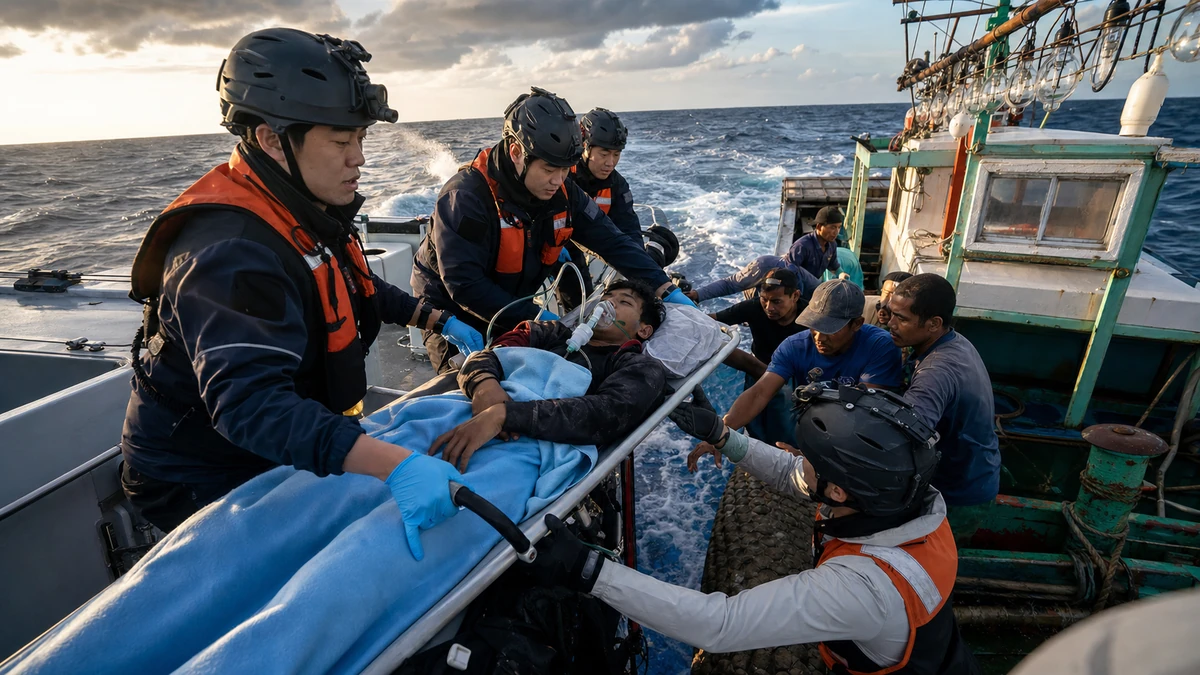
A medical crisis far from shore
A young Indonesian fisherman suffered seizure-like symptoms and unstable breathing while working aboard a South Korean fishing vessel in waters far southeast of Jeju Island, setting off a long and complex emergency transfer that underscores how fragile medical care can be on the open sea.
According to South Korea’s coast guard in Seogwipo, the emergency call came in at about 2:22 p.m. on April 2 from a fishing boat operating in the Korea-Japan intermediate zone, a disputed or jointly managed stretch of sea where fishing activity takes place far from the kind of immediate help available on land. The vessel was reported to be about 213 kilometers, or roughly 132 miles, southeast of Seogwipo — a reminder that even in a country with advanced infrastructure, distance can turn a medical episode into an all-day rescue operation.
The crew member, identified only by surname or initial under common South Korean police practice, was a man in his 20s from Indonesia. Officials said he began showing signs of convulsions and had unstable breathing while the crew was out fishing. Those are symptoms that can signal a range of serious conditions, from a seizure disorder to head trauma, infection, poisoning or another acute neurological event. On land, a patient with those symptoms would likely be rushed by ambulance to an emergency room within minutes. At sea, there is no ambulance, no nearby hospital and often no medically trained professional beyond basic first aid.
The case ended with the sailor being brought into Seogwipo Port at 11:55 p.m. and then taken to a local hospital. But the nearly 10-hour gap between the initial report and arrival in port tells the real story. In remote maritime work, survival often depends not just on whether rescuers respond, but on whether the system can preserve a patient’s condition long enough to reach definitive care.
For readers in the United States, the closest analogy may be a medical emergency on an offshore oil platform in the Gulf of Mexico or on an Alaskan crab boat hundreds of miles from the nearest trauma center. The underlying problem is the same: a dangerous workplace, limited medical equipment, long transit times and a workforce that often includes migrants doing some of the hardest labor in the industry.
How the rescue unfolded
South Korean authorities said the rescue was carried out in stages, with multiple government agencies involved. That detail matters because it shows how maritime medicine works in practice: whoever can reach the patient first begins the transfer, and another vessel with better equipment or greater range may take over later.
In this case, the South Sea Fisheries Management Service dispatched a vessel called Mugunghwa 18 to retrieve the patient from the fishing boat. While the initial pickup was underway, the patient was later transferred again to a 3,000-ton coast guard patrol ship operated by the Seogwipo Coast Guard, which was better suited for emergency treatment and a longer voyage back to shore.
Officials said the coast guard monitored the sailor’s condition using a maritime telemedicine emergency system during the trip. In plain terms, that means the patrol ship used communications equipment to connect with medical professionals on land, allowing responders to relay vital signs and symptoms and receive guidance while still at sea. It is not the same as having a doctor physically on board, but it can help bridge the gap when a patient is hours from a hospital.
That kind of remote medical support has become increasingly important in maritime nations such as South Korea, Japan and Norway, where commercial fishing, shipping and offshore labor routinely take people far beyond quick access to emergency rooms. Americans may be familiar with telehealth as a pandemic-era tool for video doctor visits from home. At sea, it serves a different, more urgent role: making it possible for medics or officers on a vessel to stabilize someone whose condition could deteriorate before landfall.
The South Korean coast guard did not release a detailed medical update on the sailor’s condition after he reached the hospital. But the agency’s account makes clear that responders treated the situation as a potentially life-threatening event from the beginning. Seizure symptoms coupled with irregular breathing can quickly become fatal if a patient loses consciousness, aspirates, stops breathing normally or experiences another underlying complication.
Why offshore medical emergencies are uniquely dangerous
What makes this case especially striking is not only the symptoms involved, but the location. The waters southeast of Jeju are busy fishing grounds, yet they are still remote enough that even a well-coordinated rescue can consume most of a day. That is the central reality of maritime emergency medicine: time moves differently when every mile must be crossed by ship.
On land, emergency care is built around speed. In many American cities and suburbs, paramedics can arrive in less than 10 minutes and transport a patient to a hospital soon after. Even in rural areas, helicopters may be available. At sea, weather, vessel speed, sea conditions and the exact position of nearby government ships all shape the outcome. A crew might have to keep a patient stable for hours while still contending with waves, cramped quarters and limited supplies.
Seizures are particularly challenging in such conditions. A seizure can end on its own, but repeated episodes, prolonged unconsciousness or breathing problems require urgent evaluation. Someone convulsing on a moving vessel is at risk of head injury, airway obstruction and falls. If the episode is caused by a stroke, infection or toxic exposure, delays in care can be even more consequential. Crewmates, who are not doctors, may have only a partial understanding of what they are seeing. Their immediate job becomes basic but critical: protect the patient from injury, watch breathing, report symptoms clearly and summon help without delay.
That is why officials and safety experts often stress that emergency response starts with communication. The most useful information in a remote rescue is often simple: when the symptoms began, whether the person is conscious, whether breathing is normal, whether there were repeated seizures, whether the patient has known medical conditions and what first aid has already been given. Those details can shape how rescue authorities deploy ships, whether they seek telemedical guidance and what hospital care is prepared on arrival.
The lengthy timeline in this rescue also illustrates another basic truth: offshore emergencies are not defined solely by how quickly someone can get to a hospital. They are equally defined by how well responders can manage the patient before arrival. That is where telemedicine, trained crews, rescue coordination and vessel-to-vessel transfers become the maritime equivalent of an emergency department waiting to begin treatment.
The overlooked role of migrant workers in South Korea’s fishing industry
The patient in this case was not South Korean. He was an Indonesian deckhand, part of a large and often overlooked migrant labor force that helps keep South Korea’s fishing industry running.
That fact broadens the significance of the rescue beyond one medical event. It also draws attention to who works on these boats, under what conditions and how fully they are protected when something goes wrong.
South Korea, like several other aging industrialized countries in East Asia, relies on foreign labor in sectors where domestic workers are increasingly scarce. Commercial fishing is one of them. The work is physically punishing, dangerous and often unattractive to younger citizens seeking more stable jobs on land. As a result, crews on South Korean vessels commonly include workers from Indonesia, Vietnam, the Philippines and other Southeast Asian nations.
For American readers, the dynamic is not entirely unfamiliar. In the United States, migrant labor is deeply embedded in agriculture, meatpacking, caregiving, construction and parts of the seafood industry. These workers are essential, yet their visibility in public debate tends to rise only when there is a tragedy, a labor dispute or an immigration controversy. South Korea’s fishing fleet presents a similar tension: foreign crew members are indispensable, but their working conditions and access to rights can remain secondary until an emergency throws them into view.
Human rights groups and labor advocates have for years raised concerns about conditions for migrant fishers in Asian waters, including long hours, isolation, language barriers, limited access to medical care and, in some cases, allegations of abuse or exploitative contracts. None of those broader issues is required to explain this specific rescue. But they form the backdrop. When a worker falls seriously ill in the middle of the sea, the question is not only whether the rescue system functions, but whether the worker was operating within a labor system designed to protect health in the first place.
This is why the nationality of the patient matters. In principle, rescue at sea does not depend on citizenship. A distress call is a distress call. The sea is one of the few domains where the moral and legal expectation of aid is especially strong. Yet in practice, migrant workers may face additional vulnerabilities before and after the emergency: communication difficulties during treatment, lack of family nearby, uncertainty about insurance or compensation, and reduced power to advocate for themselves if employment conditions contributed to the incident.
South Korean authorities have not indicated that any labor violation was involved in this case. Still, the event serves as a reminder that worker safety in the fishing industry includes more than avoiding collisions or sinkings. It also includes health monitoring, emergency protocols and equal access to care for foreign crew members who do the same dangerous work as everyone else on board.
Jeju’s strategic waters and South Korea’s maritime safety system
The rescue took place in a part of the sea that is geopolitically and economically important. Jeju Island, often marketed abroad as South Korea’s scenic vacation destination, is also a strategic maritime hub. It sits south of the Korean Peninsula near key shipping lanes and productive fishing grounds. Waters around Jeju connect local livelihoods, national food supply chains and broader regional tensions involving fishing rights and maritime jurisdiction.
The Korea-Japan intermediate zone, where this emergency occurred, is an area created to manage overlapping maritime claims and fishing activity between the two U.S. allies. For most readers, that phrase may sound technical, but the practical meaning is simple: it is a zone where fishermen work in waters that are politically sensitive and physically distant. That makes effective rescue coordination especially important.
South Korea’s coast guard plays a role that goes beyond dramatic search-and-rescue missions after shipwrecks. It also functions as a frontline public safety agency for routine but high-stakes incidents, including onboard injuries, sudden illness, missing persons and distress calls from commercial crews. This case illustrates that broader role. The response was not about a sinking vessel or a storm-tossed evacuation. It was about turning a patrol and fisheries enforcement network into a floating emergency medical chain.
In recent years, South Korea has invested heavily in public safety systems, in part because of national trauma over past disasters and a heightened public expectation that the state respond quickly and visibly in crises. Maritime response remains an especially sensitive area in Korean public life. Against that backdrop, even an individual offshore medical transfer carries broader symbolic weight. It shows whether the system can operate not only during mass-casualty emergencies, but also in the quieter, less visible moments when a single worker’s life hangs in the balance.
What stands out here is the coordination itself: a fisheries vessel first reaching the patient, a coast guard patrol ship taking over, telemedicine guiding care during transport, and a handoff to a hospital after arrival in port. It is the kind of layered system that many coastal nations aim for, but one that only proves its value when it works under real-world pressure.
What this case says about health, labor and rescue at sea
There is a temptation to treat maritime rescue stories as niche local news — dramatic perhaps, but distant from everyday life. That would miss the larger point. This incident is about the intersection of emergency medicine, labor migration and state responsibility in one of the most demanding work environments on earth.
First, it is a reminder that health care does not begin at the hospital door. In remote settings, whether at sea, on a farm, in a mine or on a construction site far from urban centers, medical outcomes often hinge on how quickly symptoms are recognized and how well the chain of response functions before a doctor ever sees the patient. The seizure-like episode suffered by this crew member could have become another invisible offshore fatality if crewmates had delayed reporting it or if rescue assets had not been available.
Second, it highlights how migrant workers are woven into national infrastructure in ways consumers rarely see. The global seafood supply chain that brings fish to dinner tables in Seoul, Los Angeles or New York depends on labor performed in risky, isolated conditions. When one of those workers collapses, the event is not simply a private medical matter. It becomes part of a larger question about what protections societies extend to the people whose labor sustains key industries.
Third, the rescue offers a practical public health lesson. Symptoms like convulsions, breathing instability and sudden changes in consciousness are emergencies. In remote environments, that means activating help early rather than waiting to see if a person improves. The same principle applies far beyond fishing boats. Hikers in the backcountry, truckers on long-haul routes, offshore workers and crews on commercial vessels all depend on early reporting and accurate information sharing when severe symptoms appear.
Finally, the episode shows why maritime safety deserves more attention from international audiences. In an era of global shipping, transnational labor and climate-driven changes to weather and ocean conditions, the challenges faced by one Indonesian sailor on a Korean fishing boat are not isolated. They reflect a wider reality of how work, migration and emergency care now intersect across borders.
By late night on April 2, the rescue had done what it was meant to do: carry a critically ill worker from a distant patch of sea to a hospital bed on land. That outcome may sound straightforward in a brief official statement. In reality, it took hours of coordination, specialized vessels, remote medical support and a public rescue network prepared to treat one foreign fisherman’s emergency as a matter of urgent state responsibility.
That may be the most important takeaway. Behind the bureaucratic language of patrol ships, intermediate zones and emergency transfers is a simpler story: a young man got sick far from home, far from shore and far from immediate medical care, and a system had to move quickly enough to give him a chance. In maritime nations, that is not a side issue. It is a measure of what safety really means.
Comments
Post a Comment