Hae-ran Ryu Opens Evian Championship in Contention, Extending South Korea’s Presence at the Top of Women’s Golf
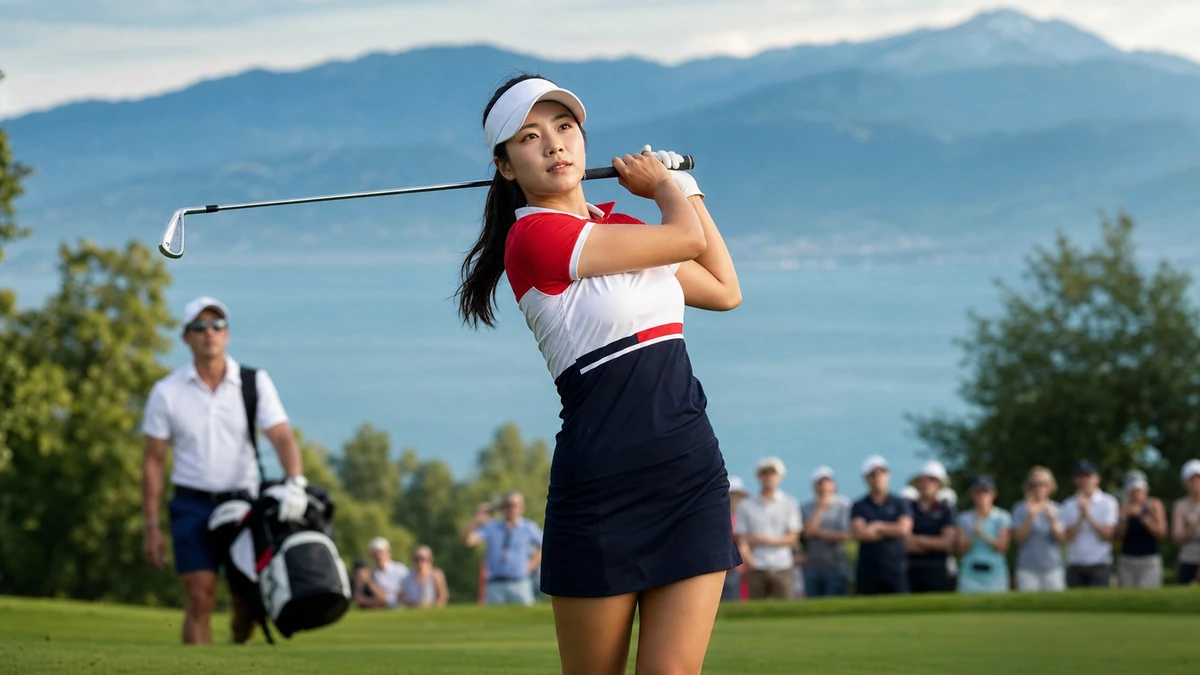
A fast start in France puts Hae-ran Ryu back in the major conversation
Just under two weeks after winning the first major championship of her career, South Korea’s Hae-ran Ryu has put herself in position to chase another one.
Ryu shot a 5-under 66 in Thursday’s opening round of the Evian Championship in Evian-les-Bains, France, leaving her tied for third and three shots behind first-round leader Akie Iwai of Japan, who posted an 8-under 63. In a sport where momentum can be difficult to hold from one week to the next — and especially from one major to the next — Ryu’s opening round carried significance beyond the numbers on the leaderboard.
For American readers who may only be starting to learn her name, Ryu is no longer simply an emerging talent from one of women’s golf’s deepest pipelines. She is now a major champion, a steady contender on the LPGA Tour, and increasingly one of the most important players in the season-long race that shapes the women’s game.
The Evian Championship, the fourth of the five annual majors in women’s golf, is one of the sport’s marquee events, with a purse of $9.1 million and a field that draws the world’s best players. Held in the resort town of Evian-les-Bains on the shores of Lake Geneva, the event combines postcard scenery with major-championship pressure. It has also become a proving ground for players trying to show that their success travels across borders, surfaces and expectations.
Ryu did that on Day 1. She made six birdies and only one bogey, a combination of controlled aggression and restraint that is often the difference between an encouraging round and a leaderboard-climbing one at a major. Starting on the back nine, she settled in quickly and built her round in stages rather than in a single burst, which may be the most telling detail of all.
This was not a chaotic scorecard built on lucky breaks. It was the kind of round that suggests a player is seeing the course clearly and managing the emotional weight that comes with being newly crowned as a major winner. In golf, that can matter as much as raw ball-striking.
Why this opening round matters more than a typical Thursday
In most tournaments, a strong first round is just that: a good start. In a major, and especially in the immediate aftermath of a breakthrough victory, it can become a referendum on whether a player has truly moved into a new tier.
Ryu arrives at Evian after winning the KPMG Women’s PGA Championship on June 29, a breakthrough that gave her the first major title of her career. Players often talk about the emotional comedown that follows a life-changing win. The media obligations multiply. Expectations shift. Competitors stop seeing a player as an outsider and begin treating her like a target.
That is why Ryu’s 66 resonated. It suggested that her major victory was not a one-week spike but part of a broader pattern. She did not look like a player still basking in a career moment. She looked like someone ready to build on it.
For American sports fans, the dynamic is familiar. Think of a young NBA star after a breakout playoff run, or a first-time Grand Slam winner in tennis returning to a big stage with the burden of proof suddenly reversed. Before the breakthrough, the question is whether the player can break through. Afterward, the question becomes whether the player can sustain it. Ryu’s start in France did not answer that question fully, but it strengthened the case that she belongs in this conversation for the long term.
There is also the rarity of the task in front of her. Winning consecutive majors is difficult in any era, but it may be especially difficult in women’s golf right now, where the depth of the field is among the strongest the LPGA has seen. Between established stars, rising Asian standouts, American contenders and European players comfortable on links-style and continental layouts, no major comes with a clear runway.
Ryu, however, has given herself something every contender wants after the first day: a realistic path. Three shots is not an insignificant deficit, but across 54 remaining holes it is manageable. The larger point is that she does not need help just to stay relevant. She is already there.
The scorecard showed both firepower and restraint
Major championships are usually remembered for dramatic putts, collapses and Sunday tension, but they are often shaped by quieter skills — patience, course management and the ability to avoid the type of mistakes that turn a 66 into a 70. Ryu’s first round had those quieter qualities.
She opened on the 10th hole and recorded her first birdie at the par-4 12th. From there, she added birdies at the par-3 14th, the par-3 16th and the par-5 18th, building early momentum without appearing reckless. On her second nine, she added another birdie at the par-4 third and finished with six birdies total against only one bogey.
That distribution matters. Birdies at a major are always valuable, but they are especially meaningful when they come across different types of holes. Par 3s test precision and nerve. Par 4s expose decision-making and approach-shot quality. Par 5s offer scoring opportunities, but only if a player chooses the right moments to attack. Ryu’s card suggested that her game was functioning across the board, not just in one narrow lane.
The lone bogey also deserves attention. At majors, one of the surest ways to disappear from contention is to compound a mistake. Players miss a green, get aggressive after a poor shot, and suddenly give away two or three strokes over a short stretch. Ryu avoided that kind of unraveling. She kept the round organized, which is often the hallmark of players who remain near the top throughout the week.
American viewers who primarily follow the biggest names in women’s golf — players like Nelly Korda, Lilia Vu or Rose Zhang — may not yet know Ryu’s style. She does not always generate the loudest headlines, but the consistency in her season has made her one of the tour’s most credible week-to-week threats. Thursday’s round fit that identity. She was efficient, composed and opportunistic.
There is a tendency in golf coverage to describe this kind of performance as “steady,” a word that can sometimes undersell what it really takes. Steady at a major is not passive. It is disciplined aggression. It is understanding when to press and when to accept par. Ryu’s 66 was steady in the best sense: controlled, intentional and difficult to poke holes in.
South Korea’s long influence on women’s golf is part of the story
Ryu’s position on the leaderboard is also part of a bigger narrative that American audiences may recognize, even if they do not always follow its origins closely. For more than two decades, South Korean women have been one of the defining forces in professional golf.
That dominance did not appear out of nowhere. South Korea built an unusually strong development pipeline through a combination of intense junior competition, elite coaching systems, corporate sponsorship and a sports culture that prizes technical discipline. In the United States, the closest comparison might be the way certain countries become identified with excellence in a particular Olympic sport, producing contender after contender even as individual names change. In women’s golf, South Korea has been that kind of powerhouse.
Players such as Se Ri Pak helped transform the sport’s geography. Pak’s success in the late 1990s and early 2000s inspired a generation of South Korean girls to see golf not as a niche pastime, but as a legitimate path to international achievement. The ripple effects reached the LPGA in waves. Inbee Park, Jiyai Shin, Na Yeon Choi, Amy Yang, Jin Young Ko and many others became fixtures at the top of the women’s game.
For American fans, Pak’s cultural importance in South Korea is sometimes compared to the trailblazing effect Yao Ming had for basketball in China or the way the Williams sisters transformed the possibilities many young Black American girls saw in tennis. The analogy is imperfect, but the core idea holds: a pioneering star broadened the imagination of what was possible, and the system that followed became remarkably productive.
Ryu now belongs to the next chapter of that story. Her rise matters not simply because she is South Korean, but because she represents how durable that pipeline remains in an era when women’s golf is more global than ever. South Korea no longer has the field to itself. American, Japanese, Thai, Australian and European players have all strengthened the competitive landscape. Yet South Korean golfers remain central to major-championship storylines, and Ryu’s performance at Evian is the latest reminder.
Another South Korean player, Kim Hyo-joo, remains high in the CME Globe standings, reinforcing the point that the country’s strength is not concentrated in a single breakout star. Ryu may be the headline entering the weekend, but she is also part of a broader national tradition of excellence that continues to shape the LPGA.
Ryu’s season suggests this is no fluke
If Thursday’s 66 had come from a player struggling for form, it might have been treated as a pleasant surprise. That is not the case here. By almost any meaningful measure, Ryu has already been one of the most reliable players on the LPGA this season.
She has played 11 LPGA events this year and recorded seven top-10 finishes, including her major victory at the KPMG Women’s PGA Championship. That kind of consistency matters more than occasional flashes because it points to a complete game and a repeatable competitive rhythm. Golf is too volatile for anyone to dominate every week, but players who keep putting themselves near the first page of the leaderboard usually have the statistical and mental profile of real contenders.
Ryu’s standing in the LPGA’s season-long races reflects that. She entered the week second to Nelly Korda in player-of-the-year points and third in the Race to the CME Globe, behind Korda and Kim. For American audiences, those measures function a bit like the various season-long points systems used in auto racing or the FedEx Cup on the PGA Tour: they are a way of separating players with one big week from players who are building sustained campaigns.
Ryu belongs firmly in the second category. Her game has held up over different courses, against different fields and under increasing expectations. That context is important because it reframes how to view her Evian start. This is not a Cinderella story or an unexpected cameo near the top of the leaderboard. It is the latest data point in a season that increasingly looks like one of the best on tour.
It also raises the possibility that Ryu could become one of the faces of the LPGA’s next era. The tour has no shortage of marketable talent, but it always benefits from rivalries and storylines that carry over from event to event. Korda remains the biggest American name in the women’s game. Rose Zhang has star power and a sizable following. Internationally, players from South Korea, Thailand and Japan continue to give the tour a deep and varied identity. Ryu’s rise adds another compelling figure to that mix — a player with major credentials, cross-cultural appeal and the kind of consistency that keeps her relevant week after week.
The leaderboard reflects women’s golf’s increasingly global center of gravity
The Evian Championship has long been one of the most international stages in women’s golf, and Thursday’s leaderboard reflected that reality. Japan’s Akie Iwai took the solo lead at 8 under, while Ryu, from South Korea, moved into a tie for third at 5 under. That early setup — Asian players setting the pace at a major in Europe on a tour headquartered in the United States — says something important about where the women’s game is today.
Unlike many American team sports, where the structure is mostly domestic even when the talent pool is global, women’s professional golf operates as a truly international circuit. Players cross continents almost weekly, changing climates, grasses, languages and time zones while trying to preserve the smallest competitive edges. Success in that environment requires not just talent but adaptability.
The Evian Championship amplifies that challenge. Its setting in southeastern France gives it a visual identity unlike anything else in major golf, but the beauty can disguise the difficulty. The course asks for precision, and the major-championship context magnifies every missed fairway, poorly judged wedge and nervy putt. A strong opening round there is meaningful because it suggests a player has adjusted quickly not only to the venue but to the moment.
For viewers in the United States, women’s golf can sometimes suffer from an attention gap outside the majors and the Olympics. Yet events like Evian offer exactly the kind of story American audiences often say they want: global stars, high stakes, changing leadership and a chance to understand how dominant sports cultures outside the United States continue to evolve. Ryu’s performance checks all of those boxes.
It also highlights the increasingly important role of Japanese and South Korean players in shaping women’s golf’s competitive identity. This is not a regional footnote to an American tour. It is the center of the action. When Asian players occupy the top of the leaderboard at a major, they are not disrupting the expected order. They are helping define it.
What to watch as the tournament moves into the weekend
The obvious question now is whether Ryu can maintain the balance she found in the opening round. At majors, contenders often separate themselves not by producing one brilliant round after another, but by avoiding the damaging one. A 66 on Thursday is valuable only if it creates a platform rather than a memory.
Ryu’s position — tied for third, three strokes off the lead — is close enough to attack but not so close that she has to force the issue. That may be ideal. Players chasing from a short distance can remain patient, trusting that major championships tend to tighten on their own as pressure mounts. If Ryu keeps generating birdie chances while limiting mistakes, the leaderboard could compress quickly.
Another key variable is how she handles the emotional weight of expectation. Before winning the KPMG Women’s PGA Championship, Ryu was one of the tour’s promising names. Afterward, she became someone people circle on the tee sheet. That change is subtle but real. Contenders feel it in interview rooms, in featured-group coverage and in the way every stretch of holes gets interpreted through the lens of possible history.
History, in this case, would mean back-to-back major titles, a feat that would instantly elevate the scale of Ryu’s season and further establish her as one of the defining players in the women’s game. It is too early to say whether she will get there. The responsible reading of Thursday is simpler: she has earned the right to be taken seriously.
Still, that alone is worth noting. In golf, reputation can lag behind performance, especially for international players building their profile with American audiences. Ryu’s recent results suggest that gap should be closing. If she remains near the top through the weekend in France, the story will no longer be only about a South Korean player staying hot after a breakthrough major. It will be about one of the best golfers in the world making a strong case that her moment is not passing — it may just be beginning.
Comments
Post a Comment