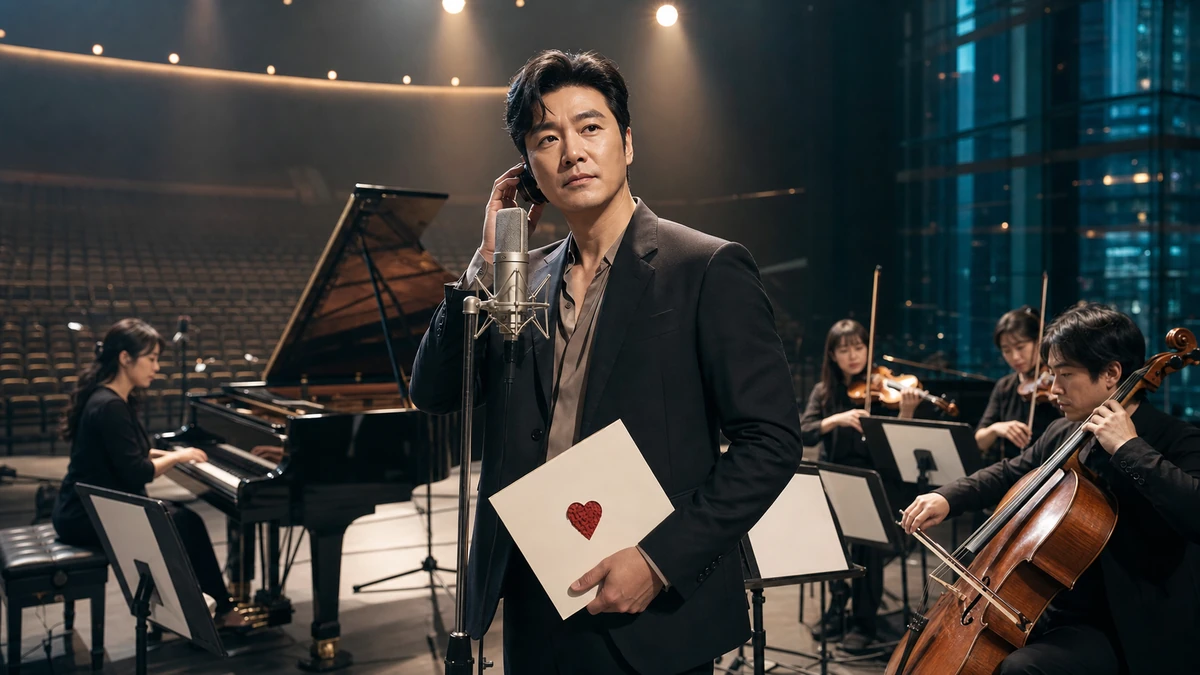
A Korean balladeer heads back to Japan with a familiar language: love songs
South Korean singer Sung Si-kyung will release a Japanese remake album titled LOVE on Sept. 30, 2026, and follow it with a concert on Oct. 4 at Tokyo Garden Theater, according to his agency. On paper, that may sound like a straightforward overseas album launch followed by a live show. In practice, it says something more revealing about where the Korean Wave is now: not just louder, bigger and more global, but also more intimate, more selective and more culturally fluent.
Sung is not the kind of Korean star most American readers would associate with the flashiest side of K-pop. He is best known in South Korea as a ballad singer with a polished, warm voice and a reputation for emotional restraint rather than spectacle. If BTS, Blackpink or Stray Kids represent the Korean music industry’s arena-scale export machine, Sung belongs to another tradition entirely — one closer to the adult contemporary or singer-songwriter lane in the United States, where vocal interpretation, lyric delivery and mood matter as much as branding.
That distinction is important in understanding why this particular project stands out. LOVE is not being framed as a debut in Japan or a simple best-of collection translated into another language. Instead, it is built around Japanese classics that Sung personally selected and reinterpreted. The track list has not yet been announced, which has only intensified interest among fans. What has been confirmed is the concept: a Korean singer taking songs already familiar to Japanese listeners and singing them anew in Japanese, through his own musical sensibility.
For American audiences, the easiest analogy may be a respected U.S. vocalist recording an album of beloved French or Italian standards specifically for listeners in Paris or Rome — not as a novelty exercise, but as a serious artistic statement aimed at people who already know the originals by heart. The success of that kind of project depends less on star power alone than on trust, taste and interpretive skill. In other words, the singer has to convince listeners that he understands not just the melody, but the emotional memory attached to it.
That is the challenge and the opportunity facing Sung. And it is also why this release carries more weight than a typical foreign-language spinoff.
Why this is more than just another K-pop overseas release
For years, the dominant narrative around Korean pop culture abroad has focused on expansion through scale: world tours, chart records, streaming milestones and social media reach. That story is real, but it is not the only one. Sung’s Japanese remake album points to a quieter model of cross-border success — one built not on breaking into a market from the outside, but on meeting that audience inside its own cultural memory.
Japan has long been a crucial market for Korean entertainers. It is geographically close, economically significant and historically complex. Korean acts have often released Japanese-language versions of their own hits, mounted major tours there or made market-specific albums for local audiences. But a remake project like this, centered on Japanese songs chosen by the artist himself, operates a little differently. It is not simply translation. It is interpretation across borders.
That difference matters because remake albums ask listeners to hear two things at once: the original song they already know and the new voice reshaping it. For Japanese fans, these tracks may carry decades of familiarity, nostalgia or personal association. Sung’s job is not to replace those memories but to enter into conversation with them. For Korean fans and international listeners, the album could also serve as a guided introduction to Japanese popular music through a singer they already trust.
In a media environment dominated by algorithmic discovery, that kind of curation has real value. People often encounter music now through playlists, short-form clips and recommendations generated by previous listening habits. But an album built around songs an artist intentionally picked for personal reasons offers something different: a map of influence. When Sung says, in effect, these are the Japanese songs worth revisiting through my voice, he is also revealing something about his own musical identity.
That may be why the project has drawn attention even before the songs themselves have been announced. The intrigue is not only in what he will sing, but in what his choices will say. Will he lean toward classic ballads? City pop? Melancholy standards? Songs associated with a particular generation in Japan? Until the details are released, speculation remains just that. But the shape of the project is already clear enough to make it culturally significant.
From YouTube covers to a formal album, the fan pipeline is changing
One of the most telling details behind LOVE is how naturally it seems to have grown out of Sung’s online activity. He has spent years covering Japanese songs on YouTube, a format that may look casual on the surface but increasingly functions as a testing ground for audience demand. Fans hear something they like, respond in comments, share clips, ask for more and sometimes help turn what might have remained a one-off performance into an official commercial release.
That pattern reflects a broader shift in the global music business. In an earlier era, international expansion was more tightly controlled by labels, broadcasters and promoters. Artists entered foreign markets through carefully sequenced campaigns: local distribution deals, TV appearances, radio promotion, physical releases, then concerts. Those systems still matter, but they now coexist with a much more porous feedback loop. A song cover uploaded online can generate real data, emotional momentum and fan pressure that executives ignore at their peril.
Reports in Japan have suggested this album was shaped by listeners who wanted to hear more of Sung performing in Japanese. That point is worth underlining. Fans were not merely asking for more content in general. They were responding to a specific combination: this particular singer, singing in this particular language, interpreting this particular repertoire. In today’s entertainment economy, that kind of focused demand can be more powerful than broad visibility.
For readers in the United States, where fan communities have helped revive canceled TV shows, push songs up the charts through TikTok and influence set lists in real time, this dynamic will sound familiar. What may be less familiar is how fully that participatory logic has taken root in Korean popular music, which is often stereotyped abroad as top-down and highly manufactured. The Korean industry can indeed be tightly managed, especially in the idol sector. But it is also remarkably responsive to audience behavior, particularly online.
Sung’s remake album illustrates that responsiveness in a mature, almost understated form. A series of cover performances created a sustained appetite. That appetite became the rationale for a formal album. The album then leads directly into a concert in Tokyo, where the music can be tested again in front of a live audience that may already know every inflection of the originals. The path from digital clip to physical stage is shorter than it used to be, and fans now help build the bridge.
The cultural meaning of a Korean singer covering Japanese classics
To outsiders, a Korean artist singing well-known Japanese songs may look like a simple example of pan-Asian entertainment exchange. It is that, but it is also more layered. Japan and South Korea are close neighbors with deep economic ties and extensive cultural overlap, yet their relationship is also shaped by painful history, including Japan’s colonial rule over Korea in the first half of the 20th century. That history still influences politics, education and public sentiment in both countries.
Against that background, cultural exchange can carry symbolic weight even when it is not overtly political. Music is one of the spaces where memory, identity and emotion can travel more easily than formal diplomacy allows. A project like Sung’s does not erase historical tension, nor should it be romanticized as some grand act of reconciliation. But it does show how pop culture can create smaller, more durable forms of recognition: a shared melody, a recognizable lyric, an acknowledgment that another country’s songs matter enough to learn, perform and reinterpret with care.
This is especially relevant because Sung is not simply releasing his own music in Japanese translation. He is choosing songs that already belong to Japan’s mainstream listening culture. That demands respect for pronunciation, phrasing and emotional tone. Japanese and Korean are distinct languages with different sounds and rhythms, and audiences tend to notice immediately when a singer treats that difference casually. The appeal here lies partly in the tension between familiarity and distance: songs that sound known, but are carried by a voice from somewhere else.
American readers may think of the way standards function across generations in the United States. When an artist covers a song associated with Frank Sinatra, Carole King, Dolly Parton or the Eagles, listeners inevitably compare not only the vocals but the feeling. Was the performance reverent? Bold? Too safe? Needlessly showy? The same logic applies here, except with the added dimension of language and national audience.
That is why the phrase “personally selected Japanese classics” matters so much. It suggests authorship within the act of remaking. Sung is not just filling a marketing brief. He is presenting a point of view. If the final album succeeds, it will likely be because listeners hear not just competent covers, but a coherent emotional argument about what love songs — and perhaps Japanese pop memory itself — sound like through Sung Si-kyung’s voice.
What the Tokyo concert adds to the story
The live show scheduled for Oct. 4 at Tokyo Garden Theater is not an afterthought. It is central to the project’s meaning. Recorded music lets listeners sit with an interpretation privately, repeat it and compare it to the original at their own pace. A concert does something else: it turns that comparison into a shared social experience.
That is especially true with remake material. In a venue full of local fans, some members of the audience will arrive with longstanding emotional attachments to the original songs. Others will come because they are already fans of Sung. Some will belong to both camps. The room, then, becomes a kind of cultural overlap zone, where people are not just hearing a singer perform but also measuring how memory changes in the presence of a new voice.
Tokyo Garden Theater is a major venue, and booking a concert there so soon after the album release suggests confidence in the project’s draw. Even without a full set list or production details, the timing is revealing. The short gap between album release and live performance indicates a deliberate effort to convert curiosity into attendance while the music is still fresh and the conversation around it is active.
Live performance also matters because Sung’s strengths have often been associated with vocal nuance and emotional delivery rather than choreographed spectacle. In the American market, where large pop tours are often judged by production scale, that may require a different frame of reference. A better comparison might be the appeal of artists who can command a room through phrasing, tone and intimacy — the kind of performers whose audiences go to listen as much as to watch. If the album is about reinterpretation, the concert is where that reinterpretation becomes embodied.
There is another practical dimension as well. In cross-border music projects, a concert is one of the clearest tests of whether interest is deep or merely online. Streams and comments can signal enthusiasm, but ticket sales show commitment. By pairing the album with a Tokyo performance, Sung and his team are not only serving existing fans; they are also measuring how durable this Japanese-language chapter of his career can be.
A reminder that the Korean Wave is not one thing
In the United States, coverage of the Korean Wave — known in Korean as Hallyu, a term used to describe the global rise of Korean popular culture — often centers on the most visible exports: idol groups, Netflix dramas, beauty brands and blockbuster films. That coverage has helped broaden American awareness of South Korea’s cultural power. But it can also flatten the picture, making Korean entertainment seem synonymous with youth-driven, highly stylized, aggressively globalized pop.
Sung Si-kyung’s upcoming Japanese album is a useful corrective. It highlights a less flashy but equally important part of the Korean music ecosystem: veteran singers with stable fan bases, strong interpretive identities and careers built on emotional credibility. In South Korea, ballad singers occupy a space that Americans might loosely compare to a blend of adult contemporary radio staples, prestige vocalists and singer-songwriters whose songs become part of everyday life — played at weddings, karaoke rooms, late-night radio shows and sentimental TV soundtracks.
Karaoke itself is another piece of context worth noting. In both South Korea and Japan, singing culture is deeply social, and songs often circulate not just as products to consume but as material ordinary people perform themselves. That gives certain ballads an afterlife different from what many American pop songs experience. When a singer remakes a classic in that ecosystem, he is not only addressing passive listeners; he is also touching repertoire that people may have sung with friends, family or co-workers for years.
That makes LOVE especially resonant as a title. Love songs travel easily across borders because they rely on emotional universals, but the way they are sung remains culturally specific. Korean ballad performance tends to emphasize controlled feeling, careful build and lyrical sincerity. Japanese pop ballads have their own traditions of melancholy, restraint and melodic clarity. Sung sits at an intriguing intersection of those styles. His appeal has long rested on conveying feeling without overselling it — a quality that could serve him particularly well with Japanese material.
For English-speaking readers who may know little about him, that is perhaps the clearest takeaway: this is not a random side project. It is the next logical step for a singer whose voice, repertoire and fan relationship are unusually well suited to the format.
What to watch as the album rollout continues
Because many of the album’s specifics remain under wraps, the next stage of the rollout will matter. The songs Sung chooses will shape how the project is received and what audience it ultimately reaches. A set list dominated by universally recognized classics could position the album as a broad mainstream bridge. A more selective or generation-specific set of songs could turn it into something more personal and curator-driven. Either route could work, but they would tell different stories.
Industry watchers will also pay attention to how the album is marketed in Japan and beyond. Will the campaign lean heavily on nostalgia? On Sung’s reputation as a vocalist? On the Korea-Japan cultural exchange angle? Will there be music videos, live clips or behind-the-scenes content that explains why he chose certain songs? In a digital environment, context often becomes part of the product, especially when the project depends on an artist’s interpretive credibility.
Then there is the question of how international fans outside Japan respond. One of the striking features of contemporary Asian pop culture is how quickly regional releases can become global talking points. A Korean singer releasing a Japanese-language album can now attract interest not only in Seoul and Tokyo but also in Los Angeles, Singapore, Bangkok, London and São Paulo. Streaming platforms and social media have collapsed many of the traditional barriers that once kept such projects local.
Still, the strongest reading of this announcement remains the simplest one. Sung Si-kyung is releasing an album of Japanese remakes because listeners wanted more of what they had already heard him do well, and because he appears to see genuine artistic meaning in that response. He is then taking that project to a Tokyo stage, where the songs can be tested in the city and language most central to their identity.
At a moment when the Korean Wave is often measured by volume — how many streams, how many tickets, how many followers, how many headlines — LOVE points to another metric: how deeply one voice can enter another culture’s songbook and be welcomed there. It is a smaller story than a stadium tour or a chart conquest. But it may say just as much about how Korean popular music continues to grow up, stretch out and find new ways to be heard.
Comments
Post a Comment