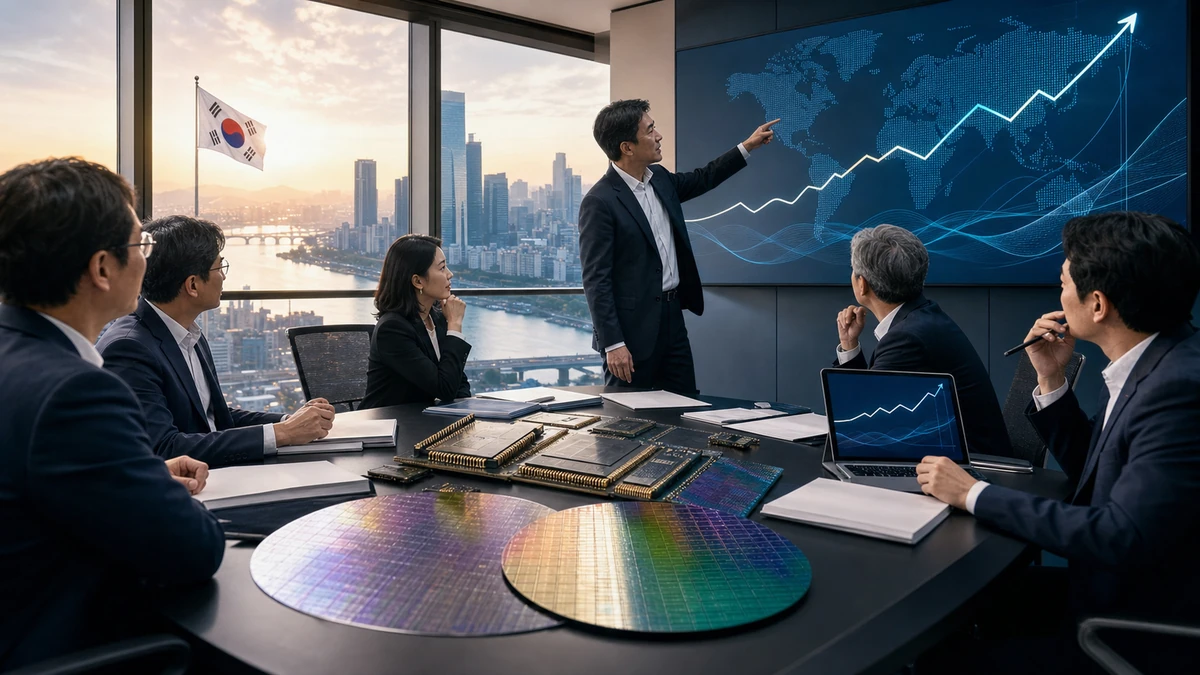
South Korea gets a major vote of confidence from the IMF
The International Monetary Fund has sharply raised its forecast for South Korea’s economic growth this year, lifting its estimate for real gross domestic product growth to 2.6% from 1.9% in a move that signals more than a routine statistical adjustment. For American readers, think of it as the economic equivalent of Wall Street revising a company from a cautious hold to a confident buy. The headline number matters on its own, but what matters even more is why the IMF changed its mind.
According to the IMF’s July update to its World Economic Outlook, South Korea now stands out among advanced economies for the strength of its expected expansion. In a world where wealthy industrialized countries typically grow at a modest pace, a forecast of 2.6% is notable. It suggests that South Korea, long seen as an export powerhouse, is benefiting from one of the most important shifts in the modern economy: the global race to build the hardware behind artificial intelligence.
That distinction is important. Much of the public conversation around AI in the United States centers on software, chatbots and the tech giants building large language models. But AI also depends on physical infrastructure: semiconductors, high-bandwidth memory, servers, packaging technologies and other components that make data centers and advanced computing possible. South Korea is deeply embedded in that supply chain, and the IMF’s revised forecast suggests that investors and policymakers are increasingly viewing the country through that lens.
For Americans who may know South Korea primarily through Samsung smartphones, Hyundai cars, Oscar-winning films like “Parasite” or K-pop groups that sell out U.S. stadiums, this is another reminder of how central the country has become to the global economy. South Korea is not just a cultural exporter. It is also a manufacturing and technology heavyweight whose performance increasingly tells us something about the health of the digital economy worldwide.
The IMF’s new outlook also comes at a time when global growth remains clouded by uncertainty, including energy volatility, geopolitical tensions and uneven demand across major markets. In that environment, a large upward revision for South Korea is significant because it suggests the country’s industrial strengths are outweighing some of its structural vulnerabilities. That makes this story bigger than a single national forecast. It is also a window into where the world economy is getting its momentum.
Why a move from 1.9% to 2.6% matters
A jump from 1.9% to 2.6% may not sound dramatic to readers accustomed to election-night percentages or stock-market swings, but in macroeconomics, it is substantial. National growth forecasts influence business investment plans, government budgeting, financial market sentiment and the way foreign investors judge a country’s trajectory. When the IMF revises a number by that much in a midyear update, it typically reflects a meaningful reassessment of underlying conditions rather than a minor technical tweak.
The IMF issues its full global economic forecasts in April and October, then publishes updates in January and July focused on major economies. That means this revision is part of a regular and closely watched process, not an offhand comment. The message is that the IMF sees South Korea’s recent economic performance and near-term momentum as strong enough to justify a materially higher projection.
That matters because economic forecasts are not just academic exercises. They can shape borrowing costs, corporate confidence and government decision-making. In the U.S., a change in the Federal Reserve’s tone can ripple through mortgage rates and equity markets. In a similar way, an IMF upgrade can help reinforce investor confidence in South Korea and support the perception that its economy is regaining speed after a period of caution.
The revised forecast also carries symbolic weight. South Korea is often grouped with other export-driven Asian economies, but it is also undeniably part of the advanced industrial world. It has world-class infrastructure, globally competitive corporations and per-capita income levels that place it among developed nations. For the IMF to single out South Korea as one of the stronger performers among advanced economies suggests the country is doing more than riding a temporary bounce. It indicates that South Korea may be positioned at a particularly favorable intersection of manufacturing depth and technological demand.
That distinction is especially meaningful because advanced economies generally do not post rapid growth for long stretches. They tend to expand more slowly than emerging markets because their industries, labor forces and consumer sectors are more mature. So when one of them meaningfully outperforms its peers, analysts want to know what is different. In South Korea’s case, the answer appears to be the country’s role in supplying the tools required for the AI era.
The AI boom is not just software. It is factories, chips and memory
The center of this story is semiconductors and AI-related hardware. The IMF identified South Korea as one of the world’s top four net exporters of AI-related hardware, a phrase that deserves unpacking for a broad English-speaking audience. In plain terms, South Korea sells more of the equipment and components needed to power AI systems than it buys, and it does so at a scale large enough to matter globally.
That is a powerful economic position to hold right now. AI systems require enormous computing capacity. That computing capacity depends on chips, memory, server infrastructure and supporting components. South Korean companies are deeply involved in these areas, especially memory semiconductors, where the country has long been a global leader. If the United States is home to many of the software platforms and cloud giants driving AI adoption, South Korea is among the countries helping provide the physical machinery that lets those systems run.
For American readers, it may help to compare this to the California gold rush cliché: during a boom, some of the most reliable money is made not only by the prospectors but by the merchants selling picks and shovels. In the AI economy, South Korea is one of the countries making many of the high-value picks and shovels. That does not mean every Korean technology company will benefit equally, and it does not guarantee smooth sailing. But it does explain why global institutions are revisiting the country’s growth prospects.
This also highlights an aspect of AI that is often overlooked in public debate. AI is not weightless. It is easy to talk about algorithms as if they live in the cloud, detached from physical reality. In fact, they rely on energy-intensive, capital-intensive infrastructure that must be designed, built and refreshed. Countries able to supply that infrastructure are likely to benefit as companies and governments around the world pour money into AI investment.
South Korea’s advantage comes from decades of industrial development. The country built its economy through export-led manufacturing, moving from labor-intensive industries into higher-value sectors such as automobiles, shipbuilding, electronics and advanced components. That industrial base, combined with deep technical expertise and globally competitive firms, gives it leverage in a moment when the world needs more chips and computing hardware. The IMF’s upgrade suggests those long-term strengths are now showing up clearly in the macroeconomic data.
Just as importantly, the revision implies that South Korea’s export mix is well matched to current global demand. Economies do best when they produce exactly what the world suddenly wants more of. Right now, one of those things is AI hardware, and South Korea appears to be in the right place at the right time.
An energy-dependent country finds a way to outgrow its constraints
One reason the IMF’s upgrade stands out is that South Korea does not have the advantages commonly associated with commodity-driven booms. It is not an oil-rich state cashing in on high energy prices. Quite the opposite. South Korea is heavily dependent on imported energy, particularly from the Middle East, and that creates an ongoing vulnerability. For an economy built on manufacturing, energy costs matter a great deal. They affect production costs, inflation, trade balances and overall competitiveness.
That is part of what makes the IMF’s new outlook so revealing. The fund did not ignore South Korea’s energy burden. Instead, it effectively concluded that the country’s export strength, especially in semiconductors and AI-related hardware, was strong enough to offset that structural weakness. That is a crucial point. It suggests the world economy is rewarding South Korea’s technological capabilities enough to overcome some of the headwinds created by imported fuel costs.
For Americans, this may sound familiar in a different context. The U.S. economy often absorbs shocks because of its scale, consumer market and technological innovation. South Korea does not have the same domestic-market size or energy independence. It has to earn resilience in another way: by making products the rest of the world urgently needs. That model can be more vulnerable to swings in global trade, but it can also produce bursts of strength when external demand lines up with domestic capabilities.
The IMF pointed to stronger-than-expected first-quarter growth, reported at 7.5%, as evidence that South Korea’s momentum had surpassed the assumptions baked into its earlier forecast. While quarterly numbers can be volatile and should be interpreted carefully, the broader implication is clear: exports have been powerful enough to shift the international view of the country’s growth path in a relatively short period.
That does not eliminate risk. Energy prices could rise further. Global demand for technology could cool. Trade frictions or supply-chain disruptions could alter the picture. But for now, the story is one of a resource-poor country using technical sophistication and industrial discipline to outrun some of the disadvantages of geography. South Korea has long had to import the raw materials that keep its factories moving. Its success has depended on turning those inputs into higher-value goods for the world. The IMF’s latest forecast suggests that formula still works, and in the age of AI, it may be working especially well.
What this says about South Korea’s place in the world economy
For years, discussions about South Korea abroad often focused on its security relationship with the United States, its tensions with North Korea or its pop-culture influence. Those remain important. But this IMF upgrade points to something equally consequential: South Korea’s role as a strategic supplier in a technology-centered global economy.
That role has become more visible as governments and corporations rethink supply chains after the pandemic and amid rising U.S.-China competition. Washington has spent years talking about semiconductor resilience, domestic manufacturing and the risks of concentrating critical technology production in too few places. In that conversation, South Korea is not a peripheral player. It is one of the countries that can materially affect how quickly the world can scale advanced computing infrastructure.
In that sense, the IMF’s growth revision is not just about Korea. It is also about the shape of globalization in the 2020s. The old model of globalization often emphasized cheap labor and mass consumer goods. The current phase is increasingly about strategic technologies, concentrated expertise and control over chokepoints in supply chains. Semiconductors are one of the clearest examples, and South Korea is one of the clearest beneficiaries.
This is also why the news deserves attention from readers outside Asia. When the IMF upgrades South Korea partly because of AI hardware exports, it is telling the world something about where demand is strongest and where economic value is accumulating. If South Korea is growing faster because companies worldwide are buying more chips and related hardware, then the broader implication is that AI investment is not just hype in financial markets. It is translating into real industrial orders and real macroeconomic effects.
That can have downstream consequences far beyond Seoul. It can influence U.S. tech spending, global capital investment, trade balances, shipping volumes and even diplomatic priorities. Countries that supply the backbone of the digital economy often gain leverage, attention and influence. South Korea already punches above its geographic size in diplomacy and culture. In advanced manufacturing, it may be doing the same in an even more consequential way.
There is also a domestic political dimension, though this story is primarily economic. Higher growth forecasts can ease pressure on policymakers, improve public sentiment and strengthen confidence in national industrial strategy. They can also validate years of investment in sectors that may have seemed cyclical or vulnerable during downturns. For Korean officials and business leaders, the IMF’s revision is likely to be read not only as good news, but as external confirmation that the country’s industrial model remains globally relevant.
Why forecasts are influential, but not guaranteed
It is important not to confuse a forecast with a final outcome. The IMF is influential, but it is still making a projection based on currently available information, assumptions and models. Growth estimates can change quickly if the facts change. Economists know that headline forecasts are snapshots, not promises.
That caveat matters in South Korea’s case because the same factors driving optimism could also create vulnerability. The economy’s dependence on exports means it remains sensitive to shifts in global demand. If AI investment slows, if major economies enter a deeper downturn, or if semiconductor prices weaken, the growth path could soften. Likewise, energy costs remain a real pressure point. An economy that imports much of its fuel can feel the pain of price shocks faster than countries with larger domestic energy supplies.
There is also the issue of concentration. When a forecast upgrade is closely tied to one broad cluster of industries, in this case semiconductors and AI hardware, the upside can be impressive, but so can the volatility. South Korea’s strengths are real, yet they are also linked to sectors known for cycles, inventory corrections and abrupt changes in investment sentiment. That does not negate the IMF’s assessment. It simply means the story should be read with appropriate caution.
Still, forecasts matter because they shape expectations, and expectations influence real-world decisions. A stronger outlook can encourage corporate investment, support hiring plans and make foreign investors more comfortable increasing exposure. In markets, perception often becomes part of reality. If enough institutions conclude that South Korea is better positioned than previously thought, that confidence can reinforce the very momentum that inspired the revision.
For readers in the United States, where economic headlines are often filtered through interest-rate policy and election politics, South Korea’s story is a reminder that industrial structure still matters profoundly. Growth does not emerge from slogans alone. It comes from what a country makes, how well it competes and whether global demand matches its strengths. Right now, South Korea appears to be benefiting from a rare alignment of capability and timing.
The bigger message for companies, investors and global readers
For Korean companies, particularly those tied to chips, advanced memory, server infrastructure and other AI-related hardware, the IMF’s forecast revision sends an encouraging signal. It suggests the international policy community sees their export performance not as a temporary blip, but as a meaningful driver of national growth. That kind of recognition can bolster corporate credibility, investor confidence and strategic positioning in overseas markets.
For U.S. businesses and investors, the lesson is just as important. South Korea is not merely a consumer market or a geopolitical ally. It is an essential node in the infrastructure layer of the AI economy. Anyone trying to understand the global technology race needs to pay attention not only to Silicon Valley software breakthroughs but also to the manufacturing ecosystems in places like South Korea that turn computational ambition into physical reality.
For policymakers, the story reinforces a broader strategic theme: the countries best positioned for the next phase of growth may be those that combine technological specialization with dependable manufacturing capacity. South Korea has spent decades building exactly that mix. The IMF’s revised outlook suggests the payoff is now becoming visible in a world newly hungry for the components of machine intelligence.
And for general readers, this is one more example of why South Korea commands outsized attention on the world stage. Americans may first encounter the country through K-dramas on Netflix, Korean skincare on store shelves or sold-out concerts from BTS and other K-pop stars. Those cultural exports are real and powerful. But behind them stands a sophisticated economy that helps make smartphones, electric vehicles, data centers and AI systems possible. The same nation that exports cultural influence also exports the industrial building blocks of the future.
The clearest takeaway from the IMF revision is this: the world is re-evaluating South Korea not only as a resilient exporter, but as a strategic technology supplier in the AI age. Raising the country’s growth outlook from 1.9% to 2.6% is a recognition that South Korea’s industrial strengths are aligning with one of the most transformative investment cycles of the decade. There are still risks, and forecasts can change. But for now, the IMF’s message is unmistakable. In an uncertain global economy, South Korea is moving faster than many expected, and a big reason is that the AI boom is running straight through its factories.
Comments
Post a Comment