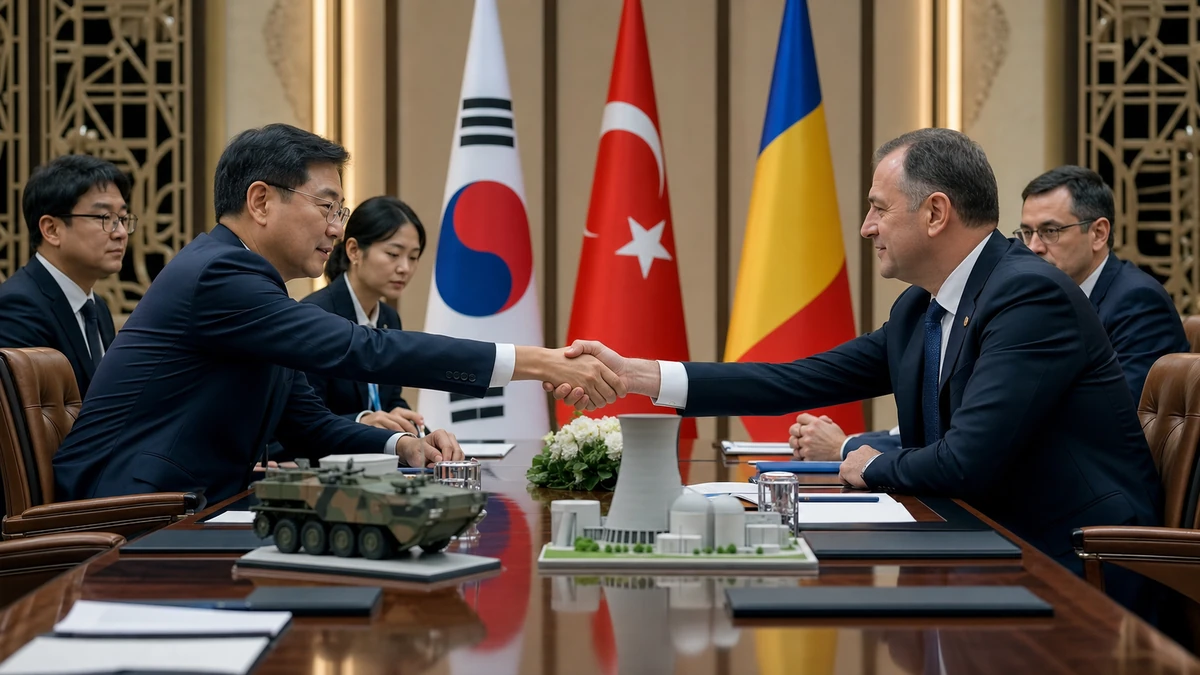
South Korea uses a NATO-stage meeting to widen its reach in Europe
South Korean President Lee Jae-myung used a high-level diplomatic stop in Ankara, Turkey, to spotlight a broader shift in Seoul’s foreign policy: South Korea is no longer talking to Europe only through the lens of abstract partnership or symbolic summit language. Instead, it is increasingly pitching itself as a practical player in two of the continent’s most sensitive and strategic sectors: defense manufacturing and nuclear energy.
According to the South Korean government and reports carried by Yonhap News Agency, Lee met Tuesday with Romanian President Nicusor Dan on the sidelines of a NATO summit-related visit to Ankara. The two leaders discussed ways to strengthen what Seoul described as “practical cooperation” in defense industries and nuclear power, two areas that require long-term political trust, technical capacity and regulatory stability.
That distinction matters. Diplomatic meetings often produce broad language about friendship, shared values or future cooperation. What stood out in this case was the narrowness and seriousness of the agenda. Defense production and civilian nuclear energy are not casual talking points. They are sectors where governments move slowly, where contracts can take years to negotiate and where political signals from the top can shape what bureaucrats, state-backed firms and private industry do next.
For American readers, one way to understand the moment is to think of South Korea’s role less as that of a regional player focused only on North Korea and more as that of a middle power trying to become indispensable in a wider set of global supply chains. In recent years, South Korea has made an increasingly assertive case that its advanced manufacturing base, defense companies and energy technology can serve allies and partners far beyond Northeast Asia. This week’s meeting with Romania suggests that pitch is gaining traction in parts of Europe where security concerns and energy planning now overlap more than ever.
South Korea is not a NATO member, and nothing about the meeting changes that. But Seoul has been using NATO gatherings and related diplomatic events as opportunities to build bilateral ties with European governments. The Romanian meeting fits squarely into that pattern: use a multilateral stage to conduct targeted one-on-one diplomacy, especially with countries reassessing how they buy weapons, secure energy and diversify strategic partnerships.
Why Romania matters more than many Americans may realize
Romania does not usually occupy much space in American coverage of Asian diplomacy, which is exactly why this meeting deserves a closer look. When U.S. readers think of South Korea’s major partners, they are more likely to think first of the United States, Japan, China or perhaps the European Union as a bloc. But South Korea’s foreign policy has increasingly involved building dense networks with countries that may not be global heavyweights on their own yet sit at important crossroads in security and industry.
Romania is one of those countries. It is a NATO member on Europe’s eastern flank, near the Black Sea, in a region where the war in Ukraine has reshaped how governments think about deterrence, ammunition, supply chains and long-term readiness. It is also a country navigating major energy questions, including how to ensure reliability and reduce vulnerability at a time when energy security has become inseparable from national security.
That makes Bucharest a potentially attractive partner for Seoul. South Korea brings a strong export-oriented industrial base, globally competitive manufacturers and growing confidence in selling not only consumer products like cars and electronics, but also higher-stakes systems such as weapons platforms, reactors and related infrastructure. Romania, for its part, has incentives to look beyond a narrow set of traditional suppliers as it tries to modernize and diversify.
Lee underscored that calculation in unusually direct language, saying Romania is “a very important cooperative partner” for South Korea and noting progress in areas including trade and defense-related cooperation. In diplomatic terms, that phrasing is significant. Leaders often flatter each other in public, but the repeated emphasis on Romania as an important partner suggests Seoul wants to elevate the relationship from cordial ties to a more strategic working partnership.
That does not mean a major deal has already been signed. Based on the information publicly available, no specific contract, dollar figure or final project announcement was confirmed as part of the summit meeting. But diplomacy often works in stages, and summit-level agenda-setting can be one of the most important stages. It tells ministries, regulators, company executives and negotiators where political support exists and where follow-up talks are worth investing in.
Defense and nuclear power are a deliberate pairing, not a coincidence
The two main sectors highlighted in the meeting, defense and nuclear power, might seem unrelated at first glance. In practice, they reveal a coherent picture of what South Korea wants to sell to the world and how it wants to be seen.
Defense exports have become a major South Korean growth story. Once best known internationally for K-pop, Samsung smartphones, Hyundai vehicles and Oscar-winning films, South Korea has also emerged as an increasingly visible arms supplier. Its companies have marketed tanks, artillery, aircraft and related systems to countries seeking speed, reliability and industrial partnership. In a world where NATO countries and other U.S. partners are reassessing stockpiles and procurement timelines, that matters.
For Americans, the comparison might be to a country moving from being known mainly for consumer innovation to being recognized as a serious strategic manufacturer. South Korea is trying to show that it can be not only culturally influential and technologically advanced, but also central to the hard-power architecture of U.S.-aligned democracies and their partners.
Nuclear energy plays a different but complementary role. Civilian nuclear power is about electricity, decarbonization and energy resilience, but it is also about prestige, financing, engineering standards and decades-long operating relationships. A country that exports nuclear technology is not merely selling equipment; it is entering into a long-term institutional relationship involving safety systems, regulation, training, maintenance and diplomacy.
That is why Lee’s emphasis on “practical cooperation” drew attention. He said there was substantial room to strengthen cooperation not only in defense industries, but also in nuclear power and other sectors. The message was not about ceremony. It was about capability. Seoul appears to be telling European partners that it can contribute in fields where reliability matters more than rhetoric.
Pairing defense and nuclear energy in one bilateral conversation also reflects how modern statecraft works. Security and economics are no longer easily separated. Arms production affects alliance planning, industrial policy and jobs. Energy strategy affects prices, resilience, climate commitments and geopolitical leverage. By discussing both at once, the South Korean and Romanian presidents signaled that they see the bilateral relationship through a broader strategic lens rather than as a narrow trade relationship.
What this says about South Korea’s changing diplomacy
For decades, much foreign coverage of South Korea centered on the Korean Peninsula: North Korea’s nuclear program, U.S.-South Korea military exercises and the risk of crisis with Pyongyang. Those issues remain central, and they are not going away. But the Ankara meeting illustrates how incomplete that framework has become.
South Korea today is trying to operate simultaneously on several levels. It remains a frontline U.S. ally facing a direct military threat from North Korea. It is also a major trading nation whose prosperity depends on global markets. And increasingly, it wants to be seen as a provider of strategic goods, from weapons systems to energy technology, in regions far from East Asia.
The use of a NATO-related trip to deepen bilateral talks with Romania shows how Seoul is broadening the map of its diplomacy. Even without formal NATO membership, South Korea sees value in participating around NATO forums, talking with European leaders and aligning itself with conversations about defense production and security cooperation. That reflects a larger trend in which U.S. allies in Asia and Europe increasingly view their security environments as connected rather than separate.
From Washington’s perspective, that development is notable. American administrations of both parties have pushed allies to do more, build more and coordinate more across regions. South Korea’s outreach to European states fits that logic. It also allows Seoul to reduce the impression that its foreign policy is confined to reacting to events on the peninsula. Instead, it can present itself as shaping global debates about deterrence, manufacturing capacity and energy security.
This is especially important for a South Korean president attending large multilateral gatherings, where the official group agenda often competes with the quieter but equally consequential work of bilateral meetings. Much of diplomacy happens outside the main stage, in side rooms where leaders compare interests and identify sectors where their national needs align. The Lee-Dan meeting appears to have been one of those moments: not dramatic enough to dominate global headlines, but potentially important as a signal of where both sides want the relationship to go.
The lighter moment about Dracula carried a diplomatic purpose
One of the more memorable details from the meeting was a joke. According to the South Korean side, when Dan invited Lee to visit Romania, Lee replied that he should make the trip to see whether Dracula is really there, prompting laughter between the two leaders.
For an American audience, the Dracula reference is instantly legible in a way many diplomatic pleasantries are not. Romania is often associated internationally, sometimes reductively, with the Dracula legend tied to Transylvania and the literary mythology popularized in the West. Lee’s comment appears to have been a playful cultural shorthand, not a policy statement, and it should not be overstated. No future trip was announced, and the exchange does not amount to confirmation of a planned state visit.
Still, such moments matter in summit diplomacy. Publicly shared humor can soften the stiffness of formal talks and help create an atmosphere of personal rapport. That is especially useful when the substantive agenda involves sectors as politically sensitive as defense procurement and nuclear power. In those areas, trust at the leader level can help open the door for technical teams to continue working through difficult details later.
There is also a broader cultural point here. South Korean official diplomacy, like many diplomatic traditions, can appear highly scripted from the outside. But carefully chosen light moments are often used to humanize leaders and suggest warmth without changing the substance of negotiations. In this case, the humor provided a contrast to the seriousness of the agenda and helped frame the meeting as friendly, even while both sides discussed hard strategic interests.
That said, the significance of the meeting lies in the policy direction, not the joke. The most important takeaway is that both governments chose to highlight areas requiring long-term commitment, and the South Korean president used language that portrayed Romania as a meaningful partner rather than a ceremonial stop on a crowded summit schedule.
Why the timing matters in Europe’s current security and energy climate
The meeting took place at a moment when Europe’s defense and energy debates remain deeply unsettled. Russia’s war in Ukraine has transformed assumptions about military preparedness, industrial capacity and the speed with which democracies can replenish critical supplies. At the same time, European governments continue to wrestle with how to balance climate goals, affordability, energy independence and reliability.
In that environment, countries like Romania are not simply shopping for products. They are evaluating long-term partnerships. Defense cooperation can involve training, local industry participation, maintenance networks and future upgrades. Nuclear cooperation can involve financing structures, regulatory compatibility and sustained technical coordination. Neither area is a one-off transaction.
That is why summit-level signaling matters so much. When leaders publicly identify these sectors as priorities, they are effectively telling their governments to take the relationship seriously. They are also telling domestic audiences and outside observers that cooperation in these areas is politically acceptable and potentially desirable.
For South Korea, the timing also reinforces a larger narrative about its industrial diplomacy. Seoul wants to be part of the solution when allies and partners ask who can manufacture at scale, deliver on time and sustain high-technology partnerships. Whether the topic is artillery, advanced equipment or nuclear-related capability, the country is trying to position itself as a dependable option in an era of geopolitical fragmentation.
For Romania, the attraction may lie in diversification. European governments have strong reasons to maintain ties with established suppliers, but they also have incentives to broaden the field. Working with South Korea can offer an additional channel for technology, industrial cooperation and strategic flexibility. The public record from the meeting does not establish any final outcome. But it does make clear that both sides see enough potential to raise these issues at the presidential level.
A diplomatic message about direction, not yet about deliverables
The most disciplined way to read the Ankara meeting is also the most useful one: as a statement of direction rather than a declaration of completed results.
What is confirmed is that Lee and Dan met in Ankara during a NATO-related diplomatic schedule, discussed ways to strengthen cooperation in defense industries and nuclear power, and publicly framed the relationship as one with room to grow. What is not confirmed, based on the available summary, is any finalized contract, announced investment total, detailed memorandum or scheduled future visit.
That distinction is important because summit diplomacy is often inflated in real time. Leaders can create momentum without producing immediate signatures. But momentum itself can matter. In many international negotiations, especially in sectors involving national security and energy infrastructure, top-level political backing is the prerequisite for any serious technical progress that follows.
Seen that way, the meeting offers a window into how South Korea wants to navigate the world in the late 2020s. It is trying to connect security, industry and energy rather than treat them as separate files. It is trying to expand beyond the old assumption that Korean diplomacy is defined primarily by North Korea. And it is trying to show partners in Europe that Seoul belongs in conversations once dominated by a narrower set of suppliers and powers.
For American readers, the significance is broader than one bilateral meeting in Ankara. The story is about the steady globalization of South Korea’s strategic identity. This is a country still shaped by the unresolved legacy of the Korean War and the immediate danger posed by Pyongyang. But it is also a country increasingly acting like a global industrial and diplomatic stakeholder, one that wants influence not only in East Asia but also in the security and energy decisions of Europe.
If future agreements emerge from this diplomatic opening, this meeting may be remembered as an early marker. If they do not, it will still stand as evidence of where Seoul is trying to position itself: as a partner that can speak the language of both alliance security and long-horizon infrastructure. In a world where defense production and energy resilience have become core political issues across democracies, that is a role with growing relevance well beyond the Korean Peninsula.
Comments
Post a Comment