A one-goal game that carried outsized meaning
SEOUL — In many American sports cities, rivalry games tend to live on far longer than the standings that framed them. Think Yankees-Red Sox, Cubs-Cardinals or Lakers-Celtics: the final score matters, but the emotional residue matters almost as much. That dynamic was on full display in South Korea on Saturday night, when FC Seoul defeated Incheon United 1-0 at Seoul World Cup Stadium in a match that felt larger than a routine midseason fixture.
According to Yonhap News Agency, the difference came from FC Seoul forward Jung Seung-won, whose winning goal in the 16th round of the 2026 K League 1 season gave the home side a tense victory over one of its nearest and most familiar opponents. On paper, it was a narrow win. In practice, it was the kind of result that can sharpen a club’s identity, reward a restless home crowd and turn a single player into the face of the night.
South Korea’s top professional soccer division, K League 1, does not always command the global attention that follows the English Premier League, Spain’s La Liga or even Major League Soccer’s biggest headlines in the United States. But matches like this help explain why domestic soccer in Korea continues to inspire deep loyalty. Rivalries are intense, stadiums are loud, and players are judged not just by statistics but by whether they can seize a defining moment when the emotional temperature is highest.
Jung did exactly that. His goal broke a deadlock against Incheon United and ultimately decided the match. By the time the final whistle arrived, the conversation was no longer just about three points in the table. It was about a player who delivered in a rivalry match, at home, in front of a full-throated crowd, just as the league returned from a long pause tied to the 2026 World Cup calendar.
Those layers matter. American audiences accustomed to the rhythm of sports storylines know that timing often shapes significance. A walk-off home run in April is not the same as one in October. Likewise, a goal in a derby after a long break carries a different emotional charge than one tucked into an ordinary stretch of the season. Seoul’s win belonged to that richer category: part result, part release, part statement.
What the Gyeongin Derby means in Korean soccer
For readers less familiar with Korean club soccer, this was not just any game between neighboring teams. It was the season’s second edition of what is commonly called the “Gyeongin Derby,” a regional rivalry between FC Seoul and Incheon United. The term “Gyeongin” refers to the Seoul-Incheon corridor in the greater capital region, an area of dense population, constant movement and overlapping civic identities. If that sounds a bit abstract from an American perspective, imagine a rivalry shaped by geographic closeness, commuter overlap and a long-running argument over regional pride.
FC Seoul represents the nation’s capital and is one of the most prominent brands in Korean soccer. Incheon United represents the port city of Incheon, which sits just west of Seoul and is known internationally as the home of South Korea’s largest airport. The cities are close enough that the matchup naturally creates tension. Fans do not need much help building a narrative when the teams are from adjacent urban centers whose residents share infrastructure but not always allegiance.
That rivalry produces something recognizable to American sports fans: a game in which the scoreline is only part of the experience. Supporters arrive with accumulated emotion. Every challenge feels louder. Every attacking move seems to carry symbolic weight. And when a player scores the only goal, he is not simply filling a box score. He is capturing bragging rights, at least for the moment, in a contest that supporters remember in personal terms.
In Korea, derby culture also intersects with highly organized fan support. Chants, banners and coordinated cheering sections are a major part of the K League atmosphere. Seoul World Cup Stadium, one of the country’s most recognizable soccer venues, can amplify that energy. Built for the 2002 FIFA World Cup, the stadium remains a landmark in Korean soccer culture, and a rivalry win there has resonance beyond the standings.
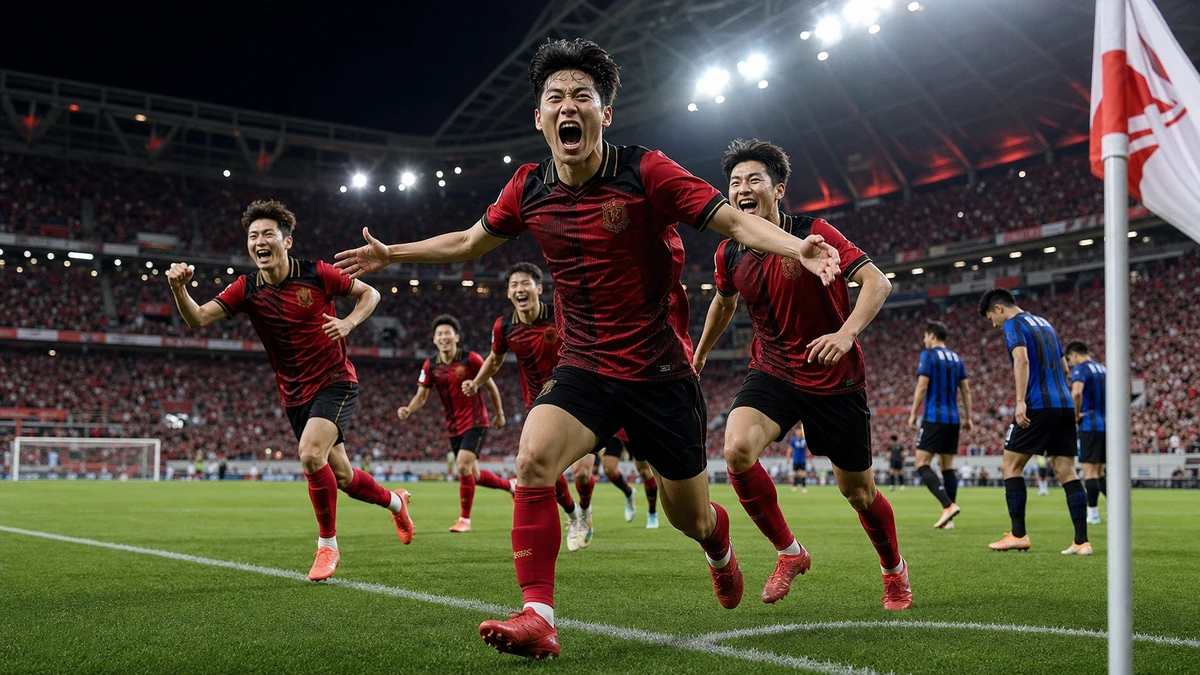
That is one reason Jung’s goal reverberated so strongly. It was not merely the opener in a game that later turned into a rout. It was the decisive moment in a match where one score proved enough. In rivalry games, especially tight ones, fans often remember the goal scorer almost as vividly as they remember the score. Seoul supporters now have a new image to hold onto: Jung breaking the tie and setting off a celebration that quickly became the visual symbol of the night.
The goal was decisive, but the celebration told its own story
If the finish won the game, the celebration ensured the moment would travel. After scoring, Jung took off his jersey and then removed the sports performance top underneath, a burst of emotion that fit the occasion even as it came with a cost. Under soccer’s rules, taking off a jersey during a goal celebration is typically punishable by a yellow card. That is true in Korea as it is in most leagues around the world. Players know it. They do it anyway when emotion overcomes calculation.
To American viewers who may be more familiar with touchdown dances, bat flips or choreographed NBA celebrations, soccer’s unwritten hierarchy of goal celebrations can seem its own language. Removing the jersey is one of the sport’s clearest signs that a player has moved beyond restraint. It is not subtle, and it is rarely accidental. In Jung’s case, that mattered because he later said the sequence had been planned. This was not just a spontaneous eruption; it was a celebration he had been waiting to use.
He reportedly counted with his fingers from 1 to 6, then held up the back of his jersey toward the cameras, displaying his No. 7 and his name. For fans, the gesture read like a personal declaration. In effect, he was saying: remember who delivered this moment. In team sports, self-expression can sometimes be viewed skeptically, especially in cultures that place a high premium on collective discipline. But sports also have room for authorship. Big moments often belong to the player willing to step into the spotlight and accept what comes with it.
That balance between team structure and individual emotion is one reason the celebration stood out in Korea. South Korean sports culture often emphasizes hard work, preparation and humility. Players are not forbidden from showing emotion — far from it — but the most memorable acts of celebration tend to gain meaning because they puncture a normally controlled atmosphere. When a player goes that far, fans understand the intensity behind it.
Jung’s explanation after the match added another layer. Saying he had prepared the celebration in advance reframed it from reckless excitement into something more deliberate: a sign that he believed his moment would come and had imagined how he would answer it. For athletes who endure scoring droughts or scrutiny, that kind of premeditated release can be revealing. It suggests confidence held in reserve, waiting for proof.
The yellow card, in that sense, almost became part of the symbolism. He knew the risk, and he embraced it. Fans often romanticize that kind of decision, especially when it follows the winning goal in a derby. The caution goes into the record book. The image goes into memory.
Why this mattered so much for Jung Seung-won
There are goals that simply happen, and then there are goals that seem to collect several narratives at once. Jung’s winner belonged in the second category. By the account provided in Korean coverage, it was described as a goal that came after a wait — a meaningful strike after a period in which scoring had not come easily. That context sharpened both the reaction in the stadium and the emotion in the celebration.
Strikers and attack-minded players everywhere are measured by production, and pressure tends to build quickly when goals do not arrive. American fans see that with slumping baseball hitters, NBA shooters going cold or NFL receivers waiting for a breakout game. Soccer is often even less forgiving because goals are rarer events. One finish can redraw a player’s recent form. One miss can linger. One winner can erase weeks of frustration.
Jung’s night appears to have done more than add one more tally to a season total. It restored his connection to the type of moment attacking players crave most: the chance to decide a big game. Scoring in a rivalry match is inherently more memorable than scoring in a lopsided or low-stakes contest. Doing it in front of the home crowd adds another layer. Doing it in a 1-0 win means the goal is not part of the story — it is the story.
That is why the post-match image of Jung in the man-of-the-match setting mattered. Soccer often creates unlikely heroes through accumulation: a key block here, a timely assist there, a quietly efficient 90 minutes. But in the public imagination, goals remain the sport’s most powerful currency. They offer a clean narrative hook. A player either provided the difference or did not. Jung provided it, and the match instantly became a showcase for his name, his number and his self-belief.
There is also a broader star-making logic at work in leagues outside the handful that dominate global television. Domestic leagues need moments that turn regular starters into talked-about figures. A winning goal in a derby, combined with a made-for-camera celebration, is exactly the sort of sequence that can deepen a player’s profile. For FC Seoul, it strengthens a club story. For Jung, it creates a personal one.
The league’s return after a World Cup pause gave the game extra edge
This match also arrived in a particularly charged moment for Korean soccer. The K League had just resumed after roughly six weeks off because of the 2026 FIFA World Cup schedule. That kind of pause can disrupt rhythm for players and fans alike. When domestic competition returns after an international tournament break, there is often a sense of restart — a reopening of local storylines after the global game has briefly taken center stage.
American sports fans know the feeling in different forms. It can resemble the emotional reset when regular-season baseball returns after the All-Star break or when college football resumes after bowl-season headlines shift back to conference races. People come back not just wanting a result, but wanting to feel the familiar energy of the home league again.
That helps explain why this particular match carried more atmosphere than a typical midyear fixture. Supporters were not simply attending another game. They were returning to their routine, their songs, their rivalries and the local emotional economy of club soccer. After weeks in which the international game naturally commands attention, the resumption of league play becomes a referendum on whether domestic competition can recapture the public’s heartbeat. Matches like this answer yes.
FC Seoul manager Kim Gi-dong also entered the day amid outside attention, including questions in separate post-match coverage about his name surfacing in discussions related to the national team coaching picture. That kind of noise can shape the environment around a club, even when it does not directly affect the match itself. Yet if there was any reminder Saturday of what ultimately decides games, it came from the field rather than the news conference room.
The sport’s beauty is often its refusal to be fully controlled by surrounding narratives. There may be talk of coaches, national-team possibilities, long-term strategy and the significance of the restart. But once the ball is in play, those themes collapse into moments. A finish. A save. A deflection. A celebration. On this night, the big-picture discussion narrowed to one act by one player, and Seoul had its winning restart.
What American readers should understand about the K League moment
It can be tempting for English-speaking audiences to treat Asian club soccer mainly as a feeder system, a curiosity or a backdrop for players who eventually move to Europe. That misses the point. Leagues like K League 1 have their own internal stakes, traditions and emotional logic. To the fans who filled Seoul World Cup Stadium, this was not a side story to global soccer. It was the main event.
The best way to understand the importance of Jung’s goal is not to compare it directly to the Champions League or the World Cup, but to recognize the universal sports ingredients it contained. There was a local rival. There was pent-up anticipation after a layoff. There was a player trying to break through personally. There was a one-score game in front of a home crowd. And there was a celebration calibrated for memory as much as joy.
That combination travels well across cultures because sports drama does not require translation to be legible. Fans anywhere understand the power of a single play that seems to organize an entire evening around itself. They understand why supporters talk about where they were when it happened, why cameras linger on faces in the crowd, why even a caution card can become a footnote to glory rather than a stain on it.
In Korean sports culture, narrative carries particular weight. Games are often discussed not only in terms of tactics and outcomes but in terms of story: who waited, who endured, who delivered, who answered the pressure. Jung’s winner checked every one of those boxes. It was a goal, yes. But it was also a resolution to suspense and an announcement of renewed relevance.
For American readers trying to place this in familiar terms, imagine a city rivalry game that reopens the season’s emotional calendar, then turns on one star’s long-awaited scoring moment. Imagine that player celebrating with enough conviction that the clip becomes the instant visual shorthand for the whole night. That is what happened in Seoul.
FC Seoul’s 1-0 win over Incheon United will show up in the standings as three points, no more and no less. But derby matches rarely live only in the standings. They survive in the chants, in the replay loops, in the social media edits and in the private boasting rights of fans who spend the next week enjoying a little extra spring in their step. Jung Seung-won’s goal gave Seoul all of that at once.
And that is why the moment resonates beyond Korea. It is a reminder that soccer’s most durable stories are often compact: one stadium, one rivalry, one chance, one finish. Everything else follows from there.
Comments
Post a Comment