NCT’s Renjun and Chenle Launch China Fan Tour, Showing How K-pop’s Global Playbook Keeps Getting More Personal
A K-pop tour built for closeness, not scale
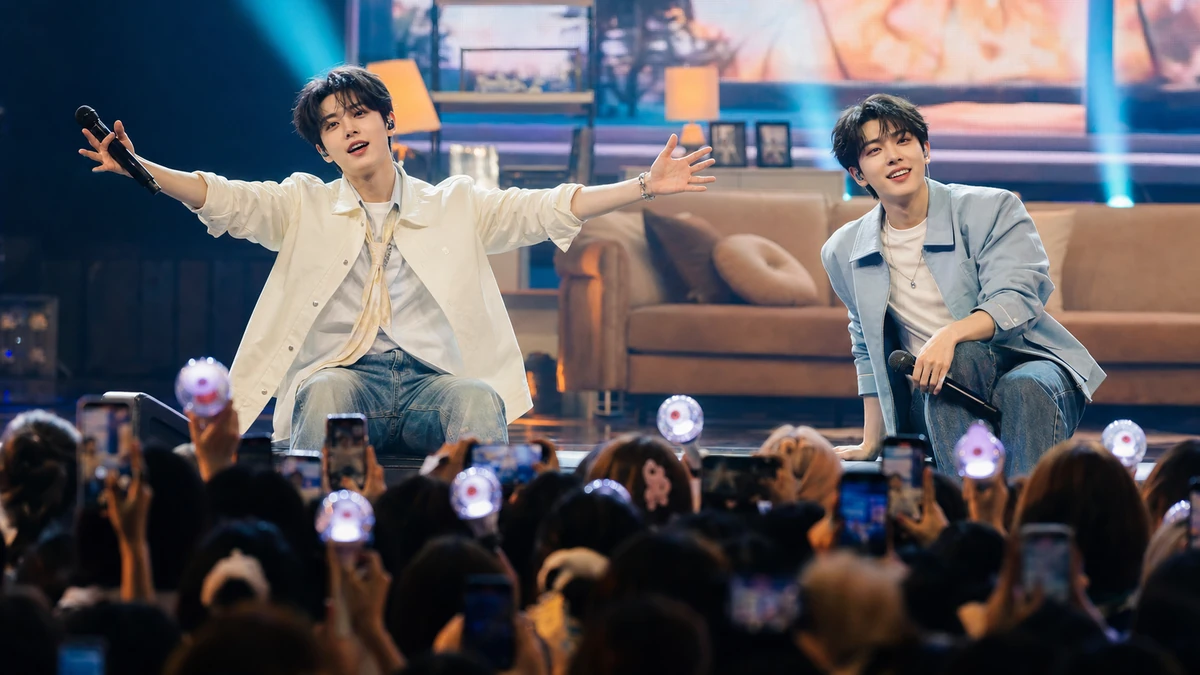
In the American pop business, the biggest headlines often belong to stadium sellouts, blockbuster festival sets and splashy chart debuts. But one of the more telling developments in global pop right now is happening in a smaller, more intimate format: the fan meeting. That is the backdrop for NCT members Renjun and Chenle, who opened a China fan meeting tour called ROOMMATE in Hangzhou on July 5, according to their agency, SM Entertainment.
The tour is scheduled to continue across five major Chinese cities — Beijing on July 11, Chengdu on July 17, Guangzhou on July 19 and Shanghai on July 25 — and, on its face, it may sound modest compared with a full-scale arena run. But in K-pop, these events carry a very specific kind of cultural and commercial weight. They are not simply meet-and-greets, and they are not conventional concerts either. Instead, they occupy a hybrid space where performance, conversation, improvisation and fan service are all part of the product.
That makes ROOMMATE worth watching beyond NCT’s own fan base. For English-speaking readers who may know K-pop mainly through polished music videos, synchronized choreography and sold-out world tours, this kind of event offers a clearer view of how the industry actually sustains loyalty. In a fan meeting, the point is not just to sing well or dance well. It is to create the feeling that the distance between artist and audience has narrowed, even if only for one evening.
The title ROOMMATE underscores that idea. In plain terms, it suggests shared space, comfort and familiarity — the sense that the stars are not remote celebrities on a giant stage, but people close enough to joke with, react to and emotionally read in real time. In American terms, think less of a stop on a major touring cycle and more of a carefully designed live experience that blends the intimacy of a podcast taping, the excitement of a variety show and the emotional payoff of a fan convention panel.
That distinction matters because K-pop has become increasingly sophisticated about how it meets fans where they are. If stadium concerts showcase scale, fan meetings showcase precision. They are built around not just the artist, but the exact emotional experience a fandom wants.
Why Renjun and Chenle are the natural faces of this tour
Renjun and Chenle are Chinese members of NCT, the sprawling boy group developed by SM Entertainment, one of South Korea’s biggest entertainment companies. For readers unfamiliar with NCT, the group is best understood not as a fixed band in the traditional Western sense, but as a larger brand ecosystem with multiple units, shifting combinations of members and a structure that allows for regionally tailored activity. That system can look complex from the outside, but its core logic is simple: meet fans through the language, format and lineup that make the most sense for them.
That helps explain why Renjun and Chenle are front and center for this China tour. Their role is not symbolic. It is practical, emotional and strategic all at once. Fan meetings depend heavily on spontaneous interaction: a quick joke, a candid aside, a playful challenge, a moment of gratitude that lands without the delay or distortion of translation. When artists and fans share a native language and cultural shorthand, those moments become smoother and more meaningful.
In many parts of the global music business, multilingual ability is a bonus. In K-pop, it is often infrastructure. It changes how artists can host, tease, reassure and perform. A joke that might seem small on paper can become a defining memory if it is delivered naturally and received instantly. So can a sincere thank-you. In that sense, putting Renjun and Chenle at the front of a China fan meeting tour reflects a mature phase of K-pop globalization: not simply exporting Korean pop abroad, but adapting the point of contact to local fans with ever finer detail.
That approach is especially notable because both artists occupy multiple identities at once. They are K-pop idols working within a South Korean entertainment system, members of a globally recognized group and Chinese performers engaging directly with Chinese-speaking audiences. Rather than treating those identities as conflicting, the tour appears to use them as an advantage. The result is not a generic overseas stop, but an event built around cultural fluency.
For American audiences, there is a useful comparison here to the way Hollywood or the sports world increasingly values authentic market connection. A celebrity appearance in Miami might look different from one in Mexico City, and a star athlete speaking directly to a hometown crowd carries a different effect than a scripted media availability. K-pop has pushed that logic further than most entertainment industries, and ROOMMATE is one more example of how deliberate that process has become.
What a fan meeting means in K-pop culture
The phrase “fan meeting” can be misleading in English because it sounds smaller and simpler than what it usually is. In K-pop, a fan meeting is a recognized event format with its own expectations and rituals. It typically includes live performances, talking segments, games, themed corners, audience interaction and moments designed less for spectacle than for intimacy. The atmosphere tends to be warmer and more conversational than a concert, even when the production values remain high.
SM Entertainment said Renjun and Chenle would communicate closely with local fans and present special stages and segments. That wording is standard in K-pop promotion, but it points to something specific. These segments are often where fandom culture comes alive: unscripted reactions, inside jokes, personal stories and activities that feel unique to the room. In an age when nearly every song clip and stage performance is available online within minutes, the value of an event increasingly lies in what cannot be fully replicated on a screen.
That is one reason fan meetings matter so much to devoted supporters. They offer proof of relationship, not just popularity. A concert can demonstrate demand at scale. A fan meeting can demonstrate connection. For a fandom, those are not the same thing. The emotional architecture of K-pop has long depended on making fans feel seen, and these events are one of the clearest ways the industry operationalizes that feeling.
American pop has its own versions of this dynamic, from Comic-Con panels to VIP acoustic sessions to fan cruises and creator conventions. But K-pop treats the format with an unusual degree of discipline. It is not an afterthought added to a promotional cycle. It is a core component of how artists maintain visibility and deepen loyalty between larger releases and tours.
The name ROOMMATE is therefore more than branding. It signals the event’s emotional promise. Rather than emphasizing distance, glamour or star power, it emphasizes shared presence. In a media environment flooded with livestreams, fancams, short-form clips and AI-assisted translation, that kind of in-person emotional specificity has become more valuable, not less. The promise is simple: for a few hours, fans are not just watching Renjun and Chenle; they are inhabiting the same atmosphere.
How individual music careers strengthen the pitch
The timing of the tour also matters because it overlaps with each member’s individual music activity in the Chinese-language market. According to the summary provided by SM Entertainment, Renjun released the Chinese special mini-album Echoes Between Us last month, while Chenle previously released the Chinese special mini-album Chan in May of last year. That means the tour is not functioning solely as a group-branded event under the NCT umbrella. It also serves as a space where fans can encounter the members as artists with their own musical identities.
That may sound obvious, but it reflects another important shift in K-pop. Increasingly, fandom does not operate only at the group level. Fans may support a full group while also following specific members’ solo or specialized projects, often with close attention to each artist’s vocal style, genre preferences and career path. In Western terms, it is a little like following a beloved ensemble cast while also tracking each actor’s side projects — except in K-pop, that parallel structure is baked into the business model and heavily integrated into fan culture.
So a fan meeting like ROOMMATE can carry multiple layers of meaning at once. A fan might attend because they love NCT. Another might be particularly invested in Renjun’s recent release. Another might want to see how Chenle’s solo material informs his stage presence in a more personal setting. The event becomes a live crossroads where group identity and individual artistry reinforce each other.
That is particularly effective in a setting built around conversation and special stages. A large concert can showcase polished songs and choreography. A fan meeting can contextualize them. It allows artists to talk about their work, react to fan responses and shape how those songs live in memory. For fans, the experience is not just hearing music again. It is hearing it in the presence of the person who made it, with all the little stories and expressions that streaming platforms cannot capture.
For the broader industry, this is another sign of how K-pop monetizes emotional continuity. Instead of treating an album release and a live event as separate chapters, the system links them. The fan meeting becomes part performance, part narrative extension. It is a place where the afterglow of a release can be experienced socially and in person.
A five-city route that reveals a larger strategy
The itinerary itself also tells a story. Hangzhou, Beijing, Chengdu, Guangzhou and Shanghai are not just random stops on a map. They are major urban centers with distinct regional identities, consumer cultures and fan communities. By visiting multiple cities instead of anchoring everything to a single marquee event, the tour treats Chinese fandom not as one giant undifferentiated market, but as a network of local audiences with their own energy and access needs.
That strategy has become increasingly important in global entertainment. It is not enough to know that you have fans in a country. The next level is understanding how they gather, travel, spend and participate city by city. A giant one-night event can create buzz, but a multi-city tour creates touchpoints. It distributes access more broadly and reinforces the sense that fandom exists in real communities, not just online metrics.
In the United States, music executives have long understood that New York, Los Angeles, Atlanta, Chicago and Dallas are not interchangeable markets. K-pop companies are now applying a similarly granular lens abroad, often with even more intentionality because their business depends so heavily on organized fandom behavior. Fans do not simply consume; they mobilize, travel, document and amplify. Meeting them in person across several cities is a way of respecting — and strengthening — that structure.
The route also highlights a broader truth about K-pop’s global expansion: digital reach is no longer the whole story. For years, the industry’s international rise was often framed through online virality — YouTube views, social media fandoms, livestreams and algorithm-friendly snippets. Those remain important, but they are only one layer. What ROOMMATE suggests is that K-pop’s next phase is about refining offline contact with the same precision it once applied to digital distribution.
That is especially relevant in a fandom economy where clips can travel worldwide in seconds, but the deepest forms of loyalty are still often forged in person. Eye contact, shared laughter, a brief unrehearsed exchange, the feeling of having witnessed something that happened only in that room — those are old-fashioned forms of live entertainment value, and they are proving remarkably durable in the streaming era.
What this says about the future of global K-pop
It would be easy to dismiss a fan meeting tour as a niche event aimed only at committed fans. In one sense, that is true: these gatherings are built for people who are already invested. But that is precisely why they matter. They show where the industry believes value will continue to grow. And increasingly, that value lies not only in massive exposure, but in increasingly customized relationships between artist and audience.
For NCT, the Renjun-Chenle ROOMMATE tour is a concrete example of how a global group translates international identity into lived fan experience. The formula is straightforward but effective: take artists who can communicate directly with local audiences, place them in a format designed for emotional proximity, connect the event to their individual musical work and bring the experience across multiple cities rather than limiting it to a single flagship stop.
For American readers, the larger takeaway is that K-pop’s power is not just about catchy hooks, polished visuals or record-breaking fandom statistics. It is about system design. The industry has become remarkably adept at creating different layers of engagement for different kinds of fans: blockbuster for the casual observer, richly interactive for the devoted one. A tour like ROOMMATE sits in that second category, where loyalty is not merely counted but cultivated.
There is also a softer cultural point here. At a moment when much of entertainment is organized around scale, speed and frictionless digital access, fan meetings reassert the value of presence. They slow things down just enough to allow for recognition, conversation and warmth. That may sound simple, but in a heavily mediated celebrity economy, simplicity can be powerful.
SM’s description of the events emphasizes friendly communication, special stages and tailored segments. That language may be promotional, but it captures something real about why these tours resonate. They are not asking fans merely to watch. They are asking them to feel included. The title ROOMMATE works because it turns that promise into a metaphor Americans can easily understand: not the unreachable idol on a pedestal, but the familiar figure sharing your space.
As K-pop continues to mature as a global force, that kind of intimacy may become one of its most durable exports. The genre’s international success was built in part on spectacle. Its staying power may depend just as much on closeness. In Hangzhou, and soon in Beijing, Chengdu, Guangzhou and Shanghai, Renjun and Chenle are putting that theory into practice one room at a time.
More than a tour stop, a blueprint for fandom
Seen from a distance, this may look like one more entry on a crowded summer entertainment calendar. Seen more closely, it looks like a blueprint. K-pop is no longer simply crossing borders; it is learning how to inhabit them with greater nuance. That means recognizing when language matters most, when a smaller room can do more than a larger arena and when fans want a story they can personally enter rather than just observe.
That is why the launch of ROOMMATE in Hangzhou carries meaning beyond a single date. It reflects an industry that understands fandom not as passive admiration, but as a relationship requiring upkeep, creativity and adaptation. It shows how major entertainment companies like SM are fine-tuning live experiences for specific audiences instead of relying on one-size-fits-all global branding. And it reinforces a point that anyone trying to understand the Korean Wave should keep in mind: the engine of K-pop is not only performance. It is proximity.
For longtime followers of NCT, the appeal of Renjun and Chenle’s tour may be obvious. For newcomers, the significance is broader. The event reveals how Korean pop keeps evolving in ways that are both highly modern and surprisingly old-school. The technology around it may be global, instantaneous and data-driven. But the emotional premise is timeless: people want to feel close to the artists they love.
That desire is hardly unique to K-pop, of course. Americans line up for comic conventions, book signings, intimate theater runs and fan weekends for the same reason. What K-pop has done especially well is turn that instinct into a disciplined, repeatable model that scales internationally without losing its sense of personal attention. ROOMMATE is the latest evidence that the model still has room to grow.
And in that sense, the story is not only about two NCT members greeting fans in five Chinese cities. It is about where global pop is heading: toward experiences that feel smaller, warmer and more specific, even as the industry around them gets bigger. If the last decade of K-pop taught the world how powerful spectacle can be, tours like this one suggest the next lesson may be about intimacy.
Comments
Post a Comment