K-pop group idntt bets on the power of 20 for its next chapter, turning scale into part of the story
A rookie K-pop act is making its size part of the pitch
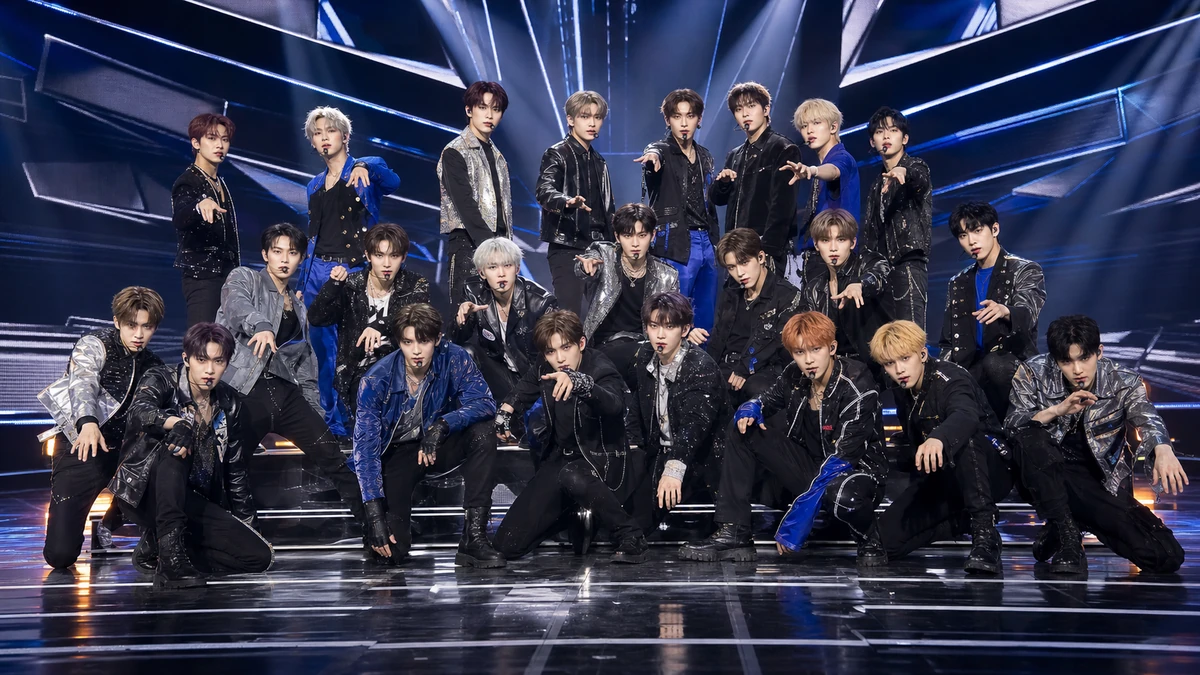
In American pop, a big group usually means a nostalgia tour, a TV competition spinoff or a one-time collaboration. In K-pop, though, size itself can be a creative strategy. That is the idea behind idntt, a South Korean boy group preparing to release a new album, itsnotover, on July 13, 2026, with 20 participating members.
According to the group’s agency, Modhaus, the album is not just another comeback, the K-pop industry term for a new promotional cycle. It is being framed as an expansion of the group’s ongoing story, one that links its music, choreography and member structure into a single concept. The title says as much: itsnotover is meant to signal continuation, not reset.
That matters because idntt is not built like a typical American pop act, where the lineup is fixed and the question is whether the songs land. The group has a total roster of 24 members, but not all of them perform in every release. Earlier promotions featured seven members, then 15. This time, 20 will take part, creating a much denser stage picture and a more ambitious visual grammar.
For U.S. readers who may know K-pop mainly through BTS, Blackpink or the now-standard image of tightly synchronized groups of five to nine people, a 20-member release can sound almost excessive. But in South Korea’s idol system, large lineups are not automatically treated as gimmicks. They can be a way to create subunits, rotate performers, widen a group’s sonic palette and, crucially, make choreography feel cinematic. In that sense, idntt is leaning into a longstanding K-pop strength: turning performance into event.
The group debuted last August, making it a relative newcomer even by the fast-moving standards of the Korean music business. Rookies are often under pressure to define themselves quickly, before the market moves on to the next launch. Idntt’s answer appears to be scale with purpose. Instead of merely announcing that more members will be onstage, the group and its label are presenting that expansion as part of the emotional logic of the album itself.
If that sounds unusually conceptual, it is because K-pop often sells not just songs but narrative worlds. Fans are asked to follow growth arcs, recurring themes and evolving identities across multiple releases. Idntt’s newest project fits squarely within that playbook, but with an extra wrinkle: the group’s fluctuating head count is part of the storytelling.
Why 20 members matters in K-pop, and why it is more than a headline number
To an American audience, the first reaction to a 20-member boy group may be practical. How do listeners learn everyone’s name? How are lines divided? How can a stage avoid looking crowded? Those are fair questions, and K-pop companies are well aware of them. But the answer is that large groups are designed to be understood differently from smaller acts.
With seven members, individual tone and personality tend to come through more clearly. Fans can track who takes the chorus, who handles the rap break, who anchors the center of the dance formation. With 15 or 20 members, the focus shifts. The unit of meaning is not just the individual performer but the movement of the collective: how members fan out, collapse inward, swap positions and create striking shapes in real time. It is closer, in some ways, to watching a halftime show or a Broadway ensemble number than a conventional boy band performance.
That is the promise idntt is making with itsnotover. The agency says the larger lineup will deliver a more dynamic performance, and that claim is not hard to imagine. In K-pop, choreography is often treated as a parallel language to the music. A formation change can convey tension, unity, vulnerability or triumph just as clearly as a lyric can. With 20 members, the possibilities multiply. A song about return can look like a crowd gathering. A song about chaos can feel fragmented before snapping into order. The eye reads the arrangement before the ear has finished processing the beat.
For that reason, large-group K-pop is not simply about having more bodies onstage. It has its own performance logic. Who steps forward in a key moment? Which members mirror one another? How does the center rotate? When the chorus hits, does the formation widen like a victory lap or tighten like a huddle? Those choices become part of the song’s meaning.
Idntt’s progression from seven to 15 to 20 suggests the group is being introduced in expanding layers. Rather than debuting all 24 members at once and risking audience overload, the rollout has gradually widened the lens. That strategy allows fans to build familiarity while preserving the sense that the full story has not yet been revealed. In an industry that thrives on anticipation, that may be as important as the music itself.
There is also a commercial reality behind the format. Larger groups can reach more niches within fandom, whether through different vocal colors, visual styles or personality types. But even when the business logic is obvious, the best K-pop acts make it feel artistically motivated. Idntt’s challenge now is to prove that 20 is not just more, but better for this particular moment.
An album built around youth, momentum and emotional whiplash
What stands out about itsnotover is that it is not being sold as a one-note blast of confidence. Modhaus says the album continues and expands the group’s previous narrative while placing sharply different emotions side by side: youthful bravado, forward motion, romantic confusion and the unsettled intensity of falling in love.
That emotional spread is familiar territory in youth-oriented pop, but K-pop often packages it with unusual precision. Albums are not always understood as loose collections of songs. They can function more like mood sequences, with intros, title tracks and B-sides each assigned a narrative role. In idntt’s case, the material appears designed to capture youth not as a stable identity but as a set of collisions: confidence and uncertainty, freedom and obsession, group belonging and private confusion.
That complexity is especially notable for a rookie act, because new groups are often encouraged to establish a narrow, easily marketable image first. One release may be all swagger, another all sweetness, another all angst. Idntt seems to be attempting something broader. The group’s concept here is not merely that it is energetic, but that youth itself can be contradictory. That is a more interesting, and riskier, proposition.
The album title helps unify those contrasts. itsnotover plainly means the story is still unfolding. In practical terms, that links the new release to the group’s earlier work. But thematically, it also captures a familiar coming-of-age sentiment: the feeling that whatever confusion, heartbreak or triumph you are living through right now is not the end of the road. There is another turn coming, another version of yourself still forming.
That message is likely to resonate with the audience K-pop depends on most, especially teenagers and young adults navigating change at high speed. But it also speaks to the broader appeal of the genre in the United States and elsewhere. K-pop’s polish can make it seem hyper-controlled from the outside, yet many of its biggest successes are built on emotional instability: wanting more, feeling too much, not knowing who you are yet. The contradiction is part of the draw.
With idntt, the emotional whiplash is reinforced by the group’s unusual structure. The story continues, but the voices carrying it become more numerous. The cast literally grows as the narrative expands. That is a clever conceptual move, assuming the songs themselves are strong enough to support it.
‘Kids Return’ aims to turn reunion into a rallying cry
The album’s title track, Kids Return, is described as a song about boys coming back together and pooling their strength. That message is direct enough to travel across borders. Even listeners with no background in K-pop will recognize the appeal of a return anthem, especially one tied to a larger cast and a more ambitious stage show.
The phrase “return” carries extra weight in Korean pop culture. Because comeback cycles are so central to the industry, a return is never just a release date on the calendar. It is a new chapter, often supported by a fresh visual concept, new styling, weeks of teaser content and carefully planned performances on music shows. In other words, “return” is both an emotional promise and a marketing engine.
In idntt’s case, Kids Return appears to tie the album’s themes together in the clearest way. The members are back, but not in the exact same form. There are more of them now, and that expanded presence is part of the song’s meaning. The group is not only saying it has returned; it is staging that return as a collective declaration.
The agency says the track combines a free-spirited atmosphere with unexpected turns, creating a distinctive tension. That description suggests a song that avoids a straightforward, feel-good march. If the arrangement keeps shifting or subverts listener expectations, it could prevent the anthem from becoming too tidy. That would fit the album’s larger interest in youth as something unruly and unsettled rather than simply triumphant.
Visually, Kids Return may be where idntt’s 20-member structure pays off most clearly. Large groups can make songs about solidarity feel literal. The camera can pull back and show the scale of the unit. Choreography can dramatize the act of gathering, dispersing and regrouping. American audiences may think of sports team introductions, drumline precision or the communal lift of a festival crowd. K-pop translates that same sense of collective force into tightly controlled stage design.
The title also has a slightly wistful edge in English, even if the intended meaning is more straightforward. “Kids” evokes youth, unfinished identity and maybe a refusal to surrender some earlier spark. In that sense, the song sounds positioned between nostalgia and defiance. It is not only about return, but about returning with proof that the story still has momentum.
The supporting tracks deepen the group’s message
If Kids Return is the headline, the surrounding songs appear designed to explain the world it lives in. The intro track, Twenty, wears its mission openly: it shares its title with the number of members participating in this release. That kind of literal naming can seem blunt, but in pop it can be effective when the goal is to make an entrance.
According to the release details, Twenty pairs rock sounds with forceful vocals. For American listeners, that may be one of the easiest gateways into the project. K-pop is often stereotyped abroad as glossy dance-pop, but rock textures have been increasingly common in the genre, whether as full-throttle arrangements or as accents added to electronic production. A rock-leaning intro can signal urgency, grit and motion before the main story begins.
Just as important, the song appears to function as a roll call of identity. The album title says the journey continues; Twenty says who is carrying it forward right now. That is a smart bit of sequencing. Instead of hiding the group’s unusual size, idntt opens by foregrounding it. The number becomes a statement rather than a footnote.
Another track, Run It Up, is described as capturing boys racing forward without hesitation. In the architecture of this album, that sounds like the purest expression of youthful charge. If Kids Return is the moment of gathering and reentry, Run It Up is what happens next: momentum, ambition and movement without pause.
That phrase “without hesitation” matters. Pop music about youth often romanticizes uncertainty, but there is a powerful countertradition built on acceleration, the fantasy of knowing exactly when to leap. For a rookie group still establishing itself, that can read as both theme and mission statement. Idntt is not just singing about charging ahead; it is effectively doing so in public, scaling up its member participation with each major activity.
Then there is Lovestruck, which brings the emotional temperature into more complicated territory. The song is said to depict confusion and obsession in the moment of falling in love. That makes it a useful counterweight to the album’s more outward-facing tracks. Confidence, teamwork and motion are all classic boy group currencies. But confusion, fixation and emotional imbalance are what keep a youth concept from feeling too polished to be believed.
For listeners in the United States, the contrast may recall the way many young pop acts toggle between swagger and vulnerability, between songs that sound ready for the stadium and songs meant for headphones at 1 a.m. Idntt’s framing suggests it wants both. The result, at least on paper, is an album that treats youth as a broad emotional field rather than a brand adjective.
How American listeners can read the bigger picture
There is a temptation in Western coverage of K-pop to reduce stories like this to novelty: a 20-member group, a labyrinth of lore, an album title rendered in all lowercase, an agency selling scale as spectacle. But that lens misses what has made Korean pop such a durable global force. The genre succeeds not just because it is different, but because it has refined forms of pop storytelling that American music often handles more loosely.
One of those forms is the integration of song, image and serialized narrative. Another is the treatment of performance as a primary text, not a secondary promotional tool. In much of mainstream U.S. pop, the definitive version of a song is the audio stream. In K-pop, the definitive version may be the live stage, the performance video or the fancam that lets fans focus on a single member. A group like idntt is built for that ecosystem.
Its shifting member count also reflects a specifically Korean idol logic that can be surprising to newcomers. In the U.S., lineup changes often signal instability or internal trouble. In K-pop, especially with large groups, variation can be built into the design. Different members may take part in different units, concepts or promotional phases. That does not eliminate the challenges of balancing visibility and fan attachment, but it does change the baseline assumption. Flexibility can be part of the brand.
There is also something distinctly contemporary about the idea of a group whose identity is modular but still emotionally coherent. In an era when audiences consume artists through clips, compilations, reaction videos and algorithmic fragments, pop acts are under pressure to be many things at once. Idntt’s answer appears to be multiplicity turned into structure: more members, more angles, more emotional registers, but one continuing narrative.
Whether that works in the long term will depend on execution. Large groups face obvious risks. Individual members can struggle to stand out. Songs can feel overstuffed. Concepts can become more memorable than melodies. And as K-pop continues to expand globally, agencies must balance intricate domestic fan culture with the need to remain legible to casual international audiences.
Still, idntt’s upcoming release offers a useful snapshot of where the genre remains inventive. Even after K-pop became a mainstream export, its companies did not stop experimenting with form. Some groups chase intimacy. Others chase lore. Idntt is chasing scale, but with a narrative argument attached: that more voices, more movement and more emotional contrast can push a young group’s story forward rather than dilute it.
A test of whether concept and craft can meet
Ultimately, itsnotover will succeed or fail on the same grounds as any other pop release. Are the songs memorable? Does the title track justify the buildup? Can the performers turn concept into feeling rather than leaving it as a clever diagram? Those questions matter more than the novelty of the number 20.
But the number is still meaningful, because it tells us how idntt wants to be seen at this stage of its career. Not as a static rookie group, but as a project unfolding in public. Not as a neat, fixed lineup, but as an expanding collective. Not as a single mood, but as a set of competing emotions gathered under the banner of youth.
For an American audience still learning the finer points of K-pop’s internal logic, that makes idntt a useful case study. The group shows how deeply the industry can bind together structure and story. A lineup is not just a lineup. A comeback is not just a release. A choreography pattern is not just decoration. In Korean pop, those things can all function as narrative devices.
The title itsnotover may sound like a broad statement, but in context it is a precise one. The story that began with fewer members has not finished unfolding. The stage is getting fuller. The emotional palette is getting wider. The group is betting that audiences will want to watch that expansion happen in real time.
That is an ambitious wager for a boy group that debuted less than two years ago. It may also be the right one. In a crowded global pop market, the hardest thing is not making noise. It is giving that noise shape, momentum and a reason for people to keep following. Idntt’s next release suggests the group understands that challenge. The question now is whether 20 members can make that understanding feel exhilarating rather than merely impressive.
On July 13, listeners will get their answer. For now, what is clear is that idntt is presenting its growth not as background information, but as the story itself. In a genre built on precision, repetition and reinvention, that is a compelling way to announce that the next chapter has arrived — and, as the title insists, that it is not over yet.
Comments
Post a Comment