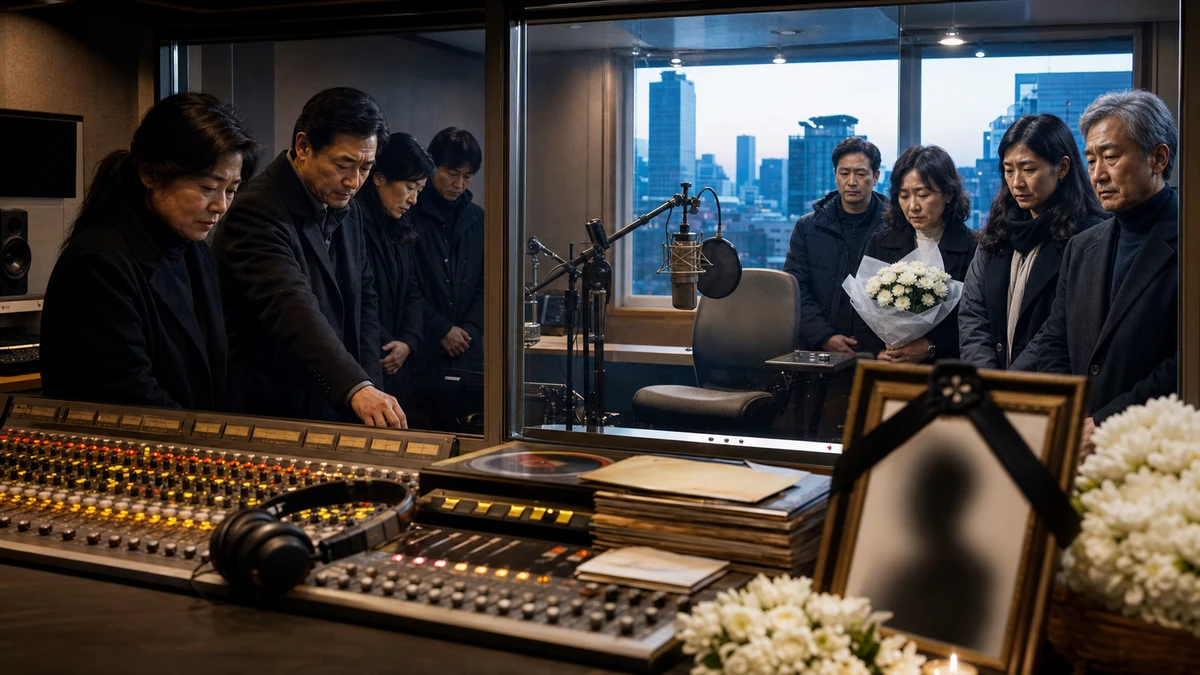
A radio architect behind half a century of Korean pop
Kim Ki-wook, a veteran South Korean radio producer whose career traced the rise of the country’s modern pop music industry from the analog age to the era of K-pop, has died at 78. Family members said he died early Monday at Eunpyeong St. Mary’s Hospital in Seoul after suffering a cerebral hemorrhage.
To many Americans, the names most associated with the global Korean Wave are likely to be BTS, Blackpink, or the Oscar-winning director Bong Joon Ho. But inside South Korea, especially among people who grew up before YouTube, Spotify and social media transformed music discovery, figures like Kim occupied a different kind of cultural importance. He was not a singer, actor or celebrity host. He was one of the people behind the microphone and behind the control board — the producer deciding which voices and songs would reach the public, and how they would be heard.
That may sound like a niche role to readers used to algorithm-driven playlists and on-demand streaming. Yet for much of the late 20th century, radio producers in South Korea had an outsize influence on popular culture, much like top program directors at influential American radio stations once did during the heyday of Top 40, adult contemporary and morning drive programming. Kim belonged to that generation. Over roughly five decades at TBC, KBS and later the community-oriented station Gwanak FM, he helped shape the soundscape of everyday life for Korean listeners.
His death has prompted an outpouring of remembrance from colleagues in broadcasting and popular music, not simply because of his longevity, but because his life intersects with a larger history: the period when Korean popular music, long before it became an international export, relied on radio as one of its most powerful pipelines to the public.
In South Korea, where broadcast media once served as a central cultural meeting place in homes, taxis, storefronts and offices, Kim’s career represented a bridge between national broadcasting and neighborhood radio, between the country’s entertainment establishment and ordinary listeners. In that sense, his passing is not only the death of a veteran producer. It is also the loss of a witness to how Korean popular culture was built.
From the TBC era to KBS, Kim’s path followed Korean broadcasting history
Born in 1948 in Masan, a port city in South Gyeongsang Province in southeastern South Korea, Kim studied at Kyungbok High School and later majored in journalism and mass communication at Kyung Hee University, according to Korean reports. He entered radio production in the mid-1970s at TBC Radio, beginning what would become a 50-year career in music and entertainment programming.
His biography matters in part because it mirrors a major turning point in South Korean media history. In 1980, under the military government of Chun Doo-hwan, the country underwent a sweeping broadcast consolidation. TBC, one of the major private broadcasters of the era, was absorbed into the public broadcaster KBS. For American readers, a rough comparison might be the forced restructuring of a major media network under government pressure — an event that changes not only corporate ownership but also the creative lives of everyone working there.
After that consolidation, Kim continued his career at KBS 2 Radio and KBS 2FM, remaining active in music programming even as Korean society, politics and entertainment rapidly changed. He worked during the years when South Korea was urbanizing at high speed, when consumer culture was expanding, and when radio still occupied an intimate place in daily routines. Listeners woke up with it, studied with it, drove with it and fell asleep to it. That intimacy made producers especially important. Unlike television, radio depended almost entirely on tone, timing and emotional atmosphere.
Colleagues remembered Kim as someone who excelled in exactly those less visible dimensions of broadcasting. Yoon Seok-hoon, a former junior colleague at KBS who now serves as a center director at Gwanak FM, described him as a producer who consistently led music, entertainment and variety programming during radio’s golden age and likened him to a godfather figure in the Korean pop world.
That description points to a broader truth about radio culture in South Korea. Producers were not simply technicians or schedulers. They functioned as tastemakers, gatekeepers and interpreters of public mood. Which song aired in the morning versus late at night, which host’s voice matched which audience, how much conversation to place between records, how to balance familiarity and surprise — all of those decisions shaped a program’s identity. Long before “curation” became a buzzword in Silicon Valley, radio producers were practicing it every day.
Kim’s resume included well-known KBS programs such as “Good Morning Pops,” a long-running English-learning show associated with host Oh Seong-sik, and “Raise the Volume,” known in Korean as “Volume-eul Nopyeoyo,” a youth-oriented music program once hosted by Yvonne. To American readers, the pairing may seem eclectic: one show built around English-language pop songs and language learning, another tied to youth music culture and emotional companionship. But that range reflects how radio functioned in South Korea. It was educational, entertaining and companionable all at once.
Why radio mattered so much in South Korea before the streaming age
To understand why Kim’s death resonates beyond the broadcasting industry, it helps to understand the role radio played in South Korea’s cultural development. Today, K-pop is often experienced through highly visual media: choreographed music videos, social media clips, polished live performances and fan content circulating across global platforms. But in earlier decades, Korean pop music spread in more intimate and less image-driven ways. A new song often entered public consciousness through the radio.
That was true in the United States, too, during the eras of AM rock, FM album stations and syndicated countdowns. But in South Korea, radio also carried special weight because of the country’s compressed modernization. It served as a shared national soundtrack during years of rapid economic development and political change. It introduced songs, deepened parasocial bonds between audiences and performers, and created habits of listening that were woven into ordinary life.
For listeners, a radio program was not just content. It was part of a daily rhythm. Commutes, meal prep, exam study, small businesses and late-night loneliness all had their corresponding radio hours. Producers like Kim had to think not only about music but about mood, pacing and trust. When colleagues say his influence was significant even if invisible, they mean he helped design the emotional architecture of listening.
That influence can be hard to explain in an age when the faces of entertainers dominate public attention and the labor behind programming is often hidden by software. But anyone familiar with the prestige of radio in America’s own past — whether at powerhouse local stations, public radio or era-defining music formats — can recognize the role. The producer may not appear on the album cover or the magazine profile, but the producer can determine whether a song becomes part of a listener’s life.
In South Korea, that function was especially consequential during the formative years of the modern popular music industry. Before digital fandoms, before fan cams and global livestreams, radio connected artists, record labels and audiences. Airplay could shape first impressions of a new release. A thoughtful introduction from a trusted host could legitimize a singer. A program’s tone could frame how listeners understood an artist’s identity. In that system, producers like Kim occupied a quietly powerful position.
His colleagues’ memories suggest he handled that power with the sort of credibility that earns long-term respect in media circles. Trust, in this context, did not just mean professional competence. It meant an ear for music, a feel for audience expectations and a capacity to build lasting relationships across the industry.
His friendship with Cho Yong-pil captured an earlier chapter of Korean pop
One of the details that stands out in Korean tributes to Kim is his longstanding friendship with singer Cho Yong-pil, one of the towering figures in South Korean popular music. While Cho may not be a household name in the United States, in Korea he occupies a place comparable to a multi-generational icon — part Bruce Springsteen, part Billy Joel, part Elton John in terms of cultural endurance, though no American analogy is exact.
Born in 1950, Cho became one of the defining artists of modern Korean pop, admired across age groups and across changing musical eras. He is the sort of artist through whom Koreans often narrate the history of their own popular music. So when writers and colleagues say Kim was especially close to Cho, they are signaling more than a personal friendship. They are identifying Kim as someone deeply embedded in the ecosystem that shaped Korean pop at a foundational level.
Writer Hong Seong-gyu, who published a 2024 biographical work on Cho’s youth titled “Young Cho Yong-pil,” received a recommendation for the book from Kim. Hong later recalled that Kim and Cho were extremely close and suggested Kim may have been the producer closest to the singer. Yoon, the Gwanak FM executive and former KBS producer, made similar remarks.
In practical terms, that closeness reflects how radio once operated. Producers and artists were often in regular contact, not merely as publicists and programmers but as collaborators in building a public relationship with listeners. A producer had to understand not only the technical demands of a broadcast but also the personality of a performer, the emotional timing of a comeback and the expectations of fans. A successful producer could create the setting in which an artist felt authentic and a listener felt addressed.
For American readers who know Korean popular culture mainly through 21st-century idols and digital fandoms, this is a useful reminder that K-culture did not begin with virality. It was built over decades by institutions and individuals who nurtured artists in slower, less spectacular ways. Kim’s closeness to Cho places him within that longer lineage. He was not a star in front of the spotlight, but he was one of the people helping determine how the spotlight was aimed.
That matters because every global cultural boom has its prehistory. Hollywood had studio publicists and radio hosts before international red carpets. Nashville had local stations and producers before arena tours. Korean pop, too, had its infrastructure builders. Kim was one of them.
After national broadcasting, he turned to local radio — and never stopped working
What may be most striking about Kim’s career is that he did not treat local radio as a quiet retirement landing spot. After leaving KBS, he remained active in broadcasting and spent 17 years, from 2009 until recently, at Gwanak FM, a station rooted in Seoul’s Gwanak district. There he served in leadership roles including programming chief and head of radio, while also directly producing music shows such as “Live Gayo Tok Tok” and “Music Café of Memories.”
That second act says a great deal about both the man and the medium. In a broadcasting economy increasingly tilted toward giant platforms, video-centric entertainment and national branding, Kim continued to invest in local radio — the kind of outlet that meets audiences not through spectacle but through familiarity. If national broadcasting is about scale, local radio is about presence. It is the voice that knows the neighborhood, the station that accompanies residents in real time.
For Americans, the closest analogy might be the difference between a major network show and a beloved local public radio or community station with deep ties to its city. The audiences are smaller, but the relationship can be more immediate. In South Korea, where media can be highly centralized in Seoul, that kind of local broadcasting plays an important civic and cultural role.
According to Ahn Byung-cheon, head of Gwanak FM, Kim’s work ethic never softened. Ahn recalled that even on Labor Day or public holidays, Kim would say, “The more other people rest, the more we should be broadcasting.” It is the sort of remark that reveals a worldview. Kim seemed to regard broadcasting not only as a profession, but as a public promise. When people are home, traveling, lonely or in need of company, the radio should be there.
That ethic may sound old-fashioned, but it helps explain why radio remains emotionally potent even in highly digitized societies. Streaming offers choice; radio offers companionship. An algorithm can deliver a song. A live program can create the feeling that someone, somewhere, is awake with you. Kim’s decision to keep making music radio at the local level suggests he understood that distinction deeply.
It also reinforces the idea that his life was not just about career duration. Plenty of media professionals accumulate long resumes. Fewer remain devoted to the same essential craft through massive industry upheaval. Kim worked through the transition from analog to digital, from centralized mass media to fragmented platforms, from national broadcasters to community stations. He kept going.
A producer who stayed with the program until the end
The final details of Kim’s life have carried special emotional weight in South Korean coverage. According to Ahn, Kim spent three hours producing “Live Gayo Tok Tok” and “Music Café of Memories” on June 6. Two days later, on June 8, he was unable to get up from bed. He died the next day.
There is an almost literary quality to that chronology: a man who spent decades making familiar music available to others continued doing so almost to the very end. In obituaries, such details can sometimes feel overly symbolic. In this case, they seem to underscore how colleagues understood him. Broadcasting was not merely something he had once done. It was still his daily practice.
That is one reason producer obituaries can carry a different kind of sadness from those of actors or singers. When a performer dies, the public often mourns a face, a voice or a catalog. When a producer dies, what disappears is less visible but no less real: a sensibility, a standard, a set of instincts about how to treat artists, how to pace a program and how to respect listeners’ time. Those things do not always transfer easily, even inside the same institution.
Kim’s career encompassed both what Koreans often call the “golden age” of radio and its more precarious contemporary local form. That means his death also invites reflection on the continuity between those eras. The Korean Wave that now dominates global entertainment headlines did not emerge from nowhere. It grew from decades of domestic media work — from studio crews, producers, writers, hosts and engineers who built sustained listening habits before Korea’s cultural products became global exports.
For a younger international audience, that may be the most revealing part of the story. K-culture’s success can sometimes seem sudden when viewed from abroad, as if South Korea’s entertainment power materialized overnight with the help of the internet. In reality, the international boom rests on older foundations. Kim represented one of those foundations: the infrastructure of care, repetition and editorial judgment that made popular music part of ordinary life long before it became a worldwide phenomenon.
What his life says about the roots of the Korean Wave
In the age of Netflix hits, sold-out stadium tours and meticulously globalized pop groups, it is easy to focus only on the stars. But cultural industries are ecosystems. They depend on the visible and the invisible, on marquee performers and on the professionals who create the conditions for audiences to connect with them. Kim’s life is a reminder that one of the Korean Wave’s roots lies in radio — a medium that trained listeners to form habits around Korean music, personalities and stories.
That history matters for American readers because it complicates the common narrative of K-culture as purely a digital-age export machine. The Korean Wave, or “Hallyu” as it is known in Korean, refers to the global popularity of South Korean cultural products, including music, television dramas, film, beauty brands and fashion. But Hallyu did not begin globally. It began domestically, through institutions that cultivated local audiences first. Radio was one of the most important of those institutions.
Kim’s career makes that point vividly. He moved from a major broadcaster linked to an earlier phase of state-shaped media history, to KBS, one of the country’s flagship public broadcasters, and then to community radio. Along the way, he worked on programs that touched education, youth culture and mainstream music. He maintained relationships with major artists. He continued live broadcasting into his late 70s. Taken together, those facts tell a story not only of personal dedication but of how Korean popular culture grew layer by layer.
There is also something distinctly moving about the modesty of his public profile. In an entertainment age that often rewards personal branding above all else, Kim appears to have represented an older broadcast ideal: the producer as steward. His success was measured not in followers or fame, but in the durability of the programs he shaped and the trust he earned from colleagues and artists.
South Korea’s broadcasting industry is mourning him accordingly. Reports said he is survived by his wife, Lee Chun-hee; a son and daughter, Kim Tae-ri and Kim Joon-seok; and a daughter-in-law, Go Doo-wan. A funeral hall was set up at Eunpyeong St. Mary’s Hospital in Seoul. The funeral procession was scheduled for Wednesday morning, with burial at Namhangang Park Cemetery.
For those outside Korea, Kim’s death may not register with the instant recognition that follows the loss of a chart-topping singer or internationally famous actor. But it deserves attention precisely because it illuminates a less visible truth about cultural power. Behind every music wave, every beloved radio hour, every generation’s soundtrack, there are people who make choices the audience rarely sees. Kim Ki-wook was one of those people, and for half a century in South Korea, his choices helped connect songs to lives.
In that sense, his legacy reaches beyond one station or one era. It lives in the listening habits that helped shape modern Korean pop — and, indirectly, in the global K-culture phenomenon the world now knows so well.
Comments
Post a Comment