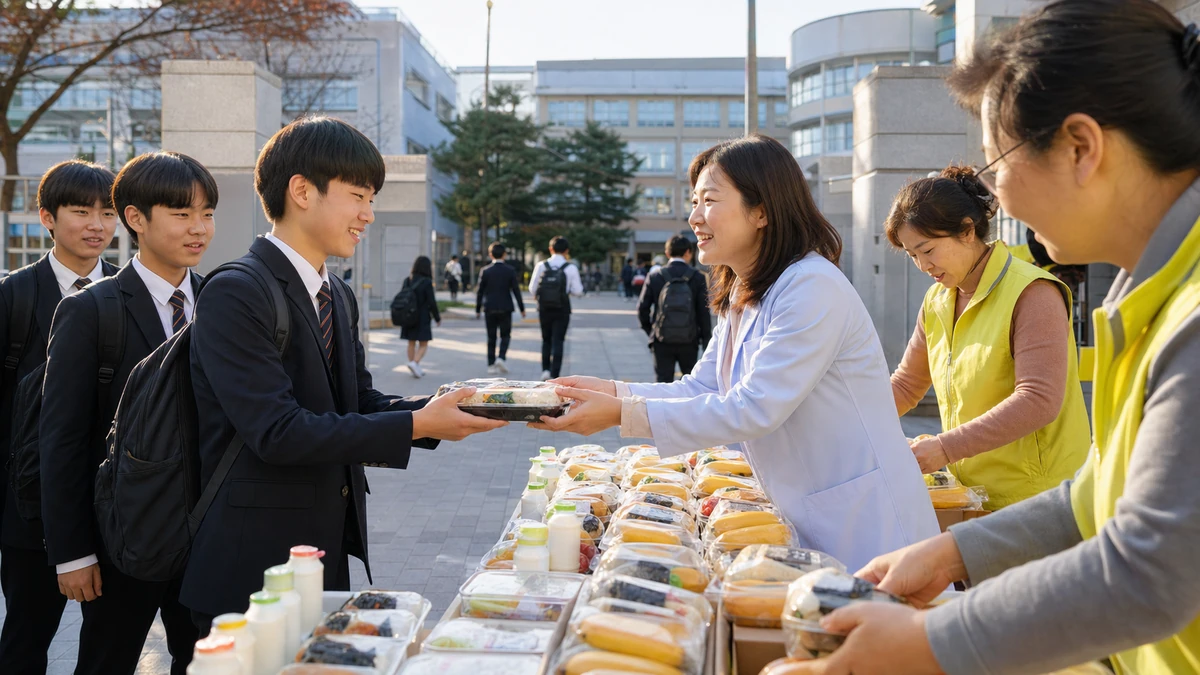
A small school event with a broader message
At a middle school in southeastern South Korea this week, local officials delivered a message that would sound familiar to many American parents, teachers and pediatricians: Teenagers should not skip breakfast. But the event in question was about more than reminding students to eat before class. It reflected a broader public health approach in South Korea, where local government agencies, agricultural cooperatives and mental health officials are increasingly treating daily habits like breakfast, sleep and emotional well-being as shared community concerns rather than purely private family matters.
The campaign took place at Samnam Middle School in Ulju County, a mixed urban-rural district within the larger industrial city of Ulsan. According to local officials, Ulju County’s public health center joined with the local branch of NH NongHyup, a major agricultural cooperative, and the county’s mental health welfare center to promote healthy eating and everyday wellness among adolescents. The centerpiece was a "breakfast eating campaign" aimed at encouraging students to start the day with a morning meal and to think more broadly about healthy routines.
In the United States, school breakfast initiatives are often framed around food insecurity, academic performance or childhood nutrition policy. In South Korea, those issues can overlap, but this campaign also carried a distinct message about rhythm and routine. Officials emphasized that breakfast is an important life habit for growing students, one linked not only to physical development but also to the ability to stay focused in class. Rather than centering on complicated diet advice, the campaign stressed a simple, practical behavior: Don’t skip breakfast.
That may sound obvious. But public health campaigns often succeed or fail on whether they ask people to make realistic changes. In that sense, the Ulju event was notable not because it unveiled a groundbreaking medical claim, but because it showed how local institutions are trying to meet teenagers in a place where daily habits are formed and reinforced: school.
Why breakfast has become bigger than a family issue
For American readers, it may be tempting to view this as a routine school nutrition message, something akin to a district wellness day or a handout from a school nurse. In South Korea, however, the symbolism is somewhat broader. The campaign suggests that breakfast is no longer being treated only as a matter of parental responsibility or individual choice. Instead, it is being framed as part of a larger public conversation about adolescent health.
That matters in a country where academic pressure is intense and students often have tightly structured days. South Korean teenagers frequently juggle full school schedules, after-school study sessions and long commutes, especially in metro areas. Even outside Seoul, students can face early mornings and demanding routines. In that environment, breakfast can become one of the first things squeezed out of the day.
Health officials in Ulju County appear to be responding to that reality with a practical strategy. Rather than telling students to overhaul their entire diet, they are focusing on one routine behavior that is easy to understand and, in theory, easier to adopt. The message is less about perfection than about consistency: A stable start to the day can support healthy growth and help students stay engaged in school.
That emphasis would resonate in the United States as well, where debates over children’s health often become tangled in larger political fights over processed food, school lunches, parental responsibility and social media-driven wellness trends. The South Korean campaign offers a different framing. It treats breakfast not as a culture-war issue, and not as a miracle cure, but as a small, manageable building block in a healthier daily structure.
Importantly, local officials did not present dramatic new data or promise measurable medical outcomes from this single event. The significance lies elsewhere: in the decision to elevate breakfast from an ordinary household matter into a community-backed health goal. In public health, that kind of framing can be powerful. It tells students that everyday choices are worth attention, and it tells families they are not expected to navigate those choices alone.
The Korean public health model behind the campaign
One reason this story stands out is that it highlights how South Korea’s local health system works at the neighborhood level. The lead organizer was the Ulju County Public Health Center, known in Korean as a "bo-geon-so." These centers are government-run local public health institutions, somewhat analogous to county health departments in the United States, though often more visible in day-to-day community life. They are involved not only in infectious disease response, but also in prevention, education, nutrition, exercise programs, screenings, counseling and mental health promotion.
For Americans accustomed to thinking of health systems primarily in terms of hospitals, insurers and private clinics, that local role is worth noting. In South Korea, public health centers often function as frontline institutions for lifestyle-oriented health campaigns. They are designed to reach residents where they live, study and work. That means health messages do not stay inside clinics. They move into schools, community centers and local events.
The Ulju campaign is a textbook example of that model. Instead of waiting for students or parents to seek out nutrition advice, the county brought the message directly onto a school campus. That kind of proximity matters, especially for teenagers. Health guidance is often more effective when it is delivered in familiar settings, using language that connects to everyday experience rather than abstract medical theory.
There is also a practical logic to choosing a middle school. Adolescence is a period when eating patterns, sleep habits and stress responses often become less predictable. Students are old enough to make some independent choices but still young enough for schools and families to shape routine. A campaign like this can therefore function as both education and early intervention, encouraging healthy habits before poor ones become entrenched.
The effort also reflects a preventive mindset. Instead of treating health only as the absence of illness, the campaign places value on habits that may support stability over time. That broader understanding of health, one that includes routine, behavior and emotional well-being, has become increasingly visible in many countries. In South Korea, local public institutions appear to be embracing it in concrete, school-based ways.
Why an agricultural cooperative was involved
For readers outside Korea, one unusual detail may be the participation of NH NongHyup’s local branch. NongHyup is South Korea’s massive agricultural cooperative network. It has roles in farming, finance, food distribution and local economic support, making it somewhat more expansive than what many Americans might imagine when they hear the word "co-op." In rural and semi-rural communities, it can be a highly visible institution with deep ties to everyday life.
Its involvement in a breakfast campaign therefore carries symbolic weight. It connects food, agriculture and public health in a way that feels logical in the Korean local-government context. The message is not merely that students should eat something in the morning, but that healthy eating is part of a larger community ecosystem involving producers, distributors, schools and health officials.
Ulju County, where the event was held, is not just another suburban district. It is often described as a mixed urban-rural area, meaning it includes both developed neighborhoods and agricultural land. That geography helps explain why a cooperative linked to farming would be a natural partner in a health promotion event. Food, after all, is not only a family concern or a consumer choice; it is also part of local identity and regional economic life.
Americans might compare this, loosely, to a county health department partnering with a school district and a regional farm bureau or food bank on a student nutrition initiative. The institutional structures are not the same, but the impulse is recognizable: Build health campaigns around existing local networks that people already know and trust.
The partnership also suggests that officials are thinking beyond one-off slogans. A campaign gains durability when it is backed by organizations that can reinforce it from different angles. A health center can provide education. A school can provide access to students. A cooperative can help connect the message to food culture and community resources. Together, those pieces turn a simple reminder into a coordinated public effort.
The mental health piece may be the most revealing
Perhaps the most striking aspect of the campaign was the involvement of the Ulju County Mental Health Welfare Center. That addition widened the frame from food and physical growth to overall well-being, including what Koreans often describe as "mind health" or emotional health. In practical terms, it signals a growing recognition that adolescent wellness cannot be divided neatly into separate boxes.
That integrated approach is increasingly familiar in the United States too. School districts, pediatricians and child psychologists often emphasize that sleep, nutrition, emotional regulation, academic stress and social life are intertwined. A teenager who is chronically tired may skip breakfast. A student under heavy stress may struggle with routine. A chaotic morning can affect mood and concentration for the rest of the day. None of those links are new, but institutions are becoming more deliberate about addressing them together.
The Korean campaign appears to reflect that same shift. Officials did not claim that eating breakfast would solve mental health challenges. Nor did they offer sweeping medical promises. Instead, the event suggested a more measured idea: Healthy routines can support both body and mind, and public institutions should encourage those routines in realistic ways.
That restraint is important. In an era of viral wellness claims and exaggerated lifestyle advice, the Ulju campaign seems to have stayed grounded. Its emphasis was on awareness and habit formation, not on overselling breakfast as a cure-all. For a public health effort aimed at teenagers, that may be the most credible approach.
There is also a cultural subtext here. South Korea has spent years expanding the public conversation around mental health, especially among young people. Stigma has not disappeared, but local governments and schools have increasingly tried to make mental health support more visible and more routine. By placing a mental health welfare center alongside a health center and a food-related institution, this campaign subtly reinforces the idea that emotional well-being belongs in ordinary community life, not just in crisis response.
Schools as the front line for everyday health habits
The choice of venue, Samnam Middle School, matters as much as the message itself. Schools are where adolescents spend most of their waking hours, and they are often where public policy becomes tangible. In classrooms and hallways, broad concepts like wellness, prevention and healthy living are translated into daily reminders, habits and social norms.
That is true in the United States, where schools have become sites for everything from vaccination drives to anti-vaping education to free meal programs. It is also true in South Korea, where school life is highly structured and institutions often play a significant role in shaping student routines. Bringing the breakfast campaign directly to a school allowed officials to deliver the message in the setting where students feel the effects of skipped meals most immediately: during the school day, when concentration and energy matter.
There is another advantage to school-based campaigns: They lower the barrier to engagement. Students do not need to visit a clinic, search for information online or interpret technical nutrition guidelines on their own. The message comes to them in a space they already inhabit. That accessibility is especially valuable for behavior-based health campaigns, where the goal is not specialized treatment but modest, repeatable action.
In this case, the action being encouraged was intentionally simple. Officials focused on the importance of not skipping breakfast, rather than prescribing a rigid menu or promoting highly specific dietary rules. That approach leaves room for differences in family schedules, economic circumstances and personal appetite. Not every student has the same commute, home environment or morning routine. A successful public campaign must account for that reality.
By emphasizing importance without dictating a one-size-fits-all solution, the campaign appears to have struck a balance between guidance and flexibility. For adolescents, that can be crucial. Health messaging that feels overly strict or disconnected from real life is easy to tune out. Messaging that feels achievable has a better chance of sticking.
What this says about Korea’s approach to teen well-being
Taken on its own, a breakfast campaign at a middle school may not sound like major news. But as a window into how South Korean communities are thinking about adolescent health, it is revealing. The event in Ulju County shows local institutions trying to build wellness from the ground up, through routine, partnership and repeated reinforcement rather than dramatic intervention.
It also speaks to a larger trend in public health, one visible well beyond Korea. Governments and local agencies are increasingly aware that many long-term health outcomes are shaped not only in hospitals, but in ordinary environments: schools, homes, neighborhoods and workplaces. Habits built there can influence everything from academic engagement to stress management to physical development.
For American audiences, the story may prompt a familiar question: Why does it take a community campaign to remind teenagers to eat breakfast? The answer is that modern adolescence, whether in South Korea or the United States, is shaped by pressures that can make basic routines surprisingly fragile. Packed schedules, digital distractions, sleep deprivation and performance anxiety all compete for time and attention. In that context, a steady morning routine is not trivial. It is one of the first markers of whether daily life feels manageable.
The Ulju initiative also offers a useful reminder that public health does not always have to arrive in the form of crisis management. Sometimes it looks like a local official visiting a school and repeating a point that sounds almost too basic to mention. Sometimes it looks like a partnership between health workers, agriculture-linked institutions and mental health staff. Sometimes it looks like treating a skipped breakfast as a signal that everyday structure itself deserves support.
That is ultimately what makes this story worth watching. Not because it proves one meal can transform student health overnight, and not because it claims an easy fix for the challenges facing teenagers. It is worth watching because it shows a community trying to turn health into a shared civic practice. In Ulju County, the morning meal was the entry point. The larger goal was a culture in which young people are encouraged to care for both body and mind, with schools, families and public institutions all pushing in the same direction.
In an age when health advice is often fragmented, commercialized or overwhelming, there is something striking about that simplicity. Start with breakfast. Start where students are. Make the message practical. And make it clear that healthy habits are not just a private burden, but a community priority.
Comments
Post a Comment