Na Hong-jin’s ‘Hope’ Brings Alien Terror to the Korean Border, Marking a High-Stakes Return After a Decade
A major Korean filmmaker returns with a new kind of nightmare
One of South Korea’s most closely watched directors is back after a long absence, and he is returning with a project that appears designed to test the boundaries of Korean genre cinema once again.
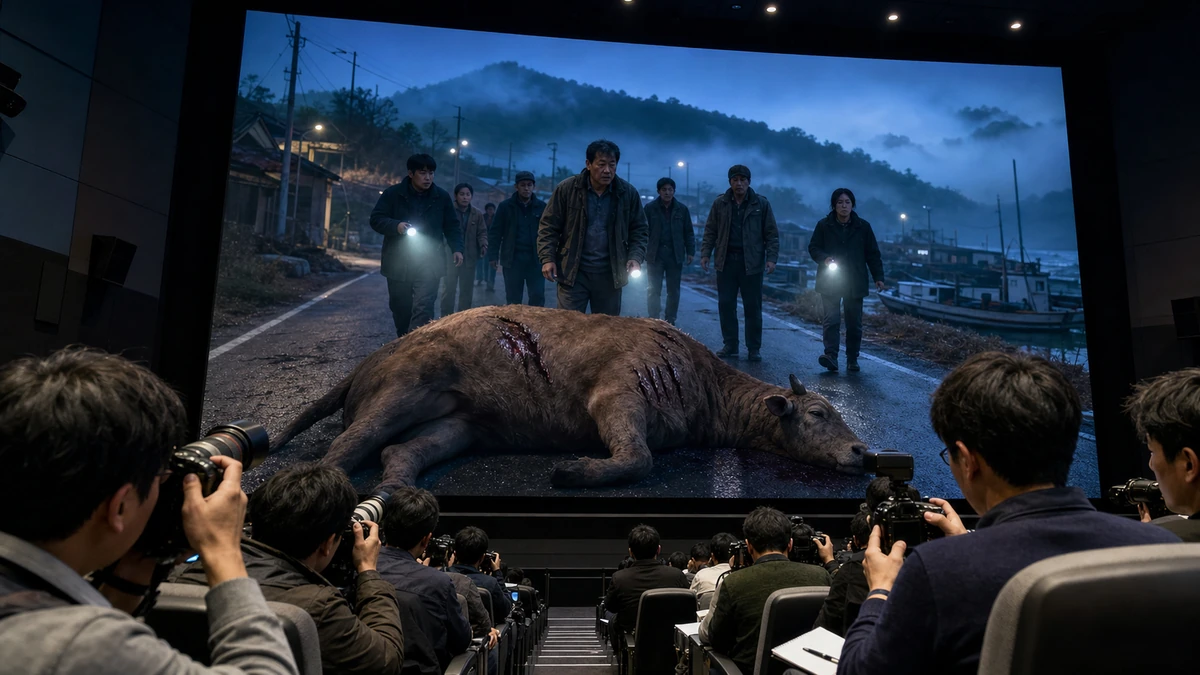
Na Hong-jin, the filmmaker behind the bruising serial-killer thriller “The Chaser,” the violent crime drama “The Yellow Sea” and the unnerving supernatural mystery “The Wailing,” unveiled his new film “Hope” at a domestic press screening on Aug. 6, according to Yonhap News Agency. For Korean moviegoers, that is news in itself. Na has not released a feature in roughly a decade, and in South Korea, where director brands can carry as much weight as star casts, his return is being treated as a major industry event.
But the attention around “Hope” is not just about the calendar. It is about the kind of film Na has chosen to make. The movie is set in a fictional village called Hopo Port, located in the Korean Demilitarized Zone, or DMZ, and follows the arrival of an unidentified life form that throws the community into chaos. In broad terms, that makes “Hope” a science-fiction action thriller. In practice, it sounds more like Na is taking the obsessions that defined his earlier films — fear, violence, uncertainty and the limits of human judgment — and placing them in a new frame.
For American audiences unfamiliar with the contours of Korean film culture, Na’s career helps explain why this matters. He is not simply another commercial director making a creature feature. He is a filmmaker known for drilling into dread and forcing viewers to sit with uncertainty. In his films, answers rarely arrive quickly, and when they do, they tend to deepen the horror rather than resolve it. That sensibility helped make “The Wailing” an international cult favorite. Now, by pairing that trademark ambiguity with gunfire, pursuit and an apparent extraterrestrial threat, “Hope” may represent both a comeback and a genre gamble.
If the summary of the film released in South Korea is any indication, Na is not abandoning the unnerving mood that made his name. He is simply pushing it into a more openly kinetic, large-scale arena. That shift alone is enough to make “Hope” one of the most intriguing Korean film releases on the horizon.
Why the setting matters: The DMZ is more than a backdrop
The most immediately striking element of “Hope” may be where it takes place. The film is set in a fictional village inside the DMZ, the heavily fortified buffer zone that has divided North and South Korea since the Korean War ended in an armistice in 1953. For many Americans, the DMZ is an idea more than a lived reality — a narrow strip of land associated with barbed wire, minefields, military patrols and one of the last unresolved front lines of the Cold War. In Korea, it is also a national wound, a political symbol and a reminder that the war never formally ended.
That makes the DMZ an unusually loaded setting for a genre film. Even before an alien or monster enters the picture, the space carries its own tension. It is already a landscape defined by suspicion, separation and the possibility of sudden violence. A fictional town placed there exists in a zone between realism and nightmare, where ordinary life and permanent emergency can sit side by side.
By inventing Hopo Port rather than using a real place name, Na appears to be giving himself room to lean into genre without severing the film from Korea’s political and emotional reality. For American readers, a rough analogy might be a movie set in a fictional small town on the edge of Area 51, the U.S.-Mexico border or a militarized post-9/11 exclusion zone — a location that already comes with national meaning before the plot even starts. A made-up town can still feel true if it is anchored in a real historical pressure point.
That choice also fits Na’s broader style. His films often begin in settings that seem concrete and knowable — a rural village, a police investigation, a local dispute — and then gradually destabilize them. Here, the instability is built into the map from the start. A village in the DMZ is not just remote; it is symbolically exposed. It sits at the edge of the state, at the edge of comprehension and, in the case of “Hope,” at the edge of contact with something not human.
For international audiences, the DMZ can sometimes function as shorthand for Korean exceptionalism, a dramatic setting that instantly signals geopolitical gravity. The challenge for any filmmaker is to use that symbolism without letting it overwhelm the story. Based on early reporting, “Hope” seems to use the DMZ not as a lecture point but as a pressure chamber. It is a place where fear already makes sense, which may make the arrival of the unknown feel even more destabilizing.
From a dead cow to a ravaged village: How the terror begins
The film’s opening movement, as described in Korean coverage, suggests a classic Na strategy: begin with a disturbing sign that defies easy explanation, then watch characters reach for the wrong answer.
At the center of the early narrative are Beom-seok, the head of a local branch office played by Hwang Jung-min, and Seong-gi, a young villager played by Zo In-sung. They and others encounter a large dead cow lying in the middle of the road, bearing signs of an attack by an unidentified creature. It is an image that does a lot of work at once. It is rural, physical and immediately unsettling. It suggests something powerful enough to kill livestock, but also strange enough that the violence does not fit an ordinary pattern.
At first, the suspected culprit is a tiger. That detail is important. It tells us that the villagers initially try to process the event using familiar logic. Something attacked the animal; perhaps it was a dangerous predator. That impulse — to explain the unknown with existing categories — is deeply human and common in disaster stories, whether the setting is a Korean border town, a Midwestern farming community or a New England fishing village. Before people can accept the extraordinary, they tend to search for an ordinary threat they already know how to fight.
Then the movie appears to yank that certainty away. Beom-seok heads into town, Seong-gi and his group move into the forest, and before long the story escalates into something far beyond an animal attack. A devastated village appears before Beom-seok, and an unidentified monstrous life form reveals itself. That progression — clue, misreading, escalation, revelation — is familiar genre machinery, but in the hands of a director like Na, it can become something harsher and more psychologically corrosive.
The use of the forest matters too. In Korean cinema, as in American horror, wooded spaces often function as zones where modern systems of order break down. Visibility narrows. Sound becomes unreliable. Human beings lose their sense of control. If the village represents community, routine and social structure, the forest represents the border beyond which those things stop protecting anyone. Cross-cutting between the two spaces can produce a very particular kind of dread: viewers know that danger is spreading, but the characters remain trapped inside partial information.
What makes “Hope” especially interesting is that the fear apparently does not stay abstract for long. The summary suggests that the movie moves from mystery into armed confrontation, with human characters literally taking up guns against the unknown. That is a meaningful shift in tone. Many horror films gain power by delaying direct contact. Na seems poised to do something different: sustain the fear of uncertainty while also expanding into action, pursuit and survival combat.
In the shadow of ‘The Wailing,’ but not repeating it
Any discussion of a new Na Hong-jin film will eventually circle back to “The Wailing,” and for good reason. Released in 2016, that film became the defining example of his ability to turn uncertainty itself into horror. The story followed a rural policeman trying to make sense of a series of grotesque events linked to a mysterious outsider, and the film’s lasting power came from its refusal to offer clean footing. It trapped both characters and viewers inside doubt.
“Hope” appears to begin from a similar place. Once again, there is an unfamiliar presence. Once again, the first clues are fragmentary. Once again, people confront something they cannot explain. But by all indications, Na is not simply making “The Wailing” with aliens.
The key difference is behavioral. In “The Wailing,” much of the tension came from anxiety, suspicion and spiritual confusion. People feared the unknown, argued over what it meant and made desperate choices without reliable knowledge. In “Hope,” that emotional pattern may still be there, but it is joined by something more physical. The characters do not only recoil from the unknown; they also move toward confrontation. Fear turns into organized survival.
That is where the science-fiction action thriller label becomes meaningful. In American terms, think of the difference between a film that asks, “What is happening to us?” and one that also asks, “How do we fight back?” The first mode is closer to possession horror or folk mystery. The second opens the door to siege narrative, creature feature and military-style action rhythms. If Na can hold onto the psychological unease of the first while delivering the propulsion of the second, “Hope” could occupy an unusual place in the genre landscape.
This is also why the project is being discussed in South Korea as more than just a new movie by a famous director. Korean genre cinema has long excelled at hybrid forms, mixing melodrama, horror, class commentary, action and dark comedy in ways Hollywood sometimes avoids. Bong Joon Ho’s “The Host,” for instance, used a monster movie to explore family dysfunction and political mistrust. “Train to Busan” folded a zombie outbreak into a high-speed melodrama about selfishness and sacrifice. “Hope,” at least on paper, looks like another attempt to stretch genre expectations rather than settle comfortably inside one lane.
That matters in a global market where Korean entertainment is often praised for originality but also increasingly pressured to become legible to international audiences. A filmmaker like Na is significant because he can work with familiar genre hooks — aliens, guns, survival, a devastated town — while preserving an unsettling local sensibility that resists easy packaging.
Star power and survival drama: Hwang Jung-min and Zo In-sung at the center
The casting of Hwang Jung-min and Zo In-sung is another reason “Hope” is drawing attention. For American readers who may not immediately recognize the names, both are major Korean stars, though they bring different screen energies.
Hwang is one of the most dependable and recognizable actors in South Korean cinema, a performer with the kind of stature that signals seriousness and box-office weight at the same time. In Hollywood terms, he occupies something like the space between a character actor and a marquee lead — someone audiences trust to carry intensity, emotional force and moral ambiguity. Putting him in the role of Beom-seok, a local official who seems to witness the collapse of his community firsthand, gives the film an anchor in credibility and lived authority.
Zo, meanwhile, has long been a prominent star in both film and television, known for charisma, presence and a more overtly leading-man image. Casting him as Seong-gi, a younger villager who heads into the forest with others as the crisis unfolds, suggests a complementary dynamic. If Hwang represents institutional recognition of disaster — the man trying to understand what has happened to the town — Zo may embody the more immediate, physical encounter with danger.
That split matters because survival thrillers often depend less on plot twists than on how distinctly characters occupy the crisis. One person sees the collapse of order. Another feels it in the body. One moves through the ruins of the social world. Another enters the wilderness where the threat lives. If “Hope” is structured around those dual paths, then the casting is doing narrative work, not just marketing work.
There is also a broader pattern here familiar to Korean film. Big stars are often used not merely as glamour figures but as emotional conduits through extreme situations. Whether the genre is gangster noir, historical epic or apocalyptic thriller, Korean blockbusters frequently ask actors to swing hard between intimacy and spectacle. They must be convincing in a close-up and in catastrophe. A film like “Hope,” where community collapse, creature horror and armed resistance appear to coexist, will likely demand exactly that range.
For overseas audiences who discovered Korean entertainment through streaming-era dramas or the global success of films like “Parasite,” star casting can sometimes be the bridge into less familiar territory. Even viewers who do not know the industry’s internal hierarchies tend to recognize when a film has assembled performers of real stature. In “Hope,” that star power reinforces the sense that this is not a niche experiment. It is an event film with art-house pedigree and commercial ambition.
What ‘Hope’ says about the direction of Korean genre cinema
The industrial significance of “Hope” may end up extending beyond its box-office prospects. South Korean cinema has spent the last two decades building a reputation for taking familiar genres and making them feel sharper, stranger or more emotionally volatile. Crime thrillers hit harder. Monster movies carry political anger. Horror stories often double as spiritual or social breakdowns. The question facing the industry now is how to keep evolving under intense global attention.
“Hope” arrives as one possible answer. Rather than choosing between local specificity and internationally recognizable spectacle, it appears to attempt both. Its setting is deeply Korean: a fictional village inside the DMZ, shaped by the history of division and the tensions of borderland life. Its engine, however, is globally legible: an unknown life form appears, the first explanations fail and survival becomes violent.
That combination is one reason Korean genre films travel so well. Viewers do not need to know every cultural nuance to feel the primal mechanics of fear, confusion and resistance. At the same time, the films often gain texture from details rooted in Korean experience, whether that means family hierarchy, regional identity, institutional mistrust or the memory of national trauma. In “Hope,” the DMZ may function as exactly that kind of local charge — not a barrier to foreign understanding, but an added layer that deepens the unease.
There is also significance in Na returning with a film that does not simply repeat his previous successes. A 10-year gap can create pressure to deliver something safe, something close enough to past acclaim to reassure investors and audiences. Instead, “Hope” seems to risk a tonal and formal expansion. If that works, it would underline a point long made by critics of Korean cinema: the industry’s most interesting filmmakers are often willing to mutate genres rather than preserve them.
For the broader global market, that matters at a moment when franchise logic dominates much of mainstream filmmaking. A movie like “Hope” can stand out precisely because it sounds hard to reduce to a single template. It is horror, but not only horror. It is science fiction, but not sleek futurism. It is action, but apparently action born from confusion and terror, not superhero certainty. That instability could be its greatest strength.
Why international audiences should pay attention
Outside South Korea, “Hope” could easily be marketed as a simple high-concept thriller: alien terror hits a village near the Korean border. That pitch is not wrong, but it would be incomplete. What makes the project compelling is that it appears to combine a universally readable premise with themes and settings that are specifically Korean without being inaccessible.
For American and English-speaking audiences, the DMZ background offers an immediate point of entry. It evokes the unfinished business of the Korean War, one of those chapters of U.S. foreign policy that remains historically important but often underexplained in popular culture. A film that stages a battle for survival in such a place does not need to become overtly political to draw power from that history. The terrain itself is already haunted.
Then there is Na’s standing as a director. In an era when many international titles break through by way of streaming algorithms, filmmakers with strong, singular voices still matter. Na has built a reputation among critics and genre fans as someone capable of creating not just suspense, but a deeper sense of moral and perceptual unease. That makes “Hope” worth watching not simply for its premise, but for the possibility that it will deliver a version of alien encounter cinema filtered through a sensibility unlike Hollywood’s.
The film also lands at a time when Korean culture remains a major force in the United States, though often through music, television and Oscar-winning prestige cinema more than through mid-to-large-scale genre experimentation. K-pop has made Korean language and celebrity culture more familiar to Americans. Streaming platforms have expanded the audience for Korean dramas. But there is still a gap between broad awareness of Korean entertainment and a fuller understanding of how ambitious Korean filmmakers approach genre. “Hope” may help narrow that gap if it reaches global audiences in a meaningful way.
Ultimately, the most intriguing thing about “Hope” may be the tension embedded in its title. The details released so far suggest devastation, panic, mystery and violent confrontation. Yet the title points in another direction, toward endurance, however fragile. That contrast feels appropriate for Na Hong-jin, a director who has spent much of his career examining human beings under extreme pressure. This time, the pressure comes not only from within the human soul, but from something arriving from outside it.
For now, the facts publicly available remain limited to what was shown and reported around the Korean press screening. Many of the film’s deeper mysteries, including the exact nature of the creature and the shape of the story’s conclusions, remain undisclosed. But that may be fitting. Na’s films often work best when they are not fully explained in advance. What is clear already is why “Hope” has become a talking point in the Korean film world: after 10 years away, a major director has returned with a border-set survival thriller that appears ready to turn uncertainty into spectacle without losing its sense of dread.
That alone is enough to make “Hope” one of the Korean releases international audiences should be watching closely.
Comments
Post a Comment