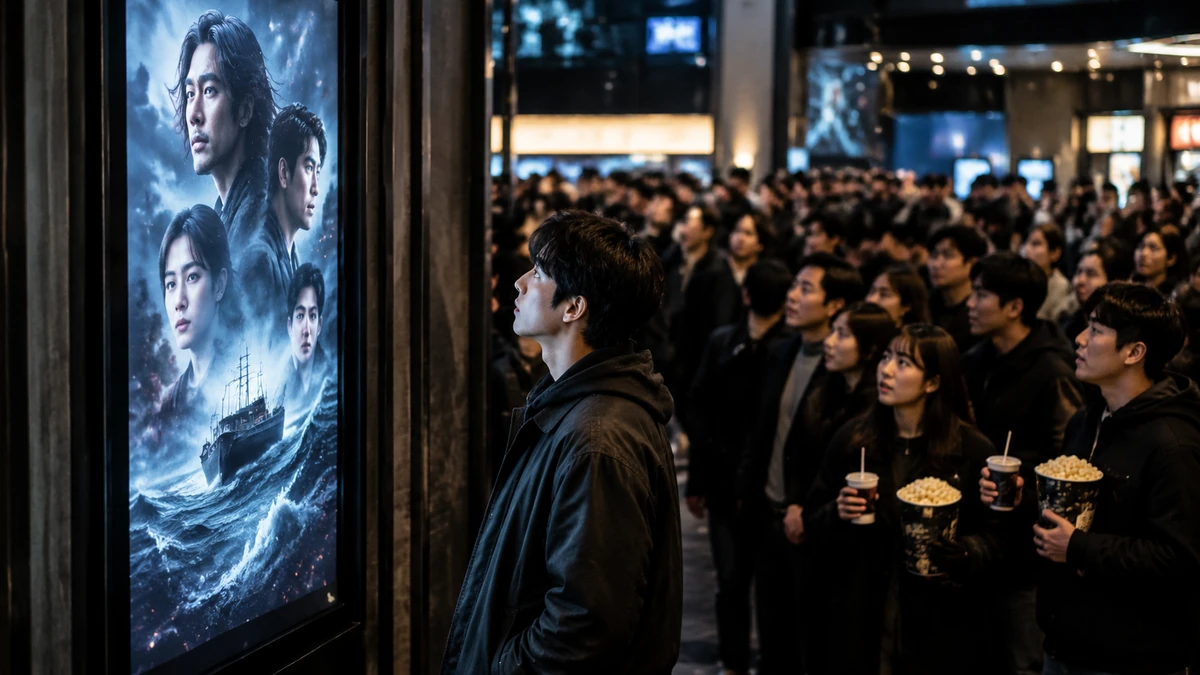
A breakout opening for one of South Korea’s most closely watched filmmakers
South Korean director Na Hong-jin, whose films have built an international following for their nerve-jangling intensity and genre-blurring ambition, has opened his latest movie with the kind of debut that immediately changes the conversation around a release. According to South Korea’s nationwide box-office tracking system, Na’s new film “Hope” drew about 333,000 moviegoers on its first day in theaters, enough to claim the No. 1 spot and dominate the market in a way that is difficult to overstate. The movie accounted for 81.3 percent of ticket sales revenue that day, a sign not just of a first-place finish but of a marketplace that, for at least one day, was overwhelmingly focused on a single title.
For American readers, one useful comparison is the way a heavily anticipated franchise film can flatten the field on opening weekend in the United States, swallowing up premium screens, conversation on social media and most of the oxygen in the room. But “Hope” is not a superhero sequel or an established global intellectual property. It is an original science-fiction film from an auteur director best known for dark, unsettling work. That makes the opening especially notable. In a global theatrical business that has become increasingly reliant on recognizable brands, Na appears to have turned his own name into a kind of event label in South Korea.
The performance also matters because theatrical moviegoing in many markets, including South Korea, remains under pressure from streaming, changing audience habits and rising production costs. A first-day surge on this scale suggests that there is still a sizable audience willing to show up in force for a filmmaker-driven big-screen experience, particularly one that promises scale, suspense and conversation-worthy shock value. It is too early to know whether “Hope” will become a long-running hit, but its debut already amounts to a powerful statement: Korean audiences were waiting for this movie.
That matters beyond South Korea. Over the past decade, American viewers have become far more familiar with Korean popular culture through Oscar-winning films, Netflix series, K-pop and a broader wave of Korean storytelling that now moves easily across borders. When a major Korean film opens this strongly at home, it is no longer just a local industry story. It is part of a larger global question about what kinds of Korean stories travel, how they travel and whether theatrical Korean cinema can still generate mass excitement in an era dominated by digital platforms.
Why Na Hong-jin commands this kind of attention
Na is not a household name to every American moviegoer, but among fans of international cinema, horror and thrillers, he is one of South Korea’s most respected and discussed directors. His 2008 breakout film “The Chaser” established him as a filmmaker with a punishing sense of tension and a willingness to push genre conventions into bleaker, stranger territory. He followed it with “The Yellow Sea” in 2010 and then “The Wailing” in 2016, a film that became especially influential among international audiences for its unnerving blend of folk horror, procedural dread and spiritual ambiguity.
Those movies did not simply perform well; they lingered. In the United States, “The Wailing” in particular became one of those films that horror fans recommend to one another with a mixture of admiration and warning. It is the kind of movie that builds reputation over years rather than weekends. That long-tail prestige helps explain why “Hope” opened with such interest. For many ticket buyers, Na is not merely a director with a new release. He is a filmmaker associated with a certain kind of experience: intense, unpredictable and impossible to half-watch.
By first-day attendance, “Hope” surpassed the opening-day figures of all three of Na’s earlier films. “The Chaser” drew about 110,000 viewers on opening day in 2008, “The Yellow Sea” about 120,000 in 2010 and “The Wailing” about 310,000 in 2016. “Hope,” with roughly 333,000 admissions on day one, starts ahead of them all. That does not guarantee it will outgross his earlier work in the long run. Word of mouth, holiday timing, repeat business and audience drop-off will all matter. But as an opening statement, it suggests that Na’s reputation has only grown since his last feature.
In Hollywood terms, this is the sort of debut that prompts people to say a director’s name has become the sell. That is rare anywhere. It is especially rare for a filmmaker whose reputation rests not on broad four-quadrant crowd-pleasing but on highly stylized, often unsettling genre work. “Hope” seems to have benefited from accumulated trust: audiences know they are going to get something forceful, even if they are not entirely sure what shape that force will take.
A Korean sci-fi premise rooted in one of the world’s most tense borders
Part of the curiosity around “Hope” comes from its premise. The film is set in Hopo Port, a village near the Korean Demilitarized Zone, or DMZ, where an unidentified life form appears. For readers in the United States, the DMZ is one of those terms that may sound familiar from headlines without always being fully understood. The Korean Peninsula remains technically at war, since the Korean War ended in an armistice rather than a peace treaty. The DMZ, the heavily fortified buffer zone separating North and South Korea, is one of the most symbolically charged spaces in modern Korean life: a place of division, military tension and unresolved history.
That context gives “Hope” a built-in dramatic charge before the science-fiction element even enters the frame. In American cinema, one rough parallel might be a story set near Area 51, the U.S.-Mexico border or a small military town under the shadow of a national emergency — a location where geography carries political meaning. In Korean storytelling, the DMZ is not just scenery. It often functions as a shorthand for the country’s unresolved trauma, its vulnerability and its constant awareness that history is not settled.
By introducing a mysterious creature into that environment, “Hope” appears to yoke a deeply Korean setting to a globally legible genre structure. The arrival of an unknown being and the response of a local community are familiar science-fiction ingredients. American audiences understand the basic framework from everything from “Alien” to “The Thing” to “Arrival,” even if the emotional and political meanings differ. What makes the concept intriguing is that Na seems to be using a universally recognizable genre engine inside a location loaded with Korean specificity.
That combination is a major reason the film is likely to draw interest well beyond South Korea. Korean entertainment has been especially successful in recent years when it balances local texture with international readability. “Parasite” was deeply tied to Korean class realities yet legible everywhere. “Squid Game” drew from Korean debt pressure and social hierarchy but used game-show and survival-thriller conventions familiar to viewers around the world. “Hope” appears positioned similarly: local in setting, global in genre vocabulary.
That does not mean overseas success is automatic. Some films travel because they are easy to decode, while others travel because they feel thrillingly unfamiliar. “Hope” may aim for both. Its setting asks viewers to enter a specifically Korean landscape of memory and tension, while its creature-based science fiction offers an accessible point of entry for anyone who likes suspense, action and apocalyptic uncertainty.
A cast designed to attract both domestic and international attention
The cast is another major reason “Hope” arrived with such momentum. The film features Hwang Jung-min, Jo In-sung and Jung Ho-yeon, all of whom carry significant recognition in South Korea, though for different reasons. Hwang is one of the country’s most bankable and versatile stars, a performer often associated with authority, grit and emotional weight. Jo is a long-established actor with both mainstream appeal and action credibility. Jung, best known globally for “Squid Game,” brings a level of name recognition that extends well beyond Korean film fans.
For American readers who may know only one name from that lineup, Jung’s presence matters because she functions as a bridge figure in the current Korean wave. After “Squid Game” became a worldwide phenomenon, she emerged not just as an actor but as a face of Korean pop-cultural globalization, moving between television, fashion and international media. Her role in “Hope,” described in South Korean coverage as involving high-intensity action alongside Hwang and Jo, adds a commercial hook for younger global viewers who may have discovered Korean storytelling through streaming rather than cinema.
The film also includes a notable Hollywood component. Michael Fassbender, Alicia Vikander and Taylor Russell are part of the project, with South Korean reporting indicating they took on alien roles. That sort of casting immediately distinguishes “Hope” from a standard domestic release. It signals a production thinking beyond a purely national frame, not necessarily by flattening itself into English-language global sameness but by building a hybrid screen presence. Korean stars and Western actors are sharing narrative space within a Korean director’s genre vision.
That kind of collaboration can be tricky. Sometimes it feels organic; sometimes it feels engineered for export. But at a minimum, it gives “Hope” an unusual profile in the current Korean film landscape. It is one thing for a Korean film to break out abroad after the fact. It is another for a Korean genre film to arrive already carrying the visible marks of international ambition. In that sense, “Hope” resembles the broader trajectory of K-content over the last several years: no longer waiting to be discovered, but increasingly built with the knowledge that the world is watching.
For U.S. audiences, the easiest analogy might be a prestige genre project that combines a celebrated local filmmaker, major domestic stars and a few globally recognizable supporting players to widen curiosity without giving up its original identity. Whether “Hope” ultimately succeeds overseas will depend on distribution, reviews and audience appetite. But the cast alone ensures that it enters the international conversation with a head start.
Strong box office, more mixed audience response
If the opening-day attendance shows intense interest, early audience scores suggest a more complicated story about how viewers are processing the film itself. South Korean reports cite a CGV Egg Index score of 81 percent. For those unfamiliar, CGV is one of South Korea’s largest theater chains, and the Egg Index functions as a local audience-satisfaction indicator, somewhat analogous to the way American readers might glance at CinemaScore, Rotten Tomatoes audience reactions or other quick-take consumer metrics to gauge whether a movie is connecting.
An 81 percent score points to generally favorable reception, but it is not the kind of overwhelming consensus that would automatically signal universal appeal. That tracks with what often happens to highly stylized genre films. The very qualities that inspire passionate advocacy from one segment of the audience can alienate another. Intense action, sensory overload, unsettling tonal choices and unfamiliar science-fiction elements can make a movie feel exhilarating to some viewers and exhausting to others.
In fact, that split may be central to the movie’s identity. Na’s work has rarely been designed for smooth, middle-of-the-road approval. His films tend to provoke strong reactions, and strong reactions can be commercially useful if they generate conversation. In the American market, movies like “mother!,” “Midsommar” or even certain late-period horror hits have shown that divisiveness is not always a liability if a film can turn intensity into must-see cultural chatter. The question is whether “Hope” can convert its opening-day curiosity into sustained word of mouth during the crucial early stretch of release.
South Korean coverage points to an upcoming holiday corridor as an important test. Like any market, South Korea has periods when moviegoing is shaped by family outings, social plans and concentrated leisure time. A big first day can establish momentum, but long-term performance depends on whether early viewers recommend the movie or warn people away from it. That is especially true for original genre films, which do not have the built-in repeat brand loyalty of a franchise installment.
So far, the numbers say this much with confidence: “Hope” has won attention. Whether it wins affection on a scale large enough to sustain a lengthy run remains open. But even that uncertainty adds to the fascination. Some of the most significant Korean films of the last two decades were not simple consensus pleasures. They were movies that people argued about, returned to and kept alive through discussion.
Praise from a Korean master adds prestige to the release
The conversation around “Hope” has also been boosted by a public endorsement from one of South Korea’s most acclaimed filmmakers, Lee Chang-dong. According to the distributor Plus M Entertainment, Na and Lee appeared together at a post-screening audience event at Lotte Cinema World Tower, one of Seoul’s most prominent multiplex venues. The event reportedly sold out as soon as reservations opened, underscoring just how much interest there is in the film among dedicated moviegoers.
For readers outside Korea, Lee’s praise carries real weight. Lee is one of the towering figures of modern Korean cinema, known internationally for films such as “Burning,” “Poetry” and “Secret Sunshine.” He is not associated with empty hype. When a director of his stature singles out another filmmaker’s work, the comment lands more like a peer review than a marketing blurb.
Lee described “Hope” as a film at the extreme edge of entertainment, praising its tension, suspense, impact and speed. He also reportedly called it, in effect, a “crazy movie,” a phrase that in this context is best understood not as a dismissal but as admiration for its sensory force and audacity. In American film culture, that kind of endorsement can be compared to the way a respected auteur praising a younger or more genre-oriented filmmaker can help legitimate a work that might otherwise be dismissed as mere spectacle.
The significance here is not that Lee’s reaction proves the film’s artistic value. Critical judgment still belongs to viewers, reviewers and time. What it does show is that “Hope” is being positioned as more than a commercial product. It is entering the public sphere as a notable cinematic event, one worthy of serious attention from peers within Korea’s film establishment. That matters because South Korea has one of the most sophisticated film cultures in the world, where popular genre work and art-house prestige often overlap in ways less common in the U.S. mainstream.
The sold-out talk also reflects a familiar pattern in Korea’s current cultural economy: audiences are not just consuming movies but participating in a broader fandom around directors, actors and the act of interpretation itself. In that way, “Hope” belongs not only to the box office but to the larger ecosystem of Korean cultural conversation that American audiences have increasingly encountered through film festivals, streaming recommendations and social media fandoms.
What ‘Hope’ says about the current state of K-content
The larger significance of “Hope” may lie in what it reveals about the present stage of Korean cultural export. For years, international coverage of Korean entertainment has centered on its breakthrough moments: “Parasite” winning the Oscar, “Squid Game” becoming a global streaming sensation, BTS redefining pop fandom. Those stories remain important, but they can also create a misleading impression that Korean success abroad depends on exceptional, once-in-a-generation lightning strikes.
What “Hope” suggests instead is a more mature ecosystem. South Korea now produces films that can be rooted in local anxieties, powered by domestic stars and still be legible to a global audience from day one. That is a different phase of cultural influence. It is not just about accidental crossover; it is about industries increasingly operating with a dual horizon, aware of local audiences and global curiosity at the same time.
That context helps explain why even a domestic opening-day box-office report can resonate internationally. A movie set near the DMZ, made by Na Hong-jin, starring Korean heavyweights and Hollywood actors, is not merely a Korean release in the narrow sense. It is part of an evolving transnational entertainment map in which Korean creators are no longer peripheral to the global genre conversation. They are shaping it.
There is also a broader industrial backdrop. South Korean cinema has spent the last several years navigating many of the same pressures facing Hollywood: budget strain, audience fragmentation and uncertainty around theatrical recovery. At the same time, Korean storytelling has become more visible than ever abroad. That creates a tension between global prestige and domestic business realities. “Hope” enters that space as both a commercial stress test and a cultural marker.
For American and English-speaking readers, that is why this opening matters. It is not only a story about ticket sales in another country. It is a story about whether a major Korean filmmaker can still turn an original theatrical release into an event; whether local history and global genre can coexist in a single mainstream package; and whether the appetite for Korean cinema remains strong not just on streaming home pages but in actual theaters.
The next few days will determine whether “Hope” becomes a durable hit or a front-loaded sensation. But its launch has already accomplished something important. It has reminded the industry that Korean cinema, even after years of worldwide acclaim, can still surprise, still mobilize crowds and still make the world pay attention when it opens a new door into the unknown.
Comments
Post a Comment