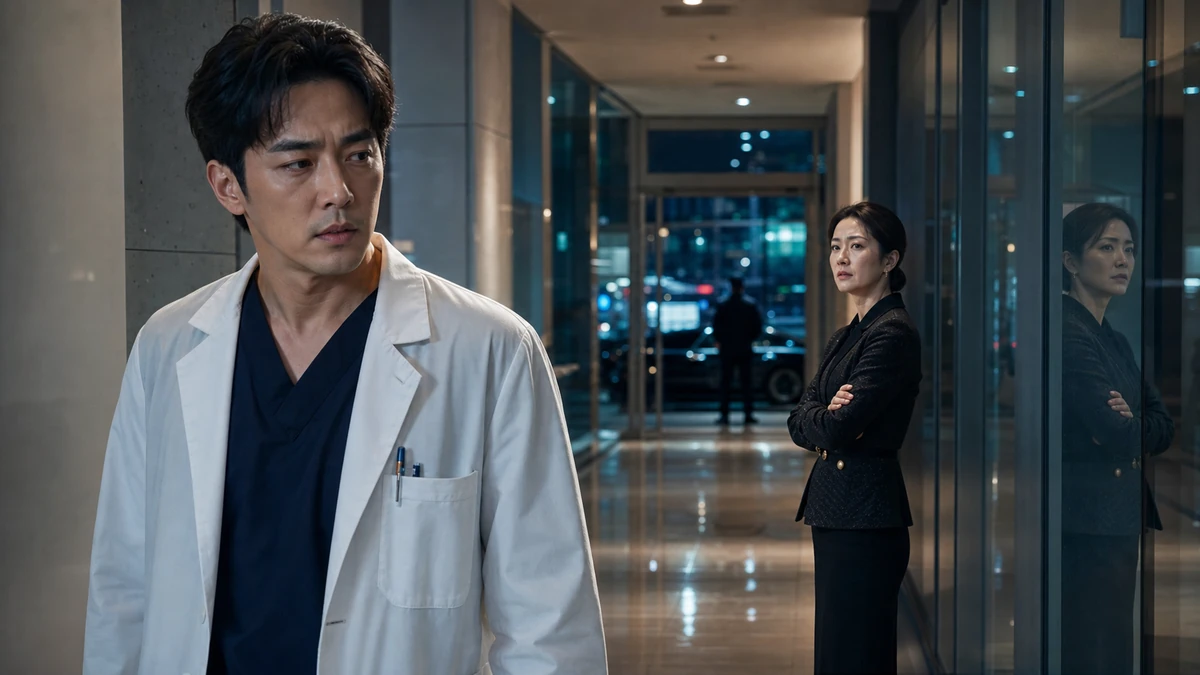
A new Korean network drama opens with pressure, not patience
South Korea’s latest weekend drama did not ease viewers in with a slow burn. Instead, it opened by throwing its lead character into a moral and emotional crisis almost immediately: A successful neurosurgeon tells his wife he wants a divorce, and by the next day she has been kidnapped.
That is the premise behind “The Completion of Marriage,” a new crime thriller from KBS 2TV starring Namkoong Min, one of South Korea’s most recognizable television actors. According to Nielsen Korea figures reported July 5 by Yonhap News Agency, the series debuted to a nationwide rating of 4.4% for its first episode.
For American readers unfamiliar with South Korea’s television landscape, KBS is one of the country’s major terrestrial broadcasters, roughly comparable in stature to a legacy over-the-air network in the United States. Its weekend mini-series slots are important real estate in Korean television, where appointment viewing still matters even in a streaming era. A premiere rating does not determine whether a drama will become a hit, but it does offer an early measure of public curiosity and how effectively a show broke through in a competitive time slot.
What stands out most about this premiere is not simply the number, but the strategy behind the storytelling. Rather than spend an episode on character backstory and scene-setting, “The Completion of Marriage” appears to have chosen acceleration. Marital conflict, hospital politics, a ransom demand, a traffic collision and a face-to-face threat all arrive in the first hour. That kind of pacing is familiar to many Korean drama viewers, especially in thrillers, where writers often try to hook audiences before they can look away.
For English-speaking audiences who may know K-dramas primarily through international streaming hits, this is a reminder that Korean television is not only about glossy romance or period epics. Network dramas in South Korea often blend genres aggressively, combining family conflict, workplace power struggles and crime mechanics in a single narrative engine. “The Completion of Marriage” seems to be doing exactly that from the start.
A husband in conflict, not a simple hero
At the center of the premiere is Kang Tae-joo, played by Namkoong Min, a neurosurgeon whose professional life and personal life are entangled in ways that quickly become combustible. The first episode sets him in conflict over surgery involving a VIP patient, placing him between medical judgment and institutional pressure. That pressure comes not only from the hospital itself but from inside his family.
His wife, Go Se-yoon, is not merely his spouse. She is also the hospital chair. Her father, meanwhile, is the hospital’s founder. That means the domestic argument at the core of the show is not just about hurt feelings, resentment or a failing marriage. It is also about hierarchy, authority, inheritance and professional ethics. In an American context, it might help to imagine a top surgeon at a powerful private hospital clashing with both the CEO and the family dynasty that built the institution — only to discover that the CEO is his spouse and the founder is his father-in-law.
That setup gives the show more than a standard melodramatic triangle of love and resentment. It turns marriage into an organizational fault line. A disagreement at home echoes in the operating room; a dispute over power inside the hospital spills back into the marriage. When Kang tells Go he wants a divorce, the moment does not function simply as a personal rupture. It also destabilizes a family-business alliance embedded in a prestigious medical institution.
That is one reason the protagonist’s dilemma lands with more force than a conventional rescue plot might. Kang Tae-joo is not introduced as an innocent bystander or a straightforward savior. He is already in conflict with the woman who is later taken. The day before the kidnapping, he is trying to leave the marriage. The day after, he is forced into the role of husband-rescuer. Those two realities coexist, and the contradiction is what gives the first episode its emotional tension.
American audiences used to prestige TV antiheroes will recognize the appeal of that kind of setup. The lead is not morally clean in the way older broadcast dramas often demanded. He is compromised, angry, professionally pressured and emotionally cornered. The story asks viewers to follow not only what he does, but what he feels about the person he now has to save.
The kidnapping plot supplies the first episode’s jolt
The strongest narrative turn in the premiere comes with Go Se-yoon’s abduction. According to the reported summary of the episode, Kang Tae-joo, while intoxicated, calls for a designated driver to take him home and falls asleep in the car. The following day, he is contacted by a mysterious man identifying himself as that driver. The message is direct: his wife has been kidnapped, and the ransom demand is 1 billion won.
For readers in the United States, that sum is roughly in the neighborhood of several hundred thousand dollars at recent exchange rates, though the exact value fluctuates. What matters dramatically is not just the conversion but the precision. In thrillers, a concrete number often gives danger heft. It transforms a vague threat into a transaction with a deadline, and it forces the protagonist to confront not only fear but logistics, status and desperation.
The episode reportedly pushes that pressure further when Kang heads to the agreed location and collides with a motorcycle. The motorcyclist then escalates the threat by confronting him with a stun gun and asking whether he brought the money. In storytelling terms, that sequence matters because it takes the danger out of the phone call stage. This is no longer only a disembodied voice making demands. It is now physical, immediate and close enough to injure him.
Kidnapping is hardly a new device in crime fiction, whether in Korean drama, American television or Hollywood film. What distinguishes a kidnapping plot is usually not the fact of abduction itself but the web of motives surrounding it. Here, the premiere appears to seed several possible layers at once. Is this a random criminal act aimed at a wealthy hospital family? Is it connected to internal hospital power struggles? Is the timing — one day after a divorce ultimatum — a cruel coincidence, or a clue?
That last question is what gives the first episode some of its intrigue. Viewers are not merely asked, “Who took her?” They are also asked, “Why this couple, and why now?” That broader framing can make a thriller feel more psychologically textured. The kidnapping is not presented in a vacuum. It arrives after the audience has already been shown a marriage under severe strain and a professional environment charged with resentment and power.
In other words, the abduction does not just create suspense. It reframes every conflict that came before it. A divorce demand starts to look less like a private marital turning point and more like the opening move before a catastrophe. The result is a first episode that seems designed to force immediate binge-style curiosity even within a traditional weekly broadcast structure.
Why hospital politics matter in Korean drama
One of the more revealing aspects of the premiere is the way it uses the hospital not merely as a backdrop but as a pressure chamber. Medical dramas are common around the world, but Korean series frequently use professional spaces to deepen family and class conflict at the same time. A hospital, law firm or corporation can double as both workplace and battleground for legacy, loyalty and social standing.
In “The Completion of Marriage,” the hospital appears to perform exactly that function. Kang Tae-joo’s role as a neurosurgeon is central because his professional authority places him in direct conflict over the treatment of a VIP patient. The phrase “VIP patient” carries particular resonance in Korean dramas, where status and influence often shape institutional behavior in overt ways. It suggests a situation where medicine, wealth and power intersect, and where a doctor may be pressured to bend toward interests that are not strictly clinical.
For American audiences, the appeal of that setting should be familiar even if the specific cultural rhythms differ. U.S. viewers have long embraced stories where hospitals become arenas for ethical compromise, whether in network procedurals, cable dramas or streaming series. But Korean television often fuses those ethical disputes more explicitly with family hierarchy. Here, the hospital chair is also the wife, and the founder is also the father-in-law. The institution is not just connected to the family; it is, in many ways, an extension of it.
That overlap reflects a recurring theme in Korean storytelling: the difficulty of separating personal obligation from professional duty in systems shaped by hierarchy. It would be simplistic to say this is uniquely Korean — family businesses and legacy institutions exist everywhere — but Korean dramas often dramatize those tensions with unusual directness. Deference, reputation and role can matter as much as love or competence. A spouse may also be a superior. A family disagreement may also threaten a career.
The result in this case is that the marriage conflict becomes larger than the marriage itself. The title, translated as “The Completion of Marriage,” carries a certain irony given where the story begins. Instead of depicting a stable union reaching fulfillment, the drama opens at the edge of collapse. What is being tested is not domestic bliss but whether a relationship already breaking apart can survive, or at least be reinterpreted, under criminal pressure.
That is a classic K-drama move: using an emotionally heightened premise not simply to ask what happened, but to ask what a relationship actually means once it has been stripped of routine and exposed to crisis. Even viewers who do not typically follow Korean television may recognize the dramatic efficiency of that approach.
What a 4.4% premiere means — and what it does not
The reported 4.4% nationwide rating is likely to be read in South Korea as a respectable but measured opening rather than an immediate breakout. Ratings culture in Korea remains closely watched by industry observers and audiences alike, even as digital viewing habits have fragmented attention in much the same way they have in the United States. A premiere number can indicate awareness and initial sampling, but it cannot, on its own, predict long-term momentum.
That said, first episodes matter intensely for thrillers. In a romance or family drama, a show may have more room to build slowly through chemistry and character familiarity. In a crime thriller, especially one scheduled for a weekend audience, the pilot often needs to prove quickly that it can generate urgency. By that measure, “The Completion of Marriage” appears to have made a clear choice: speed first, explanations later.
The reported structure of the episode supports that reading. Divorce notice. Refusal. Kidnapping. Ransom. Crash. Stun gun confrontation. These are not the beats of a cautious introduction. They are the beats of a show trying to establish high stakes before viewers drift away. In a crowded entertainment environment, that instinct is easy to understand.
For American audiences used to overnight ratings mattering less than they once did, Korean reporting on television viewership can seem old-fashioned at first glance. But ratings still function there as a cultural scoreboard, particularly for major broadcasters. They are also useful shorthand for gauging how much buzz a new series has managed to convert into immediate audience attention.
The more interesting question, however, is not whether 4.4% is good or bad in the abstract. It is whether the opening episode gave viewers enough unanswered questions to return. On that front, the series appears to have planted several. Who orchestrated the kidnapping? Is the crime linked to the hospital conflict? How much does Kang Tae-joo really know, and how much is he hiding from himself or others? And perhaps most importantly: what does it mean to save a marriage partner you were just trying to leave?
Those are the kinds of tensions that can sustain a serialized thriller if the writing remains disciplined. They also fit a pattern that has helped Korean dramas travel internationally: a willingness to compress emotional, institutional and criminal stakes into a single weekly package without waiting several episodes to reveal the hook.
Namkoong Min’s casting gives the series added weight
Even without speculating beyond the reported facts, it is fair to say that Namkoong Min’s presence is a major selling point. In Korean television, star casting can shape not just marketing but audience expectations about tone and quality. Viewers familiar with his previous work are likely to expect intensity, control and a strong center of gravity in scenes that depend on shifting emotional pressure.
That matters because Kang Tae-joo is written, at least from the premiere summary, as a character who must carry contradiction from the beginning. He is in conflict with his wife, but he is also the one compelled to respond to her disappearance. He is a doctor expected to act rationally, yet the kidnapping thrusts him into a volatile chain of panic and violence. He is positioned inside a powerful family structure, but he is also resisting it. Those competing roles require an actor who can play more than victimhood or heroism.
For overseas audiences who often discover Korean dramas through a single breakout title and then follow actors from project to project, casting can be one of the strongest gateways into a new series. A recognizable lead gives viewers confidence that even a familiar genre premise may deliver emotional detail. In that sense, “The Completion of Marriage” seems to be relying not only on plot machinery but on performance to make its opening paradox resonate.
Still, the available information does not yet support broader claims about the show’s future reception, overseas distribution or long-term success. What can be said, based on the reported details, is more modest and more useful: the series has launched with a premise sharp enough to attract attention, and it has given its lead a role built around difficult choices rather than simple reactions.
Why this kind of K-drama travels
Part of the continuing global appeal of Korean drama lies in its ability to layer seemingly incompatible tones without collapsing under them. A marriage story becomes a workplace drama, which becomes a kidnapping thriller, which may yet circle back into psychological melodrama. To some viewers that can feel excessive. To others, it is exactly the attraction. Korean series often move with a confidence that asks audiences to accept emotional extremity as the price of narrative momentum.
“The Completion of Marriage” appears to fit squarely within that tradition. Its first episode does not present marriage as comfort or stability. It treats marriage as a live wire — a relationship bound up in ego, family power, professional obligation and danger. The title itself may invite viewers to think not about perfect union but about what truly defines a marriage when affection, trust and safety are all in question.
For American readers trying to understand why Korean television continues to command such international curiosity, this premiere offers a compact example. It is not just the kidnapping twist. It is the way the series folds that twist into a larger structure of social and emotional conflict. A husband’s divorce demand becomes inseparable from a hospital’s power map. A ransom call becomes inseparable from unresolved resentment. The crime plot is not floating above the characters’ lives; it is fused to them.
That approach can make even a familiar thriller setup feel fresh. It also reflects a broader truth about contemporary Korean drama production: network television there remains willing to experiment within established formats, pushing genre combinations that might seem too crowded on paper but often prove effective on screen. Weekend scheduling, broadcaster tradition and strong star leads all help create the conditions for that kind of storytelling.
As of July 6, 2026, the core news is straightforward. A new KBS crime thriller led by Namkoong Min has premiered with a 4.4% nationwide rating, and its first episode has already put a disintegrating marriage, hospital power struggles and a 1 billion won kidnapping demand on a collision course. Whether the series grows from there remains to be seen. But as opening statements go, this one was less about making a gentle introduction than about issuing a challenge: keep up.
Comments
Post a Comment