PyeongChang’s Olympic Legacy Finds a New Mission: Helping Low-Income Young Athletes Stay in the Game
From global spectacle to local support
Seven years after South Korea welcomed the world to the 2018 Winter Olympics, the name PyeongChang is once again being tied to the future of sports. This time, however, the story is not about gold medals, opening ceremonies or geopolitical symbolism. It is about something quieter and, in many ways, more enduring: whether teenagers from low-income families can afford to keep training.
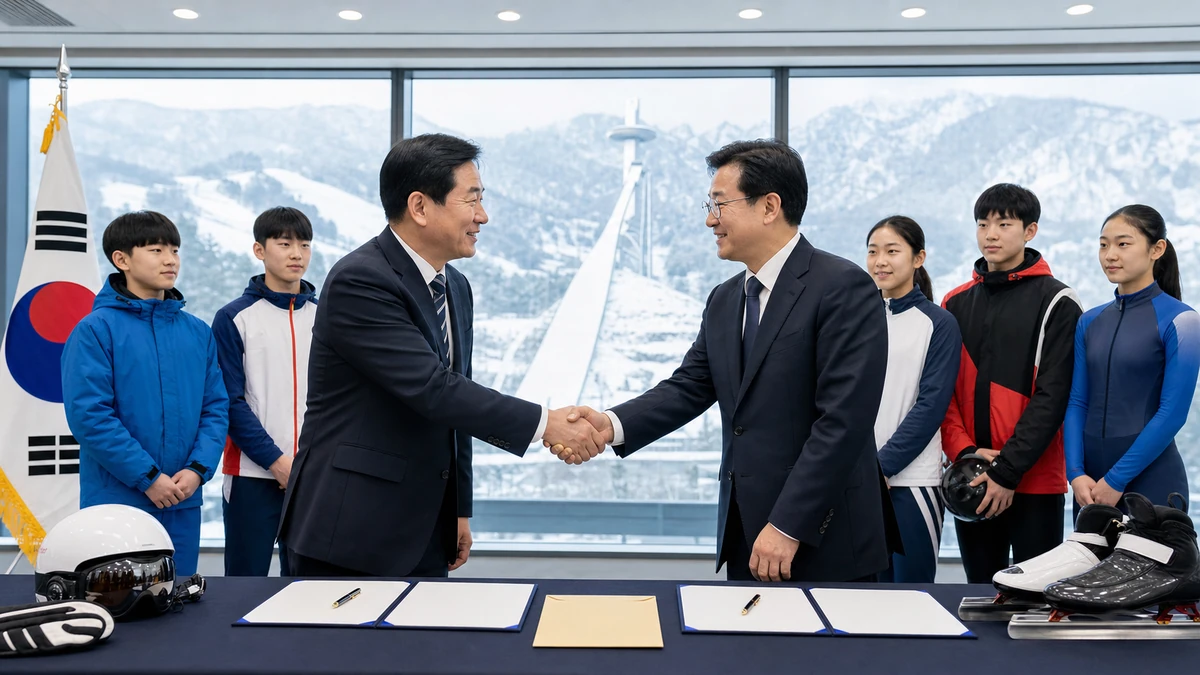
The 2018 PyeongChang Memorial Foundation said it has signed an agreement with the Gangwon State Sports Council to support young athletes from vulnerable households in Gangwon, the mountainous eastern province that hosted the Winter Games. The initiative will be funded in an unusual and symbolically potent way: Lee Hyuk-ryeol, the foundation’s newly appointed chair, has pledged to donate the full amount of his job-related official expenses during his term to the program.
According to the foundation, the project will provide a total of 90 million won, or roughly tens of thousands of dollars, over the next three years. Of that amount, 18 million won is expected to be distributed this year as an initial round of support. The money is meant to help young athletes whose training has been constrained by financial hardship.
In the United States, the idea may sound familiar in principle if not in structure. Think of a former Olympic host city deciding that its legacy should not rest only in stadiums or tourism campaigns, but in making sure a promising high school runner, skater or wrestler does not quit because the family car cannot cover another round-trip to practice or because a piece of specialized equipment costs more than a month’s groceries. That is the spirit behind this agreement.
It also reflects a broader question that follows almost every major sports event, from the Olympics to the World Cup: What remains after the cameras leave? For many host cities, the answer has too often been debt, empty venues or vague promises about economic transformation. In Gangwon, officials are trying to make a different case — that the real legacy of the Olympics can be measured in opportunities created for local children long after the closing ceremony.
Why this agreement stands out in South Korea
What makes this announcement notable is not only the amount of money involved but also the source of the money. Lee’s decision to return all of his official chair expenses to the community gives the program a public-service message that goes beyond routine philanthropy. This is not simply a charity drive or a one-time corporate donation attached to a publicity event. It is the redirection of benefits associated with a leadership position at a public-minded foundation into a social support fund.
That matters in South Korea, where public institutions, quasi-public foundations and regional organizations are often judged not just by what they build but by whether they are seen as serving the broader community fairly and transparently. The phrase used in Korean reporting — that the expenses will be “returned to society” — carries a moral and civic undertone. It suggests that resources linked to status or office should, where possible, flow back to the public good.
For American readers, the closest comparison might be a nonprofit board chair or public authority leader waiving an allowance or discretionary budget and redirecting it into scholarships for student athletes. It sends a message about stewardship. In an era when sports administrators everywhere are often criticized for being far removed from the financial realities of players and families, that symbolism can be as important as the dollar amount.
The foundation itself occupies a distinctive place in South Korea’s post-Olympic landscape. It was established to carry forward the legacy of the 2018 PyeongChang Winter Olympics and Paralympics. In the Korean context, the word “legacy” is not limited to buildings, arenas or commemorative events. It increasingly refers to whether a marquee international event continues to generate social value for the host region — whether by nurturing athletes, expanding access to sports or creating educational and civic opportunities.
That broader definition of legacy helps explain why this agreement has drawn attention. Instead of centering on new infrastructure or branding, it links the prestige of PyeongChang directly to youth who are still in the difficult, uncertain stage of trying to stay in competitive sports. In other words, it takes an Olympic name associated with world-class performance and ties it to an everyday challenge that parents, coaches and students know well: the cost of continuing.
The hidden price of chasing a sports dream
For young athletes, talent is rarely enough. Training requires time, transportation, equipment, coaching, nutrition, tournament fees and, in many cases, travel across long distances. In rural or mountainous areas such as Gangwon, those burdens can be even heavier. A teenager may need to commute to a training center far from home. A family may need to pay for lodging during competitions. Winter sports, in particular, can demand expensive gear and access to specialized facilities.
That financial pressure is not unique to South Korea. American families know it well from youth hockey, gymnastics, swimming, baseball travel teams and elite soccer programs, where “pay-to-play” has become a common complaint. The details differ by country, but the pattern is similar: children from lower-income households often face higher barriers to sustained athletic development, even when they have the ability and discipline to succeed.
In South Korea, the issue can be especially complicated because student athletes often operate within a system that places heavy emphasis on structured training and competitive advancement. While academics remain central in Korean society, youth sports can also be a path to college admission, professional opportunity or social mobility. That means dropping out of sports is not simply a matter of giving up a hobby. For some teenagers, it can mean losing a future they have spent years trying to build.
The Korean summary of the agreement emphasizes the idea of helping young athletes continue in a “stable environment.” That phrase may sound mild in English, but in sports it carries real weight. Stability means being able to show up consistently. It means having proper meals, shoes, uniforms, transportation and recovery time. It means not having to miss competition because a family cannot afford train fare or replacement equipment. It means a coach can plan around development rather than disruption.
Even modest sums can matter when targeted carefully. A relatively small grant can cover equipment for one season, transportation for a cluster of competitions or other basic costs that keep a young athlete from falling behind. And because the support is designed over a three-year period rather than as a single ceremonial gesture, the program signals an understanding that athletic development is cumulative. One year of help may prevent an immediate crisis, but multi-year support offers something more valuable: continuity.
That continuity is crucial for teenagers, especially those in low-income or otherwise vulnerable circumstances. Promising athletes often do not quit because they suddenly lose motivation. They leave because the logistics of continuing become impossible. Programs like this are less about producing instant champions and more about reducing the number of young people forced out by circumstances beyond their control.
Gangwon’s role and the meaning of place
Gangwon, recently renamed Gangwon State in English branding, is central to this story. The province is best known internationally for natural scenery, ski resorts and, of course, the 2018 Winter Olympics in PyeongChang. For many Americans, the region entered public consciousness during those Games, when headlines focused on North and South Korea marching together, U.S. athletes braving frigid weather and the logistics of hosting a winter mega-event in a less globally famous location than Seoul.
But to people in South Korea, Gangwon has long been more than an Olympic backdrop. It is a region with a strong identity shaped by mountains, distance from the capital and a close relationship between nature, tourism and sport. Hosting the Olympics gave Gangwon global visibility, but it also intensified a challenge seen in many host regions: how to convert a burst of international attention into long-term benefits for residents.
This is where the current agreement carries local significance. The support is not aimed at youth in the capital or at national-level celebrity athletes. It is focused on young competitors within Gangwon itself — children and teenagers whose lives are tied to the region that staged the Winter Games. That local focus matters because Olympic legacy debates often turn on whether ordinary residents feel any lasting benefit from the event.
If the Olympics are remembered only through photos, tourism slogans or maintenance costs for venues, the social value of the event can fade quickly. But if the region’s institutions can point to a direct line between the prestige of PyeongChang and the practical needs of local families, the legacy becomes easier to defend. A former host area begins to look less like a place that once held a spectacle and more like a place still investing in people because of it.
There is also a cultural dimension to the use of PyeongChang’s name. In South Korea, place names associated with national achievement often carry symbolic power beyond geography. PyeongChang is not just a county in Gangwon; it is shorthand for a moment when South Korea presented itself as a capable, modern and globally engaged society. To use that symbolic capital in service of disadvantaged youth is, in effect, to say that the meaning of the Olympics should not be reserved for institutions and dignitaries. It should reach the next generation.
A practical model of shared responsibility
The agreement also stands out for how it divides responsibilities between the two organizations. The PyeongChang memorial foundation will raise and oversee the funds, while the Gangwon State Sports Council will select recipients and handle the execution and management of donations. That split may sound administrative, but it is one of the more important details in the arrangement.
In any assistance program, especially one involving minors and public trust, the hardest part is often not announcing the money but ensuring it reaches the right people and is used well. The foundation brings symbolic legitimacy, fundraising authority and a broad mission tied to Olympic legacy. The sports council brings practical knowledge of local athletes, coaches and competitive realities on the ground.
That kind of division of labor reflects a common strength in regional governance when it works properly: one institution provides direction and resources, while another closer to the field provides case-by-case judgment. In theory, it should improve both efficiency and accountability. A foundation may know how to frame a public-purpose initiative, but a sports council is more likely to know which students are skipping training because of transportation costs, which families are under strain and which athletes are at risk of dropping out despite clear promise.
For American readers, it may help to think of the arrangement as a partnership between a legacy nonprofit and a state-level athletic association. One side controls the mission and funding stream. The other has the scouting report and the administrative machinery to distribute aid. Neither can do the job as effectively alone.
Transparency will be key to whether the program earns sustained public confidence. Korean reporting indicates that the sports council will be responsible for selecting recipients and managing the donated funds. That raises the usual questions any responsible observer would ask: What criteria will determine eligibility? How will need be assessed? Will support be distributed across sports fairly? Will the process favor already successful athletes, or also reach those with potential who lack exposure? The answers will shape whether the initiative becomes a respected model or remains a well-intended gesture.
Still, the structural idea is sound. Supporting youth athletes is not merely about sending checks. It requires familiarity with training schedules, competition calendars, coaching networks and family needs. A sports council, if it acts carefully and transparently, is positioned to make those judgments with more accuracy than a foundation acting on symbolism alone.
What Olympic legacy really means after the medals are gone
Major sports events are often sold to the public on the promise of legacy. The term appears in bid books, political speeches and post-event reports from Los Angeles to London to Tokyo. Yet legacy is one of those words that can mean almost everything and therefore, too often, very little. It can refer to transportation upgrades, tourism increases, civic pride, urban redevelopment or international prestige. The problem is that many of those benefits are difficult to measure, unevenly distributed or short-lived.
The PyeongChang initiative offers a narrower but arguably more credible definition. Legacy, in this case, means turning the institutional remnants of a world-class event into direct support for young people in the host region. It treats the Olympics not as a memory to be preserved behind glass but as a source of obligations to the community that carried the event.
That idea resonates well beyond South Korea. Cities bidding for global events increasingly face public skepticism, and with good reason. Residents want to know what happens after the fireworks. They want to know whether the money and attention produce something tangible for schools, neighborhoods and families. Programs like the one in Gangwon provide one possible answer: if the infrastructure and international branding cannot serve everyone equally, then at least part of the post-event apparatus can be redirected toward people with the greatest need.
There is also something refreshingly realistic about this approach. It does not depend on a new arena, a giant redevelopment scheme or a dramatic policy overhaul. It works with resources already embedded in an institution — in this case, the official expenses attached to a chairmanship — and repurposes them for a local social goal. That may not sound glamorous, but public service often looks exactly like that: taking existing mechanisms and bending them toward fairness.
In a sports culture often obsessed with elite results, the agreement also suggests a broader social purpose. Helping a teenager stay in sports is not only an investment in future medals. It is an investment in discipline, health, belonging and possibility. Not every supported athlete will become an Olympian, just as not every American student who receives help for music lessons becomes a concert soloist. That does not make the support any less worthwhile. It recognizes that structured opportunity itself has value.
And in the Korean setting, where local governments and affiliated organizations are often expected to demonstrate community benefit, the move carries a quiet political message as well. Publicly linked institutions must show that prestige can be converted into access. PyeongChang’s name, earned on a global stage, is most credible at home when it helps local children keep going.
A small program with a larger message
No one should pretend that 90 million won over three years will solve the structural inequalities facing youth sports in South Korea. The scale is limited, and the needs are likely much larger than the available funds. Families struggling with housing, wages and education costs face pressures no sports grant can erase. If this were framed as a sweeping answer to social inequality, it would be easy to dismiss.
But that is not what makes the story meaningful. Its importance lies in the example it sets and the values it highlights. It suggests that post-Olympic institutions do not have to drift into ceremonial irrelevance. It suggests that leadership can be measured partly by what officeholders choose to give up. And it suggests that helping a teenager continue training can be understood not as charity alone, but as a community’s decision about who gets to keep a dream alive.
For English-speaking audiences, especially in countries where youth sports increasingly mirror economic inequality, the story is easy to recognize. Behind every young athlete is a support system, and behind every support system is a financial reality. The farther a child advances in sport, the more expensive the path often becomes. That reality can turn talent into privilege unless institutions step in.
Gangwon’s new initiative is modest, targeted and deeply local. Yet those may be its strengths. It does not promise to remake the sports world. It promises something smaller and more believable: that some young athletes who might otherwise have been pushed aside by cost will get a better chance to stay in the game. In legacy terms, that may be one of the most meaningful outcomes any Olympic host region can claim.
Years from now, few people outside Korea will remember the administrative details of the agreement signed this week. But the principle behind it deserves attention. The true afterlife of an event like the PyeongChang Olympics is not found only in record books or architectural footprints. It is found in whether the institutions left behind can keep opening doors. In Gangwon, at least for now, one of those doors is being held open for young athletes who need it most.
Comments
Post a Comment