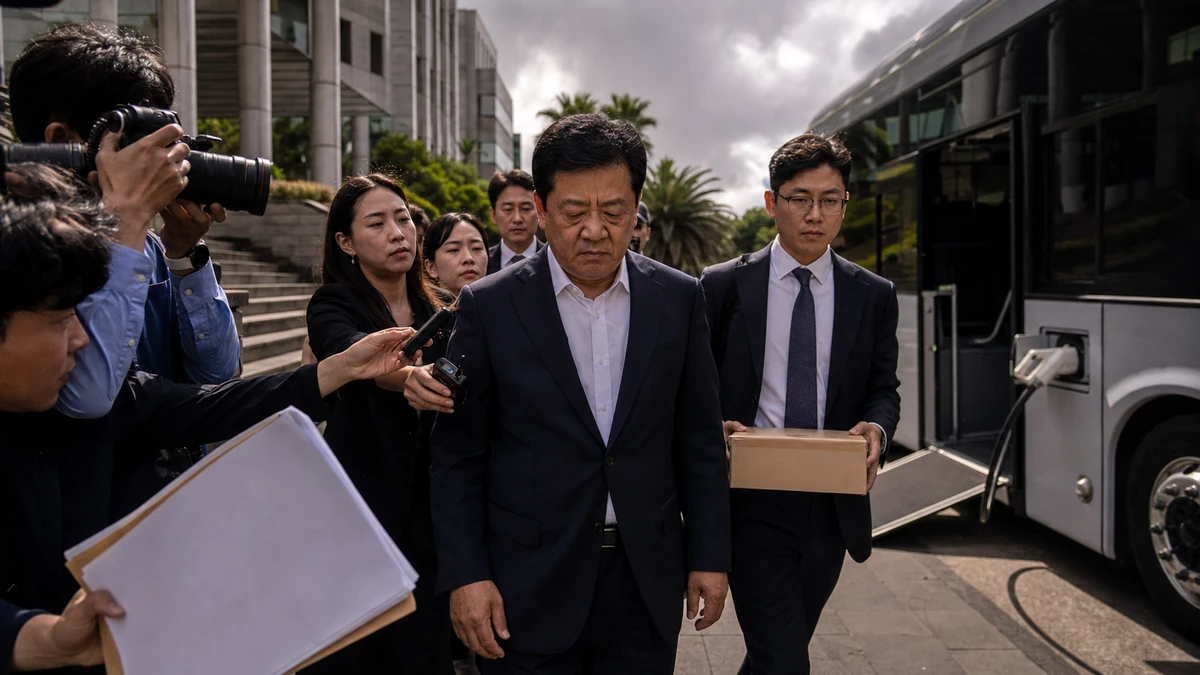
A court ruling on a resort island carries lessons far beyond South Korea
A South Korean court has handed down a suspended prison sentence to a former bus company executive in a case centered on the misuse of public subsidies meant to help bring electric low-floor buses to Jeju, the country’s best-known resort island. The ruling, while specific to one businessman and one province-level transit program, touches on a broader issue that will sound familiar to American readers: What happens when government money earmarked for a public good is diverted from its intended purpose?
According to South Korean media reports, the Jeju District Court sentenced the former head of a local bus company to three years in prison, suspended for five years, and ordered 80 hours of community service. The court found that he improperly used the equivalent of about 650 million won in bus-introduction subsidies — roughly several hundred thousand U.S. dollars, depending on exchange rates — including funds allegedly transferred to a personal account and money later refunded to the company and used at his discretion.
At first glance, the case may sound like a narrow dispute over accounting in a faraway transit system. It is not. It sits at the intersection of several issues that are increasingly relevant in the United States as well: clean-energy spending, accessibility in public transportation, oversight of taxpayer money, and the challenge of making sure high-minded policy goals survive contact with real-world bureaucracy and private operators.
For Americans, one useful comparison might be the federal and state incentives that have helped cities buy electric school buses, expand wheelchair-accessible transit fleets, or modernize aging transportation systems. When public officials promise cleaner air, better service and more inclusive infrastructure, the integrity of those funding streams becomes part of the promise itself. The Jeju case is a reminder that even when a policy is broadly popular, public confidence can be shaken if money is not handled transparently.
The story also offers a revealing look at South Korea beyond the usual headlines about K-pop, semiconductors and geopolitics. Jeju is often marketed internationally for its volcanic landscapes, beach resorts and honeymoon appeal. But like any major tourist destination, the visitor experience depends not only on postcard scenery but also on the invisible machinery of public services — buses, roads, airports and local administration. This case shows how a breach in that machinery can become a matter of public concern.
What the court said — and why the purpose of the money mattered
The core of the ruling turned on a basic legal and ethical principle: Subsidy money is not just general business revenue. It is public money given for a specific purpose. In this case, that purpose was the introduction of electric low-floor buses in Jeju.
South Korean judges said the former executive knew the funds had designated uses and nonetheless used them in ways that departed from those purposes. Prosecutors alleged that in May 2016, he transferred 200 million won in subsidy money to an account in his own name and used it, then in June of that year received 450 million won back in the company’s name and used those funds arbitrarily.
His defense argued there was no criminal intent to embezzle. The court rejected that argument. In doing so, it drew a line that is crucial in cases involving government assistance: Even if money enters the orbit of a business, that does not mean the business owner may treat it like unrestricted cash. Once public funds are tied to a policy objective, whether that is accessible buses, affordable housing, disaster recovery or green-energy investment, the government retains a strong interest in how that money moves and whether it remains attached to the original mission.
That distinction matters in the United States, too. American readers may think of pandemic relief fraud, misuse of nonprofit grants, or abuses involving municipal contracts. Often the public outrage is not simply that money changed hands. It is that taxpayer dollars intended to solve a clearly defined problem were instead siphoned into uses the public never approved. In South Korea’s Jeju case, the court appears to have viewed the damage in similar terms: as a breach of trust involving funds dedicated to a public-policy goal.
The judges also made clear that the case was not about whether electric buses are a worthwhile idea. Rather, it was about whether the money set aside for that transition was handled lawfully and in keeping with the conditions attached to it. That is an important distinction, especially at a moment when infrastructure and climate spending often become entangled in partisan arguments. Misuse of funds does not necessarily discredit the policy itself. But it can weaken public support for the next round of investment.
Why electric low-floor buses matter in Jeju
To understand why this case drew attention, it helps to understand what was being funded. Electric low-floor buses are designed to serve two goals at once. First, they reduce emissions compared with conventional diesel buses. Second, they make boarding easier by lowering the step-up height, which improves access for older adults, passengers with mobility limitations, parents with strollers and travelers carrying luggage.
That second point may require some context for readers outside South Korea. In a society that is aging rapidly, accessibility is an increasingly urgent public issue. Low-floor buses are part of a broader push to make daily life more navigable for people who might otherwise struggle with stairs or steep entryways. Americans would recognize this as a cousin to the goals behind ADA-compliant transit, curb cuts, wheelchair ramps and kneeling buses in many U.S. cities.
Jeju gives that effort added significance. The island is not just a local municipality; it is one of South Korea’s flagship travel destinations, often compared in popular imagination to Hawaii for its combination of volcanic terrain, coastal scenery and tourism-driven economy. That comparison is imperfect — Jeju has its own language history, social traditions and political identity — but it gives American readers a rough sense of the island’s role in the national imagination. Millions of domestic and international visitors pass through each year, and many rely on buses to get from the airport to hotels, beaches, museums and hiking areas.
Public transit on Jeju therefore serves two overlapping constituencies: residents who depend on buses in everyday life, and tourists whose impression of the island is shaped in part by whether transportation is reliable, easy to use and comfortable. A low-floor electric bus is not merely a vehicle purchase. It is part of a local infrastructure strategy that links environmental policy, disability access, tourism convenience and regional development.
That helps explain why the use of subsidy money drew scrutiny. If a government is subsidizing buses that are meant to be cleaner and more accessible, the public expectation is not just that the buses eventually appear. It is that the process itself reflects sound stewardship. In practical terms, voters and taxpayers want to know that money meant to improve public life is not floating into private hands without accountability.
The sentence reflects both condemnation and restraint
The Jeju court’s sentence also reveals something about how South Korean courts sometimes approach white-collar or public-fund cases. The judges said the defendant’s responsibility was serious and that the misuse of public-purpose subsidies could not be treated lightly. At the same time, the court stopped short of ordering immediate imprisonment.
Instead, it imposed a three-year prison term suspended for five years, along with community service. In the American legal system, the phrase “suspended sentence” may be less familiar to general readers than “probation,” but the practical idea is similar: A prison term is imposed, yet not immediately carried out so long as the defendant complies with conditions and commits no new offenses during the suspension period.
The court cited several factors in mitigation. It said the subsidies themselves were not obtained through a false application or fraudulent deception at the front end. It also noted that the electric low-floor buses were in fact introduced, meaning the broader project was ultimately carried out. And it took into account the absence of a prior record for similar crimes.
That balance is important. The ruling signals that the court viewed the unlawful use of funds as real and punishable, but also that it distinguished this case from one in which the entire project was fabricated or the subsidy was secured by an outright sham. In other words, this was not described as a fake transit program existing only on paper. The buses were introduced. The offense, according to the court, was that funds earmarked for a tightly defined public purpose were diverted or used without legal authority.
For some readers, that may sound like a technical difference. For sentencing, it often is not. Courts in many countries distinguish between a project that is wholly fictional and one that is real but marred by improper handling of money. Both can be crimes; the surrounding facts often shape how severely judges respond.
The 80 hours of community service adds a symbolic layer. It reinforces the idea that the wrongdoing was not just against a contract or corporate balance sheet, but against the public. In a case rooted in transit access and public service, the punishment carries an implied message about civic responsibility.
What this says about South Korea’s public spending pressures
South Korea has spent years trying to modernize transportation while also responding to climate concerns, demographic change and rising expectations for public services. Like governments elsewhere, it has leaned on subsidies, pilot programs and targeted support to push private operators and local systems toward cleaner technology. That creates opportunity, but it also creates risk.
Whenever public money moves through multiple stages — grant approval, purchase orders, reimbursement, operations and oversight — weak points can emerge. The Jeju case appears to have involved several such points: how money was received, whether it was separated from personal accounts, what happened when funds were refunded, and how post-payment controls were handled. Those are the kinds of procedural questions that can sound dry until something goes wrong.
In the U.S., similar vulnerabilities have surfaced in everything from charter school finances to transportation contracts to local redevelopment grants. The details vary, but the pattern is recognizable. Governments often rely on outside operators to deliver public goods. That reliance can work well, yet it also demands audit trails, strict controls and clear barriers between company money, executive money and public money. When those lines blur, trust erodes quickly.
South Korea’s situation carries additional pressure because the country is often praised for fast implementation. It is a place where infrastructure projects can move more rapidly than in many Western democracies, and where public-private coordination is frequently treated as a competitive strength. But speed can intensify the need for oversight. A system that prides itself on efficiency must also prove that it can police the flow of money with equal rigor.
That is especially true in sectors tied to national branding. Jeju is not just another locality. It is one of the places South Korea presents to the world. Problems involving the systems beneath the tourism economy — buses, subsidies, contracting, administration — can become reputational issues, not just legal ones.
Tourism, accessibility and the unseen side of travel
For travelers, transportation is often the first real test of a destination. The airport may be modern, the scenery spectacular and the hotels polished, but if the bus network is confusing, inaccessible or unreliable, the shine fades quickly. That reality is as true in Jeju as it is in Orlando, Honolulu or Las Vegas.
The Korean news coverage around this case emphasized an idea that deserves more attention in global travel discussions: A tourist destination is only as dependable as the public systems that support it. Visitors do not experience a place solely through landmarks and restaurants. They experience it in the time between those places — waiting at bus stops, handling luggage, navigating routes, stepping on and off vehicles, and moving through spaces designed either with inclusion in mind or without it.
Electric low-floor buses matter in that daily choreography. For an older traveler, a family with children or a passenger using a mobility aid, the difference between a steep step and a low-floor entrance can define whether transit feels available at all. In that sense, the buses at the center of this case were part of a larger promise: that mobility should be cleaner, easier and more broadly shared.
That promise resonates in the United States, where accessibility remains uneven despite decades of disability-rights law. Many Americans know the frustration of unreliable elevators in subway systems, limited rural transit options or bus stops that remain hostile to people with disabilities. Jeju’s policy push may be geographically distant, but its underlying goals are not foreign. They are part of a global conversation about who gets to move freely through public space and on what terms.
When subsidy abuse enters that conversation, it does more than raise bookkeeping concerns. It threatens confidence in whether governments and contractors are serious about the people those programs are supposed to serve.
A narrow criminal case, and a broader warning
There are limits to what can be concluded from the case as reported. The known facts, as summarized by Korean media, establish that the court found specific acts of embezzlement involving subsidy money and that the bus-introduction project itself was carried out. They do not, at least based on the reporting at hand, establish sweeping institutional reform, broader corruption across Jeju’s transit system, or new administrative penalties beyond the criminal judgment.
Even so, the case offers a broader warning relevant well beyond South Korea. Public enthusiasm for green transition projects and accessibility improvements can be fragile. Citizens may support the idea of cleaner buses or more inclusive transit, yet still grow skeptical if oversight appears lax. That skepticism can become politically costly. It can slow future investment, fuel cynicism about climate spending, and give critics an opening to argue that government programs are inherently wasteful.
The more constructive lesson is not that governments should spend less on public goods, but that they must safeguard such spending more convincingly. Effective climate and transit policy depends not just on announcing ambitious targets, but on building public confidence that every stage of implementation can withstand scrutiny.
In that sense, the Jeju ruling tells a story Americans will recognize. It is about more than one executive, one island or one subsidy program. It is about the old democratic bargain that taxpayer money comes with strings attached, and that those strings exist for a reason. When public funds are meant to deliver cleaner air, better access and stronger communities, the public is entitled to expect both the outcome and the integrity of the process.
Jeju remains, for most outsiders, a place associated with ocean views, volcanic cliffs and leisurely travel. But behind the resort image is the harder, less glamorous work of governance. This case shows that in one of South Korea’s most visited destinations, the quality of public life — and of visitor experience — still depends on something universal: whether public systems are transparent enough to deserve the public’s trust.
Comments
Post a Comment