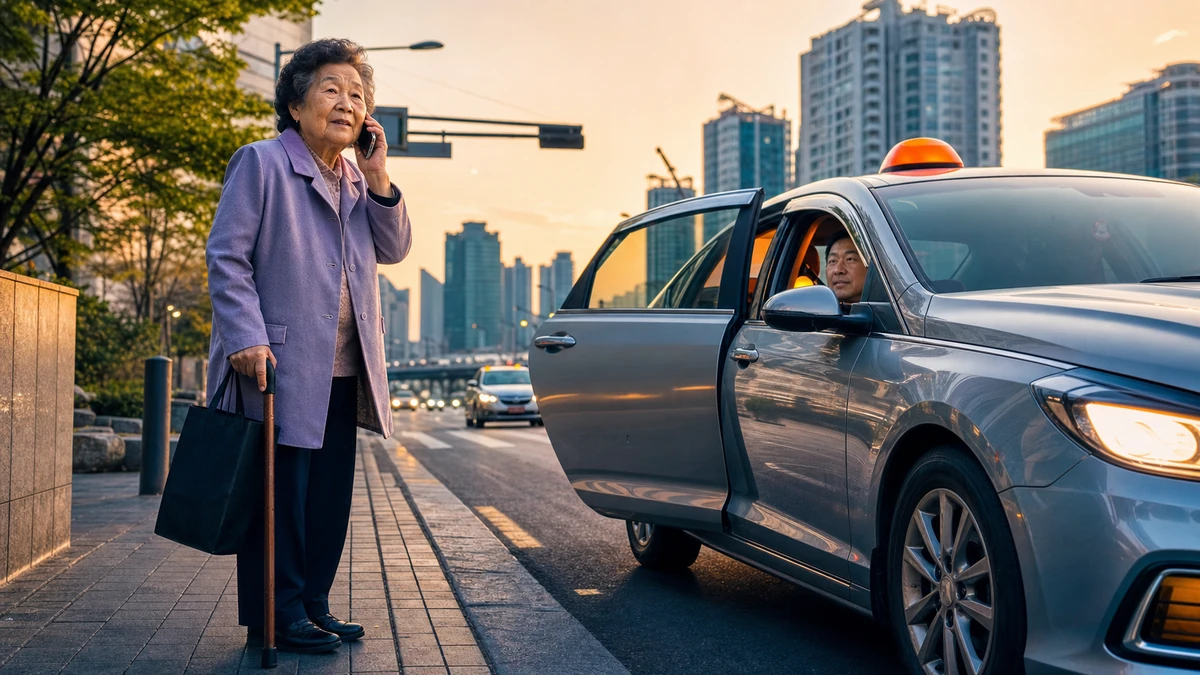
A high-tech city makes room for a low-tech option
In one of the world’s most wired cities, Seoul is making a case for something decidedly old-school: calling for a taxi by phone.
Beginning July 6, residents of the South Korean capital who are not comfortable using smartphone ride-hailing apps can request a cab by dialing 02-120, the number for the city’s Dasan Call Center, a public hotline better known for handling everyday civic complaints and administrative questions. Through that line, callers can be connected to Seoul’s “Donghaeng Onda Call Taxi” service, a new access point designed to make getting around the city easier for people who might otherwise be left behind by app-based transportation.
For American readers, the significance of the move may be easy to underestimate at first glance. In the United States, debates over ride-hailing usually center on companies such as Uber and Lyft, surge pricing, driver pay or whether taxis can still compete in a market reshaped by smartphones. In Seoul, where public transit is extensive, reliable and deeply woven into daily life, the conversation increasingly includes another question: What happens to people who live in a digital-first city but do not navigate digital tools with ease?
That question is especially pressing in a rapidly aging society like South Korea, where one in five residents is now 65 or older. Many older adults use smartphones, of course, but not everyone is comfortable downloading apps, entering destinations, adjusting location settings or managing digital payments. Even for younger people, those steps can become barriers in moments of stress, illness, weak data service or unfamiliar surroundings.
Seoul’s new service is meant to address that gap without framing it as a problem belonging only to seniors. City officials say the call-in taxi option will be open to anyone, regardless of age. That broad eligibility matters. It positions the service not as a special accommodation for a narrow group but as a public-access alternative — another door into the same system.
In a city known globally for speed, connectivity and technological sophistication, that may be the most noteworthy part of the policy. Seoul is not backing away from digital convenience. It is acknowledging that a modern city works best when convenience comes with redundancy.
Why taxis still matter in a transit-rich city
To understand why this policy has drawn attention, it helps to understand how transportation works in Seoul. The city’s subway system is among the busiest and most efficient in the world. Buses reach deep into residential neighborhoods. Transit cards, mobile payments and app-based route planning make moving through the city remarkably seamless for millions of people every day.
But even in a place with strong public transportation, taxis play an important supporting role. They fill the gaps between home and the nearest station. They serve people going to hospitals, senior centers, traditional markets, family gatherings and late-night appointments. They become especially important for residents with mobility limitations, health concerns, heavy bags or destinations that are awkward to reach by subway transfers and long walks.
That is true in many American cities, too, though the context is different. In New York, Chicago or Los Angeles, ride-hailing can be the backup plan when public transit is delayed, indirect or inaccessible. In Seoul, where transit is more robust, taxis are less a substitute for public transportation than a bridge within it — a way to complete the trip when the rest of the network cannot do the job comfortably.
That is why the method of summoning a taxi matters. If the easiest way to access a cab exists only through an app, then the transportation system quietly begins to favor people who are digitally fluent. For everyone else, the same city can start to feel smaller. Everyday outings become more complicated. Visiting a doctor, meeting a friend or running errands may depend not on whether a vehicle exists, but on whether a person can successfully navigate the technology needed to request one.
Seoul’s new phone-based option is an attempt to reduce that friction. Rather than asking residents to learn yet another interface or memorize a new service number, the city is connecting the taxi request system to an existing and familiar civic hotline. That choice may sound minor, but in public policy, familiarity can be infrastructure.
The Dasan Call Center, known simply as “120” in Seoul, has long functioned as a general municipal help desk. Residents call it for guidance on city services, neighborhood problems and administrative issues. By routing taxi requests through that already recognizable number, the city is trying to lower the psychological barrier as much as the technical one. The message is simple: If you know how to call the city, you know how to ask for a ride.
The cultural meaning behind “Donghaeng”
The name of the service also carries a tone that may not be immediately obvious to non-Korean audiences. The word “donghaeng” can be translated loosely as “accompanying” or “going together.” It is a familiar Korean term that suggests more than transportation in the literal sense. It conveys companionship, support and the idea that no one should have to navigate something alone.
That language fits a broader pattern in South Korean public messaging, where policy branding often emphasizes care, belonging and collective responsibility. To American ears, it may sound softer or more symbolic than the functional names often attached to government programs in the U.S. But in Korea, such wording is common and politically meaningful. It signals that a service is not merely transactional. It is part of a social promise, however modest, about who gets included in urban life.
That does not mean symbolism alone will make the service succeed. The city will ultimately be judged on practical questions: How long will callers wait on hold? How reliably will cabs be dispatched? Will instructions be clear? Will people know when and how to use the service? A compassionate name can open the door, but a smooth experience is what determines whether residents trust the system enough to depend on it.
Still, the branding matters because it reflects the underlying policy logic. This is not being presented as charity. It is being presented as accompaniment through a city that has become increasingly mediated by screens. In that sense, the service points to a growing recognition in South Korea, as in many other advanced economies, that digital transformation can create new exclusions even as it solves old inefficiencies.
In the U.S., policymakers often talk about the digital divide in terms of broadband access, device ownership or rural internet infrastructure. Those are crucial issues, but Seoul’s example highlights another layer of the problem: even where connectivity is widespread, usability is not evenly distributed. A person may own a smartphone and still feel shut out by an app-centered system. Accessibility is not only about whether a service exists online. It is about whether ordinary people can use it comfortably in real life.
A policy aimed at older adults, without labeling them
On the day the initiative was introduced, Seoul Mayor Oh Se-hoon visited a senior welfare center in the city’s Seodaemun district, where he demonstrated the service and explained broader policies aimed at older residents. The setting was not accidental. Senior welfare centers in South Korea are community hubs where older adults gather for classes, meals, recreation and social support. They are closer in function to a mix of a senior center, community center and local public-service outpost than many Americans might expect from the term “welfare center.”
By unveiling the service there, the city made clear who stands to benefit most immediately: older residents who may find app-based transportation cumbersome or intimidating. Images released by the city showed the mayor helping place a call for a taxi and seeing off an older rider, a scene meant to translate abstract policy into an everyday moment. The point was easy to grasp: This is for the trip to the clinic, the market, the community center, the visit to a relative.
Yet city officials have been careful not to restrict the service to seniors. That is a significant design choice. In many societies, programs aimed at older people can carry an unintended stigma, suggesting dependency or technological inadequacy. By making the service available to everyone, Seoul reduces the chance that using it will feel like admitting failure.
That decision also reflects reality. Digital difficulty is not confined to age. Someone with a visual impairment may prefer a phone call. A tourist or recent migrant may struggle with a Korean-language app interface. A person with a cracked screen, a dead battery or poor cell service may need a human-assisted option in the moment. Even people who are generally comfortable with apps may find certain situations easier to handle by voice.
There is a public-policy advantage here as well. Universal design — building systems that work for the broadest possible range of users — often produces better outcomes than narrowly targeted accommodations. Curb cuts, first championed as an accessibility feature for wheelchair users, ended up benefiting parents with strollers, delivery workers and travelers with luggage. In much the same way, a phone-based entry point to a taxi system may help seniors most visibly, but it can make the transportation network more resilient for everyone.
That universality is part of what makes Seoul’s move notable. The city is not simply adding another welfare measure for older adults. It is adjusting the architecture of a mainstream urban service so that fewer people are filtered out in the first place.
The bigger issue: when digital convenience becomes a gatekeeper
Over the past decade, cities around the world have embraced apps as the default interface for daily life. Need a ride? Open an app. Need food? Open an app. Need to pay a bill, reserve a ticket, report a pothole or book a doctor’s appointment? Increasingly, there is an app for that, too.
For many users, this shift has made urban life faster and more manageable. But the same systems can become gatekeepers when there is no practical alternative. Downloading software, verifying an identity, enabling location tracking, linking a payment method and interpreting on-screen prompts all require a baseline level of digital comfort. Public institutions sometimes treat that comfort as a given. It is not.
Seoul’s decision to provide a parallel, phone-based channel suggests a more flexible view of modernization. It treats analog access not as a relic to be phased out, but as a necessary complement to digital systems. That approach may sound less glamorous than launching a sleek new platform powered by artificial intelligence or real-time mobility analytics. Yet it may do more to determine whether a city feels usable to all of its residents.
That question is becoming more urgent as societies age. South Korea has one of the world’s fastest-aging populations, and urban policy is increasingly shaped by that demographic reality. Transportation is central to the issue because mobility connects directly to health, independence and social participation. When people can reach a clinic, a neighborhood center, a grocery store or a relative’s home, they remain anchored in community life. When those trips become difficult, isolation can follow quickly.
American policymakers are grappling with similar challenges, even if the transit context differs. Many U.S. communities are struggling with how to serve older adults who can no longer drive but live in places with limited public transportation. In that sense, Seoul’s move may resonate well beyond Korea. The mechanics are local; the underlying dilemma is global.
There is also a broader lesson for governments increasingly eager to digitize public services. Efficiency is not the same as accessibility. A streamlined app can save time for millions while still failing the people who most need help. Public systems work best when they offer multiple ways in, particularly for services tied to daily survival and autonomy.
In Seoul, the taxi call option does not solve every mobility problem. It does not eliminate wait times, guarantee supply or address cost concerns that can shape transportation choices. But it recognizes something important: in a modern city, inclusion often depends less on inventing something entirely new than on reconnecting people to systems they already know how to use.
A small change with implications far beyond Seoul
On paper, the policy is straightforward. A resident who does not want to use a taxi app can dial 02-120 and request a cab through a public call center. In practice, the significance is larger than the mechanics suggest.
By using an existing civic hotline, Seoul is effectively repurposing familiar government infrastructure to solve a modern access problem. It is a modest intervention, but one that reveals a larger philosophy: public services should meet people where they are, not only where technology assumes they ought to be.
That idea has broad relevance for global cities. From London to Singapore to New York, urban life is increasingly organized through phones, platforms and digital credentials. The benefits are real, but so is the risk of sorting residents into the comfortably connected and the reluctantly dependent. A city can be technologically advanced and still overlook ordinary human friction — the uncertainty of a small screen, the frustration of a confusing interface, the embarrassment of asking for help with a task that everyone else seems to manage effortlessly.
Seoul’s call-in taxi option does not reject innovation. It humanizes it. It acknowledges that a city’s transportation system is not just about moving bodies efficiently through space. It is also about preserving dignity, choice and independence in the routines that make up daily life.
Whether the service becomes a durable success will depend on execution. Residents will need clear public guidance. Call-center workers will need the training and capacity to handle transportation requests smoothly. Riders will need confidence that picking up the phone will not leave them stranded in a queue. If those operational details hold, the program could become a model for other services — a reminder that digital transformation does not have to mean eliminating every analog pathway.
For American readers watching South Korea as both a cultural powerhouse and a laboratory of urban modernity, this may be one of the more revealing stories to emerge from Seoul. It is not about K-pop, blockbuster technology exports or futuristic gadgets. It is about governance at street level: how a city quietly decides who gets to participate fully in public life.
Sometimes inclusion does not arrive through a grand new system. Sometimes it comes through a number people already know by heart.
Comments
Post a Comment