Rain, Heat and the Start of ‘Minor Heat’: South Korea Braces for a Muggy, Umbrella-Filled Summer Day
A summer weather story that is about much more than rain
South Korea is heading into one of those summer days that can reshape the rhythm of an entire country before breakfast. Forecasters say most of the nation will see cloudy skies and rain beginning early July 7, with additional showers possible later in the day in several inland and central regions. On paper, that may sound like an ordinary weather update. In practice, in a densely populated and highly urbanized country like South Korea, it is a story about commutes, school runs, street traffic, subway congestion, soaked sidewalks, delayed errands and the peculiar discomfort of East Asian midsummer: heat that does not let up even when the rain starts falling.
The forecast calls for varying levels of rainfall depending on the region, with some of the heaviest totals expected in and around the greater Seoul area and parts of the country’s central belt. But the headline number that may surprise American readers is not just the rain. It is the temperature. Highs are expected to climb to 95 degrees Fahrenheit, or about 35 degrees Celsius, in some areas, underscoring a familiar but punishing reality of the Korean summer: rain is not always relief. Often, it is simply warm water added to already thick humidity.
The day also falls on Soseo, one of the traditional seasonal markers in the East Asian calendar. The term is often translated as “Minor Heat,” a name that can sound understated to outsiders. In Korea, however, it signals the point when summer heat is understood to begin in earnest. That old seasonal vocabulary still appears comfortably alongside the hyper-specific language of modern meteorology — rainfall totals measured in millimeters, hourly forecasts, regional advisories and granular updates by coast, mountain zone and metro area. Together, they offer a window into how South Koreans experience weather not as background information but as one of the most practical forms of daily public knowledge.
For Americans used to weather coverage centered on hurricanes, tornadoes, heat waves or major winter storms, it may seem unusual for a broad rain forecast to carry such social weight. But in South Korea, where millions of people rely on public transit, walk dense commercial corridors and move through tightly packed cityscapes, an all-day forecast of clouds, rain and bursts of showers can alter daily life almost immediately. It changes what people wear, when they leave home, whether they linger outdoors and how they plot their route through neighborhoods built around subway exits, bus stops, underground shopping arcades and convenience stores every few blocks.
That is why a forecast like this lands as more than a casual weather note. It is, in many ways, a short-hand description of urban life in Korea at the height of summer.
What the forecast says, region by region
The rain expected July 7 is not uniform, and that distinction matters. Forecasters say the Seoul metropolitan area — including Seoul, Incheon and Gyeonggi Province — along with the West Sea islands, inland and mountainous parts of Gangwon Province, and much of the central region including Daejeon, Sejong, North Chungcheong and South Chungcheong provinces, could see roughly 20 to 60 millimeters of rain. For readers in the United States, that is around 0.8 to 2.4 inches — enough to turn a routine commute into a soggy and slower-moving one, especially in places where heavy pedestrian traffic and packed transit stations already create bottlenecks.
Elsewhere, the east coast of Gangwon, the southwestern Honam region — including Gwangju, South Jeolla and North Jeolla — as well as inland South Gyeongsang, Daegu and North Gyeongsang are forecast to receive about 5 to 40 millimeters, or roughly 0.2 to 1.6 inches. Jeju Island, the country’s southern resort island, is expected to get relatively light rainfall of around 5 millimeters.
On top of that, forecasters say additional showers are possible from the afternoon into the evening in parts of central Korea, northern North Jeolla, the Gyeongsang inland and other selected regions. That means people who wake up to light rain — or even a temporary break in the weather — may not be able to assume the rest of the day will stay manageable. A cloudy morning can give way to a drier midday, only to be followed by another burst of rain around the evening commute.
That kind of start-stop weather is a hallmark of the Korean summer. It complicates basic planning. Is it a day for sandals or waterproof shoes? Is it enough to carry a compact umbrella, or is this the kind of storm band that can overwhelm one in minutes? Should a parent pack extra clothes for a child, or should a college student budget an extra 20 minutes to move between subway lines and campus buildings? These are small questions, but in the aggregate they form the lived reality of weather in one of the world’s most wired and tightly scheduled societies.
South Korean forecasts are often consumed in precisely this way: not just as broad climatic summaries, but as neighborhood-scale logistics tools. A difference between 5 millimeters and 40 millimeters, or between rain at dawn and showers near sunset, can change how people arrange their day.
Why weather coverage matters so much in South Korea
To understand why a rainy day forecast can dominate headlines, it helps to understand the physical and social geography of the country. South Korea is compact, mountainous and heavily urban. Roughly half the population lives in the greater Seoul capital region. In major cities, daily routines are built around movement through shared public spaces — sidewalks, bus lanes, train platforms, crosswalks, market streets, apartment complexes and underground passages. When the weather shifts, millions of people feel it at once.
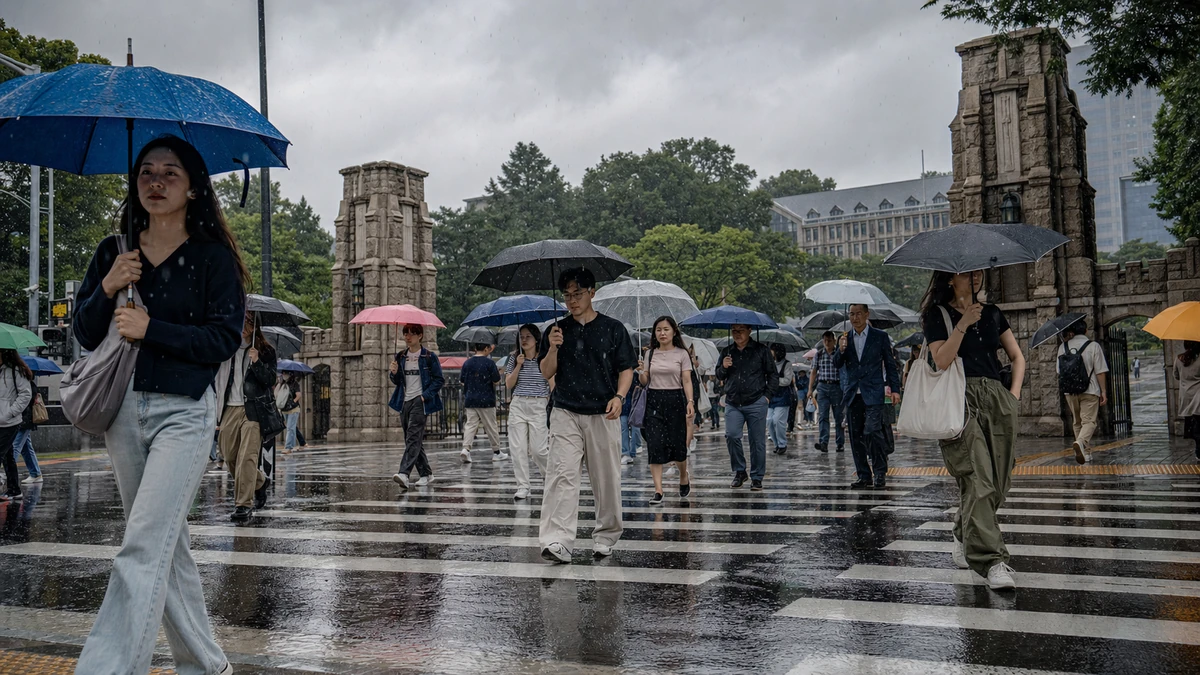
An image often used in Korean summer weather coverage is not dramatic storm damage but ordinary movement: office workers and students crossing a large intersection under umbrellas, shoppers hurrying into subway stations, or people lining up at bus stops beneath dark skies. One such scene — pedestrians moving through rain near a major university district in Seoul — captures why weather coverage in Korea reads as social reporting as much as atmospheric reporting. It is about how a city moves when the sky changes.
American readers may think of weather as a private inconvenience unless it reaches the threshold of emergency. In South Korea, where daily life is often highly synchronized, weather is public infrastructure information. It affects transit timing, food delivery, school arrival, foot traffic for small businesses, and the use of semi-public indoor spaces like malls, coffee shops and underground retail corridors. A rainy afternoon in Seoul can mean more than wet streets; it can mean slower escalators at transit hubs, crowded entrances to convenience stores, and fuller cafes as people wait out a shower or escape the humidity.
Weather news also holds an important place because Korea’s summer can pivot quickly from inconvenience to danger. The country is no stranger to monsoon-related flooding, landslides and transportation disruption, especially when persistent rain systems stall over a region. Even when a forecast does not rise to that level, public attention remains high because people know conditions can deteriorate fast. As a result, routine forecasts are closely watched. They serve as early signals for how cautious the day may need to be.
That culture of attention helps explain why forecasts are often broken down with striking specificity. It is common to see different rainfall amounts for an inland district and a nearby coastal strip, or between mountainous terrain and a neighboring city. In a country with sharp topographical variation packed into a relatively small area, those distinctions are not academic. They are practical.
Soseo and the old calendar language that still shapes modern life
One of the most culturally revealing parts of this forecast is its connection to Soseo. The word refers to one of the 24 seasonal divisions inherited from the traditional East Asian calendar, a system also known in Chinese and Japanese contexts but still familiar in Korea as part of the country’s cultural vocabulary. Soseo literally means “Minor Heat,” and it marks the period when summer warmth is expected to intensify.
For American readers, a rough parallel might be the way people refer to the “dog days of summer,” or how the first day of fall can carry meaning beyond the actual temperature. But Soseo is more structured than a colloquial seasonal phrase. It is part of a long-standing calendar system that once helped guide agricultural life and still survives in public consciousness, media coverage and everyday expressions about the changing season.
That does not mean modern Koreans plan their day around premodern cosmology. Quite the opposite. What is striking is how seamlessly the old and new coexist. A news report may mention Soseo to frame the moment in seasonal terms, then immediately pivot to highly technical forecasting: 20 to 60 millimeters here, 5 to 40 there, scattered showers expected from afternoon into evening, peak daytime heat near 35 degrees Celsius. The result is a layered picture of time. The old term explains where the country is in the emotional calendar of the year; the data explains whether you need waterproof shoes and how long your commute may take.
That pairing says something meaningful about Korean society. South Korea is often portrayed abroad through its cutting-edge technology, export power and hypermodern cities. All of that is true. But daily life also moves through inherited cultural frames that remain remarkably alive. A seasonal term like Soseo is not a relic in a museum. It is still legible enough to appear in mainstream reporting without explanation for domestic readers.
For foreign audiences, that makes a weather story unusually rich. It is not only about clouds and precipitation. It is about how a modern country names the turning points of the year, and how that naming still shapes the way people talk about heat, rain and the expected feel of a summer day.
The Korean summer: not just hot, but wet, sticky and changeable
If the forecast’s rain totals describe one side of the story, the expected heat describes the other. Highs climbing toward 95 degrees Fahrenheit despite widespread rain illustrate a central truth about the Korean summer: precipitation does not necessarily cool the day in any meaningful way. Instead, it often deepens the sense of heaviness in the air.
That combination is especially familiar during jangma, the Korean monsoon season. Jangma generally refers to the early- to mid-summer rainy period that brings humid air, frequent cloud cover and bands of rainfall that can vary in intensity and duration. Although every year is different, Koreans are accustomed to a summer in which heat and rain are not opposites but partners. The air can feel tropical, with damp clothing, fogged glasses, slippery pavement and the constant need to move between overheated sidewalks and aggressively air-conditioned indoor spaces.
For Americans who have experienced summer in places like Washington, Houston, Atlanta or Miami, the sensation is not entirely foreign. But in Korea’s dense urban settings, the effect can feel more compressed. Heat radiates off pavement and high-rise buildings. Humidity lingers in narrow streets and transit corridors. A short walk can become draining, and the arrival of rain may offer visual drama without much physical relief.
That is why the forecast matters even for people who do not plan to be outdoors for long. A rainy, 95-degree day changes everything from clothing choices to energy use. Office workers may carry umbrellas while also dressing to manage heat. Students may time their movements between classes to avoid the most intense downpours. Delivery workers, who are a crucial part of Korea’s convenience-driven urban economy, face especially difficult conditions in weather like this, navigating traffic and rain-slick streets under pressure to maintain fast service.
The possibility of additional afternoon and evening showers makes the day more unpredictable still. In weather like this, the morning sky can be misleading. A lull can tempt people into leaving umbrellas at home, only for a sudden shower to hit during the trip back. That unpredictability is one reason Korean cities are full of small adaptive habits: keeping spare umbrellas at work, ducking into a cafe to wait out a storm, choosing underground walkways over open sidewalks and monitoring forecast apps throughout the day rather than just once in the morning.
How rain changes the pace of city life
In Seoul and other major Korean cities, weather often shapes not just comfort but choreography. The path from home to work or school is rarely a simple door-to-car route. It might involve an apartment elevator, a walk through a residential complex, a bus stop, a subway transfer, a crowded station exit and another several blocks on foot. Rain inserts friction into each step.
Crosswalks slow. Stairs become slick. Umbrellas collide. Bus shelters fill up. Subway entrances turn into funnels of foot traffic. Street-level businesses may see fewer wandering customers and more people stepping inside simply to avoid getting drenched. Coffee shops become temporary refuges. Underground shopping areas grow busier as pedestrians reroute to stay dry and cool at the same time.
This is especially visible in neighborhoods with large student and office populations, such as areas around major universities or business districts. A rainstorm in those places does not empty the streets so much as rearrange them. People move faster, cluster under awnings and adjust their patterns on the fly. The city still functions, but it does so differently.
That is part of why weather coverage in Korea often reads with an everyday, civic emphasis. It is not necessarily warning of catastrophe. It is telling people how the machinery of ordinary life may feel. Will the commute take longer? Will children need rain gear for school? Will evening plans require a backup indoor option? In a society where time management is often precise and urban movement is deeply collective, that information has real value.
The forecast for July 7 is a good example. It does not suggest a single nationwide experience. Instead, it points to a patchwork day in which different regions are nudged off balance in different ways. The capital region and parts of the central provinces may deal with more sustained or heavier rainfall. Some southern and eastern areas may see lighter rain but still face showers and heat. Jeju may escape with comparatively little precipitation. The result is not one story but many local versions of the same seasonal pattern.
A revealing snapshot of Korea’s summer and its daily culture
For global audiences, it can be tempting to treat weather abroad as filler unless it is tied to disaster. But ordinary weather stories often reveal the most about how a place actually works. In this case, South Korea’s forecast for July 7 offers a compact portrait of the country’s summer life: the persistence of traditional seasonal language, the precision of modern forecasting, the social importance of transit and dense public space, and the physical reality of a rainy season that does not erase the heat.
There is also something distinctly Korean in the coexistence of efficiency and adaptation. People will check the forecast in detail, compare regional rainfall totals, decide whether the evening shower risk is worth carrying an extra bag, and move through a city designed to absorb large flows of people under changing conditions. The weather is inconvenient, but not paralyzing. It becomes another variable to manage.
That, in some ways, is the deeper story behind the umbrellas. They are not just props in a rainy-day photograph. They are signs of how a modern society responds to seasonal volatility as part of normal life. The image of pedestrians crossing a Seoul intersection under gray skies may seem mundane. But inside that moment is a lot of information about climate, infrastructure, culture and routine.
July 7, marked by Soseo, will likely bring exactly the sort of summer day Koreans know well: overcast skies, spells of rain, possible showers later on, and heat stubborn enough to linger through it all. For anyone visiting South Korea, living there or simply trying to understand the texture of daily life beyond the headlines of politics and pop culture, that is worth paying attention to. In Korea, the weather is rarely just the weather. In midsummer, it is a public script for how the day will unfold.
Comments
Post a Comment