South Korea and Mongolia Strike Trade Deal Centered on Critical Minerals, Expanding a Strategic Partnership Beyond Mining
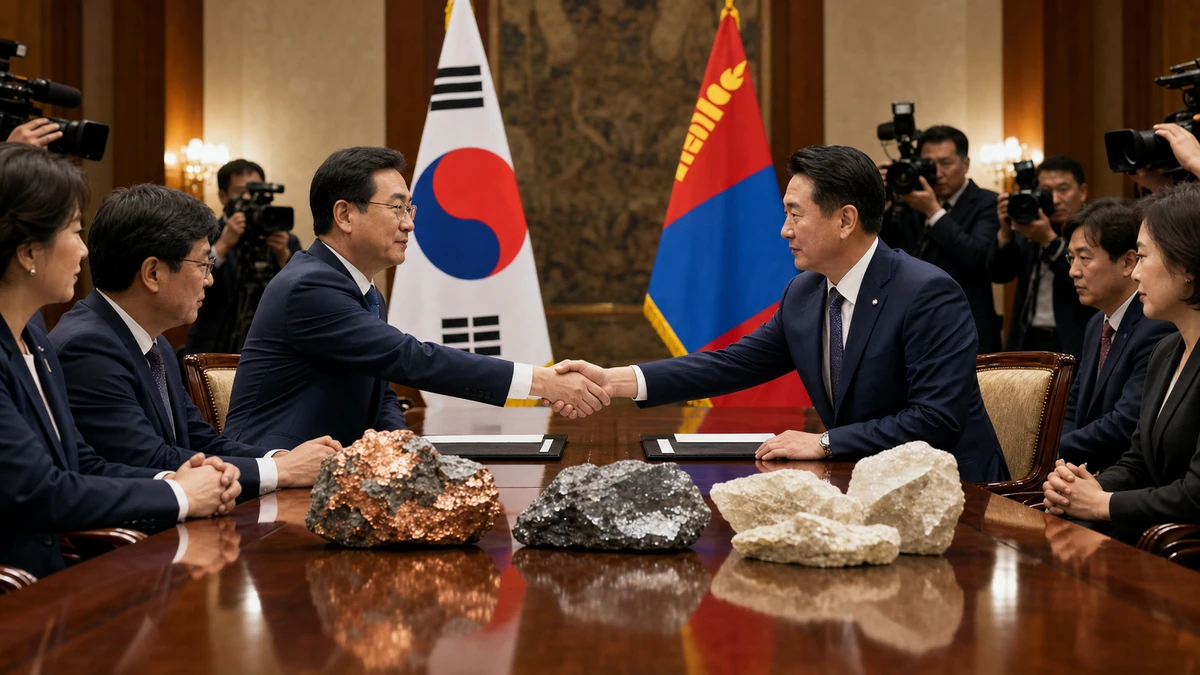
A trade deal with implications far beyond tariffs
South Korea and Mongolia have reached a preliminary trade agreement that may sound technical at first glance but carries consequences for the global scramble over critical minerals, industrial supply chains and the next phase of Asia’s economic realignment. The two countries announced what officials described as an “agreement in principle” on a Comprehensive Economic Partnership Agreement, or CEPA, during South Korean President Lee Jae-myung’s state visit to Mongolia. In practical terms, the deal lays the groundwork for lowering trade barriers, expanding investment and setting rules that could make it easier for South Korean companies to buy strategically important raw materials from Mongolia.
The headline item is minerals. Mongolia, a landlocked democracy sandwiched between China and Russia, holds deposits of copper, molybdenum and rare earth elements, all of which have become increasingly important as countries race to secure supplies for semiconductors, batteries, electric vehicles, power equipment and advanced manufacturing. South Korea, one of the world’s most export-dependent industrial economies, said it would immediately eliminate import tariffs of 2% to 5% on those Mongolian materials. Officials in Seoul framed that move as a way to help South Korean businesses secure essential inputs more cheaply and with greater predictability.
For American readers, a useful comparison is the way Washington talks about reshoring, “friend-shoring” and reducing dependence on a single source for critical goods. South Korea is pursuing a version of that strategy of its own. It is a manufacturing heavyweight with globally recognized companies in electronics, autos, batteries, shipbuilding and heavy industry, but it remains heavily exposed to disruptions in the supply of raw materials. That vulnerability has become more visible in recent years as geopolitical tensions, pandemic-era bottlenecks and competition between the United States and China have reshaped how governments think about trade.
The South Korea-Mongolia announcement does not mean mines suddenly start shipping at new volumes overnight. No specific corporate contracts or guaranteed tonnage were disclosed. But it does mark a shift from broad diplomatic goodwill to a rules-based framework that businesses can plan around. In trade policy, that distinction matters. Companies deciding where to source materials do not look only at the commodity price. They also consider tariffs, customs rules, rules of origin, legal protections for investment and whether the broader relationship between two countries is stable enough to support long-term planning. The CEPA framework is designed to address those questions.
That is why this is more than a ceremonial diplomatic development. It is a window into how South Korea is trying to widen its economic network in Asia: not just by selling finished products abroad, but by connecting upstream resources, midstream processing and downstream industrial know-how into a more durable regional strategy.
Why critical minerals matter to South Korea — and to the wider world
The term “critical minerals” can sound like policy jargon, but it has become one of the defining economic and geopolitical issues of the decade. Copper is essential to electrification because it is used in wiring, motors, grids and charging infrastructure. Molybdenum is often used to strengthen steel and other alloys, making it valuable for heavy industry and machinery. Rare earth elements, despite the name, are not always geologically rare, but they are difficult and expensive to process. They are crucial in magnets used in electric vehicles, wind turbines, consumer electronics and defense systems.
For South Korea, securing these materials is not an abstract national project. It is directly tied to the competitiveness of its industrial base. The country’s economy depends heavily on major manufacturers that sit at the center of global supply chains. When South Korean officials say they want more stable access to raw materials, they are talking about protecting the cost structure and reliability of industries that produce everything from smartphones and displays to advanced batteries and steel products.
American policymakers have had similar debates in recent years, especially over China’s dominance in parts of the rare earth supply chain and over vulnerabilities in battery materials. The Inflation Reduction Act, semiconductor initiatives and wider industrial policy discussions in Washington all reflect an understanding that industrial leadership depends not just on innovation but also on access to minerals and components. South Korea faces that same reality, perhaps even more acutely, because of the central role exports play in its economy.
Mongolia enters this picture as a country with substantial natural resource potential that has long drawn outside interest but has often struggled to convert that interest into broader, diversified development. Its mineral wealth is well known, particularly in copper. Yet being resource-rich does not automatically translate into economic transformation. Infrastructure limitations, geographic constraints, dependence on neighboring markets and the challenge of building value-added industries at home have all shaped Mongolia’s economic trajectory.
That is part of what makes the new agreement noteworthy. Seoul is not simply looking at Mongolia as a place to buy rocks from the ground. The broader agenda includes investment, logistics, distribution and industrial cooperation. In other words, both governments are signaling that the relationship should be structured, repeatable and institutionally supported, rather than dependent on ad hoc deals or political symbolism.
Tariff elimination alone will not solve every supply-chain problem. A 2% to 5% tariff cut does not magically overcome transportation costs, market volatility or processing bottlenecks. But for companies evaluating procurement strategies, those savings still matter. They can affect margin calculations, sourcing decisions and the viability of longer-term commercial relationships. Just as important, they send a political signal that the two governments intend to make economic exchange easier, not harder.
What a CEPA actually does, and why the term matters
One reason this story deserves explanation for an English-speaking audience is that the phrase “Comprehensive Economic Partnership Agreement” can sound interchangeable with “free trade agreement,” even though the policy architecture is often broader. A CEPA typically addresses tariff reductions, but it also goes beyond simple market opening. It can include rules on investment, customs procedures, rules of origin, business cooperation and other mechanisms that help companies operate across borders with fewer uncertainties.
Think of it as the plumbing behind trade. Consumers tend to notice trade only when a product disappears from shelves or gets more expensive. Businesses, by contrast, pay close attention to the legal rules that determine whether a shipment qualifies for tariff benefits, how a product’s origin is certified, how quickly goods move through customs and whether investment protections are strong enough to justify putting money into local operations. Those details rarely make headlines, but they shape whether a trade relationship actually functions.
In this case, South Korean officials said the two sides agreed on the major outlines, including market opening for goods and rules of origin, while some technical matters remain to be finalized through working-level talks. That is what “agreement in principle” means here. Negotiators have effectively reached the political end of the road, but lawyers, trade specialists and ministries still need to close remaining gaps before the pact becomes fully operational.
For Americans, one rough comparison would be when the United States announces a framework agreement or a broad trade understanding before final legal text is wrapped up. The politics and strategic direction may be set, but implementation still depends on detailed drafting and domestic procedures. Businesses often treat such moments seriously because they show where policy is headed, even if all the paperwork is not finished.
The emphasis on rules of origin is particularly important. Those rules determine when a product can be considered as coming from a partner country and therefore qualify for lower tariffs or other benefits. In a world of highly fragmented supply chains, where components may cross borders several times before becoming a final product, rules of origin can be decisive. If they are too restrictive, companies may find it too cumbersome to use the agreement. If they are clear and workable, the agreement becomes much more commercially meaningful.
That helps explain why Seoul is presenting the CEPA as a move from exchange to institutionalized cooperation. South Korea and Mongolia have traded before, invested before and maintained diplomatic ties for decades. What changes now is the level of formal structure around that relationship. That kind of institutional foundation can make cooperation more resilient, especially at a time when Asian economies are trying to hedge against shocks in the global system.
Diplomacy, business and people-to-people ties are moving in the same direction
The trade announcement did not happen in isolation. It came alongside a South Korea-Mongolia business forum in Ulaanbaatar, where political leaders and business representatives appeared to coordinate their messages. That matters because trade agreements often fail to deliver much unless governments and private companies are moving in parallel. Public policy can create the conditions for commerce, but firms still have to see practical opportunity.
President Lee said the two countries have distinct strengths and substantial room for cooperation, and he urged faster collaboration in economic areas including critical minerals. That language reflects a familiar South Korean approach to economic diplomacy: pairing summit-level statecraft with private-sector outreach. South Korea’s development model has long depended on tight interaction among government planners, major corporations, industry groups and export promotion agencies. When a new overseas partnership is announced, it is common to see government, business associations and investment bodies all working in tandem.
There is also a human dimension to the relationship that may be underappreciated outside the region. Lee noted that about one in 10 Mongolians has experience working in South Korea. Whether taken as an exact social statistic or a rhetorical measure of closeness, the point underscores how unusually dense the people-to-people ties have become. Labor migration, educational exchanges and business travel have created a familiarity between the two societies that goes beyond formal diplomacy.
For American readers, that context helps explain why a deal like this can gain traction. Economic agreements tend to work better when there are already communities, companies and workers with first-hand knowledge of each other’s systems. South Korea is not approaching Mongolia as a total stranger. There is an accumulated base of social and economic contact, including Mongolian workers who have spent time in Korean workplaces and companies that have already explored opportunities in one another’s markets.
At the business forum, South Korean and Mongolian chambers of commerce also reinforced those ties by signing a new memorandum of understanding that builds on an earlier cooperation arrangement dating back to 2016. Such documents do not carry the force of a treaty, but they can still matter by creating networks for information sharing, trade missions and practical business matchmaking. In many cases, what turns a diplomatic success into real economic activity is not one dramatic contract but dozens of smaller institutional links that reduce friction over time.
That layered approach is especially characteristic of South Korea’s international economic strategy. Unlike a superpower that can sometimes rely on sheer market size, South Korea often succeeds by being systematic: combining policy agreements, corporate engagement, technology transfer and long-term relationship-building. The Mongolia deal fits neatly into that pattern.
Beyond mining: Retail, investment and a development model Seoul wants to export
The new economic agenda between Seoul and Ulaanbaatar is not limited to resource extraction. South Korean officials also highlighted cooperation in distribution and investment, with Lee describing a mutually beneficial model in which Korean retail companies provide technology and operational expertise while Mongolian firms invest directly and gain experience running the business. That concept may sound modest compared with the drama of critical minerals, but it reveals something important about how South Korea sees its comparative advantage.
South Korea is not just a buyer of raw materials. It is also an exporter of systems — logistics systems, retail management systems, digital platforms, supply-chain know-how and forms of operational discipline built through decades of rapid industrialization. In the same way that Americans might think of U.S. companies exporting franchise models, management tools or e-commerce infrastructure, South Korean firms increasingly market the less visible competencies that support modern consumer economies.
That is a notable evolution. For years, South Korea’s global image was dominated by manufactured exports and, more recently, by cultural influence through K-pop, Korean dramas and beauty products. Those remain important, but the country’s overseas footprint is broadening. Today South Korea is just as likely to pitch smart retail systems, digital services, logistics expertise and industrial partnerships as it is to sell televisions or sedans. In Mongolia, that means Seoul appears to be promoting a model in which local partners are not just passive recipients of foreign goods but active participants in building commercial capacity.
From Mongolia’s perspective, that approach may be attractive because it speaks to a long-standing development challenge: how to avoid remaining dependent on raw commodity extraction alone. Resource wealth can produce growth, but it can also create vulnerability if prices swing sharply or if too much economic activity is concentrated in a narrow set of sectors. Partnerships that combine foreign expertise with local investment and management experience offer at least a potential pathway toward economic upgrading.
Of course, these ambitions should not be overstated. It takes more than a forum speech or a memorandum to transform an economy. Success depends on financing, execution, local conditions, infrastructure and whether projects are commercially viable. Still, the rhetoric around the agreement suggests both governments want the relationship to mature into something broader than a buyer-seller dynamic. They are talking about industrial development, capability-building and longer-term shared gains.
That emphasis also makes political sense. In many countries, foreign economic engagement is easier to defend domestically when it can be framed as a partnership that creates local opportunity rather than one-sided extraction. By highlighting joint growth, technology sharing and reciprocal benefits, South Korea and Mongolia are placing the deal within a more durable political narrative.
Agriculture and food security are now part of the conversation, too
If the minerals component reflects hard-nosed industrial strategy, the agricultural component shows how wide-ranging the relationship has become. South Korea and Mongolia also expanded cooperation in food and agriculture, updating a memorandum of understanding in those areas during the visit. Officials said the agenda includes food security and smart agriculture, two issues that have grown more urgent as climate pressures, supply disruptions and changing weather patterns affect farming around the world.
This is another area where American readers will recognize the broader trend. Food security is no longer treated as a purely domestic issue in many countries. It is increasingly linked to technology, trade, water stress, rural development and geopolitical resilience. Smart agriculture — a catch-all term that can include data-driven farming, precision irrigation, greenhouse technologies, mechanization and more efficient supply management — has become part of how countries talk about modernizing food systems.
For Mongolia, whose climate and geography present clear agricultural constraints, cooperation on productivity and food systems can be especially significant. For South Korea, it represents another opportunity to export technology and policy experience, not just manufactured goods. This is consistent with the broader pattern of the visit: Seoul is trying to connect its industrial and technical strengths to Mongolia’s needs across several sectors at once.
It also shows that the CEPA announcement should not be read narrowly as a mining story. The real significance lies in the diversification of the bilateral agenda. The two countries established a strategic partnership in 2021, and this latest round of agreements and public messaging suggests they are trying to give that label more substantive content. Resources, logistics, investment and agriculture are all being placed under the same umbrella of long-term cooperation.
That matters because sustainable bilateral relationships are rarely built on one sector alone. If commodity prices weaken or a specific project stalls, a partnership that spans several industries is more likely to endure. From Seoul’s perspective, that diversification also helps reduce risk. From Mongolia’s perspective, it may offer more opportunities to draw in technology and investment that support broader development goals.
Why this matters internationally, not just to Seoul and Ulaanbaatar
At one level, the South Korea-Mongolia CEPA is a bilateral story about two mid-sized Asian economies deepening ties. At another level, it is part of a much bigger global shift. The old assumption that globalization would simply keep expanding through ever-cheaper trade has given way to a more strategic era. Governments are now thinking about where materials come from, who controls processing, which partners can be trusted in a crisis and how to build redundancy into supply chains without giving up competitiveness.
South Korea is an especially interesting case because it sits at the intersection of those pressures. It is deeply integrated into the world economy, highly exposed to trade shocks and heavily reliant on technologies and industries that require stable access to critical inputs. It is also allied with the United States, economically intertwined with China and increasingly active in building its own network of regional and global partnerships. In that sense, what Seoul is doing with Mongolia is not a side story. It is part of a wider balancing act that many U.S. partners in Asia are now engaged in.
Mongolia, meanwhile, occupies a strategic niche that is easy to overlook from Washington or New York but increasingly relevant. Its geography alone ensures that every major external partnership carries geopolitical weight. As countries search for alternatives in critical mineral sourcing, Mongolia’s resources become more attractive. The challenge for Ulaanbaatar is to turn that interest into stable, diversified and politically sustainable development.
There are still important limits to what has been announced. Because the agreement is only in principle, some technical issues remain unresolved. The real-world commercial effects will depend on how quickly the final provisions are completed, how companies respond and whether supporting infrastructure and logistics can keep pace. It is entirely possible for ambitious trade frameworks to produce slower or narrower results than politicians initially suggest.
Even so, the significance of the moment is hard to miss. South Korea is signaling that its future growth strategy will depend not only on selling to the world but also on stitching together a broader ecosystem of supply, investment and cooperation across Asia. Mongolia is signaling that it wants to be more than a resource frontier. And together, the two countries are offering a case study in how middle powers respond to a more fragmented global economy: by institutionalizing relationships, widening the agenda and trying to lock in strategic flexibility before the next disruption arrives.
For American readers used to seeing Asia through the lens of U.S.-China rivalry, this is a reminder that much of the region’s most consequential economic activity happens in the space between the superpowers. Deals like this one do not generate the same immediate attention as a tariff fight in Washington or a summit between Beijing and Tokyo. But they help determine who controls supply routes, who gains industrial leverage and which countries are best positioned for the next phase of global competition. In that respect, the South Korea-Mongolia agreement is not just a regional footnote. It is part of the architecture of the emerging world economy.
Comments
Post a Comment