South Korea and Mongolia put Korean Peninsula peace back on the agenda, with Ulaanbaatar offering a potential diplomatic bridge
A quiet diplomatic signal from Ulaanbaatar
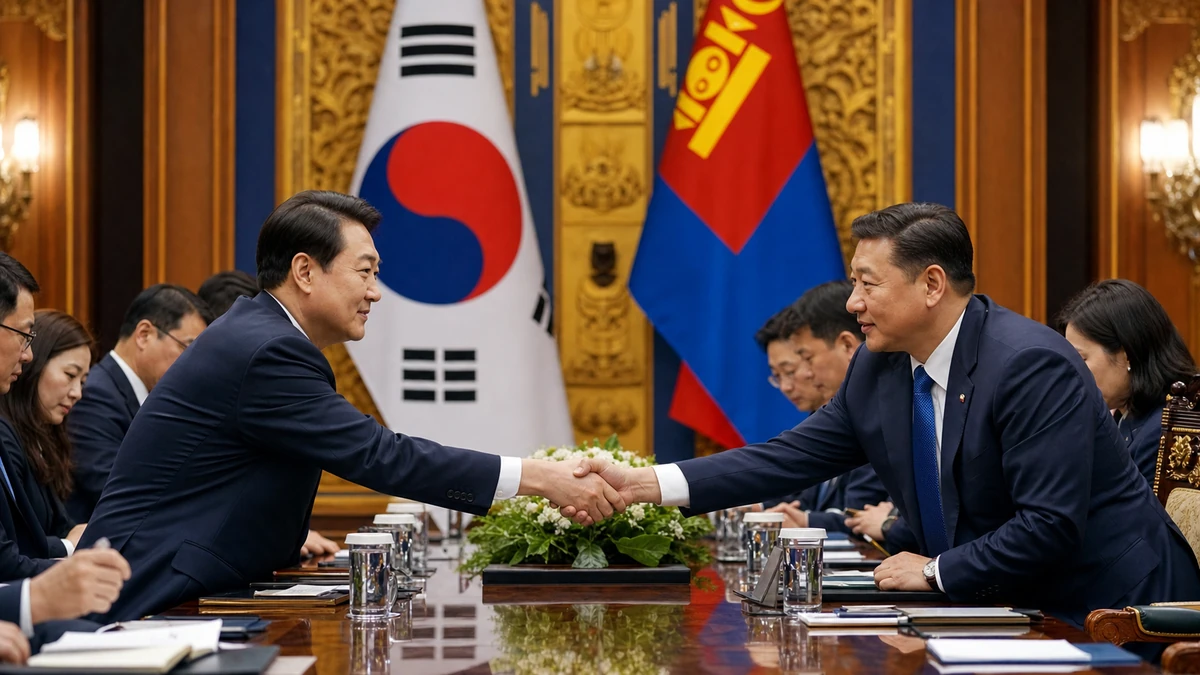
South Korean President Lee Jae-myung and Mongolian President Ukhnaa Khurelsukh used a summit in Ulaanbaatar to send a message that may sound modest on paper but carries real weight in Northeast Asian diplomacy: The question of peace on the Korean Peninsula is back in active discussion, and Mongolia wants to help.
According to South Korea’s presidential office, the two leaders agreed during Lee’s state visit to strengthen cooperation aimed at advancing peace on the Korean Peninsula. Officials said both presidents confirmed that peace and stability in the region, including on the peninsula, are a shared interest for both countries.
That language may appear cautious, even bland, to American readers used to dramatic summit headlines or the made-for-television style of U.S. political diplomacy. But in Asia, and especially when North Korea is involved, careful wording is often the story. Diplomatic statements are typically negotiated line by line, and what is included, softened or omitted can reveal as much as any headline-grabbing pledge.
What stood out most from this meeting was Mongolia’s signal that it is willing to play a role in creating conditions for improved inter-Korean relations and a possible resumption of dialogue with North Korea. Khurelsukh, according to the South Korean side, expressed support for Seoul’s efforts to build peace and said Mongolia could take on a useful role, given that it maintains traditionally friendly ties with Pyongyang.
That does not mean talks between North and South Korea are imminent. It does not mean a mediation process has been formally launched. And it certainly does not mean a breakthrough is at hand in one of the world’s most entrenched security disputes. But it does mean that Seoul is actively looking beyond the usual major powers — the United States, China, Japan and Russia — and testing whether middle powers with unique relationships can help widen the diplomatic space around North Korea.
In that sense, the summit was less about a single deliverable and more about reestablishing momentum. For a region that has endured years of missile tests, military signaling and diplomatic stalemate, even the reopening of a conversation about who might help facilitate future dialogue can matter.
Why Mongolia matters more than many Americans realize
For many Americans, Mongolia is often understood through a handful of familiar reference points: vast grasslands, Genghis Khan, and its position squeezed between Russia and China. In Washington foreign-policy circles, it is sometimes mentioned as a democratic outlier in a difficult neighborhood. But it rarely enters mainstream U.S. discussion about the Korean Peninsula.
This summit is a reminder that Mongolia occupies a more interesting diplomatic position than its relatively low global profile might suggest.
Mongolia has maintained working relationships across ideological and geopolitical lines for decades. It has long pursued what it calls a “third neighbor” policy, a strategy meant to deepen ties beyond its two giant neighbors by working with countries such as the United States, South Korea, Japan and European partners. At the same time, it has preserved traditional ties with North Korea. That combination gives Ulaanbaatar a certain utility: It is politically acceptable to Seoul, not inherently threatening to Pyongyang, and seen internationally as a country with little obvious hidden agenda in the Korean conflict.
For South Korea, that matters. Seoul’s North Korea policy has always involved more than direct contact with Pyongyang. It also depends on building an international environment that makes talks more possible, less costly and more sustainable. Sometimes that means coordination with Washington. Sometimes it means managing Beijing. And sometimes it means identifying countries that can serve as lower-pressure channels for communication or confidence-building.
Mongolia has occasionally been discussed in exactly that role before. Over the years, it has hosted international dialogues and been mentioned as a possible neutral venue for sensitive regional conversations. Its value is not that it can force North Korea’s hand. No one can. Its value lies in its ability to help create settings in which engagement does not immediately look like capitulation for any side involved.
Americans might compare this, loosely, to the role countries such as Norway, Switzerland or Oman have played in other conflicts: not kingmakers, but facilitators; not the principal architects of security guarantees, but useful intermediaries whose credibility comes from not being at the center of great-power rivalry. Mongolia is not identical to any of those cases, but the logic is similar.
That is why Khurelsukh’s reported offer to help shape conditions for renewed North-South dialogue drew attention. It suggested Mongolia is not just endorsing a broad peace slogan. It is indicating a willingness to use its particular diplomatic relationships in a practical way.
The wording shift tells its own story
One of the most revealing details from the visit was not a new initiative or signed agreement, but a difference in wording.
Before the summit, Lee said in a written interview with Mongolia’s state news agency that he envisioned pursuing denuclearization in a phased and comprehensive manner. After the summit, however, the joint press statement did not use the word “denuclearization.” Instead, it referred more generally to efforts to establish peace on the Korean Peninsula.
That distinction is significant.
In U.S. political language, “denuclearization” often functions as the default objective in policy discussions about North Korea. In South Korea, too, it has long been a central part of the official vocabulary. But in diplomacy, especially multilateral or leader-level diplomacy, the use of a broad or narrow term can signal what kind of consensus was realistically available.
The omission of “denuclearization” from the joint statement does not necessarily mean Seoul has abandoned that goal. There is no evidence of that. Rather, it suggests that when both sides reduced the summit outcome to mutually acceptable language, they chose a broader formula centered on peace and stability instead of a more specific formulation that might have narrowed room for agreement.
That is particularly understandable given Mongolia’s relationship with North Korea. A country that wants to preserve its usefulness as a possible bridge is more likely to favor wording that keeps diplomatic space open. The broader phrase “peace on the Korean Peninsula” is less confrontational, less prescriptive and easier for more parties to publicly support.
For American readers, a helpful comparison might be the difference between stating an end goal in a White House speech and negotiating acceptable language in a joint communique with foreign leaders. Public rhetoric can be aspirational. Joint diplomatic texts are often products of compromise. Every word survives because both sides can live with it.
That makes the wording shift more than semantic trivia. It offers a glimpse into the realism guiding this diplomacy. Lee can continue to speak about phased denuclearization as a strategic objective, while the summit outcome reflects a more immediate focus: rebuilding enough regional consensus and trust to keep the peace process, however distant, politically discussable.
Peace and minerals: a modern diplomatic package
The summit also underscored something increasingly true not just in Asia but around the world: Security policy and economic policy are now deeply intertwined.
Alongside the peace discussions, Lee used a separate South Korea-Mongolia business forum to call for faster cooperation in economic sectors including critical minerals. South Korean officials also said rare earths were a major topic in discussions with Mongolia.
That may sound like a separate track from Korean Peninsula diplomacy, but in reality the two issues fit together neatly. A state visit today is rarely about only one thing. Leaders are expected to address strategic stability, economic resilience and supply-chain concerns all at once. In this case, the peace agenda and the mineral agenda reinforce a broader South Korean message: Seoul wants relationships in the region that are comprehensive, not single-issue.
For American audiences, the significance of rare earths and critical minerals is easy to understand through a familiar lens. These materials are essential to advanced manufacturing, electric vehicles, batteries, defense technologies and semiconductors. In the United States, concern over dependence on China-dominated supply chains has become one of the few issues that draws bipartisan attention. South Korea faces a similar challenge. Its economy depends heavily on high-tech manufacturing, and securing stable access to strategic inputs has become a national priority.
Mongolia, with its substantial mineral resources, is an attractive partner in that context. No major contract or investment package was confirmed in the information released around the visit, and it would be premature to present the discussions as finalized business. Still, the fact that rare earths were highlighted shows that Seoul sees Mongolia not only as a potentially useful diplomatic partner on security issues, but also as a meaningful player in the competition to diversify critical supply chains.
This pairing of peace diplomacy and economic cooperation reflects a broader trend in South Korean foreign policy. Like many middle powers, South Korea increasingly treats diplomacy as an integrated project. Security relationships support economic resilience. Economic ties deepen political trust. And countries once seen as peripheral can become more important because they sit at the intersection of both concerns.
That makes the Mongolia visit notable even beyond the Korean question. It shows how Seoul is trying to widen its regional map, looking past the usual capital cities and toward partnerships that can serve several strategic purposes at once.
What this means for Lee Jae-myung’s foreign policy
Lee’s trip to Mongolia also offered an early indicator of the style and priorities of his administration’s diplomacy. South Korean presidents often arrive in office facing a familiar tension: how to address the immediate military threat from North Korea while also preserving room for eventual engagement. Domestic political camps in South Korea differ sharply on how much emphasis to place on deterrence, sanctions, dialogue and reconciliation, but no president can ignore the fact that the North Korea problem is both a security challenge and a political symbol.
Lee appears to be signaling that he wants to reintroduce diplomacy into the conversation without overpromising immediate results. That matters because the history of Korean Peninsula diplomacy is littered with moments of inflated expectations followed by disappointment. From the “sunshine” era of inter-Korean rapprochement to the collapse of high-profile U.S.-North Korea summitry during the Trump years, the pattern is familiar: dramatic opening, unresolved fundamentals, eventual stall.
Against that backdrop, a more cautious approach may be intentional. By emphasizing peace-building and international support rather than announcing a headline-grabbing initiative, Lee’s team may be trying to avoid setting benchmarks it cannot meet. That is especially prudent at a moment when North Korea has shown little interest in returning to negotiations on terms favorable to Seoul or Washington.
The summit language also suggests Lee is willing to think in stages. Instead of treating denuclearization as the starting point for any meaningful progress, his administration may be treating it as part of a longer horizon while focusing first on reducing tensions, rebuilding channels and gathering support from partners. If so, Mongolia fits the strategy well. It offers no magic solution, but it does offer a credible setting for patient, incremental diplomacy.
There is also a domestic political dimension. South Korean presidents are judged not only by whether they improve security, but by whether they demonstrate international stature. State visits, joint statements and economic forums all help project the image of a leader actively shaping the regional agenda rather than simply reacting to Washington, Beijing or Pyongyang. A visit that combines peace messaging with business diplomacy serves that purpose.
None of this guarantees success. In Korean Peninsula diplomacy, intentions and outcomes are separated by a wide and often brutal gap. But the signals matter, and this trip suggested that Lee wants South Korea to be seen as actively building diplomatic networks around the peninsula issue, not waiting passively for events to force the next move.
The limits of the moment
For all the interest surrounding Mongolia’s offer, it is important not to overstate what happened in Ulaanbaatar.
No timeline was announced for resumed talks between North and South Korea. No specific mechanism was publicly described for how Mongolia might assist. There was no declaration of a new peace process, no detailed roadmap and no sign that Pyongyang has endorsed any such role. The South Korean briefing described Mongolia’s position as a willingness to help create the right conditions, not as the launch of a formal initiative.
That distinction matters because the Korean Peninsula has a long history of symbolic diplomatic gestures that do not immediately translate into substantive change. North Korea’s calculations are driven by regime security, military strategy and its own reading of the international environment — especially its relations with the United States and China. Mongolia’s goodwill cannot override those fundamentals.
There is also the broader strategic climate to consider. Northeast Asia today is more polarized than it was during some earlier periods of diplomacy. U.S.-China rivalry is sharper. Russia’s war in Ukraine has strained international alignments. North Korea has deepened military cooperation with Russia and continued advancing its weapons programs. In that environment, simply reopening space for dialogue is harder than it once was.
That is why the measured language from the summit should be read as realism rather than weakness. The leaders did not claim a breakthrough because none exists. What they did do was reaffirm that peace on the Korean Peninsula is not a frozen or forgotten issue, and that regional states beyond the usual great powers still see value in helping manage it.
For American readers, perhaps the clearest way to understand this is to think of it as diplomatic infrastructure. Before major negotiations can happen, there must be trusted venues, intermediary relationships, acceptable language and countries willing to facilitate contact without dominating it. Those quiet pieces are less visible than missile launches or summit photo ops, but they are often what makes future diplomacy possible.
Why the world should pay attention
The Lee-Khurelsukh summit will not by itself change the trajectory of the Korean conflict. But it does highlight an important shift in how South Korea is presenting its diplomacy to the world.
Rather than framing the Korean Peninsula only through the language of military confrontation, Seoul is tying together peace-building, regional stability, economic cooperation and supply-chain strategy. That is a more expansive and arguably more modern diplomatic frame. It reflects the reality that in 2025, security is not just about armies and missiles; it is also about trade routes, minerals, partnerships and the political flexibility to talk across divides.
Mongolia’s role is central to that story because it illustrates how countries outside the usual hierarchy of power can still matter. Ulaanbaatar is not Washington or Beijing. It cannot impose terms on the peninsula. But because it maintains friendly ties with North Korea while also cooperating closely with democracies such as South Korea and the United States, it occupies a diplomatic niche that larger powers sometimes cannot.
For South Korea, having Mongolia publicly support its peace efforts is symbolically useful and potentially practically useful. It broadens the coalition of countries willing to endorse dialogue. It reinforces the idea that stability on the peninsula is a regional interest, not merely a bilateral dispute between North and South. And it offers one more avenue — however tentative — for keeping communication options alive in a period when formal negotiations remain stalled.
For the United States and other outside observers, the summit is also a reminder that Korean Peninsula diplomacy does not always move in dramatic leaps. Often it advances, if it advances at all, through quiet repositioning: a phrase changed in a statement, a partner country signaling willingness to help, a state visit that links security to economics in a way that expands future leverage.
That may not produce the kind of instant headline Americans often expect from international summits. But in the context of Korea, where the gap between rhetorical ambition and political reality has so often swallowed entire initiatives, modesty can be a sign of seriousness.
The real significance of Lee’s Mongolia visit, then, lies not in a concrete breakthrough but in the restoration of diplomatic possibility. South Korea and Mongolia have jointly placed peace on the Korean Peninsula back at the center of a high-level conversation. They have done so in language broad enough to preserve room for future engagement and alongside economic talks that reflect the strategic priorities of an increasingly fragmented world.
That is not a peace deal. It is not even a roadmap. But it is a signal — to Pyongyang, to the region and to global partners — that Seoul is trying to widen the circle of countries invested in lowering tensions and reopening channels. In a geopolitical climate where even maintaining the possibility of dialogue can be difficult, that is no small thing.
Comments
Post a Comment