
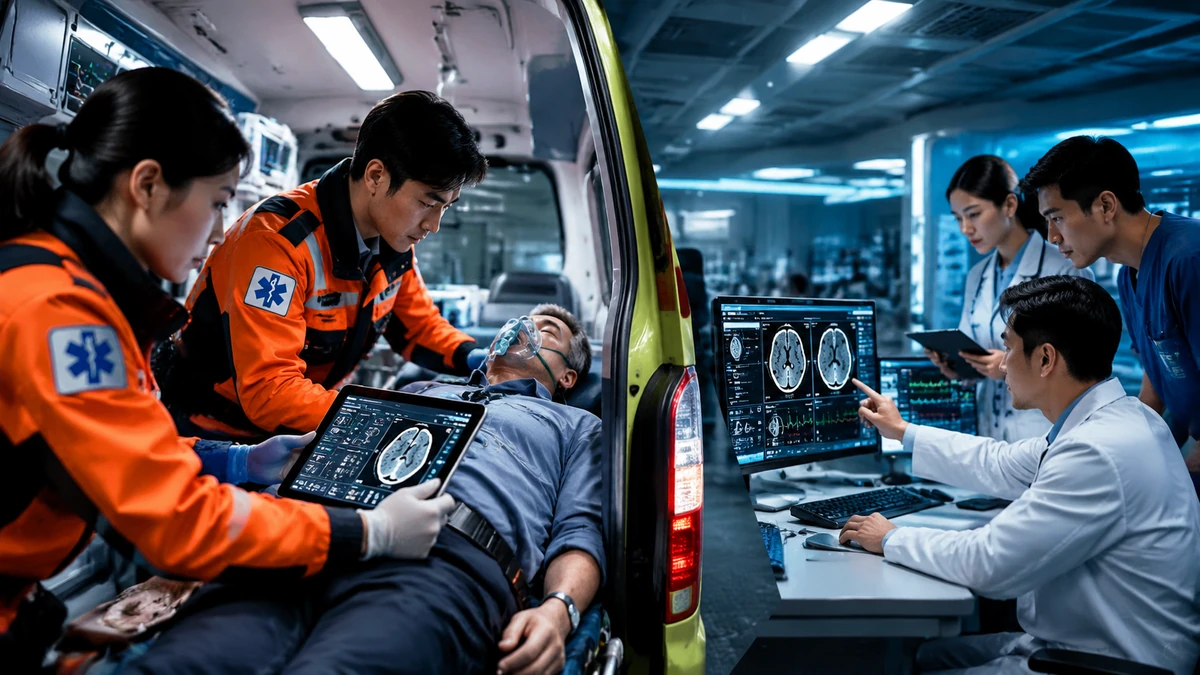
A regional Korean city is building an emergency response system around one brutal medical fact: time is brain.
South Korea’s city of Chuncheon, working with Gangwon provincial authorities and Hallym University Chuncheon Sacred Heart Hospital, has won national backing for an ambitious new project aimed at one of medicine’s most unforgiving races against the clock: treating stroke patients before irreversible damage sets in.
The project, selected for South Korea’s 2026 second-round national health care technology research and development program under the Ministry of Health and Welfare, is designed to create what officials call an “intelligent Brain Saver” integrated platform. The goal is not simply to add artificial intelligence to an ambulance ride or a hospital dashboard. It is to redesign the flow of emergency stroke care so that first responders and hospital specialists begin working from the same stream of information before a patient even reaches the emergency room.
For American readers, the premise will sound familiar. In the United States, stroke specialists often repeat the phrase “time is brain,” meaning that millions of neurons can die each minute a stroke goes untreated. The faster a stroke is identified and the faster a patient reaches a team prepared to deliver clot-busting drugs or perform a procedure to reopen a blocked artery, the better the odds of survival and long-term recovery. South Korean officials say this new platform is built around the same reality.
What makes the Korean effort especially notable is where it is happening. Gangwon, the northeastern province where Chuncheon is located, is known for its mountains, long travel distances and uneven access to advanced medical care outside major urban centers. It is also familiar to many Koreans as a region of lakes, ski resorts and military bases, and to some international audiences as the setting for parts of the early Korean drama “Winter Sonata,” one of the cultural touchstones of the Korean Wave. But beyond the tourist image, Gangwon also represents a challenge shared by many rural and spread-out places around the world: how to get a critically ill patient from the field to the right treatment fast enough to matter.
That is where officials believe digital coordination, not just a new software tool, could make a difference.
More than an app: A redesign of emergency care from curbside to hospital bed
According to the project outline released by local officials, the system is meant to connect the emergency scene, ambulance crews and hospital stroke teams in real time. Instead of waiting until a suspected stroke patient arrives at the hospital for doctors to begin assessing the situation, the platform would allow key information gathered in the field to reach the hospital while the patient is still in transit.
That might include symptoms, time of onset, neurological observations, vital signs and other details that can help doctors decide what resources need to be ready. Mobile-based AI tools are expected to be part of the system, helping first responders identify possible stroke cases more quickly and route information in a structured way.
In practical terms, the Korean partners are trying to compress or eliminate the dead space that often exists between the ambulance and the emergency department. In many health systems, including in the U.S., delays do not happen only because of distance. They also happen because information is fragmented. Paramedics assess a patient. A hospital gets a phone call. A receiving team tries to interpret incomplete details. Imaging, specialists and treatment areas may not be fully prepared until after the patient is wheeled through the door.
The Chuncheon-Gangwon model aims to shrink that gap. If the emergency team on the scene and the hospital team are effectively looking at the same case in real time, the patient’s arrival becomes less of a starting point and more of the next step in a process already underway.
Officials have framed that as the central value of the project. The significance, they say, is not merely the introduction of AI software. It is the effort to place stroke identification, transport and hospital preparation inside one integrated platform so each part of the chain of care can move in sync.
That is a deceptively important distinction. Health technology projects often attract attention for their futuristic language, especially when AI is involved. But in emergency medicine, dazzling algorithms matter less than dependable execution. A platform that helps a medic spot a likely stroke but does not successfully alert the right hospital team in time may have limited value. A sleek hospital system that cannot absorb field data quickly enough may also fall short. The real test is whether the technology improves the choreography of care when people are stressed, moving fast and making high-stakes decisions.
Why stroke care is such a high-pressure test for artificial intelligence
Stroke is a particularly difficult problem because treatment windows can be narrow and the symptoms can vary. A patient may have facial drooping, slurred speech, weakness on one side, confusion, vision problems or sudden severe dizziness. Some signs are obvious. Others can be subtle, especially for non-specialists dealing with chaotic conditions in the field.
There are also different kinds of stroke. Ischemic strokes, caused by a blocked blood vessel, are the most common and may be treated with clot-dissolving drugs or with thrombectomy, a procedure in which specialists physically remove the clot. Hemorrhagic strokes, caused by bleeding in the brain, require a different course of care. Either way, the patient’s odds often improve when clinicians move fast and make the right decisions early.
That makes stroke an appealing area for AI support, at least in theory. Artificial intelligence can be trained to recognize symptom patterns, structure triage data, flag urgency and reduce communication delays. In some settings, AI tools are also being used to interpret brain scans, identify blockages and alert specialists faster. But even the most enthusiastic advocates in medicine usually emphasize the same point Korean officials are making here: technology is a support tool, not a replacement for clinicians.
The message matters because public concern about AI in health care tends to split into two opposing fears. One is that hospitals will rely too heavily on black-box systems that patients do not understand. The other is that promising tools will be trapped in pilot programs and conference presentations without changing real-world care. The Gangwon project is trying to answer the second concern by focusing on field validation, not just lab development.
Local officials say the platform will be tested in actual medical settings and used to build a standard emergency stroke-care model tailored to Gangwon’s regional conditions. In plain English, that means the system is supposed to prove that it works in the messiness of everyday ambulance calls and hospital workflows, not just under ideal conditions. Because medical resources, staffing levels and transport times differ from one region to another, developers will need to refine the platform based on what happens on the ground.
That real-world focus may be the most important part of the project. In medicine, implementation is often harder than invention. A promising stroke alert system can fail if paramedics find it too cumbersome, if hospitals are not staffed to respond consistently, if connectivity drops in remote areas or if protocols are unclear. The Korean partners appear to understand that the platform’s value will be judged not by its branding but by whether it works quickly and consistently at the moment of crisis.
Gangwon’s geography helps explain why this project could matter beyond South Korea
To understand the broader significance of the effort, it helps to know something about Gangwon. The province sits far from the dense urban concentration of the Seoul metropolitan area, where South Korea’s top hospitals are clustered. Gangwon has beautiful but rugged terrain, with communities spread across mountain corridors and coastal areas. Travel can be complicated by weather, winding roads and the simple reality of distance.
Americans might compare parts of the challenge to delivering advanced emergency care across Appalachia, rural Maine, the Mountain West or sections of Alaska, where geography can work against the clock. Even in wealthy countries with universal or near-universal coverage, access is not simply a matter of insurance. It is also a matter of where specialists are, how fast an ambulance can travel, what hospital is equipped to handle a particular case and whether the handoff between systems is smooth enough to avoid wasteful minutes.
South Korea, despite its advanced health care infrastructure and high-speed digital networks, faces many of the same regional disparities found elsewhere. Major hospitals and top specialists are concentrated in and around Seoul. That has fueled longstanding political debate inside the country over so-called regional medical gaps, a phrase that refers to differences in access and quality between the capital region and provincial areas.
Against that backdrop, the Chuncheon project is being watched not only as a stroke initiative but also as a possible model for narrowing local health disparities through better coordination. If every region cannot immediately build a top-tier tertiary medical center or recruit the same number of specialists, digital systems that link field responders to treatment-capable hospitals may offer a more realistic near-term solution.
That is one reason the collaboration itself is significant. The project brings together city government, provincial government and a university hospital, combining local administrative authority, regional policy support and clinical expertise. In many countries, emergency care improvements stall because agencies operate in silos. A city runs ambulance services. A province or state controls budgets. A hospital follows its own protocols. A national ministry funds research on a different timeline. By putting those actors inside one project, South Korean officials are trying to align decision-makers who would all need to cooperate if the system is to function at scale.
A familiar Korean pattern: local governments using national R&D support to solve practical social problems
For readers who mostly encounter South Korea through K-pop, Oscar-winning films, hit television dramas or the consumer-tech giants Samsung and LG, this story points to another side of the country: its habit of using public-private and central-local partnerships to turn digital policy into concrete services.
That does not mean every Korean technology initiative succeeds, or that bureaucratic coordination is seamless. Far from it. South Korea debates regional inequality, hospital overcrowding, physician shortages in some specialties and the concentration of opportunity in Seoul as intensely as Americans debate the urban-rural divide and the future of health care access. But the country has repeatedly shown a willingness to use state-backed research and development programs to address practical bottlenecks in daily life, from transportation and smart-city projects to health care digitization.
In this case, the Ministry of Health and Welfare’s selection of the stroke platform for a national R&D program gives the project more than prestige. It also places it inside a policy framework that can support development, testing and potentially broader adoption if the model proves successful. In South Korea, being chosen for such a program typically signals that the central government sees a project as worth nurturing beyond a local experiment.
The project title itself reflects Korean emergency medicine culture in an interesting way. Officials describe the effort as protecting the stroke “golden time.” That phrase, commonly used in South Korea, refers to the critical window in which treatment is most effective. Americans would usually say “golden hour” in trauma settings or simply refer to the treatment window, but the underlying concept is the same: some emergencies allow very little room for delay, and outcomes worsen quickly when systems are slow.
That language also reveals something about how this initiative is being sold to the public. Rather than presenting AI as a futuristic add-on, officials are connecting it to a simple promise that ordinary people immediately understand: faster recognition, faster transport coordination and faster treatment preparation when a loved one may be having a stroke.
The promise and the limits of AI in the ambulance era
Still, optimism should come with caution. Artificial intelligence in health care is often strongest when it handles narrow, well-defined tasks: surfacing patterns in data, prioritizing alerts, standardizing documentation or helping clinicians see a diagnosis they might otherwise miss. It is weaker when asked to solve deeper structural problems on its own.
Gangwon’s stroke platform will likely confront challenges familiar to any emergency medicine project. The first is reliability. Can first responders use the mobile tools quickly under pressure? The second is interoperability. Can ambulance systems, hospital systems and regional networks actually communicate without friction? The third is trust. Will clinicians believe the AI-generated suggestions are useful enough to act on? And the fourth is equity. Will communities with weaker infrastructure or longer transport routes benefit as much as those closer to better-equipped hospitals?
There is also the issue of false positives and false negatives. If AI flags too many cases as likely stroke, hospitals may face alert fatigue. If it misses cases, the consequences could be severe. That is why most successful clinical AI systems are built to support, not override, trained medical judgment.
Korean officials appear aware of that balance. Their public messaging emphasizes that technology is not a substitute for doctors and emergency personnel, but a tool to support faster judgment and better connection. That framing is not just politically prudent. It is medically sound.
It also speaks to a broader global shift in emergency care. Increasingly, the most meaningful innovation is not a robot in the operating room or a flashy consumer gadget. It is the invisible infrastructure that helps the right information reach the right people at the right moment. In stroke care, where minutes can define a life after survival, infrastructure can be as important as innovation.
What success would look like, in Korea and beyond
If the Chuncheon-Gangwon project works as intended, success will not be measured mainly by headlines about AI. It will be measured by shorter door-to-treatment times, more patients routed appropriately, better preparation before arrival and, ultimately, improved survival and reduced disability.
That may sound modest compared with the grand claims often attached to artificial intelligence. But in public health terms, it would be substantial. A stroke patient who receives treatment sooner may avoid paralysis, speech loss or cognitive damage that would otherwise change the rest of a family’s life. Multiply that across a region, and a digital platform becomes more than a technical upgrade; it becomes a way of reducing the human cost of distance.
The implications could extend well beyond South Korea. Around the world, many regions face the same basic problem Gangwon does: specialized care is unevenly distributed, but emergency needs are not. Whether in rural America, remote parts of Japan, provincial Canada or mountainous areas of Europe, health systems are searching for ways to bridge geography without waiting decades for every community to receive the same concentration of specialists and facilities.
That is where Gangwon’s experiment may offer a useful lesson. The future of emergency care may depend less on building identical hospitals everywhere than on building smarter connections between the field and the places that can actually deliver advanced treatment. AI, in that model, is not the star of the story. Coordination is.
For now, the project remains a development and validation effort, not a finished system. Much will depend on how well local responders and hospitals adapt the platform to real conditions, and whether the model can deliver consistent performance where it matters most: in the unpredictable minutes after someone collapses, slurs a sentence or loses movement on one side of the body.
But the direction is clear. In a region where mountains and distance can work against emergency care, South Korean officials are betting that digital connectivity can give patients some of that lost time back. In stroke medicine, that is not a small promise. It is the difference between a technology demo and a second chance.


0 Comments