South Korea Moves to Protect Citizens in Guam and Saipan as Typhoon Approaches, Highlighting a Safety Net Beyond Its Borders
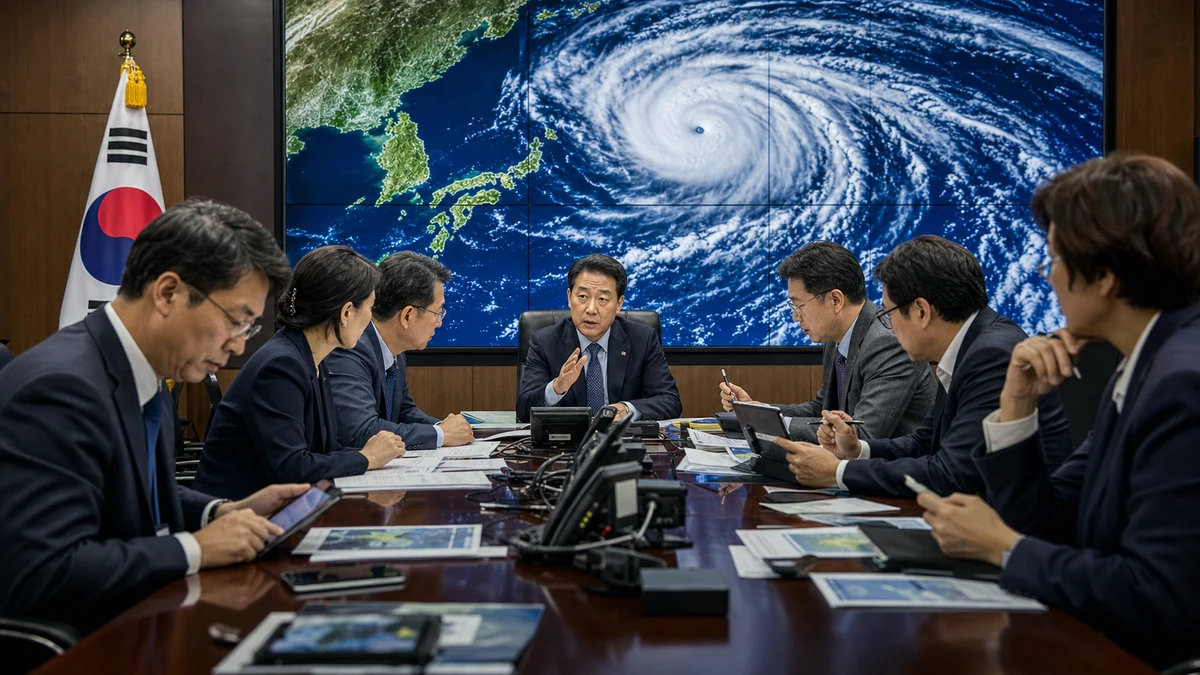
As a storm closes in, Seoul looks outward
As Typhoon Bavi tracks toward Guam and Saipan, South Korea’s Foreign Ministry is shifting into disaster-response mode for a population that many Americans may not immediately think of when they hear the words “Korean citizens abroad.” According to the ministry, officials held an emergency review meeting led by Yoo Byung-seok, director general of the Consular and Safety Affairs Bureau, to check preparedness measures for South Koreans in the two Pacific island territories as forecasts warned the storm could pass through the area this weekend.
On one level, this is a familiar story about a government preparing for a dangerous weather event. In the United States, that kind of response might involve the State Department issuing travel alerts, FEMA coordinating with local authorities, or consular officials checking on Americans overseas after a hurricane or earthquake. South Korea is doing something similar here: monitoring the storm’s path, keeping in touch with its overseas offices and local support staff, and pushing out safety information to Korean nationals who live in, work in or are temporarily staying in Guam and Saipan.
But the story also says something larger about modern Korea and its relationship with its global diaspora. South Korea is a country with a highly mobile population — students, business travelers, military families, tourists and long-term residents spread across the world. Guam and Saipan, in particular, occupy a distinct place in that map. Though they are U.S. territories in the western Pacific, they are also well-known destinations for Korean travelers and home to communities of Korean residents and business owners. That means a storm in the Mariana Islands is not simply local news for Seoul. It is, in a real sense, a domestic safety concern playing out beyond the country’s borders.
The ministry’s message so far has been cautious rather than alarmist. Officials have not claimed major damage or announced a mass evacuation. Instead, they are emphasizing readiness: tracking the typhoon, maintaining constant contact with local offices, and making sure Korean citizens receive up-to-date weather and safety guidance. In disaster reporting, that distinction matters. The key development at this stage is not what the storm has already done, but what governments are doing before conditions worsen.
Why Guam and Saipan matter in South Korea’s public life
For many American readers, Guam and Saipan may register first as strategically important U.S. territories, known for military bases, tourism and their location in a part of the Pacific regularly exposed to typhoons. For South Koreans, they also carry another layer of meaning. These islands have long been popular destinations for family vacations, honeymoons, golf trips and short-haul travel from Northeast Asia. They are also places where Korean-owned businesses operate and where some South Korean nationals live for extended periods.
That helps explain why a weather threat there can trigger a response in Seoul that goes well beyond routine diplomatic housekeeping. In Korean, the government often uses the term “jaeoe gukmin,” meaning citizens residing or staying overseas. Another commonly used word is “gyomin,” referring broadly to overseas Koreans, especially those living abroad for a longer period. These are not abstract bureaucratic categories. They describe real communities that the South Korean state increasingly treats as part of its public responsibility.
Americans have their own parallels. When a hurricane bears down on Puerto Rico, or wildfires threaten U.S. citizens overseas, the public expects government agencies to provide warnings, evacuation information and emergency support. South Korea’s response to the Guam-Saipan threat reflects a similar expectation: that a government’s duty of care does not end at the water’s edge.
That expectation has grown stronger as South Korea has become more globalized. A generation ago, the country was still thought of primarily through the lens of export manufacturing and the unresolved tensions of the Korean Peninsula. Today, it is also a major cultural exporter, a top travel market, an education hub and a country whose citizens move frequently for business and leisure. The Korean Wave, or “Hallyu,” has made South Korea feel culturally close to audiences around the world. Less visible, but equally important, is the administrative machinery that follows that global reach — including the consular systems designed to protect Koreans when crises unfold abroad.
How South Korea’s overseas safety system works
The Foreign Ministry said Yoo stressed the need for an around-the-clock communication system between headquarters in Seoul and overseas missions. That phrase may sound technical, but it gets at one of the most important variables in disaster response: the speed of information. In a typhoon, conditions can shift quickly. Forecast tracks wobble. Wind intensifies or weakens. Flooding and infrastructure damage can change what roads are usable, which shelters are open and how easily residents can move.
In South Korea’s system, “headquarters” refers to the ministry in Seoul, while “missions” refers to embassies, consulates and affiliated offices abroad that handle on-the-ground consular support. In the case of Guam and Saipan, local Korean officials and support personnel act as a bridge between Seoul and Korean nationals in the area. Their job is not only to relay official notices but also to translate rapidly changing local conditions into practical guidance people can use.
The ministry’s emphasis on constant communication reflects a basic truth that emergency managers everywhere understand: a warning delayed can become a warning denied. If local developments are reported too slowly, updated safety notices and evacuation guidance may reach residents after the window for easy action has already narrowed.
What stands out in this case is that South Korea appears to be relying not just on formal channels but on informal, everyday ones as well. Officials in Saipan said they have been sharing the storm’s projected path and weather information through group chat rooms. That detail is worth pausing on. In South Korea, group messaging apps are deeply embedded in daily life, whether for families, schools, office teams or neighborhood networks. Using those existing digital channels in a crisis can be far more effective than posting a notice to a website and hoping people happen to see it in time.
American emergency managers have increasingly embraced similar strategies, from text alerts to neighborhood Facebook groups to county emergency apps. The principle is the same: in a disaster, the most useful communication channel is often the one people are already checking. For Korean nationals abroad, especially travelers who may be moving between hotels, airports and unfamiliar streets, a real-time message in Korean delivered through a familiar platform can provide both practical information and a measure of reassurance.
More than diplomacy: daily safety for citizens abroad
At first glance, this might look like a narrow diplomatic item — a ministry meeting, a weather update, a consular coordination effort. But in substance, it is a public-safety story. It is about how a state protects people who are living ordinary lives outside the country: working shifts, running small businesses, taking vacations, caring for children, waiting out a storm in a hotel room or apartment far from home.
That is part of what makes this development notable. Governments are often judged on visible moments of rescue after disaster strikes. Yet some of the most consequential work happens earlier, in the less dramatic phase of monitoring, messaging and preparing. South Korea’s review meeting appears aimed at precisely that stage — gathering information before it becomes outdated, checking lines of communication before they fail, and making sure Korean nationals know where to turn if conditions deteriorate.
The Hagatna office, which oversees consular functions for Guam and Saipan, has also been relaying safety notices, including evacuation information in case conditions require it. That repeated messaging is important. One announcement is rarely enough in a fast-moving weather emergency. People miss alerts, phone batteries die, travel plans change, and the facts on the ground evolve by the hour. Effective crisis communication is repetitive by design.
For Korean residents abroad, language is also a factor. Guam and Saipan operate within U.S. systems, and local authorities issue their own warnings. But for many travelers or short-term residents, receiving guidance in Korean can make a critical difference, especially when stress is high and local administrative terms are unfamiliar. Anyone who has tried to navigate a weather emergency in a place where they do not fully understand the language knows how quickly confusion can become a safety risk.
That is why the ministry’s role cannot be dismissed as mere bureaucracy. In practice, it functions as a social safety net extending across borders. It helps translate not just words, but systems: where to shelter, what evacuation guidance means, how to reach help, which updates are official and what steps are worth taking now rather than later.
The central role of trust and speed in disaster information
Every major storm generates an information battle alongside the weather itself. Rumors spread, outdated screenshots circulate, and people latch onto the forecast they most want to believe. In that environment, two things matter more than almost anything else: how quickly information moves and whether people trust the source.
South Korea’s response in Guam and Saipan appears to be built around both of those concerns. The ministry has formal authority and access to official channels. Local missions and support personnel provide proximity and context. Group chat rooms provide speed and reach. Put together, that creates a layered communication structure designed to move reliable information from government offices to individuals in real time.
That architecture reflects a broader evolution in disaster response. In earlier eras, governments often treated public communication as a one-way broadcast: issue a statement, hold a briefing, trust that the message will trickle down. Today, emergency communication is more decentralized and more immediate. People expect updates in the same spaces where they receive family news, school messages and work instructions. They also expect them quickly.
South Korea, one of the world’s most digitally connected societies, has become adept at this kind of high-speed communication. Its domestic emergency-alert systems are already familiar to residents at home, whether for severe weather, public safety incidents or public health warnings. Extending that habit of rapid notification to citizens overseas is a logical next step, especially in places like Guam and Saipan where Korean communities are large enough to sustain their own information networks.
Still, there are limits to what can be concluded at this point. The information summarized so far does not establish the extent of any local damage, whether evacuations have already occurred, or how many Korean nationals may ultimately be affected. Responsible reporting requires that distinction. The significance of this story lies not in confirmed disaster outcomes but in the activation of a protective system before those outcomes are clear.
A familiar threat in the Pacific, with a distinctly Korean dimension
Typhoons are a regular part of life across the western Pacific, just as hurricanes are in the Atlantic and Gulf Coast. Guam, in particular, has a long history of storm preparation and resilience. Residents there are used to boarding up windows, stocking supplies and watching the latest track updates with a practiced eye. Saipan, too, knows the rhythms of severe weather and the vulnerabilities that come with island geography.
What gives this story its distinct character is not the existence of the storm itself, but the transnational web it activates. A weather system moving across U.S. territories is prompting meetings in Seoul, guidance from Korean officials in the field, and safety messages sent in Korean to people living under American jurisdiction in the Pacific. It is a reminder that in a globalized era, the boundaries of public responsibility are more porous than maps alone suggest.
This is especially true for South Korea, which has spent decades building institutions that match its expanding international footprint. The country’s global presence is often discussed through culture — K-pop, K-dramas, Korean food, cosmetics and technology brands. But the less glamorous side of globalization is administrative: helping citizens navigate legal systems, medical emergencies, political unrest and natural disasters far from home. Consular protection is one of the clearest expressions of that responsibility.
There is also an emotional element that should not be overlooked. In crisis situations, contact from a home-country institution can provide not only information but a sense of connection. For a Korean traveler or resident in Guam or Saipan, a message from a Korean consular office can reduce uncertainty in a way that generic alerts sometimes do not. It says, in effect, that someone is paying attention to your situation specifically, in your language, with your practical needs in mind.
That kind of reassurance is difficult to quantify, but it is part of what makes overseas safety systems meaningful. They do not eliminate risk. They do, however, help people understand the risk and act on it more confidently.
What this says about South Korea’s expanding public obligations
In the broadest sense, this episode highlights how South Korea’s concept of public service has expanded beyond its own territory. The country is not only managing domestic emergencies and regional security tensions; it is also increasingly expected to track and respond to hazards affecting citizens scattered across the globe.
That expectation reflects the reality of Korean life in the 21st century. A society once defined in outside eyes by war and reconstruction is now deeply interwoven with global travel, education, commerce and culture. The Korean passport is widely used. Korean businesses operate internationally. Korean communities abroad are sustained by dense social and digital networks. As those patterns deepen, the state’s obligations follow.
Seen that way, the ministry’s meeting over Typhoon Bavi is not a minor footnote. It is part of a larger pattern in which governments must think about citizen welfare across multiple jurisdictions at once. Climate-related disasters, in particular, make this challenge more urgent. Storms, heat waves, wildfires and floods do not respect borders, and citizens on the move are often exposed to risks in places where they may not fully understand local systems.
For American readers, there is a useful lesson here as well. Consular protection can seem remote until a crisis makes it immediate. Whether the citizens involved are Korean in Guam, Americans in the Caribbean, or tourists stranded during a natural disaster somewhere else in the world, the core questions are similar: Who is checking on them? How do warnings reach them? What happens when local conditions change faster than people can adapt on their own?
South Korea’s response suggests one answer: build a network that combines central oversight, local presence and everyday digital tools, then activate it before the worst arrives. That may not be dramatic, but it is often what effective disaster governance looks like.
For now, preparation is the story
At this stage, the most important fact is simple: South Korean authorities are watching the storm closely and reviewing how to protect their citizens in Guam and Saipan should conditions worsen. Officials say they are monitoring the local situation carefully and considering measures to secure the safety of Korean nationals in the area. Local support channels are distributing weather updates and practical guidance, while consular officials are keeping evacuation and safety information ready to share as needed.
There is no need to overstate what is known. The current reporting does not establish a final path of destruction or a confirmed tally of damage affecting Korean nationals. What it does show is a government trying to get ahead of a potential emergency, not merely react to it.
In an age when governments are often criticized for being too slow, too opaque or too distant, there is something telling about this quieter kind of intervention. A meeting in Seoul, a steady line of contact with overseas offices, a group chat alert sent to someone checking their phone in Saipan — these can sound like small things. In the middle of a storm threat, they are often the things that matter most.
For South Korea, the approach underscores a principle that has become increasingly central to its public life: citizenship does not stop at the border, and neither does the duty to protect it. As Typhoon Bavi approaches Guam and Saipan, that principle is being tested in real time across a stretch of ocean far from Seoul, but very much within the reach of the Korean state’s modern safety net.
Comments
Post a Comment