As Typhoon Bavi Nears Guam and Saipan, South Korea Shows How Modern Consular Protection Works Far From Home
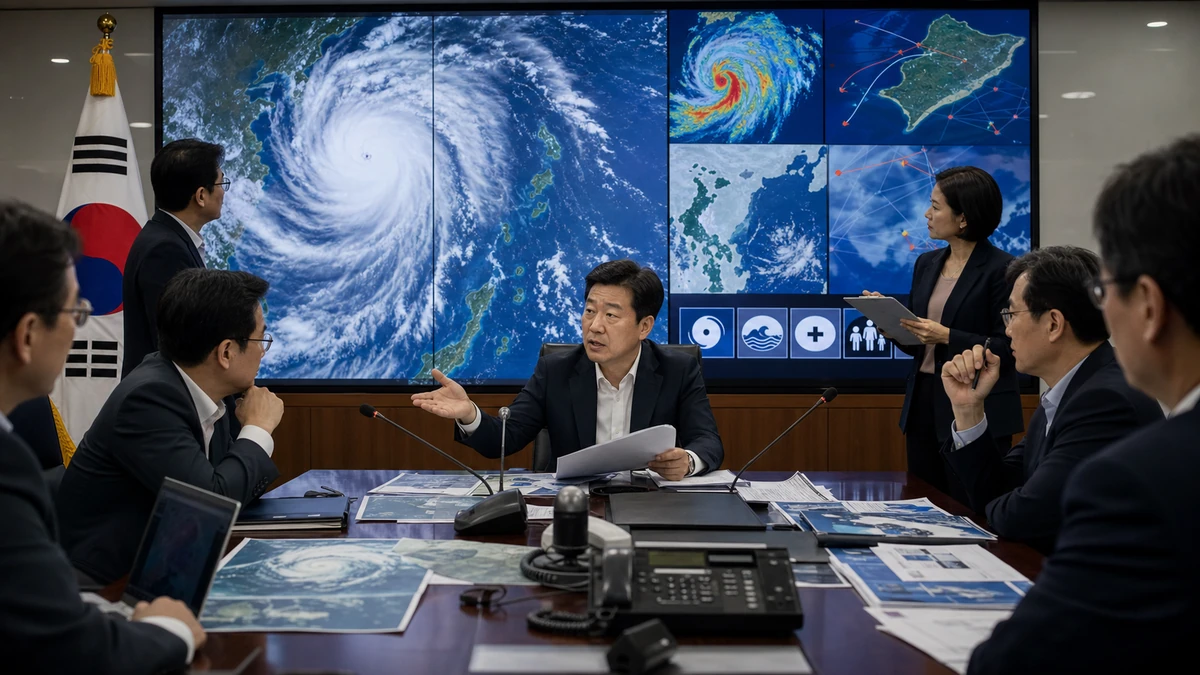
A storm in the Pacific, and a test of government duty
As Typhoon Bavi moves toward Guam and Saipan, South Korea’s Foreign Ministry is doing something that can sound bureaucratic on paper but becomes deeply personal in practice: checking, in real time, how it will protect its citizens overseas before the worst of the weather arrives.
According to the ministry, senior consular officials convened an emergency review meeting on July 4 to assess protective measures for South Koreans in the U.S. Pacific territories as the storm approaches. The session was led by Yoo Byung-seok, the head of the ministry’s consular and safety bureau, underscoring that this is not being treated as a routine weather advisory. It is being handled as a test of the government’s responsibility to citizens abroad.
For American readers, the closest comparison may be the way the U.S. State Department and local emergency agencies coordinate when hurricanes threaten Americans traveling or living overseas. The point is not simply to tell people a storm is coming. It is to make sure embassies and consular offices are gathering reliable information, passing on evacuation guidance, staying in contact with people in the danger zone, and keeping headquarters and local officials working from the same playbook.
That is the larger significance of this moment for South Korea. On the surface, the story is about a typhoon track and a meeting in Seoul. Underneath, it is about how a country with millions of citizens traveling, studying and working abroad defines the basic obligations of the state in an age of frequent climate disasters and constant mobility. Consular protection, in this view, does not begin after buildings are flooded or flights are canceled. It starts when the forecast turns worrisome.
That preventive approach is what South Korean officials appear eager to demonstrate now. The emphasis has been on maintaining steady communication between ministry headquarters and the local offices responsible for Guam and Saipan, closely monitoring the storm’s path, and sending practical safety information to Korean nationals in the area. In disaster response, governments cannot control the weather. What they can control is the quality, speed and credibility of the information reaching people who may have only hours to make decisions.
Why Guam and Saipan matter to South Koreans
To many Americans, Guam and Saipan are familiar mainly as strategic U.S. territories in the western Pacific, places associated with military installations, World War II history and tropical tourism. For South Koreans, they are also major travel destinations. Guam in particular has long been one of the most popular short-haul resort escapes for Korean families, newlyweds and package tourists, offering warm weather, beaches and the convenience of a U.S. destination that feels relatively accessible from Seoul. Saipan, part of the Northern Mariana Islands, has a similar appeal.
That tourism link matters in a crisis. At any given time, the Korean presence in Guam and Saipan can include vacationers, short-term business travelers, airline crews, students and residents connected to local Korean communities. Unlike citizens living permanently in a foreign country, some of these travelers may not know local emergency systems well, may be staying in hotels rather than private homes, and may rely heavily on airline updates, hotel staff or social messaging apps for fast-moving information.
This helps explain why South Korea’s Foreign Ministry has put particular stress on local outreach. When a typhoon threatens an island community, there are only so many roads, shelters and flight options. The margin for confusion is slim. A missed message about sheltering in place, an airport closure or a recommended evacuation point can have serious consequences, especially for visitors unfamiliar with the terrain or language.
There is also a broader geopolitical layer that makes Guam and Saipan different from, say, a storm threatening a beach town on the Korean Peninsula. These islands are under U.S. jurisdiction, which means South Korean officials must work within a framework that depends on close communication with local authorities while still fulfilling Seoul’s obligation to warn and support its own nationals. Consular protection in such cases is partly about translation in the broadest sense: turning local conditions, weather bulletins and emergency instructions into clear guidance that Korean citizens can understand and act on immediately.
That sort of quiet coordination rarely draws international attention. It lacks the drama of summit diplomacy or the symbolism of a high-level state visit. But for ordinary citizens, it is often the most tangible form of foreign policy they will ever encounter. When disaster looms abroad, the question becomes simple: Will your government know where you are, tell you what is happening, and help you navigate what comes next?
Inside South Korea’s consular response system
The July 4 review meeting offers a window into how South Korea organizes that task. The ministry’s consular and safety bureau is the branch responsible for many of the issues Americans would associate with consular affairs: responding to accidents involving citizens overseas, issuing safety alerts, coordinating with overseas missions and trying to maintain a functioning chain of communication when events turn chaotic.
Officials said the key message from the meeting was that headquarters in Seoul and the local diplomatic office must stay in constant contact while monitoring the typhoon’s path. That may sound basic, but in crisis management it is foundational. Information can fragment quickly. Local conditions can change by the hour. Forecast models shift. Travelers move from one hotel to another, or from an island resort to the airport, or lose mobile connectivity altogether. The central challenge is making sure frontline observations and central decision-making do not drift apart.
In practical terms, that means South Korea’s system is trying to do several things at once: verify storm developments, relay actionable information to people on the ground, keep channels open among local and central officials, and prepare for escalation if the storm causes real damage. It is less a single decision than a chain of administrative habits meant to reduce the chance that someone falls through the cracks.
One notable aspect of the response is that senior leadership is visibly involved before impact, not after. In many governments, bureaucracies become most visible once there are casualties, dramatic rescues or a public outcry over delays. South Korea’s ministry appears to be making the case that the real measure of competent consular work is preventive: the hours and days when no headline-grabbing tragedy has happened yet, but the window to lower risk is rapidly closing.
That philosophy reflects a broader evolution in how modern states think about citizen protection abroad. A generation ago, consular work was often seen narrowly: passports, notarizations, legal trouble, occasional emergencies. Today, it is inseparable from disaster readiness, digital communication and the expectation that governments remain reachable wherever their citizens travel. South Korea, with its highly connected public and a population accustomed to instant updates, faces especially high expectations on that front.
In that sense, this typhoon response is not just about weather. It is about administrative trust. Citizens are being asked to believe that the state can see risk coming, synthesize information from multiple levels and deliver guidance quickly enough to matter. Whether that trust is earned depends less on rhetoric than on the mechanics of communication.
The role of local offices and digital communication
Some of the most revealing details in the government’s account concern the local offices serving Korean nationals in Guam and Saipan. The head of South Korea’s mission office in Hagatna, which has jurisdiction over the area, said safety notices including evacuation information are being distributed regularly to Korean citizens staying locally. A consular cooperation official in Saipan said real-time updates on the storm’s track and weather conditions are being shared through group chat rooms and other rapid communication channels.
That detail will resonate with anyone who has watched how disasters are managed in the smartphone era. In South Korea, group messaging apps are not just casual social tools. They are deeply woven into everyday life, from family coordination to workplace communication to school notifications. In emergencies, they can serve as an informal but highly effective last-mile distribution network, allowing officials and community intermediaries to share urgent notices faster than many traditional systems.
Americans saw versions of this during wildfires, hurricanes and the pandemic, when neighborhood groups, text chains and local apps became lifelines for practical information. In Korean communities, where mobile messaging platforms are especially central, the use of group chats by consular personnel makes immediate sense. It is a culturally and technologically natural way to reach people where they already are.
Still, the approach has limits, and the ministry’s emphasis on official channels matters for exactly that reason. In a disaster, speed without credibility can become dangerous. Rumors spread fast. People may share unverified screenshots, hearsay about shelter capacity or exaggerated claims about airport closures. The value of a consular office is not that it can outpace every rumor; it is that it can provide an authoritative baseline. When an official notice arrives repeatedly through trusted channels, people have a better chance of separating fact from noise.
That is why redundancy is so important. Local offices issue formal alerts. Cooperation officials reinforce them. Group chats circulate them. Headquarters stays aligned with the field. In crisis communication, repetition is not clutter; it is strategy. If one message is missed, another may land. If one platform fails, another may still work. The goal is not elegance. It is reach.
For travelers in Guam or Saipan who may be worried about the storm, the most immediate effect of this system is practical rather than political. They need to know whether to remain in place, when flights may be disrupted, where to seek shelter if conditions worsen and how to contact consular staff if they need help. The machinery of state matters only insofar as it answers those questions clearly.
What this says about South Korea’s diplomacy beyond summits and headlines
South Korea is often viewed abroad through the lenses of technology, export power, security tensions with North Korea and the global spread of its popular culture. Those are real pillars of the country’s international image. But there is another side of Korean diplomacy that receives less attention: the everyday work of protecting citizens overseas.
That work can be easy to underestimate because it is administrative rather than theatrical. There are no grand speeches or joint communiques. Yet it is central to how states are judged by their own people. A government that can host summits and sign trade agreements but struggles to communicate with citizens stranded abroad during disasters will quickly discover that prestige and public confidence are not the same thing.
This is particularly true in South Korea, where public expectations for government responsiveness are high and where overseas travel has become a normal part of middle-class life. In recent decades, more Koreans have studied abroad, vacationed internationally and built lives that move fluidly across borders. That has expanded not only the country’s global footprint but also the burden on its consular system. The state is expected to be present, in some form, even when citizens are far from home.
The Guam and Saipan case illustrates what might be called the domestic face of foreign policy. From Seoul’s perspective, consular protection is not secondary to diplomacy; it is one of diplomacy’s most concrete expressions. The promise is simple: if a Korean national faces danger overseas, the government will not wait passively for news reports or calls for help after the fact. It will try to anticipate the crisis, maintain lines of contact and support local decision-making with centralized oversight.
There is also a subtle but important message here for international audiences. South Korea’s rise as a global player is not measured only by semiconductor exports, K-pop tours or diplomatic initiatives. It is also reflected in the competence of its institutions. A modern state’s credibility depends in part on whether it can convert capacity into protection. In that sense, even a weather-driven consular meeting carries symbolic weight. It shows what kind of government a country believes itself to be.
For Americans used to seeing federal, state and local agencies divided by jurisdiction, South Korea’s model may appear more centralized. But the underlying principle is familiar: in a crisis, coordination matters more than form. The real question is whether the people with the best local information and the people with the authority to mobilize resources are speaking to one another without delay.
The bigger lesson: Disaster readiness begins before disaster strikes
The most telling part of South Korea’s response may be its timing. Officials have stressed that Typhoon Bavi could pass directly through Guam and Saipan this weekend, but the emphasis so far has remained on monitoring, information-sharing and precautionary steps rather than damage assessment. That distinction matters. It highlights a view of public safety that starts with prevention, not merely reaction.
In recent years, governments around the world have been forced to adapt to increasingly volatile weather events. Whether the hazard is a typhoon in the Pacific, a wildfire in California or flash flooding in Europe, the old model of emergency response, waiting until impact and then improvising, looks less defensible. Citizens now expect warnings that are earlier, more precise and more actionable. They expect institutions to communicate across distance and bureaucratic lines. And they expect that someone is thinking about vulnerable travelers before a crisis turns into a rescue operation.
That is the standard South Korea is trying to meet here. The ministry has not suggested it can eliminate risk. No government can. Planes may be grounded. Hotels may lose power. Communications may be disrupted. But officials can reduce uncertainty and help citizens make informed choices. In a storm zone, that can be the difference between orderly preparation and dangerous confusion.
For Guam and Saipan, where island geography can make severe weather especially disruptive, those choices matter quickly. There are limits to evacuation options, supply lines and medical capacity in any island emergency. Visitors who do not understand local emergency protocols are at a disadvantage from the start. That is why consular advisories, even when they sound routine, can carry outsized importance.
The broader takeaway is that diplomacy, at its most grounded, is not always about nations speaking to nations. Sometimes it is about a government speaking clearly to its own people when they are far away and vulnerable. South Korea’s actions ahead of Typhoon Bavi suggest it understands that protection abroad is not an afterthought to foreign policy but part of its front line.
Whether this storm causes major damage or passes with limited impact, the episode already offers a useful glimpse into how Seoul wants its consular machinery to function: early, coordinated, locally informed and digitally connected. That may not make for the flashiest headline. But for citizens waiting out a typhoon on an island thousands of miles from home, it is exactly the kind of foreign policy that matters most.
Comments
Post a Comment