South Korea Reports Its First SFTS Case of the Year in Suncheon, Renewing Warnings About Tick-Borne Illness in Rural Areas
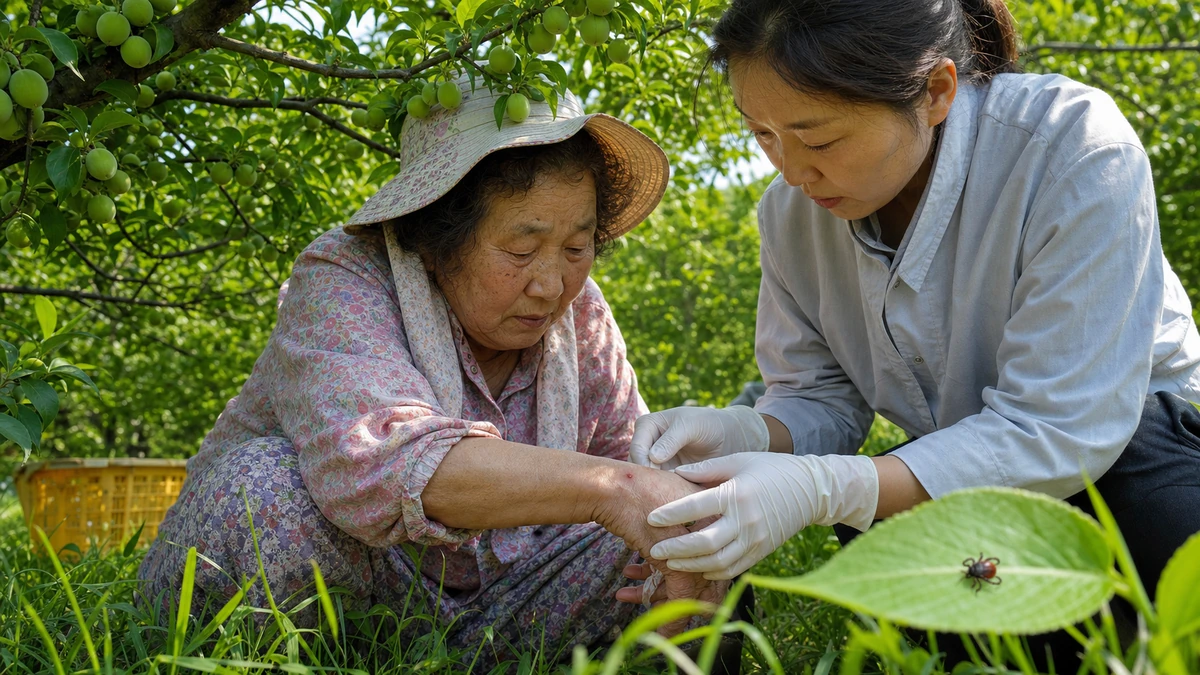
A summer farm chore turns into a public health warning
South Korean health officials say a woman in her 70s has become the country’s first confirmed patient this year in the Jeonnam-Gwangju region with severe fever with thrombocytopenia syndrome, or SFTS, a serious tick-borne disease that appears every year as temperatures rise and outdoor work intensifies.
The patient, who lives in Suncheon, a city in South Korea’s southwest, is believed to have been infected after being bitten by a wild tick while working in a plum orchard, according to regional health authorities. She began showing symptoms on May 27, including fever, nausea, vomiting and severe weakness, then sought medical care and tested positive for SFTS. She is now hospitalized and receiving treatment.
To many American readers, the details may sound at once distant and familiar. The setting is a plum field in southern Korea rather than a wooded trail in the Northeast or a ranch in Texas. But the larger story is recognizable: a seasonal outdoor activity, an insect or arachnid-borne illness, vague early symptoms that could be mistaken for fatigue or a stomach bug, and a health system urging people not to ignore warning signs. In the United States, Americans have grown used to summer reminders about Lyme disease, West Nile virus and Rocky Mountain spotted fever. In South Korea, SFTS has become part of that same seasonal public health vocabulary.
The case is drawing attention not only because it is the first of the year in the region, but because it highlights an ongoing pattern. Officials say the southwestern province of South Jeolla, often shortened in English to Jeonnam, has reported SFTS cases year after year. The tally over the past five years shows that this is not a one-off event or a freak accident. It is a recurring risk tied to the rhythms of farm work, brush-clearing, orchard maintenance and other activities that bring people into close contact with grass, soil and low vegetation where ticks live.
In that sense, the diagnosis in Suncheon is more than an isolated medical update. It is an annual signal, the sort of early-season case that prompts health authorities to remind residents to cover exposed skin, check their bodies after time outdoors and seek care quickly if symptoms appear after a suspected bite.
What SFTS is, and why doctors take it seriously
SFTS stands for severe fever with thrombocytopenia syndrome. The name is technical, but the central point is straightforward: it is a viral disease spread primarily by ticks, and in some patients it can become dangerous very quickly. “Thrombocytopenia” refers to a low platelet count, a problem that can interfere with the blood’s ability to clot properly. The illness can also cause white blood cell abnormalities, high fever, gastrointestinal symptoms and, in severe cases, organ failure.
The disease was first identified in East Asia and has been reported in South Korea, China and Japan. It is not as widely known to Americans as Lyme disease, which is caused by bacteria and is often associated with the distinctive bull’s-eye rash, though not always. SFTS is different. It is viral, there is no widely used specific antiviral cure, and treatment typically focuses on supportive care such as managing fever, dehydration and complications while the patient is monitored in the hospital.
Symptoms can begin in a way that seems deceptively ordinary. Fever, nausea, vomiting, fatigue and general weakness are not unusual complaints in late spring or summer, especially among older adults doing physically demanding labor outdoors. In agricultural communities, where long hours in heat and humidity are common, those symptoms may initially be written off as exhaustion, dehydration or a passing stomach illness. That is one reason public health authorities emphasize context as much as symptoms. If someone develops fever and profound weakness after working in fields, orchards, brush or grassy areas, that history matters.
Doctors also stress the importance of telling medical workers about possible tick exposure. Patients do not always notice a bite, and in many cases the tick may already be gone by the time symptoms appear. But reporting recent outdoor work, especially in rural areas during tick season, can help clinicians decide what tests to order and how urgently to monitor a patient.
South Korean health agencies have repeatedly warned that older adults in rural communities may be especially vulnerable, in part because they spend more time doing farm labor and in part because age can raise the stakes when a serious infection develops. That concern looms large in this latest case, involving a woman in her 70s whose orchard work was not a recreational excursion but part of ordinary rural life.
Why a plum orchard matters in South Korea
The mention of a plum orchard may need some cultural context for readers outside Korea. In parts of southern South Korea, plum growing is a routine part of rural agriculture, and late spring into early summer can be a busy period for maintaining orchards and preparing for harvest. The Korean word often translated as “plum” can refer to maesil, a green plum or Japanese apricot that is widely used in Korean food culture. Maesil is commonly turned into syrups, teas, pickled products and fruit extracts that many Koreans associate with home remedies, digestion and summer kitchens.
That means a plum field is not some exotic or marginal site. It is a familiar agricultural workplace, closer in cultural terms to an American peach orchard in Georgia, an apple farm in upstate New York or a citrus grove in California. For many older Koreans, especially in the countryside, work in such places is woven into daily life. Retirement does not necessarily mean leaving physical labor behind. Elderly residents often continue tending fields, managing small orchards or helping family farms well into their later years.
That reality is critical to understanding the health message. Advising people simply to avoid outdoor work is not practical in communities where field labor is tied to income, food production and lifelong routines. Public health guidance therefore centers on harm reduction rather than total avoidance: wear long sleeves and long pants, use protective gear, minimize direct contact with grass and brush, shower and inspect the body after work, and seek medical attention quickly if fever or gastrointestinal symptoms develop.
For American readers, there is a useful parallel in the public health advice given to landscapers, farmers, gardeners and hikers in tick-heavy parts of the United States. The message is not “never go outside.” It is “go outside with precautions, know what to watch for and don’t dismiss symptoms after exposure.” Korea’s approach to SFTS reflects that same logic.
The Suncheon case also speaks to a larger demographic issue in South Korea: the aging of rural communities. Many younger South Koreans have moved to large metropolitan areas such as Seoul, leaving smaller cities, villages and farming districts with older populations. As a result, a disproportionate share of physically demanding agricultural work often falls to seniors. That makes seasonal disease warnings not just a matter of ecology, but also of demographics and social structure.
A recurring risk in the country’s southwest
Regional officials say the Jeonnam area has reported SFTS cases consistently over the past five years: nine in 2021, 14 in 2022, 16 in 2023, eight in 2024 and nine in 2025. Those figures underscore that the disease remains a recurring concern rather than a disappearing one.
In news coverage, single case counts can sometimes sound small, especially when compared with large-scale outbreaks of influenza or COVID-19. But for diseases like SFTS, the significance lies less in raw numbers than in the pattern and severity. A relatively modest annual case count can still command close attention if the illness is serious, difficult to treat specifically and associated with a meaningful fatality risk. Health officials in East Asia have long regarded SFTS as one of the more dangerous tick-borne infections in the region.
The geography helps explain why the southwest receives particular attention. South Jeolla Province is known for its agricultural land, coastal climate and extensive rural terrain. Suncheon itself is often recognized for its ecological assets, including wetlands and garden areas, and for a landscape where city and countryside sit close together. That combination can be an asset for tourism and farming, but it also creates the kind of environment where people regularly come into contact with ticks.
This is not only a rural labor issue, either. Korean officials often warn that tick exposure can happen during a range of ordinary outdoor activities: home gardening, family visits to ancestral gravesites, hiking, clearing weeds around homes, or spending time in grassy areas. In the Korean calendar, certain seasonal traditions bring people outdoors in ways that may surprise foreign readers. Families may visit burial sites to clean surrounding land, for instance, and even that kind of culturally rooted routine can create exposure risk if people kneel in brush or handle overgrowth without protection.
That broader context matters because it keeps the story from being misread as a problem affecting only farmers. The patient in Suncheon was working in a plum orchard, but the warning extends beyond agricultural workers. As in the United States, where suburban homeowners can encounter ticks while mowing lawns or walking dogs, tick-borne disease risk follows people into the edges of everyday life.
At the same time, officials have been careful not to frame the case in alarmist terms. The existence of a first case of the year does not mean a widespread emergency is underway. It means the annual season of vigilance has begun. Public health messaging in Korea, as elsewhere, works best when it avoids panic and instead offers clear, concrete steps people can actually follow.
The symptoms may look ordinary, but the timing matters
One of the most important details in the Suncheon case is how ordinary the first symptoms sounded. Fever, nausea, vomiting and weakness could describe any number of illnesses. In a hot, humid environment, they could also be mistaken for heat exhaustion, dehydration or overwork. That is particularly true in farming communities, where discomfort after a day outdoors may be treated as routine rather than urgent.
But timing can change the meaning of a symptom. A fever after a week indoors may point doctors in one direction; a fever after recent work in a field or orchard may point them in another. That is why the patient’s outdoor activity is central to the case. The presumed tick bite did not happen during a dramatic wilderness adventure. It happened during a familiar task in a familiar place.
Health authorities often confront a basic communication challenge with diseases like SFTS: how to persuade people not to overreact, while also persuading them not to shrug symptoms off. The answer is usually specificity. Officials do not tell everyone with an upset stomach to fear the worst. They tell people who have had recent contact with grassy, wooded or brushy outdoor environments to pay closer attention to fever, vomiting, weakness and other changes in condition.
That message may be especially important for older adults living alone or in sparsely populated rural areas. If symptoms are chalked up to “just being tired,” valuable time can be lost before care begins. The Suncheon patient did seek medical attention after symptoms developed, and that decision is itself part of the public health lesson. Early evaluation may not prevent every severe outcome, but delayed care can narrow treatment options and complicate monitoring.
American readers may recognize a similar pattern from Lyme disease awareness campaigns, which encourage people to think back on recent hikes, yard work or camping trips if unexplained symptoms develop. The difference is that SFTS can present with prominent gastrointestinal symptoms and may progress in ways that require more intensive hospital care. The underlying principle, however, is familiar on both sides of the Pacific: when a symptom follows a likely exposure, the exposure history can be as important as the symptom itself.
What this reveals about aging, climate and rural health
Beyond the immediate diagnosis, the Suncheon case illuminates a deeper set of issues facing South Korea and many other developed societies. One is the aging of agricultural populations. In both Korea and parts of the United States, farm communities are older on average than urban populations. That can make seasonal hazards more consequential, because older residents may have underlying health conditions, reduced mobility or less margin for recovering from severe infection.
Another issue is the intersection of climate and disease. Warmer weather lengthens the period in which ticks are active and increases the time people spend outdoors. Public health researchers around the world have been tracking how changing temperatures, shifting habitats and altered land use can influence vector-borne diseases. While a single case cannot prove a climate trend, the steady return of tick-related warnings each year is part of a global conversation about how environmental conditions shape health risks.
Rural health systems also come into focus. South Korea has a highly developed medical system, but as in many countries, access and awareness can vary by region and age group. Early recognition depends not only on doctors and laboratories, but also on the quality of communication between public health offices and residents. When regional authorities publicly identify the place, timing and suspected exposure route of a case, they are doing more than releasing data. They are giving neighbors a reason to think back over their own recent activities.
That is especially useful in tight-knit communities where many residents share similar routines. If one person becomes ill after orchard work, others who were in nearby fields, trimming grass or working around shrubs may be more likely to notice symptoms in themselves or relatives. In that way, disease reporting becomes a practical tool of community prevention.
The case also highlights a tension common in health coverage: how to treat an illness that is serious but not broadly familiar. Public awareness campaigns often work best when a disease already has high name recognition. SFTS does not, at least not outside East Asia. That means journalists and health officials alike have to explain it from the ground up, without sensationalizing it. The essential message is that this is a real, recurring and preventable seasonal risk, particularly for older adults engaged in outdoor labor.
A local Korean case with a lesson that travels
For readers far from South Korea, it may be tempting to see this as a narrowly local story from a plum-growing area in the country’s southwest. But the lesson travels well. Across the world, people routinely underestimate health risks that emerge from ordinary surroundings rather than dramatic disasters. A quiet field, a backyard garden, a patch of overgrown grass or a day spent doing seasonal chores can all become the backdrop for illness.
That is why this case matters beyond Suncheon. It reminds readers that prevention is often built from unglamorous habits: long sleeves in hot weather, checking the body after outdoor work, washing up promptly, noting where and when symptoms begin, and telling a doctor about recent exposure. None of that is dramatic. All of it can matter.
It also underscores a basic truth of global health reporting: local stories often reveal universal patterns. In Korea, the setting is a maesil orchard and an elderly woman continuing farm work in a rural community. In America, the specifics might be different — a retiree gardening in Pennsylvania, a ranch worker in Oklahoma, a hiker in Connecticut. But the public health challenge is the same. How do societies help people live with the outdoors safely, especially as populations age and environmental risks evolve?
South Korean officials, in announcing the first SFTS case of the year in the region, appear to be trying to answer that question the practical way: not by stoking fear, but by urging vigilance. The information released so far is limited and precise. The patient is a woman in her 70s. She is from Suncheon. She is believed to have been exposed while working in a plum orchard. Symptoms began May 27. She tested positive and is now hospitalized.
Those facts are enough to make the point. A seasonal disease has returned. The early signs can look ordinary. Older rural residents remain particularly vulnerable. And the best response, in Korea as in the United States, begins with recognizing that small symptoms after outdoor exposure may not be small at all.
Comments
Post a Comment