South Korea Reports Sharp Drop in Malaria Cases, but Health Officials Warn the Risk Is Far From Gone
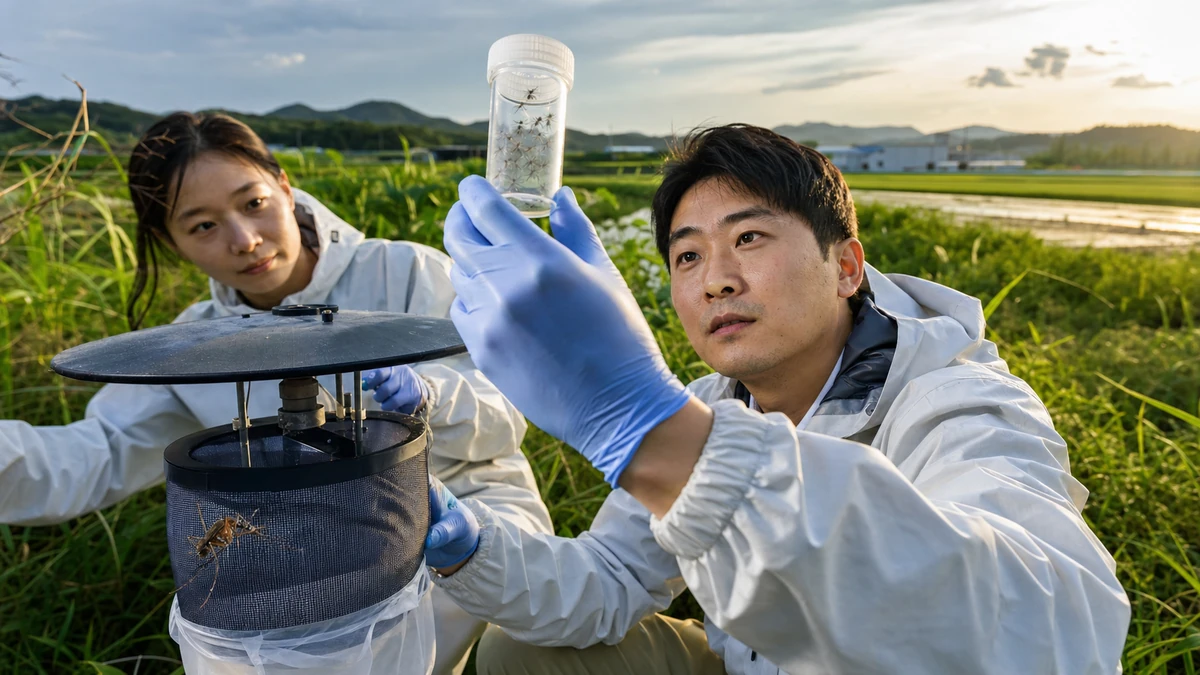
A welcome decline in a disease many Americans do not associate with South Korea
South Korea recorded 154 domestic malaria cases in the first half of 2026, a 25.9% drop from 208 cases during the same period a year earlier, according to figures compiled by the Korea Disease Control and Prevention Agency, or KDCA, and local authorities in Gyeonggi Province. On paper, that is undeniably good news: 54 fewer people were infected between January and June than in the first six months of 2025.
But public health data rarely tell a simple story, and this is one of those cases where the headline number needs context. The decline suggests that the country’s malaria burden has eased compared with last year, at least so far. It does not mean malaria has disappeared from South Korea, nor does it mean the country can relax. More than 150 cases have already been confirmed nationwide this year, and the peak summer mosquito season is not over.
For many American readers, malaria is more often associated with tropical regions in Africa, Southeast Asia or parts of Latin America than with a highly urbanized, high-income democracy like South Korea. But malaria has long remained a seasonal and localized public health issue on the Korean Peninsula. In South Korea, cases are typically concentrated in areas near the border with North Korea and in northern parts of the country where mosquito activity and geography create conditions for transmission.
That is part of what makes this latest data meaningful. South Korea is not battling malaria on the scale seen in countries where the disease kills large numbers of children every year. Still, it continues to manage a recurring, domestically monitored infectious disease that rises and falls with the seasons, local mosquito populations and regional patterns of exposure. The first-half decline is encouraging. It is not a declaration of victory.
The numbers released this month offer a snapshot of where things stand now: better than last year, but still worth close attention from health officials and residents alike.
Why the numbers matter — and what they actually show
The most important point in the new data is the basis for comparison. The 25.9% drop comes from measuring the same six-month period year over year: January through June 2026 versus January through June 2025. That kind of apples-to-apples comparison matters in disease reporting, especially for mosquito-borne illnesses that tend to surge in warmer months.
Put differently, this is not a comparison between different seasons or mismatched reporting windows. It is a direct look at the first half of one year against the first half of the previous one. By that standard, South Korea’s malaria situation was clearly lighter this year than last year.
Still, percentages can obscure the human dimension. A 25.9% decline sounds substantial, and statistically it is. But the absolute number may be more intuitive: 54 fewer cases. Public health experts often emphasize the need to read both kinds of figures together. Percent changes help show trend direction and scale, while the raw count reminds readers that these are not abstract data points but actual infections affecting actual people.
That distinction matters because “down” is not the same as “gone.” A country can post a meaningful decline in cases and still be dealing with a public health concern. South Korea’s 154 confirmed malaria cases in the first half of the year remain significant enough to warrant sustained surveillance and local prevention measures.
The data also underscore a broader lesson that applies well beyond Korea: disease numbers are easy to misread when audiences focus only on the headline. In the United States, Americans saw this repeatedly during the COVID-19 pandemic, when confusion often arose over whether a figure represented a daily count, a weekly total, a cumulative number or a preliminary estimate. The same caution applies here. The trend is positive, but the baseline matters, and the reporting window matters just as much.
Gyeonggi Province drives much of the national picture
The most striking regional detail in the South Korean figures is the role of Gyeonggi Province, the densely populated region that surrounds Seoul. For Americans unfamiliar with Korean geography, Gyeonggi is not some remote rural outpost. It is home to a large share of the country’s population and includes communities that function as part of the greater Seoul metropolitan area, one of the largest urban regions in the world.
And yet the province also plays an outsized role in South Korea’s malaria statistics. More than half of the nation’s domestic malaria cases are reported there, according to the figures cited in the latest report. That means national trends can be heavily influenced by what happens in this one region.
This year, Gyeonggi Province reported 85 malaria cases in the first half of 2026, down from 120 during the same period in 2025. That is a reduction of 35 cases — a large share of the nationwide decline of 54. In other words, much of the improvement seen in South Korea’s overall numbers was driven by a single province.
That concentration is important because it warns against overreliance on national averages. A broad countrywide figure may suggest one story, while local reality can be more complicated. Americans know this dynamic well from public health tracking at home: a nationwide flu or measles trend can mask concentrated hot spots in a handful of states or counties. The same principle applies in South Korea.
Even after the decline, Gyeonggi’s numbers remain high enough to demand attention. Eighty-five cases in six months is not trivial, especially in a country where the total national count is relatively modest. The regional concentration suggests that residents, commuters and travelers in northern parts of the country still need to pay close attention to public health advisories, even if the national trend line is moving in the right direction.
It also highlights the reality that infectious diseases do not spread evenly. Geography, local ecology, travel patterns and land use all shape where risk is highest. South Korea’s malaria burden, at least domestically, continues to be a regional story as much as a national one.
July looks quieter so far, but the calendar matters
The report also includes an early look at July, and that is where careful reading becomes especially important. Last July, South Korea recorded 168 malaria cases over the full month. This year, as of July 14, authorities had counted 26 cases.
At first glance, that gap looks dramatic. But it would be misleading to compare the two numbers as if they represented the same thing. The 168 figure covers an entire month. The 26 figure is only a midmonth tally, a partial count reported with more than half of July still remaining at the time of publication.
That does not make the mid-July number meaningless. It does suggest that the month may be tracking lower than the same point in the previous year. But it is still preliminary. Until the month closes, the only precise statement is that 26 cases had been confirmed by July 14, whereas 168 were confirmed by the end of July last year.
This is a familiar issue in health reporting, and one that can easily be lost in translated or shortened summaries. Provisional data can be useful in spotting trends, but they are not substitutes for final monthly totals. News consumers often see a number and assume it is directly comparable to the one next to it. Good reporting requires slowing down long enough to ask: comparable over what time frame?
For South Korea, July matters because mosquito-borne diseases often intensify in the summer. Warmer weather can expand mosquito activity, increase outdoor exposure and create the conditions for faster transmission. So while the first-half decline is encouraging, the weeks ahead are still important in determining whether the year’s overall malaria burden remains below last year’s level.
At this stage, the most accurate description is that a downward trend has been observed, not that the season’s outcome is settled.
Malaria in South Korea is a reminder that modernization does not erase every disease
There is a tendency among international audiences, especially in the United States, to think of advanced economies as places where older infectious diseases have been left behind. South Korea complicates that assumption. It is one of the world’s most connected and technologically sophisticated countries, a global exporter of semiconductors, automobiles and pop culture. Yet it still monitors malaria as a recurring public health issue.
That is not as contradictory as it may sound. Economic development can dramatically improve healthcare capacity, surveillance systems and treatment access. It does not automatically eliminate ecological or geographic conditions that allow mosquito-borne disease to persist. In South Korea’s case, malaria has been an intermittent and regionally concentrated concern for years, particularly in northern areas.
For American readers, there is a useful analogy in the way the United States handles diseases that many people assume belong only to history books. West Nile virus, Lyme disease and even periodic measles outbreaks show that wealth and modern infrastructure do not place countries outside the reach of infectious threats. They change the scale of the problem and the tools available to fight it, but they do not nullify risk.
The South Korean data also reflect the strength of a public health system capable of gathering and publishing detailed, timely information. The KDCA’s infectious disease portal and provincial counts allow journalists and residents to see not just whether a number rose or fell, but where that change is happening and over what period. That kind of transparency matters. It gives the public a more nuanced picture and helps reduce the chances of either complacency or panic.
Still, the current figures do not explain why cases fell this year. The available summary does not attribute the decline to any single cause, whether mosquito control campaigns, weather patterns, changes in human behavior, improved detection practices or some combination of factors. Without that evidence, it would be premature to claim that a specific policy intervention is responsible.
That restraint is important. Public health reporting is strongest when it distinguishes between what the numbers show and what they do not. Right now, the numbers show fewer cases than last year. They do not yet establish a definitive explanation for the decline.
How readers should think about the risk
For South Koreans, and for foreigners living in or traveling through the country, the practical lesson is not alarm but attentiveness. A lower case count is a good sign, but it should not be read as permission to ignore official updates, especially in regions that account for a disproportionate share of cases.
That point may sound obvious, but it is exactly where people often go wrong with health statistics. Once a headline announces a decline, audiences can unconsciously shift the story into a “problem solved” category. In reality, declining case counts usually mean only that a problem has become less severe than it was before. The degree of remaining risk depends on where you are, when you are there and whether the disease’s transmission season is still unfolding.
In South Korea’s case, local context is essential. Nationally, the first-half number is down. Regionally, Gyeonggi Province still accounts for more than half of domestic cases. Temporally, July data remain incomplete. All three facts are true at the same time, and any serious reading of the report has to hold them together.
That is also why health agencies often urge the public to follow official dashboards or recurring updates rather than relying on a single article or one-time statistic. Trend lines are built over time. A favorable half-year result can be reinforced, narrowed or partly reversed as additional weeks of data come in.
For journalists, this is the difference between reporting a number and reporting meaning. The meaning here is not just that malaria cases fell, but that they fell in a pattern shaped heavily by one province, during a surveillance period that does not yet include the full summer peak.
The broader lesson in reading health news
If there is a takeaway here for readers outside Korea, it may be less about malaria itself than about how to read disease statistics intelligently. This South Korean report contains several kinds of numbers at once: a first-half cumulative national total, a regional breakdown, a year-over-year comparison and an incomplete monthly update for July. Each serves a different purpose, and mixing them carelessly can distort the story.
The first-half national figures provide the clearest basis for saying cases are down: 154 this year, compared with 208 over the same period last year. The Gyeonggi figures explain where much of that decline occurred: 85 this year, down from 120. The July figure offers an early directional sign but not a finalized monthly comparison: 26 cases through July 14 versus 168 for all of July 2025.
That kind of statistical literacy has become increasingly important in an era when health news travels globally and quickly. A disease update in Seoul can be clipped, reposted and summarized for readers in Los Angeles or London within minutes. But the faster information moves, the easier it is for nuance to fall away. Reporting that preserves context is not a luxury; it is the difference between informing the public and merely feeding the news cycle.
South Korea’s latest malaria numbers deserve to be read as good news, with an asterisk. The country has seen a clear reduction in cases compared with the same point last year, and the biggest contributor to that decline appears to be Gyeonggi Province, the region that bears the heaviest share of infections. Those are meaningful developments.
But the disease has not vanished, the summer season is still underway and the available data do not yet explain why the decline occurred or whether it will hold through the rest of the year. For now, the most responsible conclusion is also the simplest: South Korea’s malaria situation appears improved, but still active, and the next round of official numbers will matter.
In public health, as in journalism, precision matters. A falling number is encouraging. Understanding exactly what fell, where it fell and over what period is what turns that number into a story worth trusting.
Comments
Post a Comment