A Korean Director Put His Unfinished Indie Film on YouTube Instead of Waiting for Theaters. That Says a Lot About Where Cinema Is Headed.
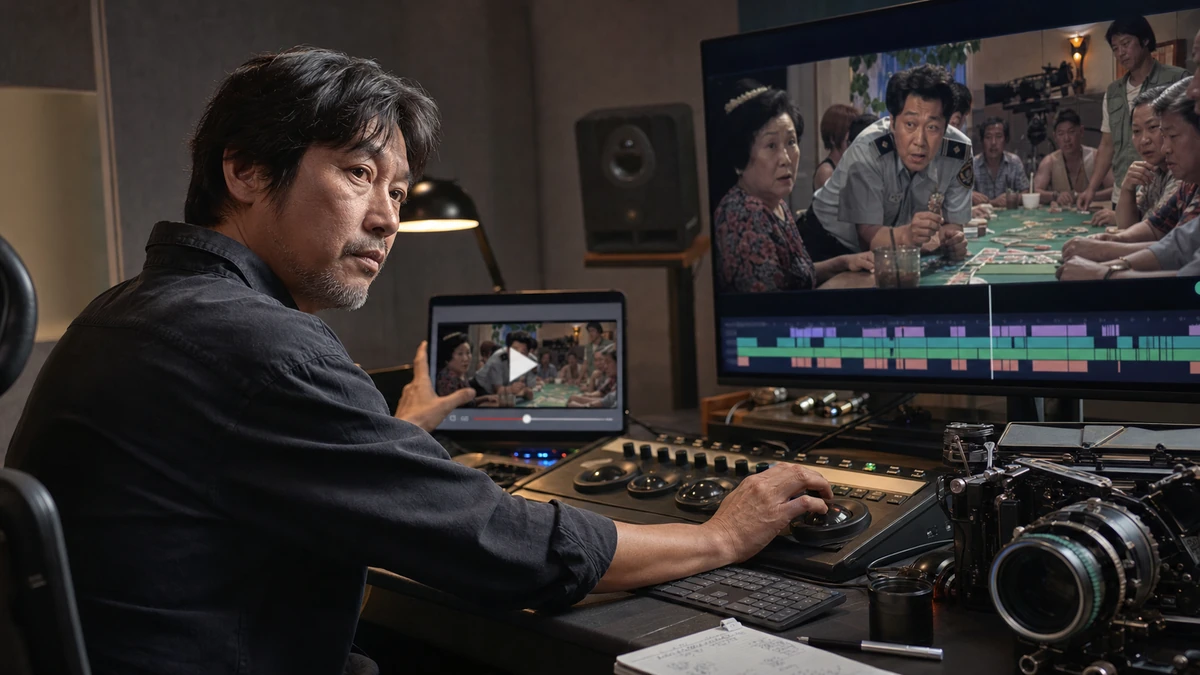
A rough cut goes public before the red carpet
In an era when even finished independent films can struggle to find a screen, South Korean director Shin Jae-ho has taken a route that would have been almost unthinkable in the old festival-to-theater pipeline: He released a rough cut of his latest feature on YouTube for free.
According to South Korean media reports, Shin quietly uploaded a preliminary edit of his 13th feature film, I’m Your Man, to YouTube on July 10. News of the move began circulating more widely in the film world a few days later. The significance is not simply that the movie is online. Plenty of films, especially small ones, eventually land on streaming or video platforms. What makes this case unusual is timing. Shin did not wait until the film was fully polished, formally distributed or screened in theaters. He put out a work-in-progress version while postproduction was still ongoing.
That makes I’m Your Man something more than another internet release. It is a test of what happens when a filmmaker invites the audience in before the movie reaches what the industry typically calls the finish line. In Hollywood terms, it is closer to a director screening an assembly cut for the public than dropping a completed independent feature on a digital rental service. For moviegoers used to thinking of films as sealed products, packaged only after every sound cue and edit has been locked, the move challenges long-standing assumptions about how movies are supposed to meet audiences.
It also says something urgent about the economics of independent filmmaking in South Korea, where critical acclaim and artistic ambition do not always translate into booking power. Theaters have limited screens, commercial distributors prioritize bigger titles, and a film can be completed without ever receiving a traditional release. Shin’s decision appears to be rooted in that reality. Rather than waiting indefinitely for a conventional theatrical opening, he chose to make the film available directly, globally and at no cost to viewers.
For American readers, the closest comparison may be an indie filmmaker bypassing Sundance hopes, arthouse negotiations and limited theatrical runs by uploading a near-finished cut straight to YouTube. It is a dramatic move, but also a practical one: If the usual doors do not open, the internet is at least a door you can open yourself.
The film: comedy built around addiction, family and police work
I’m Your Man centers on a police officer whose mother is addicted to gambling. As he investigates a gambling ring, his professional responsibilities collide with deeply personal family burdens. That premise alone suggests a tonal balancing act. Gambling addiction, family dysfunction and criminal investigation are heavy subjects in any national cinema. Shin, however, reportedly frames the story as a comedy.
That choice matters. In Korean film and television, tonal hybridity is common in ways that may feel surprising to American audiences. Korean storytellers often move fluidly between comedy, melodrama, suspense and social critique within the same work. A scene can pivot from absurd humor to genuine pain without the sharp compartmentalization often expected in mainstream American genre filmmaking. That does not mean the subjects are treated lightly. It means humor is frequently used as a way of making difficult realities emotionally legible.
In this case, the central conflict appears to hinge on the impossible overlap between public duty and private damage. A police officer is supposed to uphold order, but his own home life is entangled with the very world he is tasked with investigating. That setup gives Shin room to explore both institutional and personal pressure: how family shame operates, how addiction ripples through a household and how a person can be trapped between the role society assigns and the obligations that blood ties impose.
For American audiences, gambling addiction may bring to mind stories set in Las Vegas, Atlantic City or online betting culture, but the Korean context adds its own texture. South Korea has long maintained complicated attitudes toward gambling, with legal restrictions on many forms of betting for Korean citizens even as tourism-oriented exceptions and illegal gambling markets persist. That tension gives gambling stories in Korea a specific charge. They often tap into questions of debt, secrecy, desperation and social stigma rather than mere vice or flashy risk-taking.
The mother-son relationship at the center of I’m Your Man also draws on a recurring theme in Korean storytelling: the heavy emotional weight of family obligation. In South Korea’s culture, influenced in part by Confucian traditions, family ties often carry intense expectations around duty, sacrifice and reputation. Adult children may feel responsible not only for caring for parents, but also for absorbing the consequences of a parent’s choices. In dramatic terms, that can create stories where a character’s burden is never entirely his own. He inherits it, whether he wants to or not.
By placing that tension inside a comedy, Shin seems to be doing more than providing relief. He is using humor as a delivery system for discomfort. That approach has a long history in Korean cinema, from social satires to crime comedies that smuggle serious critique into fast-moving entertainment. Whether I’m Your Man ultimately lands as broad comedy, bittersweet satire or a mix of both, its premise fits squarely within that tradition.
Why an unfinished release is so unusual
The phrase “rough cut” can sound technical, but the basic idea is simple. It is an early edited version of a film, assembled to reflect the structure of the story before all the refinements of final postproduction are complete. A rough cut may still be missing color correction, final sound mixing, music adjustments, visual effects polish or more precise editing rhythms. It is a movie in shape, but not necessarily in finished form.
In the normal life cycle of a feature film, that version stays private. It might be shown to producers, investors, trusted collaborators or test audiences, but rarely to the general public. The logic is straightforward: A rough cut is not meant to represent the final artistic statement. Releasing it risks locking public perception around something the filmmaker still intends to improve.
That is what makes Shin’s move noteworthy. He did not merely embrace online distribution. He collapsed the distance between creation and exhibition. Instead of saying, “Here is the completed film I want you to judge,” he effectively said, “Here is the version I have now, and I want it to live in front of viewers anyway.”
There is something democratizing in that choice, but also vulnerable. Filmmakers are generally trained to guard unfinished work because audiences do not always separate process from product. A public viewer encountering a rough cut may not mentally footnote every uneven transition or unpolished element. They may simply decide the movie feels rough. By making the work-in-progress status explicit, Shin reframes the release itself as part of the story. The condition of the film is not a flaw to conceal; it is the context through which the film should be understood.
That framing invites a different kind of spectatorship. Viewers are not just watching a narrative about a policeman and his gambling-addicted mother. They are also witnessing a stage of independent filmmaking that is usually hidden. In an age when audiences are accustomed to behind-the-scenes featurettes, director’s cuts and production diaries, Shin’s approach pushes transparency one step further. He is not merely showing how the movie was made after the fact. He is exposing part of the making as the release.
To be clear, this does not necessarily mean rough-cut distribution will become standard practice. Most filmmakers would likely resist it, and for good reason. But as a one-off or a strategic choice made under financial pressure, it underscores how digital platforms can blur the old boundary between workshop and premiere.
Busan roots, regional support and the economics of indie survival
I’m Your Man was shot last fall in Busan, South Korea’s second-largest city and one of the country’s most important film hubs. To Americans, Busan is perhaps best known internationally as the home of the Busan International Film Festival, a major event on the Asian film calendar often compared, in regional significance, to the role Sundance or Toronto plays in North America for discovery, prestige and market visibility. But Busan is more than a festival city. It has spent years building an identity as a production center, with local institutions that support filmmaking.
This film reportedly received funding from the Busan Film Commission, along with money from Shin himself. That detail is easy to miss, but it is crucial. It signals a familiar independent-film equation: public support plus personal financial risk. In other words, this is not a lavishly backed commercial project that simply chose a quirky marketing rollout. It is a film built under constrained conditions, with regional assistance helping to get it made and the director personally carrying part of the burden.
That kind of financing structure is common in independent cinema around the world. Filmmakers patch together grants, local support, private investment, deferments and out-of-pocket spending, hoping that festivals, sales agents or distributors will later provide a path to audiences. Sometimes that works. Often it does not. A movie can exist, sometimes impressively so, and still remain stuck between completion and visibility.
That limbo is especially important in South Korea, whose global film reputation can obscure the fragility of its indie sector. International audiences often associate Korean cinema with glossy thrillers, Oscar-winning auteurs or the global success of K-dramas on streaming platforms. But beneath that high-profile layer is a crowded ecosystem of smaller productions competing for attention in a market dominated by commercial titles, franchise logic and limited theatrical bandwidth. Even in a film culture admired worldwide, independent filmmakers can be squeezed out.
Shin’s reported explanation points directly to costs as a factor in his decision. That makes sense. A theatrical release requires more than simply finishing a film. There are expenses tied to marketing, distribution logistics and the broader machinery of getting audiences into seats. For a small production, the hurdle is not only making the movie. It is paying for the right to be noticed once the movie exists.
By uploading the rough cut to YouTube, Shin sidestepped at least part of that bottleneck. He traded the prestige and potential revenue of a formal release for immediate access. In practical terms, he lowered the barrier between the film and its viewers. No ticket purchase. No geographic restriction. No limited showtimes. No dependence on a theater chain deciding the movie deserved a slot. For anyone with an internet connection, the film became reachable.
The cast and what this says about Korean independent filmmaking
The film features a cast that includes Lee Ji-hoon, Moon Hee-kyung, Kim Ki-bang, Choi Yoon-young, Jung Ho-bin and Bang Eun-hee. For viewers outside Korea, those names may not carry instant recognition the way a top streaming star might. But that, too, is part of the film’s identity. Independent cinema often relies on performers who bring credibility and range rather than international brand power.
Within Korea, ensemble casting in a project like this can help anchor a film that toggles between crime investigation and family comedy. Actors with experience in television, film and character roles are often essential in maintaining tonal balance, especially in stories where broad setups need emotional specificity to avoid becoming caricature. A film about a cop investigating gambling while dealing with an addicted parent could tilt toward farce or gloom. Performers are often what keep it human.
There is also a wider lesson here about how Korean film labor works outside blockbuster contexts. International fans of Korean entertainment sometimes imagine the industry primarily through its most exportable products: K-pop idols in dramas, high-concept thrillers or prestige festival titles. But much of the real texture of Korean screen culture lies in the mid-level actors, veteran character performers and local production networks that keep smaller projects alive. Films like I’m Your Man are built not only on directorial vision, but on the accumulated professionalism of artists working without the guarantee of large-scale commercial exposure.
Shin himself is no novice. This is his 13th feature, a number that matters precisely because it undercuts the idea that this is a naïve experiment by a first-time filmmaker. A director with that many features behind him understands standard release patterns. He knows what a theatrical opening represents and what a rough cut is not. That experience gives added weight to the choice. If someone seasoned enough to have directed more than a dozen features decides to release an unfinished version online, the act reads less like impulsiveness and more like a diagnosis of the system around him.
It also suggests a filmmaker willing to rethink not just story but delivery. Directors evolve in many ways across a career: aesthetically, thematically, commercially. In Shin’s case, the change here appears logistical as much as artistic. The movie’s genre may be comedy, but the release strategy is itself a kind of industry statement.
What YouTube offers — and what it cannot solve
There are obvious advantages to a free YouTube release. The biggest is accessibility. A film that might have been confined to a few local screenings or not shown publicly at all can suddenly become available worldwide. For Korean cinema in particular, that matters. International audiences are larger and more curious than ever, and many are already used to discovering Korean content online long before it receives formal distribution in their own markets.
For American viewers, that means a film like I’m Your Man can enter the same digital space where people already consume everything from movie trailers and fan edits to full-length documentaries and web series. The platform removes friction. You do not need an arthouse theater nearby. You do not need a festival pass. You do not even need to know much about Korean cinema beforehand to click play.
But accessibility is not the same thing as sustainability. A free upload can build awareness, generate conversation and maybe create momentum for a filmmaker’s work. What it cannot automatically do is solve the underlying financial problem. Independent films cost money to make, and postproduction itself is not free. If a rough cut is made available without charge before the final version is completed, the question becomes what comes next: Can the film still recoup costs? Can a finished version later find another release window? Can public exposure in unfinished form help rather than hurt its long-term prospects?
At the moment, those questions remain open. The available information does not indicate whether a final cut will later be released separately or whether another distribution plan is in place. That uncertainty is part of what makes the experiment compelling. It is both an act of outreach and a sign of structural pressure. Opportunity and precarity sit side by side.
The move also raises a subtler challenge for viewers. How should an audience evaluate a rough cut? If people respond negatively to aspects that would ordinarily be refined later, are they judging the film fairly? On the other hand, if they respond warmly, does that feedback become part of the creative process? The public release of an unfinished work blurs authorship in interesting ways. Even if Shin is not formally crowd-testing the film, audience perception enters earlier than usual, before the final version is locked.
A small Korean film with a larger message
It would be easy to treat this as a niche curiosity: one Korean independent director, one unusual upload, one film about a policeman and his mother. But the broader significance lies in what the move reveals about control. Faced with the possibility that a film might not secure a standard theatrical path, Shin exercised the one power still fully available to him: deciding how audiences would encounter it.
That is increasingly relevant in a global media landscape where the lines between cinema, streaming, social platforms and direct-to-audience publishing continue to erode. American filmmakers have wrestled for years with questions about whether a movie “counts” if it bypasses theaters, whether streaming undermines the communal ideal of cinema and whether digital convenience comes at the cost of artistic prestige. South Korea, despite its strong theater culture and dynamic film history, is clearly grappling with parallel tensions.
I’m Your Man enters that debate from the margins rather than the center. It is not a studio-backed provocation or a celebrity-driven release gambit. It is a modestly financed independent production from Busan, supported in part by a regional film body and in part by the director’s own money. That modest scale is exactly why the story matters. Industry change often becomes visible first at the edges, where creators with fewer resources have to improvise sooner.
For English-speaking audiences interested in Korean culture, this is also a reminder that the Korean Wave is not only about polished export hits. The same country that produces globally dominant pop groups and internationally celebrated prestige content also produces artists working around real bottlenecks, improvising with whatever tools are available. The glamour and the grind coexist.
And that may be the most revealing part of Shin’s decision. He did not present YouTube as a triumph over the old system so much as a workaround inside it. The upload does not magically erase the challenges facing independent film. It does, however, refuse silence. Rather than letting a completed shoot and ongoing postproduction remain invisible while waiting for a release structure that may never materialize, he let the audience in early.
Whether that becomes a model for others is uncertain. But as a snapshot of where independent cinema now stands — squeezed by costs, liberated by digital access, exposed to global audiences and forced to rethink tradition — it is hard to ignore. I’m Your Man may be a rough cut, but the signal it sends is sharply clear: For some filmmakers, reaching viewers now matters more than waiting for permission to be finished.
Comments
Post a Comment