A new agency takes shape under a close presidential watch
South Korea’s presidential office is sending an unmistakable message as the country prepares to launch a new national investigative body: This is not just another bureaucratic reorganization.
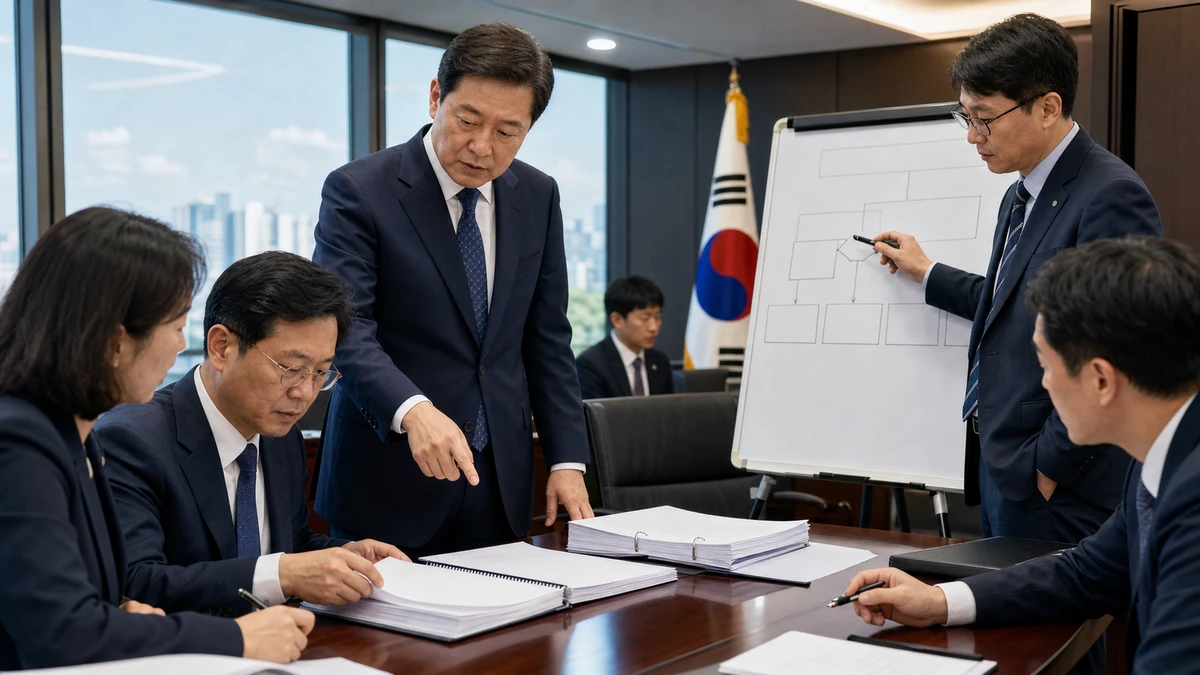
Han Chan-sik, the newly appointed senior presidential secretary for civil affairs, visited the task force preparing for the opening of the Major Crimes Investigation Office on July 1, according to the South Korean news agency Yonhap. The visit, while limited in its publicly disclosed details, carries political and administrative weight because it shows the presidential office is directly monitoring the nuts-and-bolts work behind the launch of a powerful new law enforcement institution.
The agency is scheduled to open Oct. 2. In practical terms, that means South Korea is now in the final stretch of building the legal rules, administrative procedures and chains of responsibility that will determine how the office actually functions once it begins operating. For American readers, the scene may bring to mind the painstaking work that goes into standing up a new federal watchdog, task force or specialized enforcement unit in Washington: the headline may sound dramatic, but the real stakes often lie in the internal rules, reporting lines and limits on authority.
That appears to be the case here. The preparatory task force is housed under South Korea’s Ministry of the Interior and Safety, the ministry responsible for core government administration and organizational management. Its role, based on the information made public, is to refine the laws, regulations and working rules tied to the new office before the October launch date.
Han’s presence matters because his post is not ceremonial. In the South Korean system, the senior presidential secretary for civil affairs has historically been one of the Blue House or presidential office’s most sensitive posts, dealing broadly with legal affairs, public service discipline and matters tied to state oversight. Although administrations have restructured the office over time and the powers attached to it can vary, the position is widely understood as one that sits near the intersection of politics, law and presidential control.
So when a newly named official in that job shows up to inspect the launch preparation for a new major-crimes body, the signal is hard to miss: The administration wants this rollout managed carefully, and it wants the public to know the process is being watched from the top.
Why “preparation” means more than paperwork
It would be easy to read the announcement as routine government scheduling. A senior aide visits an office, receives a briefing, checks progress and leaves. But in South Korea, as in the United States, the creation of a new investigative institution is rarely just an administrative footnote.
According to a presidential official cited in the Korean reporting, Han received a broad briefing on the overall state of preparations and conducted an inspection. That word, “overall,” is important. Drafting enforcement decrees and agency rules may sound technical, but those technical decisions are where power is defined. They determine what procedures investigators follow, how cases move through the system, how responsibilities are divided and what safeguards exist when the state exercises coercive authority.
Americans are familiar with the idea that a law can pass Congress but still leave huge questions unresolved until agencies write detailed regulations. The same principle applies here. A new agency’s legal existence on paper does not by itself guarantee clarity, efficiency or public trust. The internal architecture matters. Who reports to whom? How are cases assigned? What boundaries separate this office’s jurisdiction from that of prosecutors, police or other state bodies? What accountability mechanisms exist if authority is abused or blurred?
The Korean summary makes clear that the task force’s job is to prepare the regulations and rules needed for the new office’s opening. That sounds procedural, but procedure is substance in law enforcement. In democracies, the difference between a disciplined institution and a politicized one often lies not in the headline law that created it, but in the less visible rules that shape everyday conduct.
This is one reason Han’s visit drew notice. It suggests the administration sees the launch not simply as a matter of opening doors on schedule, but as a test of whether the institution can begin operating with a coherent design. South Korea has spent years debating how investigative power should be distributed among police, prosecutors and specialized agencies. Against that backdrop, even a seemingly dry briefing on implementation becomes politically meaningful.
What the new office represents in South Korea’s system
The Major Crimes Investigation Office, as described in the Korean report, is being prepared as a state investigative body dedicated to serious crimes. The public summary provided does not specify its precise case distribution, staffing model or full authority structure, so any definitive claims beyond that would go beyond the available facts. But even at this stage, the launch matters because it touches one of the most sensitive questions in any constitutional system: who gets to investigate major wrongdoing, and under what controls.
For readers in the United States, it may help to think less in terms of a one-to-one comparison and more in terms of institutional function. South Korea is not simply adding another office plaque to a government building. It is deciding where a major investigative function sits within the state and how that function will be governed. In a country where prosecutorial reform, police authority and anti-corruption enforcement have all been flashpoints in recent years, the design of a new major-crimes body inevitably carries broader implications.
South Korea’s modern democratic history has made law enforcement structure an unusually charged issue. Since the country’s transition from authoritarian rule in the late 20th century, governments of different ideological stripes have faced recurring public scrutiny over whether powerful institutions are sufficiently independent, whether they are too centralized and whether political actors are using reform language to consolidate or redistribute control. That does not mean every institutional change is inherently partisan. It does mean that ordinary administrative steps can quickly take on symbolic significance.
The name of the new office itself underscores the stakes. An agency built around “major crimes” implies responsibility in areas where public fear, political pressure and state power can all converge. In any democracy, institutions that investigate serious wrongdoing sit at the point where citizens’ rights meet the state’s authority to search, seize, detain and prosecute. The public therefore tends to judge not only whether those agencies are effective, but whether they are predictable, restrained and accountable.
That is why the October deadline has more than calendar significance. Once a start date is formally set, the government is no longer debating an abstract reform. It is on the clock to make the machinery work.
The significance of the October deadline
The scheduled opening date of Oct. 2 gives this story much of its urgency. Han’s visit on July 1 came roughly three months before the planned launch, placing it squarely in the period when governments tend to shift from concept to execution. Timelines matter in institutional reform because delays can expose unresolved disputes, while rushed rollouts can create confusion that undermines a new agency before it even settles in.
For the South Korean government, the task is not merely to meet a date on the calendar. It is to ensure that by the time the office opens, the rules beneath it are strong enough to prevent operational disorder. A newly created body that begins work without clear lines of authority can quickly become a source of political controversy, interagency conflict or public mistrust. That risk exists everywhere, from Washington to Seoul.
The reporting available so far does not indicate any new policy announcement, fresh personnel decisions or confirmed details about how cases will be allocated. That restraint matters. It would be tempting to overread the visit as evidence of an imminent shift in power or a major change in criminal justice policy. But the facts disclosed publicly support a narrower conclusion: the presidential office wanted an on-site review of how preparations are progressing and how ready the institution is for its launch.
Even so, the political meaning remains significant. Deadlines concentrate power and attention. With Oct. 2 approaching, every internal rule becomes more consequential because it will shape real-world practice almost immediately. If South Korea wants the new office to open without avoidable friction, the preparation stage must answer questions before investigators ever take their first cases.
That is especially true in legal systems where multiple institutions can have overlapping interests in major criminal matters. Anyone who has watched jurisdictional disputes among U.S. federal agencies, state investigators and prosecutors understands the problem. Ambiguity can become a power struggle. It can also become a public confidence problem if citizens begin to see institutional turf wars instead of clean, credible enforcement.
Why Han Chan-sik’s role matters
Han’s visit also matters because he is described as the new senior presidential secretary for civil affairs. In South Korea, a newly appointed senior aide’s first visible moves often draw outsized attention because they can hint at what the administration considers urgent. First steps are rarely random in presidential politics.
The Korean article summary stops short of saying Han announced any new directives, and there is no indication from the provided material that he unveiled a specific policy change. But symbolism in politics does not require a formal proclamation. Choosing to make the launch-preparation unit for a major new investigative office one of the early destinations of a new top aide tells officials across the bureaucracy that this is a priority file.
To Americans, the closest parallel may be when a newly installed White House counsel, attorney general or domestic policy adviser makes an early stop at an agency involved in a politically sensitive initiative. The visit itself can function as a management signal. It says: This issue is live. The timeline matters. The president’s team is watching.
In the Korean context, that signal is sharpened by the traditional scope of the civil affairs role. The office has long been associated with oversight of legal and disciplinary matters within government, even as different administrations have revised its structure and powers. As a result, Han’s inspection can be read as part compliance check, part political reassurance and part administrative pressure test.
It also suggests that the presidential office sees the success of the new institution as tied not only to legal enactment but to operational credibility. Governments can announce reforms easily. Convincing the public that a new coercive institution will behave fairly is much harder. A visible inspection by a senior presidential aide is one way of showing that the government understands the difference.
The meeting point between politics and administration
One reason this episode deserves attention beyond Korea’s daily political churn is that it reveals where high politics meets administrative reality. The presidential office represents policy direction and political authority. The task force under the Ministry of the Interior and Safety represents implementation: the quiet, technical labor of turning a state decision into an operating institution.
That intersection is where many government projects succeed or fail. Political leaders can frame a reform as historic, necessary or urgent, but unless someone builds the internal systems to support it, the reform can collapse under its own ambition. Conversely, a technically sound rollout can still falter if it lacks political backing or legal clarity. Effective institution-building requires both.
The Korean summary also notes broader same-day reporting that President Lee Jae-myung urged ruling party floor leaders to accelerate legislation tied to his administration’s policy agenda. It would be a mistake to collapse that dinner meeting and Han’s site visit into one formal decision, because the available reporting does not do that. But it is reasonable to view them as part of the same larger governing pattern: legislation, institutional design and implementation are moving in parallel.
That rhythm is familiar in democracies everywhere. Laws set the direction. Bureaucracies write the rules. Political aides monitor whether execution matches intent. In South Korea, where institutional reform often unfolds under intense public and media attention, those steps can happen with unusual speed and visibility.
The task force’s placement under the Interior and Safety Ministry is telling on its own. That ministry is central to the organization of government administration. Housing the preparation team there suggests the launch is being treated not merely as a legal matter but as a broader question of how the state should organize a new investigative function. That can involve staffing frameworks, command structures, reporting procedures and coordination with existing bodies — the scaffolding that makes a formal institution real.
Why global readers should care
To international readers, particularly those outside East Asia, this may initially sound like an internal administrative story. But it touches on themes that travel well across borders: rule of law, state capacity and democratic accountability.
How a country structures its investigative institutions says a great deal about how it balances efficiency with restraint. A government that wants stronger enforcement may create a specialized body to handle serious crimes. A public wary of abuse, however, will ask what checks exist. Those questions are not uniquely Korean. They are central to modern democracies, including the United States, where debates over the power of federal investigators, prosecutors and inspectors general are constant features of public life.
South Korea offers a particularly revealing case because it is both a highly developed democracy and a country with a fast-moving political system. Institutional changes can proceed quickly, but they do so in a landscape shaped by sharp public scrutiny, intense partisanship and a sophisticated civil society. That means a new investigative office cannot rely on legal existence alone. It must establish legitimacy.
The launch process will therefore be watched not only for efficiency but for signs of how clearly authority is defined. If the office opens with coherent procedures and minimal institutional friction, the administration can argue it has translated reform into workable governance. If the process appears opaque or improvised, critics will likely seize on that as evidence of weak design or excessive concentration of power.
For now, the firm facts remain limited but important: Han visited the preparation task force, received a general briefing and conducted an inspection; the task force is under the Ministry of the Interior and Safety; and the Major Crimes Investigation Office is set to launch Oct. 2. Everything else — including the ultimate scope, internal structure and political consequences of the new agency — will be tested by what happens between now and opening day.
More than a political photo op
In the end, the significance of Han’s visit lies less in what was announced than in what was implied. This was not presented as a splashy policy rollout. It was a check on readiness. Yet in the architecture of government, readiness checks are often where the real story is.
Creating a major investigative institution is one of the most sensitive things a democratic state can do. Such agencies carry the ability to intrude into private life, build cases and shape public trust in justice. That is why the framework around them matters so much. The laws, regulations and work rules being refined now are not merely back-office details. They are the operating code of state power.
South Korea’s presidential office appears keenly aware of that. By dispatching a newly appointed senior civil affairs secretary to inspect the preparation unit months before launch, the administration has signaled that the transition from statute to functioning institution is being treated as a matter of consequence, not routine.
For American readers, the lesson is straightforward. Democracies are often judged not only by the laws they pass but by the care with which they build the institutions that enforce those laws. South Korea’s new Major Crimes Investigation Office is still in that construction phase. What officials are doing now — clarifying rules, tightening procedures and stress-testing the system before opening day — may do as much to define its future as any public speech or legislative vote.
In that sense, Han’s visit was not just a stop on an official schedule. It was a window into how Seoul wants this new arm of state authority to begin: supervised closely, timed carefully and framed as an exercise in disciplined institution-building rather than political theater. Whether that effort succeeds will become clearer as Oct. 2 approaches. But the message from the presidential office is already plain. The government wants this launch to look orderly, credible and firmly under control.
Comments
Post a Comment