South Korea signals a broader economic playbook
South Korea, long known to Americans for shipping out semiconductors, cars, smartphones and giant container ships, is signaling that it wants its next chapter of growth to rely less exclusively on factory floors and more on the businesses that sit around them: finance, software, health care, tourism, logistics, design, data, platforms and other service industries.
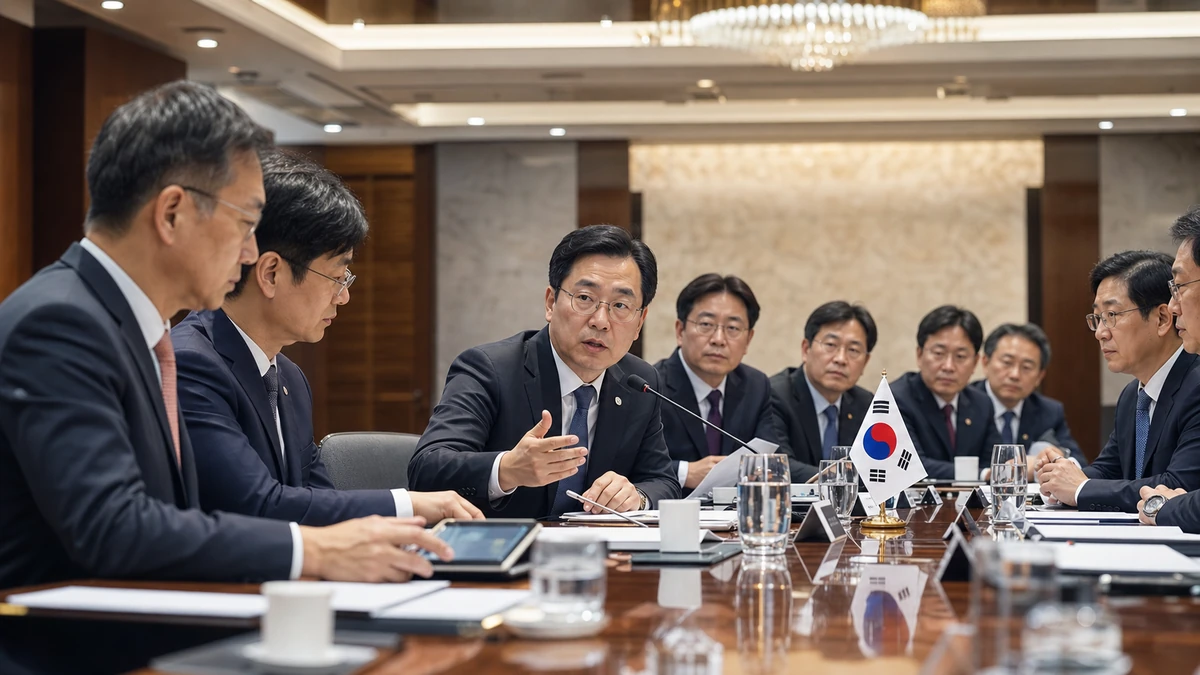
That message came into focus this week in Seoul, where Deputy Prime Minister Koo Yun-cheol, who also serves as finance and economy minister, said legislation to promote the service sector is urgently needed. Speaking at the second meeting of a government task force on strengthening service-industry competitiveness, Koo argued that South Korea needs to, in his words, redraw the board for service-sector development — a phrase that in Korean policy language suggests more than a routine reform. It means the old framework is no longer viewed as sufficient.
For readers in the United States, the shift may sound familiar. Washington, state capitals and business groups have spent years debating how to update industrial policy for an economy increasingly shaped not only by what a country makes, but by what it designs, manages, finances and delivers digitally. South Korea is now making a similar argument in its own way: that manufacturing strength alone is not enough to secure the next wave of national competitiveness.
The urgency is notable because South Korea has often been held up as a model export economy. The country built global brands in electronics, autos and heavy industry with a development model that emphasized manufacturing prowess, scale and overseas sales. That model still matters enormously. But officials and business leaders are increasingly arguing that higher-value services must become a co-equal pillar of growth, not merely a supporting act for manufacturers.
The meeting in Seoul did not produce a fully detailed roadmap, a legislative timetable or a list of company-specific investments. What it did provide was a clearer statement of direction. The government is framing services as a strategic national industry and calling for an institutional foundation — including a basic law for service-industry development — that could make policy support more systematic and less fragmented.
Why this matters in a country famous for manufacturing
To many Americans, South Korea is already deeply associated with services, whether they realize it or not. Korean pop music fills stadiums. Korean dramas dominate streaming recommendations. Beauty products line shelves at U.S. retailers. Online platforms, gaming, food delivery and digital payments are all part of South Korea’s highly wired consumer economy. Yet inside South Korea’s economic policy debates, services have often occupied an awkward place: important, growing and visible, but still not treated with the same strategic weight as export manufacturing.
That imbalance helps explain why Koo’s remarks drew attention. South Korea’s growth story was built in large part by nurturing industrial champions in sectors like steel, shipbuilding, autos and semiconductors. In the American imagination, that is the part of Korea’s economy most analogous to Detroit in its prime, Silicon Valley chip design, or Boeing-era industrial might in the Pacific Northwest. The state helped create conditions for scale, exports and technology catch-up. Services, by contrast, can be more diffuse, harder to classify and spread across multiple ministries and regulatory systems.
That fragmentation is central to the current debate. Koo said South Korea needs integrated governance for the service industry, a term that may sound bureaucratic but points to a real structural problem. Policy for software, tourism, education, medical services, finance, distribution and cultural content often sits in separate silos. If those fields are increasingly converging — for example, when digital health combines data, regulation, finance and care delivery, or when e-commerce blends logistics, payments, cloud systems and retail — then old ministry-by-ministry boundaries can become a drag on innovation.
South Korea is hardly alone in facing that issue. The United States has its own patchwork of federal and state regulators that businesses often say slows innovation in sectors that do not fit neatly into legacy categories. The difference is that South Korea, with its more centralized policymaking culture, is explicitly considering whether a broad framework law could help align these pieces under one national strategy.
In practical terms, the debate is about productivity and value creation. Service industries are no longer just labor-heavy sectors like restaurants, salons or brick-and-mortar shops, though those remain important employers. Increasingly, services also include data-driven and exportable businesses: cloud operations, software subscriptions, telemedicine systems, content platforms, research services, consulting, fintech and design. These are the kinds of sectors governments hope can generate high margins, sticky intellectual property and international influence.
The proposed law is about more than symbolism
Koo’s central argument was that South Korea urgently needs to enact a Framework Act on Service Industry Development. In Korean policymaking, a “framework act” is not just a slogan. It usually refers to a basic law that establishes legal grounds for long-term planning, coordination among ministries and a formal governance structure. For American readers, think of it as an attempt to create a durable policy architecture rather than a one-off spending bill.
Officials described the proposed law as a basis for systematic development plans and more integrated governance. That matters because many service-sector businesses fall between policy categories. A company building an AI-powered tourism platform, for example, could touch communications rules, local tourism policy, payments regulation, venture finance, labor rules and data governance. A law that sets common principles for service-industry development could, in theory, make it easier for the government to coordinate support and remove contradictory rules.
Koo also emphasized opening the barriers between industries. That phrase is important. South Korea’s officials are not simply talking about helping one more sector at the margin. They are suggesting that old divisions between services and manufacturing, technology and finance, research and commercialization are preventing the economy from evolving as fast as it could.
That is a significant conceptual shift. In traditional industrial policy, manufacturing often sits at the center, while services are treated as downstream support. But a modern electric vehicle is not just a car; it is also software, financing, charging infrastructure, mapping, customer data and after-sales ecosystem management. A successful cosmetics brand is not just a product; it is also retail experience, influencer marketing, logistics, branding and digital community building. A semiconductor company needs not only fabs but also design services, cloud tools, cybersecurity, financing and global customer support.
Seen through that lens, the service sector is not separate from manufacturing success. It is increasingly interwoven with it. The proposed law, then, is about institutional recognition of a reality that many businesses already live every day.
Still, caution is warranted. The meeting established policy intent, not guaranteed outcomes. No detailed implementation schedule was disclosed in the summary provided, and no final legislative text was announced. Whether the law would meaningfully improve competitiveness will depend on its specifics: what counts as a service industry priority, how conflicts among ministries are resolved, how support is targeted and whether regulatory changes are broad enough to matter but careful enough to avoid new distortions.
Why research, tax policy and finance are at the center
Koo said South Korea should concentrate support in three areas: research and development, tax policy and finance. Those may sound like standard government tools, but their inclusion is revealing because it shows the administration does not want service industries treated as low-tech or secondary. It wants them viewed as innovation sectors worthy of the same strategic toolkit often reserved for manufacturers.
Research and development is especially telling. In many economies, R&D support has historically been associated with labs, machinery, advanced materials and engineering-heavy production. Applying that logic to services means recognizing that innovation in services can come from software, data analytics, customer-experience design, platform architecture, automation, AI tools and new operating models. In other words, service productivity is not just about hiring more workers; it can also be about building smarter systems.
That distinction matters for South Korea, where concerns about growth, demographics and productivity have become harder to ignore. Like other advanced economies, the country faces pressure from an aging population, slower labor-force growth and increasingly intense global competition. In that environment, a sector that can scale through technology and know-how, rather than only through headcount or physical plant, becomes more attractive.
Tax policy is another important lever. If companies receive incentives to invest in digital infrastructure, training, software development or expansion into new service lines, the government can lower the cost of transformation. In the United States, lawmakers have long used tax credits and deductions to shape behavior in sectors from clean energy to manufacturing. South Korea appears to be signaling that services should now qualify for similar strategic thinking.
Finance is the third pillar. Access to capital is often one of the biggest hurdles for service businesses, particularly those whose assets are intangible. A factory can be valued in machinery and land. A platform business, software company or specialized service provider may depend more on code, data, brand, contracts and human talent. Governments that want such firms to grow often need financial systems willing to underwrite that kind of risk.
What remains unclear is how large or targeted any new support would be. The available summary does not provide funding levels, tax formulas or industry-by-industry beneficiary lists. So while the direction is clear, the actual economic impact will hinge on future details.
Business leaders are trying to define a “New K-Industry” era
The message from the private sector echoed the government’s tone. Ryu Jin, chairman of the Korea Enterprises Federation, said the service industry should be developed into a central pillar of the national growth strategy alongside manufacturing. The federation, one of the country’s major business lobby groups, represents the perspective of large companies and corporate leadership in policy debates.
Ryu described the upgrading of services as a key task in opening what he called a “New K-Industry” era. The phrase is classic Korean branding: concise, forward-looking and built around the now-familiar “K” label that international audiences associate with Korea’s export identity, from K-pop and K-dramas to K-beauty and K-food. But in this context, it points to something broader than pop culture. It suggests a new phase in which South Korea exports not only products and entertainment, but integrated business models and service ecosystems.
That concept may be easier for Americans to grasp if they think about how Apple is not just an electronics company, or how Amazon is not just a retailer. Much of the value lies in the services wrapped around the product: software, subscriptions, payments, logistics, customer relationships and data-driven ecosystems. South Korean policymakers and executives appear to be asking whether the national economy can move further in that direction.
There is also a branding dimension. South Korea has spent years building global recognition for its culture and technology. That visibility can create opportunities for service exports in education, tourism, health care, entertainment platforms, design, consulting and digital consumer experiences. A traveler drawn to Seoul by Korean food and music may also engage with Korean payment systems, transportation apps, beauty services, wellness products and branded retail spaces. A global fan of Korean dramas may become a customer of related online content, e-commerce and lifestyle businesses.
But translating cultural appeal into durable economic strategy requires more than popularity. It requires rules, investment, talent and institutional support. That is the harder part — and the part policymakers are now trying to address.
Regulatory reform could be the most consequential piece
Perhaps the most sensitive part of Koo’s message was his call for bold regulatory rationalization. That phrase should not be read as a blanket push for deregulation. In South Korea, as elsewhere, regulatory reform often means revisiting rules that were built for older industrial structures and no longer fit sectors where technology, finance, data and consumer services overlap.
For example, a new service business might operate partly as a software provider, partly as a marketplace and partly as a financial intermediary. If each activity is regulated separately, the company may face duplicate requirements, unclear jurisdiction or delays that favor incumbents over innovators. Rationalization in this sense means keeping necessary protections while reducing friction that no longer serves a clear public purpose.
That is easier said than done. South Korea has a reputation for energetic digital adoption but also for dense, sometimes conservative regulation in sensitive sectors such as health, education and finance. Any effort to loosen barriers will likely spark debates about consumer protection, market fairness, labor conditions and the balance between innovation and oversight.
Those tensions are not unique to Korea. Americans have seen similar arguments around ride-hailing, telehealth, crypto, online marketplaces and AI. The broader question is the same: how does a government modernize rules quickly enough to enable new industries without creating loopholes or social costs it later struggles to contain?
The answer often lies in administrative capacity as much as ideology. Integrated governance can sound dry, but it is essential when industries no longer stay in their lanes. If South Korea wants service sectors to scale, it will need agencies that can coordinate rather than compete, and rules that can adapt across sectors rather than freeze them into outdated categories.
What the shift could mean for Korea’s place in the global economy
For international observers, the significance of this week’s meeting lies in what it says about South Korea’s next economic ambition. The country is not turning away from manufacturing; it is trying to build on it. The new message is that factories alone do not define competitiveness anymore. In a world where customer experience, data, branding, software and finance increasingly shape where profits accumulate, the service layer matters as much as the physical product.
If South Korea can successfully deepen high-value services, it could strengthen the global reach of its existing industrial base. Manufacturers could capture more of the value chain through software, financing, maintenance, platforms and post-sale customer relationships. Service firms could also emerge as export players in their own right, leveraging Korea’s reputation for technology, design and cultural influence.
That would fit a broader pattern in advanced economies, where the line between goods and services continues to blur. A vehicle can be updated over the air. A TV comes bundled with a content ecosystem. A beauty brand becomes a digital community. A hospital system can export medical protocols, training and technology as much as clinical expertise. The countries that thrive in that environment are often those that combine engineering with services, not those that cling to one side of the divide.
There are, however, limits to what policy declarations can accomplish on their own. Service industries are highly diverse. What works for tourism may not work for fintech. What helps a software firm may do little for education services or retail logistics. Success will depend on whether South Korea can design support that is both coordinated and flexible, strategic without becoming overly centralized, and ambitious without picking winners too narrowly.
For now, the most important takeaway is that Seoul’s economic leadership is publicly reframing the conversation. The government says services should be treated as a strategic growth axis. Business groups say the same. The legislative and regulatory details remain to be worked out, but the direction is unmistakable.
For American readers accustomed to seeing South Korea primarily through the lens of chips, cars and K-pop, this may be the more consequential story: one of Asia’s most successful manufacturing powers is trying to reinvent itself for an era when intangible value — software, experience, finance, design and data — may determine the next winners in the global economy.
Comments
Post a Comment