South Korea’s Bid for Canada’s Next Submarines Runs Into a Bigger Force Than Price and Performance: NATO Politics
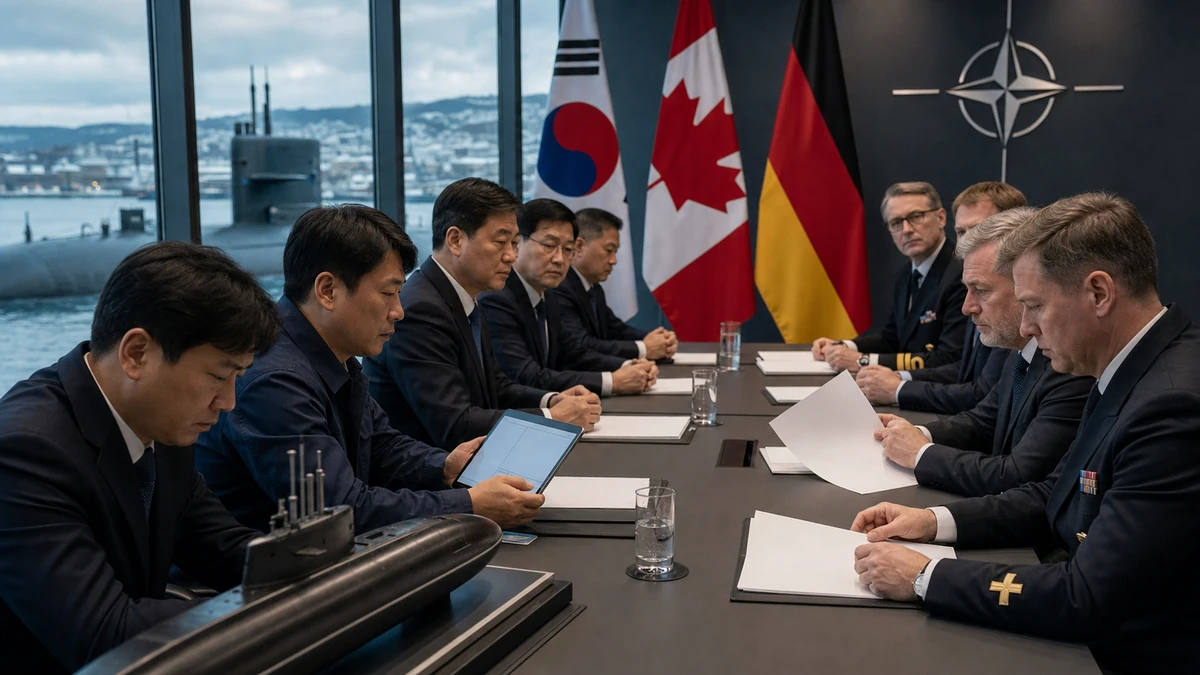
A high-stakes loss may be taking shape for South Korea
South Korea appears increasingly likely to come up short in one of the most closely watched submarine competitions outside Europe: Canada’s multibillion-dollar effort to replace and expand its patrol submarine fleet. The project, often described in South Korean coverage as potentially worth up to 60 trillion won — roughly tens of billions of U.S. dollars depending on the final scope and exchange rates — had been seen in Seoul as a potential breakthrough moment for the country’s defense industry.
But the emerging picture is that South Korea may have run into something more powerful than a standard arms-procurement checklist. According to reporting from South Korea, Canada may be leaning toward Germany, not simply because of the submarines themselves, but because of what a German deal would mean inside the NATO alliance.
That distinction matters. In major defense deals, especially for systems as sensitive and long-lived as submarines, governments are not just buying hardware. They are buying a decades-long strategic relationship: training pipelines, maintenance networks, software support, munitions compatibility, intelligence coordination and, just as importantly, political trust. In that kind of competition, the question is not only which submarine is faster to deliver or better at staying underwater. It is also which supplier best fits the buyer’s alliance structure and long-term security planning.
For American readers, there is a useful analogy here. If a U.S. state were choosing a new emergency communications system, the decision would not be based only on which company made the best radios. Officials would also ask which system integrates with neighboring states, federal agencies and existing command structures. Now multiply that logic by the stakes of undersea warfare in the Arctic and North Atlantic, and the politics become far more consequential.
That is why this competition has drawn unusual attention in South Korea. It is not just about whether one export campaign succeeds or fails. It is also a test of whether a rising Asian defense manufacturer can break into a procurement space where alliance solidarity may matter as much as engineering.
Why Canada’s submarine project matters far beyond Canada
Canada’s submarine modernization effort carries unusual symbolic and strategic weight. The Royal Canadian Navy’s current Victoria-class submarines are aging, and Ottawa has been under pressure to modernize maritime capabilities as security concerns grow in both the Arctic and the Atlantic. Climate change is opening northern routes, Russian military activity remains a concern, and Western governments are rethinking the condition of fleets that were often neglected after the Cold War.
For Canada, submarines are not prestige items. They are tools for surveillance, deterrence and alliance operations in some of the world’s most demanding waters. A submarine fleet affects how Canada monitors its coasts, participates in NATO missions and signals seriousness about defense burden-sharing — an issue that has repeatedly surfaced in Washington, Brussels and Ottawa alike.
For South Korea, meanwhile, the project has represented something even larger: validation that its shipbuilding and defense sectors can compete at the very top of the global market. South Korea is already a world-class shipbuilder in the commercial sector, and in recent years it has turned that industrial depth into a growing defense export portfolio. The country has sold tanks, howitzers, trainer jets and other systems abroad, with Poland becoming one of the clearest examples of Seoul’s growing role as an arms supplier.
That expansion has been driven by a combination of factors that appeal to buyers: solid technology, relatively competitive pricing and, crucially, faster delivery times than many traditional Western suppliers can offer. In a world where defense procurement is often delayed by years, speed itself has become a strategic advantage.
That is part of what made South Korea a serious contender in Canada. South Korean firms were seen as offering quick delivery and strong underwater endurance, two features that resonate in any submarine program. In practical terms, long endurance means a submarine can remain submerged for extended periods, reducing the need to surface and making it harder to detect. In an era of increasingly sophisticated surveillance, that kind of capability can be decisive.
Even so, the symbolic value of the Canadian competition may have been just as important as the business case. Winning would have marked a major step for South Korea in entering a defense space historically dominated by NATO and European suppliers. Losing narrowly would still show how far the country has come. But losing because alliance politics outweigh technical merits would send a different message — one about the structural barriers facing even highly competitive non-NATO suppliers.
South Korea’s pitch was strong on industrial logic
South Korea’s case in this competition appears to have been built on a straightforward argument: it can deliver capable submarines on time, at scale and with proven industrial capacity behind them. That is no small claim. One of the enduring frustrations in Western defense procurement is that political promises often run far ahead of production reality. Many governments want more ships, more ammunition and more equipment, but the factories and supply chains needed to produce them quickly are under strain.
South Korea has become attractive in that environment because it offers what many buyers want most right now: manufacturing credibility. The country’s shipyards are among the most productive in the world, and its defense manufacturers have gained a reputation for moving faster than some of their European competitors. That reputation has mattered in markets where the urgency of war and deterrence has changed the timeline for military buying.
There is also a broader strategic appeal to South Korean defense products. Seoul sits in one of the most militarily tense regions in the world, facing a heavily armed North Korea and living under constant pressure to maintain readiness. That environment has shaped a defense industrial base that is not theoretical or ceremonial. It is built around immediate operational needs and large-scale production.
In the submarine context, South Korea’s strengths reportedly included rapid delivery schedules and strong long-submergence capability. Those are not abstract talking points. For a country like Canada, where distances are vast and operating conditions can be unforgiving, reliability and endurance matter. A submarine is only as useful as the support system behind it, and South Korea likely sought to demonstrate that it could provide the full package: construction, training, sustainment and technical adaptation to Canadian requirements.
That South Korea was viewed as running neck-and-neck with Germany at points in the competition is itself a significant marker. It suggests that Seoul’s submarine technology is being taken seriously in markets that, not long ago, might have looked almost automatically to Europe or North America for such purchases. In that sense, even a disappointing outcome would not erase the larger story of South Korea’s rise. It would simply underscore that top-tier defense competitions are rarely decided by technical factors alone.
Germany’s edge may have less to do with the vessel than the network behind it
If Canada ultimately favors Germany, the logic appears rooted in alliance integration. Germany is deeply embedded in NATO’s defense ecosystem, and reporting cited in South Korea notes that German industry supplies a large share of NATO submarine capability. That matters because military procurement is often about standardization as much as innovation.
Think of it the way American defense planners think about interoperability, a word that sounds bureaucratic but has enormous practical meaning. Interoperability means allied forces can operate together smoothly: sharing logistics, spare parts, maintenance procedures, doctrine, training routines and, when necessary, operational plans. It reduces friction during crises and lowers long-term costs associated with managing unique systems.
In the German case, one reported advantage is the possibility that Germany, Norway and Canada could operate a broader common submarine framework. That could create efficiencies in training, sustainment and alliance coordination that extend far beyond the initial purchase price. For NATO governments, those efficiencies are often politically attractive because they reinforce the idea that allied militaries should not function as isolated national silos.
For Canada, the logic is especially compelling. Ottawa is a NATO member with responsibilities tied to the North Atlantic, Arctic approaches and broader allied planning. A submarine fleet that plugs neatly into NATO habits and supply networks may look more strategically prudent, even if a rival bid offers strong technical performance. In such cases, the buyer is not rejecting the technology of the outsider so much as rewarding the institutional familiarity of the insider.
That is likely the heart of the South Korean concern. Seoul may have brought a competitive submarine to the table, but Germany brought a submarine plus the reassurance of NATO continuity. In a time of geopolitical strain, that second factor may be hard to beat.
For U.S. readers, there is a parallel in the way Washington often thinks about defense cooperation among close allies. When the United States backs joint platforms, shared missile defense structures or common procurement initiatives, the objective is not only to equip partners but to make the alliance itself more cohesive. Canada may be applying a similar mindset here.
The timing reflects deeper unease about the Western security order
This competition is unfolding at a moment when NATO governments are thinking harder about self-reliance and internal cohesion. Questions about the durability of U.S. security commitments — whether fair or exaggerated — have pushed allies to consider how dependent they should remain on Washington and how tightly they should coordinate with one another.
That context matters because procurement choices can function as strategic signals. Buying German submarines would not just fill a naval requirement. It could also be read as an affirmation that Canada wants to anchor more of its future defense posture within established NATO industrial and operational frameworks.
In other words, a submarine contract can serve as a foreign policy statement. That may sound dramatic, but major weapons purchases often operate that way. Countries use them to reassure allies, deepen partnerships or indicate which strategic camp they expect to rely on over the coming decades.
Canada’s calculation, if that is indeed where it is heading, may reflect a simple conclusion: in a less certain security environment, sticking closely with alliance suppliers reduces risk. Even if South Korea can provide an excellent submarine, it does not carry the same built-in political symbolism within NATO that Germany does.
This is not an indictment of South Korea. In fact, it highlights how far the country has come that it can compete seriously in such a contest. But it also shows the limits of purely commercial logic in the defense sector. In ordinary markets, a company can win by offering a better product faster and cheaper. In strategic weapons markets, governments may prioritize trust networks accumulated over decades.
That is especially true for submarines, which are among the most sensitive military platforms any country can buy. They require high secrecy, long support horizons and extensive confidence that the supplier will remain politically aligned over the life of the fleet. Those conditions naturally favor suppliers already embedded in the buyer’s security architecture.
For South Korea, the lesson may be diplomatic as much as industrial
The likely outcome in Canada does not mean South Korea’s defense export model is broken. If anything, it suggests the model is strong enough to threaten established players — but not always strong enough to overcome entrenched alliance preferences. That distinction is important for understanding what Seoul may do next.
South Korea’s defense industry has spent years proving that it can compete on engineering, production capacity and delivery speed. The next phase may require proving something more intangible: that South Korean systems can fit smoothly into the strategic ecosystems of countries that are not part of Seoul’s immediate alliance network.
That means defense diplomacy may need to become more sophisticated. Instead of selling only the platform, South Korea may need to sell the broader cooperative value of the platform. How would a South Korean submarine integrate with NATO operating concepts? What maintenance partnerships could be built in Europe or North America? How would training, spare parts, upgrades and data systems align with alliance expectations over 20 or 30 years?
Those questions may sound secondary, but in the current market they are often decisive. The challenge for non-NATO suppliers seeking NATO business is not merely to prove technical excellence. It is to compensate for the trust and familiarity that alliance members grant one another almost automatically.
South Korea is hardly alone in facing that problem. Any advanced defense exporter outside a major security bloc encounters similar hurdles when trying to enter high-end markets dominated by long-standing strategic relationships. What makes the Canadian case notable is how clearly it appears to expose that reality.
There is also a domestic political dimension in South Korea. Defense exports are not just commercial wins; they are increasingly tied to national prestige and economic strategy. A major submarine victory in Canada would have reinforced the narrative that South Korea is moving into the front rank of global defense suppliers. If that victory slips away, policymakers in Seoul may feel new urgency to connect arms exports more closely with diplomatic outreach and alliance management.
A setback in Canada would still say something important about South Korea’s rise
It would be a mistake to read a possible loss in Canada as evidence that South Korea’s defense ambitions have hit a wall. In some ways, the opposite is true. The fact that South Korea was regarded as a credible contender in a massive Canadian submarine program is itself evidence of a major shift in the global defense landscape.
A generation ago, many Western analysts would not have treated Seoul as a likely finalist in a competition of this scale and sensitivity. Today, South Korean defense companies are not niche players. They are increasingly central to discussions about how democracies rearm, diversify supply chains and reduce procurement delays.
That matters not only in Asia, but also in Europe and North America. As Russia’s war in Ukraine has reshaped defense planning and as concerns about China continue to influence military strategy, governments are looking more broadly for dependable suppliers. South Korea has benefited from that search because it offers a mix of industrial sophistication, democratic governance and geopolitical alignment with the West, even if it is not a NATO member.
Still, the Canadian submarine contest highlights a hard truth. In elite segments of the defense market, the final question is often not “Who built the better machine?” but “Who belongs most naturally inside our security circle?” Germany appears to have an advantage on that question.
That may be frustrating in Seoul, where officials and industry leaders can plausibly argue that their submarines deserve evaluation on their own merits. But from Ottawa’s perspective, procurement is about more than fairness in competition. It is about risk, alignment and the shape of Canada’s future military partnerships.
If that is the calculation now taking shape, then this story is larger than a single contract. It is a snapshot of how the global arms market really works: open in theory, but often structured by alliances, institutional trust and long-memory politics. For South Korea, the lesson is not that it cannot compete. It is that competing successfully at the highest level may require marrying first-rate hardware to an equally persuasive geopolitical strategy.
And for American readers, the broader takeaway is familiar. Even in an era obsessed with technology, military power still runs through old-fashioned relationships. Nations may admire a supplier’s efficiency and engineering, but when the stakes involve strategic assets that will serve for decades, they often choose the partner whose flag already flies inside the same security tent.
Comments
Post a Comment