South Korea’s APS Moves to Buy Transformer Automation Firm in a Bet on the Machinery Behind Modern Manufacturing
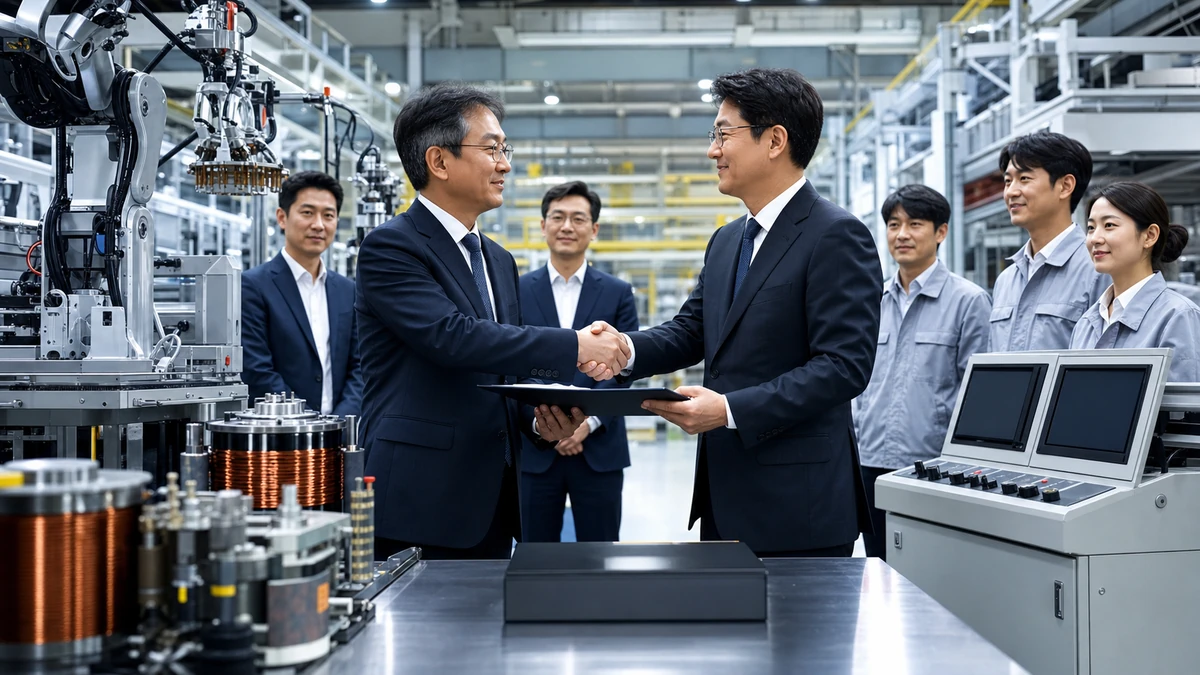
A Korean tech company makes a quiet but telling bet
South Korean listed company APS said it plans to acquire 100% of UPI, a manufacturer of automation machinery used in transformer production, in a deal valued at 18 billion won, or about $13 million to $14 million depending on exchange rates. The announcement, disclosed through Korea’s regulatory system, may look modest beside the splashier headlines that usually dominate coverage of South Korean business — semiconductors, electric vehicle batteries, K-pop entertainment companies or consumer electronics. But for anyone trying to understand where Korean industry is headed, this is the kind of transaction worth watching.
APS, which trades on the KOSDAQ market, said it would buy 30,000 shares in UPI and, if the deal closes as scheduled on the 31st of this month, will own the company outright. APS described the purpose in plain corporate language: portfolio diversification. That phrase can sound bloodless in a securities filing, but in practice it signals something straightforward. APS is trying to broaden the base of its business, reduce reliance on any one segment and position itself in a part of manufacturing where specialized equipment, long customer relationships and process know-how can matter as much as the end product itself.
There is also a larger industrial story here. South Korea’s economic rise is often told through its globally recognized brands — Samsung phones, Hyundai cars, LG appliances. But the country’s manufacturing strength has always depended on a deeper layer that many consumers never see: the machinery, automation systems and production processes that make those finished products possible. UPI operates in exactly that less visible layer of the economy. It makes automation machines used in the production of transformers, a crucial piece of electrical infrastructure that sits at the center of power transmission and distribution.
In other words, this is not a consumer-facing acquisition. It is a purchase aimed at gaining control over a niche but strategically important industrial capability. And while APS has not publicly laid out detailed synergy plans, revenue targets or post-deal operating changes, the structure of the deal itself sends a clear message. This is not a small minority stake or a tentative financial investment. APS is moving to fully absorb UPI into its corporate structure.
For American readers, the closest analogy may be a mid-sized industrial technology company deciding not just to invest in a promising supplier, but to bring that supplier fully in-house because it sees long-term value in owning the tools behind the factory floor. It is the kind of move that tends to matter more over five or 10 years than it does over five or 10 trading days.
Why transformer manufacturing matters beyond the factory gate
Transformers are among the least glamorous and most indispensable pieces of modern infrastructure. They change voltage levels so electricity can be transmitted efficiently over long distances and then safely distributed to homes, offices, factories and data centers. Without them, the power grid does not function in the way modern economies require.
That makes the production equipment used to build transformers more important than it may first appear. Machinery designed for transformer manufacturing can influence how quickly products are made, how consistently they are assembled and how reliably quality standards are maintained. In industries tied to energy infrastructure, those factors matter. Even incremental improvements in production efficiency or defect reduction can have meaningful effects on cost, delivery schedules and operational stability.
This helps explain why a company like APS might see value in buying a specialist firm like UPI outright. The machinery used in transformer production is not generic equipment that can be developed overnight or easily replaced by an off-the-shelf alternative. It sits within a specialized industrial ecosystem, one that depends on accumulated engineering experience, tailored customer needs and integration with broader manufacturing workflows.
The timing is notable, too. Around the world, power infrastructure has become a bigger economic and political topic than it was a decade ago. In the United States, debates over grid modernization, clean energy expansion, data center electricity demand and supply chain resilience have all pushed electrical equipment back into focus. Transformers have become part of that conversation because they are a bottleneck in many power-related projects. Korea’s industrial suppliers do not operate in the same market structure as U.S. utilities or manufacturers, but they are participating in the same global shift toward valuing the hardware that keeps electricity systems running.
UPI’s specific customer base, export profile, production capacity and technical details were not disclosed in the summary information surrounding the deal. That means any interpretation should remain measured. Still, based on the public facts alone, APS is buying a company in a field tied directly to the machinery of power-equipment manufacturing. In a world increasingly concerned with electrification, industrial resilience and infrastructure capacity, that is not a trivial category.
What 100% ownership tells the market
One of the most significant details in the filing is not the deal price, but the ownership structure. APS said its stake in UPI would become 100% if the acquisition closes as planned. In corporate terms, full ownership offers a very different level of control from a minority or even majority investment.
With a minority stake, a parent company may gain exposure to a business without fully directing it. With full ownership, strategic alignment becomes much easier. Management decisions can be centralized. Capital spending can be coordinated. Sales strategy, research priorities, staffing and integration with the parent company’s existing operations can all be adjusted with fewer of the compromises that come with shared control.
That does not automatically make an acquisition successful, of course. Full ownership creates strategic freedom, but it also increases responsibility. APS will have to decide how tightly to integrate UPI, whether to preserve its operating independence, and how to position the business within its wider portfolio. Those choices can determine whether diversification becomes a genuine growth engine or simply a broader collection of unrelated assets.
Still, the decision to acquire UPI outright suggests APS sees more than short-term financial upside. A company does not usually buy 100% of a niche industrial manufacturer merely to hold it passively. Full ownership implies that APS wants the option to shape UPI’s future direction and potentially use the business as a building block in a broader industrial strategy.
That matters in the Korean market context. Corporate filings in South Korea often use concise, standardized language that gives investors essential facts without narrating a broader strategic story. So when a company says the purpose is “portfolio diversification,” readers often have to infer the bigger picture from the structure, timing and sector involved. Here, the most reasonable reading is that APS is seeking a more durable foothold in manufacturing automation through acquisition rather than trying to develop all of that capability internally from scratch.
Understanding KOSDAQ for American readers
APS is listed on KOSDAQ, South Korea’s secondary stock market, which is often compared loosely to the tech-heavy growth segments of U.S. capital markets. The comparison is imperfect, but useful. If South Korea’s main KOSPI market is home to many of the country’s largest and most established companies, KOSDAQ has traditionally served as a venue for smaller, growth-oriented and technology-focused firms.
That matters because the strategic behavior of KOSDAQ-listed companies can differ from that of the giant conglomerates, known in Korea as chaebol, that are more familiar to international audiences. A chaebol is a large family-controlled business group — think Samsung, Hyundai or SK — with sprawling affiliates across sectors. Mid-sized KOSDAQ firms generally do not have the same capital base or internal ecosystem. They often have to be more selective and tactical in how they expand.
For those companies, growth can come through several channels: internal research and development, capital investment in equipment, partnerships, equity investments or mergers and acquisitions. In specialized industrial fields, acquisitions can be especially attractive because technical depth is hard to build quickly. Buying a company that already has a working product, experienced engineers and existing customer relationships can be faster and less risky than trying to construct those capabilities entirely in-house.
That appears to be the backdrop against which APS made its move. Even though the company has not disclosed a detailed integration playbook, the transaction fits a pattern seen in Korea’s growth-company sector: expanding into adjacent, technically demanding areas by acquiring firms with established expertise. It is a pragmatic version of industrial scaling. Rather than betting on a distant moonshot, a company buys competence that already exists and then tries to create value through ownership, coordination and longer-term investment.
For American readers more accustomed to stories about Korean consumer brands or entertainment exports, this can be a useful reminder that much of South Korea’s economic dynamism still comes from business-to-business manufacturing and industrial engineering. The companies may be less famous abroad, but they are part of the infrastructure that underpins the country’s export model.
The hidden strength of Korean manufacturing
South Korea’s industrial success is often framed around finished products — memory chips, smartphones, displays, ships, cars and batteries. But those products do not emerge from thin air. They depend on a dense network of precision machinery, process technology and specialized suppliers. That “hidden infrastructure” of manufacturing is one reason Korean companies have been able to compete globally even in sectors where margins are tight and technological standards are unforgiving.
The APS-UPI deal fits squarely into that story. UPI’s business is not one most consumers will ever encounter directly. Few people shopping for electronics, driving a car or paying an electric bill will stop to think about the automation machinery used to build transformers. Yet industrial ecosystems are built on exactly these kinds of invisible components. The reliability of a broader manufacturing base often depends on the companies that make the equipment used by other manufacturers.
In that sense, APS is investing not in a brand, but in capability. And capability has become a central theme in global industrial policy. In the United States, policymakers from both parties have spent recent years talking about domestic manufacturing, supply chain security and strategic industries. In Europe and Asia, similar conversations have centered on production resilience, industrial autonomy and control over key technologies. Korea, as a heavily export-dependent economy with advanced manufacturing at its core, has long understood that competitive advantage is rooted not just in final assembly, but in process excellence.
That process expertise is especially relevant in automation. Automation equipment can help manufacturers raise throughput, reduce labor-intensive steps, improve consistency and respond more effectively to quality-control demands. In sectors tied to infrastructure and electrical systems, those gains can be economically meaningful even if they never become visible to the average consumer.
There is also a strategic logic to owning a specialized automation business at a time when manufacturers worldwide are under pressure to do more with less — less labor slack, less tolerance for delays and less room for quality failures. A company with a foothold in industrial automation is not just selling machines. It can become part of a customer’s long-term effort to modernize production. That can make such businesses attractive acquisition targets, particularly for firms looking to broaden their industrial relevance.
What investors still do not know
As with many regulatory disclosures, the public facts here are limited. APS has disclosed the basic terms: the target company, the value of the share purchase, the number of shares, the expected date of acquisition and the stated purpose of diversification. What it has not yet disclosed, at least in the summary available, are the specifics that investors usually want next.
There is no detailed public explanation of how UPI will fit into APS’s existing business lines. There are no revenue or profit projections tied to the acquisition. There is no public breakdown of UPI’s customer mix, export exposure, order backlog or manufacturing capacity. And there is no detailed account of what operational changes APS may pursue once the company becomes a wholly owned subsidiary.
That means it would be premature to make bold claims about the financial impact of the transaction. Investors and industry observers can reasonably say the deal expands APS into a more specialized manufacturing-automation niche and gives it complete control of the acquired company. They cannot yet say with confidence how much earnings growth, if any, that will generate, or how quickly synergies might emerge.
This caution is particularly important in the Korean market, where headlines can sometimes race ahead of the underlying disclosures. A concise filing may be enough to trigger excitement about strategic expansion, but the real test comes later, when management explains execution plans and quarterly results begin to show whether the acquisition is delivering on its promise.
For now, the most relevant question is not whether the deal sounds strategic — it does — but whether APS can turn ownership into operational advantage. Can it place UPI effectively within its broader portfolio? Can it preserve the specialist expertise that made the company worth buying in the first place? Can it identify cross-selling, technology-sharing or market-expansion opportunities that justify full ownership rather than passive investment? Those are the questions that matter after the filing headline fades.
Why this deal deserves attention beyond South Korea
At first glance, an 18 billion won acquisition by a Korean mid-sized technology company may seem too narrow to matter outside the local market. But that would miss the broader signal. The transaction highlights how Korean firms continue to deepen their reach into the industrial systems behind global manufacturing, not just the consumer products that win international attention.
For English-speaking audiences, especially in the United States, the story lands at a moment when infrastructure, electrification and industrial policy are moving back to the center of economic debate. Americans may know South Korea as the home of K-pop, Oscar-winning films, beauty products and headline-making electronics giants. Those exports are real and influential. But another Korea exists alongside them: a Korea of machine tools, factory systems, process engineering and industrial equipment. It is less visible, but it is one of the foundations of the country’s economic model.
APS’s move to buy UPI in full suggests confidence in that quieter side of the economy. It indicates that at least some Korean growth companies see future opportunity not only in the products people buy, but in the machinery that other manufacturers need to keep modern industry running. In practical terms, APS is betting that control over specialized transformer-production automation is a worthwhile place to deploy capital.
The deal’s closing date, scheduled for later this month, will be the first near-term milestone to watch. After that, attention will turn to how APS describes the acquisition in subsequent filings and earnings updates. If management begins outlining clearer integration plans or links the purchase to broader business expansion, the significance of the deal may come into sharper focus.
Until then, the clearest takeaway is also the simplest. APS is not merely investing in another company. It is buying complete ownership of a business tied to the machinery of electrical manufacturing. In a global economy increasingly defined by the ability to build, automate and scale critical infrastructure, that is the kind of move that can say more about industrial priorities than a dozen splashy marketing campaigns ever could.
Comments
Post a Comment