South Korea’s Lee pitches a deeper NATO defense partnership, signaling Seoul wants a bigger global security role
From arms sales to shared systems
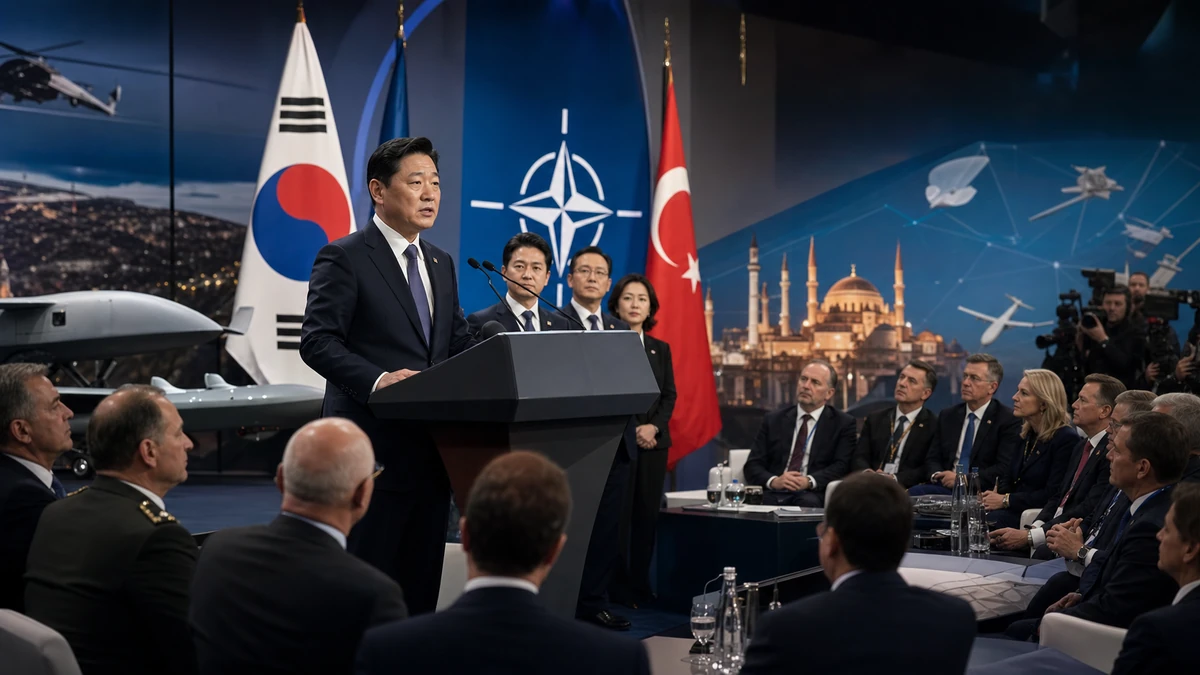
President Lee Jae-myung used a NATO defense industry forum in Ankara, Turkey, to make a pointed argument about where South Korea wants its security relationships to go next: beyond buying and selling weapons, and toward building them together. In remarks delivered alongside the NATO summit schedule, Lee said cooperation between South Korea and NATO should be upgraded into what he called a “Korea-NATO Defense Industry Partnership 2.0,” a framework centered on joint research, joint production and joint operation of weapons systems.
That may sound like bureaucratic jargon, but in practical terms it marks a meaningful shift in emphasis. The current model of defense ties between countries often begins with transactions: one country sells tanks, artillery, missiles, aircraft components or radar systems to another. Lee’s pitch suggests Seoul wants something more integrated and politically significant. Instead of treating defense as a one-off export business, he is framing it as part of a shared industrial base and a longer-term security architecture.
For American readers, a useful comparison might be the difference between a straightforward foreign military sale and a deeper alliance structure in which partners co-develop technology, align logistics, train around common standards and prepare to operate equipment together over time. That second model creates more than revenue. It creates interdependence, trust and strategic alignment. It also ties defense manufacturing more closely to diplomacy.
Importantly, Lee’s remarks did not amount to an announcement of a signed contract, a new procurement package or a finalized weapons program. Based on the public account of the speech, what he offered was a policy direction and a political signal. He proposed a new vocabulary for cooperation and invited NATO and its members to think of South Korea not just as a supplier or customer, but as a partner in the design and sustainment of future capabilities.
That distinction matters. In international security, leaders often use high-profile forums not to unveil fully negotiated deals, but to establish the direction of travel. Lee’s appearance did exactly that. By choosing a NATO-linked defense industry gathering and by naming the concept publicly, he gave a clear indication of how his government wants South Korea’s place in the global defense ecosystem to be understood.
Why this matters beyond Europe
At first glance, a South Korean president speaking at a NATO defense forum in Turkey might seem like a niche diplomatic moment, far removed from the concerns of readers in the United States. But the speech reflects a broader change in how security is being organized in the 21st century. The old map that sharply separated Europe’s security from Asia’s is becoming harder to sustain.
Russia’s war in Ukraine, tensions in the Taiwan Strait, North Korea’s accelerating weapons programs, supply chain competition in semiconductors and critical minerals, and the militarization of advanced technologies have all pushed governments to think across regions rather than within them. NATO remains a trans-Atlantic alliance, not a Pacific one. South Korea is not a NATO member. But the alliance increasingly works with what it calls Indo-Pacific partners, especially on technology, resilience and strategic coordination.
That is where Seoul comes in. South Korea occupies a distinctive position in American foreign policy and increasingly in broader Western security thinking. It is a formal U.S. treaty ally, home to one of the world’s most advanced manufacturing economies, and a country living under the direct threat of a nuclear-armed North Korea. It also has a rapidly growing defense industry that has become more visible globally in recent years.
For U.S. audiences, South Korea is often best known through consumer technology and pop culture. Samsung phones, Hyundai and Kia cars, Oscar-winning films like “Parasite,” and K-pop acts such as BTS and Blackpink have helped define the country’s image abroad. But that soft-power success sometimes obscures another reality: South Korea is also a major industrial military power with the capacity to produce artillery, armored vehicles, naval platforms, aerospace systems and ammunition at scale.
Lee’s proposal, then, is about more than Korea-NATO relations in a narrow sense. It is about whether South Korea can translate that industrial strength into a broader diplomatic role. It also raises a question Washington policymakers have increasingly asked in recent years: how can America’s allies in Europe and Asia work more closely together without pretending they face identical threats or belong to the same formal alliance structure?
The political signal behind “Partnership 2.0”
Lee’s wording was carefully chosen. Calling for “Partnership 2.0” implies that an earlier phase already exists and that the next step should be qualitatively different, not just larger. In the first phase, defense cooperation can be measured in contracts, deliveries and occasional industrial tie-ups. In the version Lee described, cooperation becomes systemic.
That means research laboratories, supply chains, production lines, maintenance systems and military users become more closely connected. A country that helps develop a weapons system is more likely to shape how it evolves. A military that trains to use shared systems with partner countries becomes more interoperable, a term defense officials use to describe forces that can communicate, coordinate and operate together effectively.
For an American audience, interoperability is a concept worth pausing on. It is one of the pillars of NATO’s long-term military effectiveness. Common standards, compatible communications, shared doctrine and overlapping logistics can matter as much as the weapon itself. Two countries may both own advanced equipment, but if their systems cannot work together in a crisis, the strategic value is limited. Lee’s speech appears aimed at moving South Korea closer to that deeper layer of cooperation with NATO partners.
It also sends a political message about trust. Defense technology is not shared casually. Joint production and joint research require confidence that partners will protect intellectual property, maintain export controls, secure supply chains and stay aligned on major strategic questions. By asking for closer cooperation in those areas, Lee is effectively saying South Korea sees itself as qualified for that level of trust and wants NATO countries to see it that way, too.
There is also a domestic and diplomatic audience for this kind of language. For South Korea, defense exports are not only an economic opportunity but also a sign of geopolitical relevance. A country whose systems are adopted by others gains influence, visibility and repeated channels for military and industrial engagement. By framing future cooperation around a “shared base” rather than “transactions,” Lee is elevating South Korea’s role from vendor to stakeholder.
Joint research takes center stage
One of the most notable parts of Lee’s speech was his call to “boldly expand” joint research in advanced technologies. That phrase matters because advanced defense technology is increasingly expensive, specialized and difficult for any one country to master alone. Modern weapons and military support systems draw on artificial intelligence, satellite capabilities, sensors, propulsion, cyber defense, munitions production, data links and a web of industrial inputs that stretch across borders.
Lee also referenced broader participation in cooperative programs, including in ammunition and space. Those two areas point to the changing grammar of defense collaboration. Ammunition may sound old-fashioned compared with drones or hypersonic missiles, but wars in Ukraine and elsewhere have shown that basic industrial capacity still matters enormously. The ability to produce shells, replenish stockpiles and sustain long conflicts has become a central strategic concern for NATO governments.
Space, by contrast, represents the frontier end of defense cooperation. Military communications, navigation, surveillance, missile warning and targeting increasingly depend on assets in orbit and on the data systems that support them. When a leader pairs ammunition and space in the same speech, he is effectively speaking to both ends of modern warfare: the brute industrial demands of conflict and the high-tech systems that shape command, intelligence and precision.
South Korea’s interest in expanding joint research suggests Seoul wants to avoid being seen only as a country that manufactures efficiently. It wants to be recognized as a country that co-creates advanced capability. That is a significant distinction in today’s defense economy. Being a subcontractor can bring revenue; being a co-developer can bring influence over standards, upgrades and long-term strategic ties.
For American readers, there is a familiar echo here. U.S. defense cooperation with close allies increasingly works through collaborative research, shared innovation ecosystems and industrial partnerships rather than through simple transactional exchanges. South Korea appears to be making the case that its relationship with NATO should evolve along a similar path, even if its institutional status remains different from that of an alliance member.
South Korea’s place between NATO and the Indo-Pacific
The speech also needs to be read in the context of Lee’s other meetings during the trip. According to the Korean summary, he met with NATO Secretary General Mark Rutte and joined a small-group session with representatives from Japan, Australia and New Zealand, countries often grouped with South Korea as NATO’s Indo-Pacific partners, sometimes referred to as the IP4.
That acronym is not widely familiar outside security circles, so it is worth unpacking. The IP4 are not NATO members, and there is no indication they are on a path to becoming members. Rather, they are close partner countries that share concerns with NATO on issues such as regional stability, technology security, cyber threats, maritime order and supply chain resilience. Their participation in high-level talks reflects the reality that events in Europe and Asia increasingly affect one another.
South Korea’s role in that grouping is especially interesting. Japan and Australia are often discussed in Washington as central players in the Indo-Pacific strategic balance, while New Zealand is viewed as a reliable democratic partner. South Korea belongs in that conversation too, but sometimes occupies a more complicated place in Western analysis because its immediate security agenda is so heavily shaped by North Korea. Lee’s appearance at a NATO-linked forum suggests Seoul does not want to be seen as focused only on the Korean Peninsula.
That matters because South Korea has long balanced several identities at once: a front-line state facing an unpredictable northern neighbor, an export-driven economic powerhouse, a U.S. ally, and an increasingly global middle power. In international relations, “middle power” usually refers to countries that are not superpowers but can still shape outcomes by building coalitions, contributing specialized capabilities and acting as connective tissue between regions. Lee’s proposal fits squarely within that tradition.
For the United States, stronger links between NATO and Indo-Pacific partners do not automatically mean a formal expansion of alliance commitments. But they can create habits of consultation and practical cooperation that become more valuable during crises. South Korea’s effort to insert itself more firmly into that network should be understood in that light.
Defense industry as diplomacy
One of the clearest takeaways from Lee’s remarks is that South Korea increasingly treats defense industry as a tool of statecraft, not merely as a business sector. That may be obvious to policy specialists, but it is an important point for general readers. Defense exports are not like selling consumer goods. They involve long-term training, maintenance, spare parts, doctrine, political trust and often years of follow-on engagement between militaries and governments.
When a country buys another nation’s tanks or missile systems, it often ends up buying into a relationship as much as a product. Officers train together. Technicians coordinate on sustainment. Political leaders consult on upgrades and exports to third countries. In some cases, local production arrangements build out manufacturing jobs and industrial ties in both places. In that sense, defense cooperation can become a durable diplomatic channel.
Lee’s framing reflects that reality. By speaking of a “safer world” and linking industrial cooperation directly to security cooperation, he signaled that South Korea sees its defense sector as an instrument through which it can shape international partnerships. This is not unusual for advanced industrial democracies, but South Korea’s case stands out because of how quickly its profile has risen in recent years.
That rise has been driven by several factors. South Korea has deep manufacturing capacity, a highly educated workforce and strong state-private sector coordination in strategic industries. It also faces a constant security threat at home, which has helped sustain domestic investment in military readiness. As a result, Seoul can present itself as a country that not only understands deterrence in theory but also lives with it in practice.
For NATO countries that are reassessing stockpiles, supply chains and defense production after Russia’s invasion of Ukraine, that combination can be appealing. South Korea offers industrial capacity, technological competence and the political reliability associated with a democratic U.S. ally. Lee’s proposal appears designed to turn those advantages into a more institutionalized form of cooperation.
What Lee did not announce
Just as important as what Lee said is what he did not say. The Korean summary makes clear there was no public confirmation of a specific new agreement, no announced contract and no disclosed decision by NATO to adopt a formal “Partnership 2.0” mechanism. In journalism, especially on defense matters, that distinction is essential.
Leaders often speak in ambitious language at international gatherings, and analysts can be tempted to treat that rhetoric as if it were already a settled policy outcome. Here, the more accurate reading is that Lee set out a preferred model for future cooperation. He broadened the conceptual framework. He did not announce that the machinery of implementation was already in place.
That may sound cautious, but it does not make the speech unimportant. In many cases, public framing comes first. Once leaders define a relationship in new terms, officials, diplomats and industry executives gain a reference point around which they can build follow-up discussions. A named concept can shape agendas even before any formal agreement exists.
There is also a strategic benefit to speaking in directional rather than transactional terms. It allows a government to signal ambition while preserving flexibility. NATO members vary in their defense priorities, procurement rules and industrial politics. South Korea, meanwhile, must balance its ties with Europe, the United States, its Indo-Pacific partners and its own regional security concerns. A broad proposal gives all sides room to explore what deeper cooperation might actually mean in practice.
For readers accustomed to splashy summit headlines, this may look like a modest story. But diplomacy often works this way: the headline event is not the signature on the document, but the moment a leader publicly redefines what kind of partnership he is seeking.
Why Americans should pay attention
For American readers, Lee’s remarks are worth watching for several reasons. First, they underscore how central allies and partners have become to the future of defense production. The United States remains the world’s largest military power, but it is also increasingly aware that industrial resilience cannot be taken for granted. Questions about stockpiles, supply chain dependencies and production capacity now sit at the heart of strategic planning.
Second, the speech highlights South Korea’s evolution. For decades, many Americans primarily viewed South Korea through the lens of the Korean War legacy, nuclear tensions with the North, or more recently through the lens of culture and consumer brands. Those frames still matter, but they are incomplete. South Korea is now positioning itself more assertively as a contributor to wider security networks, not simply a protected ally on America’s periphery.
Third, the proposal reflects a broader reality of U.S. foreign policy: the lines between Europe and the Indo-Pacific are increasingly blurred. Washington may still organize strategy by region, but its allies and adversaries alike are learning to think across those boundaries. When a South Korean president addresses a NATO defense forum and calls for joint weapons research and production, he is participating in that new map of international politics.
Finally, there is a larger lesson about how power works in today’s world. Security is no longer only about troop numbers or treaty text. It is also about who can innovate, who can manufacture, who can sustain long-term cooperation and who can knit together networks across continents. Lee’s speech was, in essence, an argument that South Korea belongs in that category of consequential states.
Whether “Korea-NATO Defense Industry Partnership 2.0” becomes an official framework or remains a useful rhetorical device will depend on what follows in meetings, working groups and industrial negotiations. But the message from Ankara was clear enough: Seoul wants to be part of the infrastructure of Western-aligned security, not just adjacent to it. For a country better known in many American households for K-pop, Korean dramas and electronics than for defense strategy, that is a reminder that South Korea’s global story is still expanding.
Comments
Post a Comment