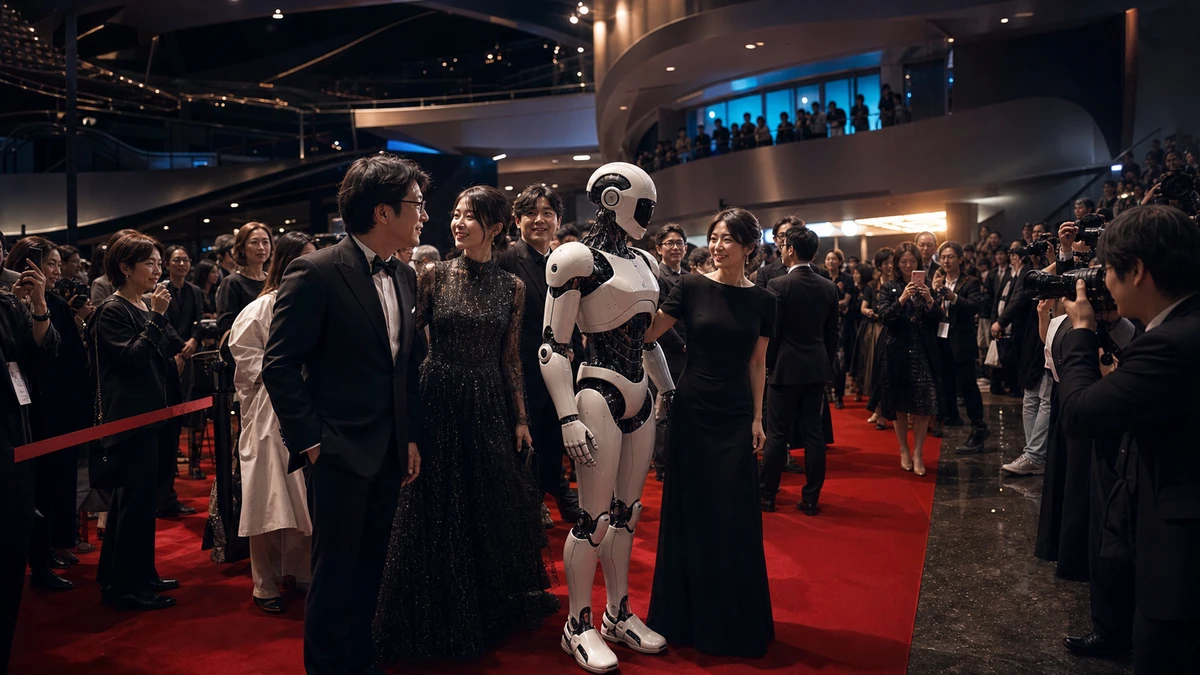
A festival milestone beyond Seoul’s spotlight
South Korea’s Bucheon International Fantastic Film Festival, better known as BIFAN, opened its 30th edition this week with the kind of symbolism that film people love: a milestone anniversary, a red-carpet ceremony, international stars and a big thematic question about the future. The opening ceremony, held at Bucheon Arts Center in the city of Bucheon just west of Seoul, marked more than the start of another film festival. It was also a reminder that South Korea’s cultural rise is not limited to K-pop stadium tours, Netflix dramas or Oscar-winning auteurs. For three decades, BIFAN has quietly built itself into one of Asia’s most durable showcases for fantasy, horror, thriller and science fiction films — the kinds of movies that often begin on the margins before moving into the mainstream.
That matters because genre cinema has become one of the clearest ways to understand the anxieties and ambitions of a rapidly changing society. In the United States, audiences are used to seeing major festivals like Sundance, Toronto and South by Southwest help shape the conversation around independent film. In South Korea, BIFAN occupies a somewhat different but comparable lane: It is a place where experimentation is welcomed, fan culture is taken seriously and filmmakers can test bold ideas about technology, fear, desire and the unknown.
The festival’s name can sound unusual to American ears. “Fantastic” here does not simply mean “great.” In the context of global film culture, it refers to works driven by imagination and genre conventions — movies that venture into horror, dystopian futures, supernatural stories, dark thrillers and other forms that push beyond straightforward realism. If Cannes is associated with prestige cinema and the Academy Awards with industry recognition, BIFAN has made its reputation by championing the films that ask stranger questions.
This year’s opening, which took place at 7 p.m. local time on July 2, arrived with a sense of accumulated history. Turning 30 is no small feat for any film festival, especially one devoted to genres that were long treated by many cultural gatekeepers as less serious than literary dramas or art-house fare. BIFAN’s endurance suggests something larger about South Korea’s film ecosystem: It has matured enough to sustain not only blockbuster entertainment and critically acclaimed dramas, but also a long-running institution devoted to cinematic risk-taking.
Why Bucheon matters in Korean film culture
For readers outside Korea, Bucheon may not carry the instant recognition of Seoul or Busan. But its location is part of the story. Bucheon sits in the greater Seoul metropolitan area, giving the festival access to the country’s largest concentration of filmmakers, actors, students and moviegoers while maintaining an identity distinct from the capital. That has allowed BIFAN to develop a personality of its own — less formal than some of the world’s elite festivals, more accessible to fans and unusually committed to genre storytelling.
In the Korean cultural landscape, regional festivals often play a larger role than outsiders might expect. They are not simply civic events staged for tourism, though that is part of the equation. They also serve as gathering points for industries that move quickly and are intensely networked. A festival like BIFAN can bring together directors, producers, critics, actors, buyers and ordinary audiences in ways that help define what kinds of films get noticed and what themes begin to circulate more widely. For a country with one of the world’s most dynamic screen industries, that kind of platform is influential.
BIFAN’s growth also reflects a broader shift in how Korean culture is consumed globally. For years, international audiences often encountered South Korean entertainment through breakout phenomena: a hit horror film, a viral pop song, a prestige drama or a single auteur director such as Bong Joon Ho or Park Chan-wook. But Korea’s cultural strength does not come only from headline-grabbing successes. It also comes from the infrastructure behind them — the schools, studios, production systems, fan communities and festivals that nurture talent over time. BIFAN is one of those institutions.
That is why the 30th edition carries a significance beyond ceremony. Anniversaries at film festivals can easily become exercises in nostalgia, celebrating past glories while avoiding hard questions about relevance. BIFAN appears to be doing the opposite. By making technology and human identity central to its opening night, the festival signaled that it wants to remain in conversation with the forces reshaping cinema itself, from artificial intelligence to digital production to new forms of audience engagement.
A theme for the streaming age: humans and humanoid robots
The most talked-about idea at this year’s opening was “the coexistence of humanoid robots and humans.” On paper, that might sound like a familiar science fiction concept, the sort of premise Hollywood has explored for decades in films from “Blade Runner” to “Ex Machina” and TV series like “Westworld.” But BIFAN’s choice to foreground it at its opening ceremony suggests something more immediate than a generic futuristic motif. It points to the way questions once confined to science fiction are now creeping into everyday life.
Humanoid robots, in simple terms, are robots designed to resemble human beings in form or movement. The phrase can evoke everything from lab-built machines and service robots to digital avatars and AI-generated personalities. In a country like South Korea, where high-speed connectivity, automation and tech adoption are woven deeply into daily life, the line between speculative fiction and lived experience can feel unusually thin. The festival’s opening theme asked audiences to consider not only what machines can do, but what happens to creativity, emotion and ethics when technological systems increasingly mirror human behavior.
That is a timely question in filmmaking itself. Around the world, the screen industry is wrestling with artificial intelligence in script development, visual effects, dubbing, translation and even digital performance. American readers will recognize the parallels with debates that surfaced during Hollywood labor disputes, when writers and actors warned that new tools could disrupt creative labor and blur the boundaries of authorship. At BIFAN, the topic was not framed as a policy white paper. It was staged as performance — a reminder that genre festivals are often better at making audiences feel a question before they are able to fully explain it.
The opening ceremony was directed by Song Seung-hwan, a veteran figure in Korea’s performance and content industries who returned to oversee the event after doing so last year. In the American context, it may help to think of him as a producer-director whose work sits at the intersection of live performance, mass entertainment and cultural presentation. That experience seems to have shaped an opening night that was less a matter of standard protocol and more a designed spectacle, using the festival stage to dramatize the tension between innovation and humanity.
That approach aligns neatly with BIFAN’s identity. Genre cinema has always been one of the best places to process fears and fantasies that society cannot yet fully articulate. Horror gives shape to dread. Science fiction turns abstract technological change into story. Thrillers expose the instability beneath ordinary life. By choosing human-robot coexistence as its opening lens, BIFAN was not necessarily predicting the future. It was reflecting a present in which the future already feels close enough to touch.
International stars underscore BIFAN’s global reach
This year’s opening ceremony also underscored how far the festival’s profile now extends beyond Korea. Special honors were awarded to Hong Kong actor Josie Ho, Chinese actor Fan Bingbing and French screen legend Isabelle Huppert. The combination of those names is striking not simply because of celebrity power, but because each represents a different strand of global cinema.
Ho received the Fantastic Icon Award, while Fan received the Global Icon Award. Huppert, one of the most acclaimed actors in world cinema, was recognized with an achievement honor for her impact on film art internationally. To American audiences, Huppert may be the most immediately familiar of the three because of her long association with the European art-house tradition. Her presence adds prestige in a recognizable festival sense. But the inclusion of Ho and Fan is just as telling. Both have been major figures in Asian popular culture, and both carry careers that cut across commercial entertainment, star image and transnational media attention.
In practical terms, these awards suggest that BIFAN is no longer operating as a niche event for local horror buffs or hardcore cinephiles alone. It has become part of a wider international network in which festivals compete and collaborate for premieres, talent and cultural relevance. For a genre festival, that is a meaningful evolution. Genre films have historically had a complicated status: wildly popular with audiences, sometimes dismissed by elite institutions and frequently more adventurous than the mainstream will admit. When BIFAN honors artists as icons rather than curiosities, it is making a statement about what kind of film culture deserves central recognition.
There is also a larger geopolitical context. Asian film industries increasingly intersect through co-productions, streaming platforms, festivals and fan communities that do not map neatly onto national borders. BIFAN’s stage, with Korean hosts and guests alongside stars from Hong Kong, mainland China and France, offered a snapshot of cinema as a global conversation rather than a strictly local celebration. At a time when audiences worldwide discover films through algorithms as often as through theaters, festivals still matter precisely because they create physical moments of encounter — a room, a screen, a red carpet, a public applause — that can cut through digital fragmentation.
For American readers used to seeing East Asian culture flattened into a single category, that distinction is worth emphasizing. The participants honored at BIFAN come from different national, industrial and artistic traditions. Their appearance together in Bucheon shows how Korean festivals can function as meeting grounds where those traditions overlap, compete and influence one another.
Korean filmmakers show up, and that says something
The attendance of notable Korean directors such as Lee Joon-ik and Kwak Kyung-taek may sound like a routine detail, but in festival politics such appearances are rarely meaningless. Their presence signaled that BIFAN is not viewed merely as a subcultural event for specialty audiences. It has standing within the broader Korean film community.
That is particularly notable because the directors named are known for different sensibilities and bodies of work, not all of them easily reduced to the “fantastic” label. Their appearance suggests that BIFAN’s influence now extends beyond a narrow genre silo. In the United States, there has long been a tension between how the industry values prestige drama and how audiences embrace horror, action or sci-fi. South Korea has its own version of that divide, even though its commercial and art-house sectors often overlap more fluidly than Hollywood’s. A festival like BIFAN helps bridge those worlds.
It does so by creating a space where genre is not treated as a guilty pleasure but as a serious mode of artistic inquiry. That has been one of the defining features of contemporary Korean cinema overall. Many of the country’s most successful filmmakers move comfortably between social critique and genre mechanics. Think of how Korean films have used serial-killer procedurals, monster stories, revenge thrillers and dystopian setups not just for entertainment, but to explore class tension, political trauma, family pressure and institutional failure. BIFAN has long been part of the ecosystem that validates those experiments.
Its 30th opening ceremony, then, can be read as a compressed image of accumulated relationships — among filmmakers, city institutions, audiences and international guests. Festivals survive because enough people continue to believe they are worth showing up for. In that sense, the red carpet is not merely decorative. It is evidence of a network holding together year after year.
More than K-pop: a wider view of the Korean Wave
For many English-speaking readers, Korean popular culture still arrives through a relatively narrow set of exports: chart-topping pop groups, streaming dramas, beauty brands and the occasional breakout film. Those phenomena are real, and their global success has transformed how South Korea is perceived abroad. But they can also obscure the depth and diversity of the country’s cultural production. BIFAN offers a useful corrective.
What the festival demonstrates is that the Korean Wave — often called “Hallyu,” the Korean term for the global spread of Korean culture — is not just a pipeline of polished finished products. It is also a process of experimentation. Festivals are where tastes are tested, emerging artists are discovered and new forms are granted legitimacy before they become commercially obvious. In that sense, BIFAN does for genre filmmaking what music festivals, indie labels and midnight screenings have often done in the American cultural landscape: It turns fringe energy into future influence.
That role may become even more important as global entertainment grows more standardized. Streaming platforms have expanded access, but they have also pushed creators toward formulas that travel easily. Genre film can resist that flattening because it depends so heavily on local fears, local myths and locally inflected styles. A Korean horror film does not simply replicate an American one. It brings different family structures, different social taboos, different historical memories and different visual codes. A festival dedicated to those differences becomes a cultural translator as much as an exhibitor.
That is one reason BIFAN is increasingly relevant to audiences far beyond Korea. A reader in Chicago, London or Sydney may not know Bucheon, but they likely understand the appeal of a festival that treats imagination as a serious cultural force. The worldwide success of Korean creators has already shown that subtitles are not the barrier industry conventional wisdom once claimed. The next phase of global interest in Korean screen culture may well depend less on discovering another singular hit and more on understanding the institutions that keep producing them.
What 30 years of BIFAN says about the future
A 30th anniversary naturally invites retrospective praise, but the more interesting question is what comes next. If this opening ceremony is any indication, BIFAN is using its milestone not to freeze itself in legacy mode, but to reassert its purpose. The festival appears to be asking: How far can Korean genre cinema expand? What happens when technology changes not only the stories on screen, but the process of making and watching them? And can a festival still create meaningful human connection in an entertainment environment dominated by platforms, data and distraction?
Those are not just Korean questions. They are global ones. Yet BIFAN’s advantage is that it approaches them through the language of genre, where difficult issues can be explored with bold imagery, suspense and emotional immediacy. That makes the festival a useful barometer of where the culture is headed. If prestige cinema often tells us how institutions want to see themselves, genre cinema often tells us what audiences are actually afraid of — and what they still hope for.
The opening night’s focus on humanoid robots and human coexistence captured that duality. It acknowledged anxiety about technological change while also suggesting curiosity, even wonder. That combination is one reason fantasy, horror and science fiction continue to thrive. They are not escapist in the simple sense. They are often the forms best equipped to confront a world that already feels surreal.
As BIFAN enters its fourth decade, its challenge will be to keep serving multiple constituencies at once: local audiences who have sustained it, Korean filmmakers who need adventurous platforms, international artists who lend it visibility and global viewers who increasingly look to Korea for cultural innovation. If it can keep balancing those roles, the festival will remain far more than a regional event. It will continue to be one of the places where the future of genre cinema is rehearsed in public.
For now, the message from Bucheon is clear. South Korea’s cultural influence is not only about perfected pop exports or awards-season triumphs. It is also about the institutions willing to take the weird, the speculative and the not-yet-classifiable seriously. Thirty years in, BIFAN is celebrating that legacy — and betting that the next big questions in film will come from the edges, where imagination is still allowed to run ahead of certainty.
Comments
Post a Comment