South Korea’s President Joins Samsung and Celltrion Leaders in Push to Turn Central Region Into a High-Tech Powerhouse
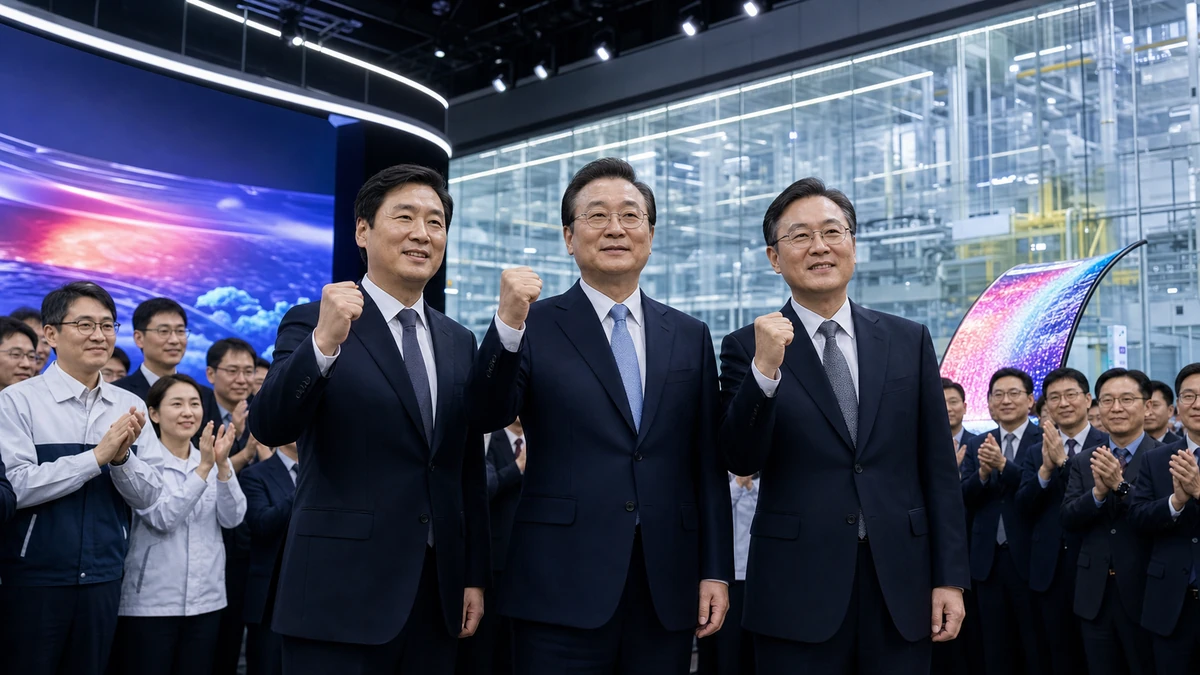
A presidential stage for South Korea’s next growth bet
South Korean President Lee Jae-myung traveled Friday to a Samsung Display complex in the city of Asan, south of Seoul, to deliver a clear economic message: The country wants its future to be built not only in the capital region, but in a broader network of advanced manufacturing hubs tied to global supply chains.
The event, held at Samsung Display’s Asan Campus 2 in South Chungcheong Province, was billed as a public briefing on a development vision for the broader Chungcheong region, an area in the country’s center that has increasingly become important to South Korea’s industrial map. According to the presidential office and South Korean media reports, Lee used the occasion to encourage business leaders who have decided on major investments in the region and to signal that his government intends to back them aggressively.
For American readers, the scene may call to mind the kind of carefully staged appearances U.S. presidents make at semiconductor plants, electric vehicle battery factories or clean-energy manufacturing sites to underscore a jobs and competitiveness agenda. But in South Korea, where major family-controlled conglomerates known as chaebol have long played an outsized role in national development, such a tableau carries added symbolic weight. When the president appears shoulder-to-shoulder with the chairman of Samsung and the chairman of biotech giant Celltrion, the moment is not just about ribbon-cutting politics. It is a public display of coordination among the state, the country’s most powerful corporations and local governments competing to attract investment.
That symbolism was on full display when Lee stood beside Samsung Electronics Chairman Lee Jae-yong and Celltrion Chairman Seo Jung-jin as the event emcee shouted, “Chungcheong, the center of global advanced industry.” The three men responded by raising their fists and shouting “fighting,” a common Korean expression of encouragement roughly equivalent to saying, “Let’s do this,” or, “We’ve got this.” In Korea, the phrase is heard everywhere from school sports days to political rallies to office celebrations. In this setting, it was meant to project resolve, optimism and shared purpose.
The message was aimed at multiple audiences at once: workers in the region, investors watching South Korea’s industrial strategy, foreign companies deciding where to place future production and a domestic audience keenly aware that the country’s long-term growth now depends on staying ahead in technologies where global competition is intensifying.
Why Asan matters beyond one factory campus
The location itself was part of the story. Samsung Display’s Asan Campus 2 is not just another corporate facility. It represents a sector that has been central to South Korea’s rise as a technology powerhouse. Displays may not get the same public attention as smartphones or artificial intelligence chips, but they are a foundational component industry. The screens used in phones, vehicles, tablets, televisions and next-generation electronics all depend on advanced display technology, and South Korean firms have spent decades battling rivals in China, Japan and elsewhere for an edge in this field.
By choosing a display plant as the venue for a national-level industrial vision event, Lee’s administration was making a statement about what kind of economy it wants to champion: one rooted in high-value manufacturing, research-intensive production and export-oriented technology ecosystems. In other words, the president was not announcing an industrial future in a lecture hall or conference room in Seoul. He was placing that vision directly inside a production zone associated with one of South Korea’s best-known global brands.
There is also a distinctly regional dimension to the visit. South Korea’s economy is often viewed from abroad through a Seoul-centric lens, much the way outsiders sometimes think of the American economy primarily through New York, Silicon Valley or Washington. But the country’s real industrial power has long been spread across specialized regional clusters. The southeastern city of Ulsan is associated with shipbuilding and autos. Suwon, south of Seoul, is deeply tied to Samsung. The city of Osong has developed a reputation in bioscience and health policy. The Chungcheong region, located in the country’s middle, has increasingly marketed itself as a strategic corridor for manufacturing, logistics, science and technology.
Asan fits that story well. It is close enough to the Seoul metropolitan area to benefit from talent and infrastructure, but far enough away to serve as part of the government’s broader push for more balanced national development. In South Korea, “balanced development” is a recurring political and economic theme, similar in some ways to debates in the United States over how to revive manufacturing in the Midwest, attract investment beyond coastal cities or spread the gains of growth to second-tier regions. The idea is not simply to move factories out of the capital. It is to create durable local ecosystems where suppliers, researchers, engineers, logistics providers and public institutions reinforce one another.
That helps explain why a presidential stop in Asan matters. It was not presented merely as a tour of a successful corporate site. It was framed as evidence that the Chungcheong region could become a central pillar in South Korea’s advanced-industry strategy.
Lee’s message to business: big investment is a national act
At the event, Lee thanked executives for what he described as bold decisions to invest on a large scale in the region. “On behalf of the people, I thank you for your bold decision,” he said, according to the presidential office. That line is important because it reveals how the administration wants the public to see corporate capital spending. These are not being cast as purely private boardroom choices. They are being framed as decisions with national consequences, affecting employment, technological capabilities and regional vitality.
That framing is deeply characteristic of South Korea’s political economy. Since the country’s postwar industrialization, governments of different ideological stripes have often viewed strategic industries as something larger than conventional private enterprise. The specific tools and rhetoric have changed over time, especially as South Korea became a mature democracy and an advanced economy. But the underlying instinct remains familiar: If a company like Samsung expands a cutting-edge operation, the benefits can ripple outward through subcontractors, engineering talent pipelines, housing markets, local universities and even service-sector businesses that grow around industrial campuses.
To be clear, the publicly available summary of the event did not include concrete numbers for new investment, precise timelines or details about future production capacity. That distinction matters. It would be inaccurate to present the occasion as a formal project launch with fully disclosed financial commitments. Instead, what can be responsibly said is that Lee publicly praised corporate leaders for major investment decisions and linked those moves to a broader national vision for advanced industry.
Even without hard figures, the political signal was unmistakable. South Korea’s government wants domestic companies to keep spending on high-end production at home, even as those same companies navigate global pressure to diversify manufacturing footprints, comply with industrial policies in the United States and Europe and respond to fierce competition from China. For Korean officials, every large investment in a place like Asan is about more than local employment. It is about holding onto technological leadership in sectors where the barriers to entry are high and the strategic stakes are rising.
That is especially true now, as the global economy puts new emphasis on resilient supply chains, domestic production of critical technologies and national competitiveness in everything from semiconductors to biotechnology. In Washington, those debates have played out through laws like the CHIPS and Science Act and the Inflation Reduction Act. In South Korea, the policy toolkit is different, but the underlying concern is similar: How do you keep advanced industry at the center of your national growth model when the world is becoming more protectionist, more fragmented and more technologically competitive?
Samsung and Celltrion on the same stage
The presence of Lee Jae-yong and Seo Jung-jin at the same event broadened its significance beyond one industry. Samsung, of course, is shorthand for the modern South Korean economy itself. The company’s reach extends across consumer electronics, semiconductors, displays and a much wider corporate empire. Celltrion, while less familiar to many Americans, is one of South Korea’s most prominent biotech companies and is best known for its work in biopharmaceuticals and biosimilars, which are near-copy versions of complex biologic drugs.
Putting those two figures beside the president suggested that the administration wants to define South Korea’s next industrial chapter not narrowly, but expansively. This is not only about preserving a lead in legacy strengths like electronics manufacturing. It is also about presenting a wider portfolio that includes life sciences and other research-heavy industries. In the American context, it would be something like featuring the heads of a top chipmaker and a major biotech company at the same White House event to underline that the country’s strategic industries are diversifying, not shrinking.
That matters because South Korea’s export model has been evolving. For decades, the country’s global image was tied to ships, steel, autos, appliances and memory chips. Those sectors remain important, but South Korean policymakers and business leaders have spent years trying to move further into areas that promise higher margins, deeper intellectual property and stronger insulation from commodity-style competition. Biotech fits that ambition. So does advanced display technology, which sits at the high end of precision manufacturing and materials science.
The event did not provide detailed policy announcements on those sectors. But the optics alone carried a message to domestic and foreign audiences alike: South Korea sees its industrial future as a combination of advanced manufacturing and science-based innovation, and it wants regional hubs like Chungcheong to be key staging grounds for that effort.
The cultural and political meaning of a factory-floor vision speech
Lee’s visit also reflected a style of economic politics that can be hard to fully appreciate from outside Korea. Public events like this often combine ceremonial symbolism, regional development messaging and practical signaling to investors. When the president tours a product and technology exhibition prepared by Samsung before the main event, as the presidential office said Lee did, that is not merely a photo opportunity. It is a way of showing that industrial policy must be anchored in actual technologies, production realities and corporate strategy.
In the Korean system, where presidents have historically taken an active interest in strategic sectors, these visits can serve as a form of economic communication. They tell business leaders that the government is paying attention. They tell local officials that their region has national backing. And they tell voters that the administration is engaged in the concrete mechanics of economic growth, not just abstract promises.
It is also notable that senior Samsung executives joined the president during the exhibition tour. The available summary named Vice Chairman Jun Young-hyun and President Lee Cheong among those present. Although no detailed readout of their conversations or the specific technologies shown was released, the fact that top management participated suggests the company regarded the event as more than routine protocol. This was an opportunity to demonstrate capability, confidence and alignment with a national growth agenda.
That matters in a country where corporate investment decisions can take on broad public meaning. South Koreans often watch the moves of major conglomerates not just as business news but as a barometer of national momentum. A new investment can signal confidence in the domestic economy. A scaled-back plan can stir anxiety about jobs, competitiveness or capital flight. Against that backdrop, Lee’s praise for “bold” corporate investment was both an expression of gratitude and a subtle appeal for continued domestic commitment.
The slogan used at the event, “Chungcheong, the center of global advanced industry,” should be read in that light. It was aspirational, not a declaration of completed fact. The region has not suddenly become the uncontested global capital of advanced industry. Rather, the slogan was a way of publicly staking a claim: this is where South Korea intends to build more of its future.
A regional strategy with global implications
For readers outside Korea, perhaps the most interesting aspect of the Asan event is the way it links regional development to global competition. South Korea is a relatively small country geographically, but it has long punched above its weight by organizing production, talent and capital into highly efficient industrial clusters. The question now is whether that model can keep delivering in an era defined by supply-chain disruption, U.S.-China rivalry, demographic pressure and slower growth in many mature economies.
The Chungcheong region has several advantages that make it attractive for this next phase. It sits in a central part of the country, offering transportation and logistics benefits. It has industrial land, established manufacturing infrastructure and access to a broader network of suppliers and research institutions. And because it is outside the Seoul core, it fits neatly into long-running political efforts to reduce overconcentration in the capital area, where housing costs, congestion and inequality have all become major public concerns.
In that sense, the event was about more than economics narrowly defined. It was also about the geography of opportunity. If advanced industries can deepen their roots in places like Asan, the government can argue that high-quality jobs, investment and innovation do not have to remain concentrated near Seoul. That is a politically appealing argument in a country where regional disparities have long shaped elections, public policy and social mobility.
Still, there are limits to what one event can accomplish. The public summary did not specify what forms of government support might follow, whether through tax incentives, infrastructure investment, regulatory changes, workforce development or some combination of those tools. Nor did it provide measurable benchmarks by which the success of the Chungcheong vision could be judged. Those unanswered questions are significant because industrial policy ultimately depends not on slogans but on execution: permitting timelines, electricity supply, transport links, skilled labor, research support and the confidence of private investors.
Yet public symbolism has its own value, especially in industries where long-term investment depends heavily on expectations. If companies believe the government is committed to a region, that can help shape planning decisions. If local universities believe demand for engineers and researchers will rise, they may adapt programs accordingly. If suppliers believe anchor companies are staying and expanding, they are more likely to deepen their own presence. In that sense, a presidential appearance can be part of the machinery that helps turn a regional cluster from a policy aspiration into an economic reality.
What the event says about South Korea’s economic direction
The gathering in Asan ultimately offered a compact portrait of where South Korea sees its strengths and anxieties. Its strengths are clear: globally competitive manufacturing, world-class technology firms and a proven ability to build industrial ecosystems that connect local production to international markets. Its anxieties are just as visible: intensifying competition, the need to keep advanced investment at home and the challenge of ensuring that growth is not confined to one overburdened metropolitan area.
For American audiences, the underlying story is a familiar one dressed in distinct Korean form. It is about a government trying to secure its technological future. It is about major corporations being asked, publicly and patriotically, to help shape that future. And it is about a region outside the capital making the case that it deserves to be one of the places where the next chapter of economic growth gets written.
Lee’s appearance at Samsung Display did not, by itself, settle the practical questions that determine whether grand industrial visions succeed. It did not lay out a complete policy blueprint, reveal the full scale of corporate commitments or prove that the Chungcheong region is destined to dominate advanced industry. What it did do was show the current direction of travel. South Korea wants the world to know that its growth strategy still runs through high technology, still depends on close interaction between government and major corporations and increasingly aims to elevate regional industrial hubs as engines of national strength.
That is the signal the country sent from Asan: the factory floor remains a political stage, advanced manufacturing remains a source of national confidence and the contest for the future will be fought not only in boardrooms and laboratories, but in regional clusters that tie local investment to global competition.
Comments
Post a Comment