South Korea’s spy agency pushes back on U.S. report over Coupang data leak, widening a dispute beyond corporate cybersecurity
A Korean data leak dispute becomes an international political issue
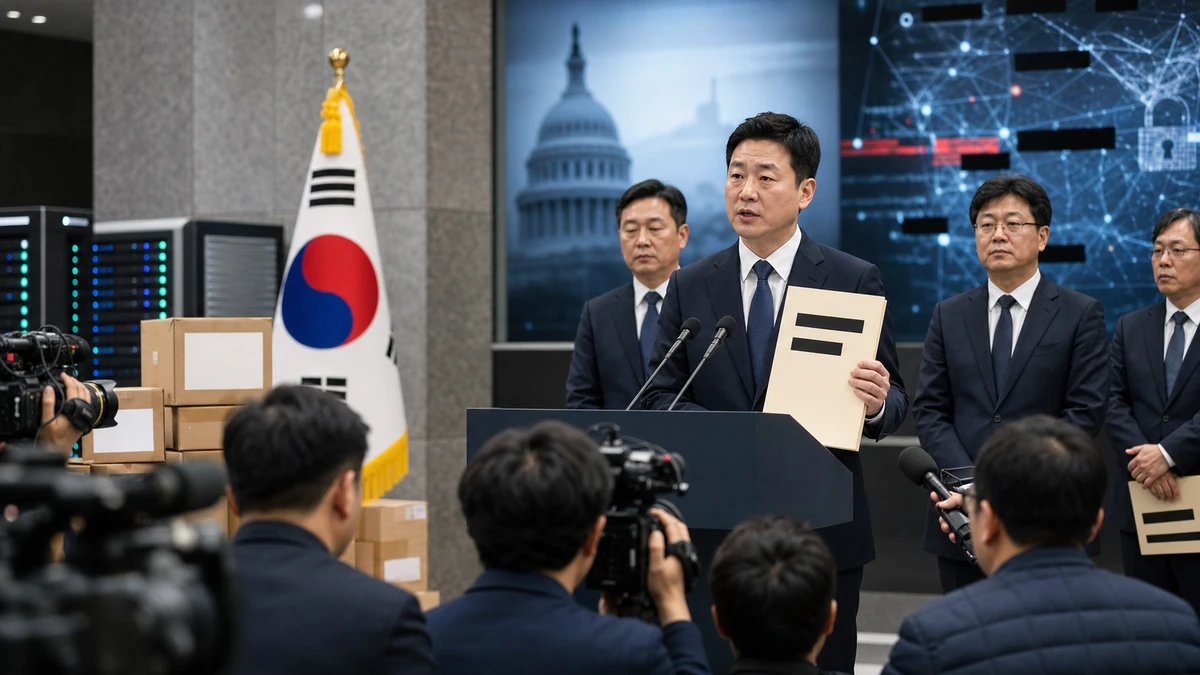
South Korea’s main intelligence agency is publicly challenging how a recent U.S. congressional report described its role in a personal data leak involving Coupang, the country’s dominant e-commerce company, turning what might otherwise have remained a corporate cybersecurity dispute into a broader argument about national security, government power and international trust.
The National Intelligence Service, or NIS, said July 2 that claims attributed to Coupang in the U.S. report — particularly the suggestion that the agency directed or ordered the company through a series of steps including obtaining information technology equipment — were “clearly false.” The unusually direct statement is notable in South Korea, where the intelligence service does not often step into public view to rebut details in a private-sector data incident so explicitly.
For American readers, the closest comparison may be the kind of tension that emerges in the United States when a major technology company suffers a breach and federal agencies such as the FBI, Department of Homeland Security or intelligence officials become involved because the incident appears to have foreign ties or broader security implications. The core question is familiar on both sides of the Pacific: At what point does a company’s internal security failure stop being merely a corporate problem and become a matter of national security?
That question now sits at the center of a cross-border disagreement involving one of South Korea’s best-known tech platforms, its most powerful intelligence agency and a report produced by the U.S. Congress. In its statement, the NIS did not announce new investigative findings or a new policy response. Instead, it focused on the factual record, arguing that the report mischaracterized what happened and overstated the agency’s influence over Coupang’s response.
The dispute matters not only because of what it says about one leak, but because of what it reveals about a digital economy in which private companies hold enormous amounts of sensitive information and governments increasingly view cyber incidents through a national security lens. South Korea, one of the world’s most connected societies, is an especially important case study.
Why Coupang matters in South Korea
To understand why this case has drawn so much scrutiny, it helps to understand Coupang’s place in Korean life. Often described as South Korea’s answer to Amazon, Coupang is far more than a retailer. Its reach into daily routines — from next-day and even dawn delivery to payments, food delivery and other digital services — makes it one of the country’s central consumer platforms. In a highly wired society where smartphones, digital payments and app-based commerce are deeply embedded in everyday life, the company holds a vast amount of customer information.
That gives any breach involving Coupang importance beyond a normal corporate embarrassment. In South Korea, as in the United States, personal data can include not just names and contact details, but purchase histories, service usage patterns and other information that helps create a detailed map of a person’s habits and identity. Even when such data is not classified in the traditional national security sense, a leak at scale can become highly sensitive, especially if foreign actors may be involved.
South Korea’s economy is also unusually concentrated around large, nationally significant firms. In Korean, these giant corporate groups are often called “chaebol,” a term Americans may have heard in reference to conglomerates such as Samsung, Hyundai or LG. Coupang is not a traditional chaebol in the old family-controlled manufacturing mold, but it occupies a similarly outsized place in the digital marketplace. When a company that central experiences a data security incident, the ripple effects quickly move beyond ordinary customer service concerns.
That helps explain why the NIS is framing the matter as something larger than a private company’s operational mistake. According to the agency, it viewed the possibility of a large-scale information leak involving foreigners as a national security threat and acted under its legal duties to collect relevant information and help prevent the damage from spreading. In other words, the NIS is arguing that its presence was justified by the scale and potential implications of the incident, not by any desire to run the company’s response.
What the NIS says happened — and what it denies
The intelligence agency’s public explanation hinges on an important distinction: consultation versus command. The NIS said it engaged in what it described as working-level consultations with Coupang to share necessary information after recognizing the incident as a possible security threat tied to large-scale data leakage by foreigners. It cited Article 4 of the National Intelligence Service Act as the legal basis for that involvement.
But the agency sharply rejected the suggestion that it instructed or ordered the company to take steps such as securing IT equipment, or that it broadly directed the response process. On that point, it was blunt, calling such claims “clearly false.” It also said that materials it received from Coupang were not the product of any coercive new demand, but rather were part of information the company had already submitted to police.
That distinction is not semantic. In democratic societies, the difference between a government agency asking for coordination in response to a security threat and ordering a private company to act can carry major legal and political consequences. In the United States, it would be the difference between a federal agency advising cooperation during a cyber emergency and effectively taking control over aspects of a private company’s internal decisions. One can be seen as prudent public protection; the other may raise alarms about overreach, due process and accountability.
The NIS also disputed another point reportedly attributed to Coupang: that the intelligence service proposed the hiring of a specific domestic cybersecurity company. According to the NIS, Coupang first complained that it was receiving slow responses from a U.S. firm’s analysis and asked for information on domestic options. The agency said it merely shared general information in response to that request and did not designate or recommend a particular company for employment.
Again, the distinction matters. In cyber incident response, who selects outside investigators can affect independence, credibility and later judgments about responsibility. If a government agency is seen as steering a company toward a particular vendor, critics may ask whether it influenced not just the response but the narrative that followed. The NIS appears acutely aware of that risk and is trying to draw a bright line between providing information and making decisions on the company’s behalf.
Why the public rebuttal is unusual in South Korea
The NIS is one of the most powerful and historically sensitive institutions in South Korea. It is the country’s premier intelligence body, responsible for national security-related information and long associated with the high-stakes realities of the Korean Peninsula, where North Korea remains a constant threat. For decades, Korean intelligence agencies have carried political baggage, and questions about oversight and proper limits have repeatedly surfaced in domestic debates.
That history helps explain why this public rebuttal carries weight. When an intelligence service that typically operates behind the scenes issues a detailed statement pushing back on wording in a U.S. congressional report, it is signaling that the stakes are not merely reputational for one company. It is suggesting that the episode touches on how South Korea is perceived internationally, how its institutions exercise power, and whether foreign policymakers are receiving an accurate picture of events.
In South Korea, where cyber threats are not abstract policy scenarios but part of a long-running national security environment, the boundary between public safety and intelligence activity can be especially contested. The country has lived for years with concerns about espionage, hacking and cross-border information threats. As a result, government agencies may be quicker than many Americans would expect to treat a data incident as part of a larger security picture.
Still, South Korea is also a democracy with vigorous public debate, and intelligence involvement in civilian matters can quickly become politically charged. That is one reason the NIS appears intent on emphasizing process and legal basis. By saying it acted under statutory authority and limited itself to consultation and information-sharing, the agency is trying to reassure domestic and international audiences that it did not cross the line into improper direction of a private company.
The significance of a U.S. congressional report
The involvement of a U.S. congressional report raises the temperature considerably. Once a dispute like this is captured in a Washington document, it is no longer just a Korean corporate matter. It becomes part of the official paper trail that shapes how American lawmakers, regulators, analysts and companies understand a close U.S. ally’s digital governance and security practices.
That matters because congressional reports, even when they are not binding, often influence the policy conversation. They can frame future hearings, inform agency attention and shape media coverage. For a South Korean institution, being described in a way it sees as inaccurate inside such a document is not just an embarrassment. It can have diplomatic, reputational and commercial consequences.
South Korea and the United States are deeply intertwined on security and technology. They are treaty allies, major trading partners and increasingly important collaborators in areas ranging from semiconductors to supply chains and digital infrastructure. Trust matters in all of those areas. If a U.S. report suggests that a Korean intelligence agency exercised stronger control over a private company’s handling of a data leak than the agency says it did, that can feed concerns about state influence, transparency and corporate autonomy.
At the same time, American readers should be careful not to overread the dispute. Based on the facts available in the Korean account, the NIS has rebutted how certain claims were characterized, but there has been no announcement here of a new legal finding, a policy overhaul or a formal resolution of the underlying disagreement. The argument at this stage is about interpretation, description and factual precision — not yet about a settled institutional judgment.
Still, in international politics, wording often matters almost as much as action. Digital trust is built not only on technical capability, but on whether governments and companies appear candid, restrained and accountable when things go wrong. That is why this battle over language has become so consequential.
When a privacy breach becomes a national security issue
One of the most important themes in this case is the way personal data has moved from the realm of consumer protection into the realm of strategic risk. In the United States, Americans have grown used to data breaches being treated as stories about credit monitoring, class-action lawsuits or corporate negligence. But governments around the world increasingly see large stores of personal data as security assets — or vulnerabilities.
That shift is not hard to understand. A major platform’s data can reveal identities, locations, routines, networks of association and patterns of behavior. On its own, a single purchase record may seem mundane. At scale, datasets can become a powerful tool for profiling, blackmail, influence operations or intelligence mapping. If foreign actors are involved, a breach can begin to look less like a customer service disaster and more like a strategic threat.
The NIS is leaning into that logic. Its statement says it viewed the possibility of large-scale information leakage by foreigners as a national security threat. That framing does not prove the full extent of the harm, and the Korean summary does not provide specifics about the total scale of damage. But it does show how the agency wants the public to understand its role: not as micromanaging a retailer, but as responding to a security scenario in which private data could have broader national implications.
That framing will sound familiar to many in Washington. U.S. debates over TikTok, Chinese access to personal data, ransomware attacks and critical infrastructure hacks all reflect the same basic idea: that massive pools of civilian data can no longer be treated as separate from national security. South Korea, a country with some of the world’s fastest digital adoption and one of its densest online consumer ecosystems, is confronting that reality in especially vivid form.
The harder question is how to preserve boundaries while responding quickly. Governments may need rapid access to information during a cyber emergency. But if those relationships are not transparent, well documented and properly limited, the same response can later look like undue state interference. That tension is at the heart of the current dispute.
The gray zone between corporate responsibility and state intervention
This episode underscores a recurring problem in modern cybersecurity: incidents often require cooperation among companies, police, regulators, intelligence agencies and outside security firms, yet the responsibilities of each party can remain frustratingly unclear. The more serious the incident, the more crowded the field becomes. And once multiple institutions are involved, competing narratives are almost inevitable.
From the company side, a firm may feel pressure from all directions at once — from customers demanding answers, law enforcement seeking evidence, security vendors offering analysis and government agencies warning of wider threats. What a company experiences as forceful official pressure may be described by the state as ordinary emergency coordination. Without a transparent record, those perceptions can diverge sharply.
From the government side, agencies often argue that they must move fast, particularly when foreign involvement is suspected. Waiting for perfect procedural clarity can mean losing time during a rapidly unfolding incident. But acting quickly can create exactly the kind of ambiguity that later fuels distrust. Who asked for what? Who suggested a vendor? Who initiated a transfer of information? Who had legal authority, and over which part of the process?
The NIS statement appears designed to answer those questions preemptively. It says there was consultation, not command. It says information was shared, not forcibly extracted. It says general guidance was provided only after the company asked for help, not as a directive to hire a specific local firm. In effect, the intelligence agency is trying to establish a clean administrative boundary around its conduct.
Whether that explanation satisfies critics is another matter. In both South Korea and the United States, public confidence in cyber incident response depends heavily on process. People want to know not only that the threat was addressed, but that officials stayed within proper limits and that companies did not evade responsibility by shifting blame to government pressure.
What this says about South Korea’s digital politics
For outside readers, this dispute is also a window into the way politics is changing in South Korea. The country’s public life is often understood abroad through familiar headlines about North Korea, elections, K-pop and major industrial giants. But the political agenda is increasingly shaped by questions that would be recognizable in Silicon Valley or Capitol Hill: data governance, platform power, cybersecurity, surveillance, cross-border information flows and institutional accountability.
South Korea is one of the most digitally sophisticated societies in the world, with high broadband penetration, intense e-commerce competition and a population accustomed to conducting daily life through apps. That makes it fertile ground for innovation — and especially vulnerable to the kinds of governance conflicts that emerge when a platform economy collides with a national security state.
The Coupang dispute brings all of those themes together. A large platform suffered a data incident. An intelligence agency said the circumstances raised national security concerns. A U.S. congressional report recorded claims about what happened. And now the Korean government agency is publicly contesting that account line by line. This is not just a story about one leak; it is a story about who gets to define the facts when data, power and international oversight intersect.
It is also a reminder that digital politics does not stop at national borders. A breach in Seoul can land in Washington. A company’s explanation can be cited by foreign lawmakers. A Korean intelligence agency can feel compelled to answer not only domestic critics but an international audience. That is the new reality of the data age: local incidents can become global governance disputes almost overnight.
What remains unresolved
At this point, the available facts support several clear conclusions and leave several important questions unanswered. The clearest fact is that the NIS has formally denied claims that it directed or ordered Coupang through the response process, including the securing of IT equipment. It has also denied proposing the hiring of a specific domestic cybersecurity company, saying it shared only general information after the company requested help.
Also clear is the agency’s legal and political framing. It says it acted under the NIS Act because it viewed possible large-scale information leakage involving foreigners as a national security threat and sought to prevent the damage from spreading through consultation and information gathering. The agency’s statement is, in essence, an attempt to define the limits of legitimate state involvement in a private-sector cyber emergency.
What remains unresolved is the broader factual dispute reflected in the U.S. report and in Coupang’s apparent characterization of events. The Korean summary does not indicate that a new independent adjudication has settled the disagreement. Nor does it offer fresh detail on the ultimate scale of the leak, the specific technical failures involved or any major new policy reforms resulting from the controversy.
That means the significance of this moment lies less in a final verdict than in the debate it exposes. As data breaches become more geopolitically charged, governments and corporations will need clearer rules, cleaner documentation and more transparent communication about who did what and why. Otherwise, the aftermath of a cyber incident can become nearly as damaging as the incident itself.
For American readers, the takeaway is straightforward: South Korea is grappling with the same fundamental digital-age tensions confronting the United States and other advanced democracies. How much state involvement is appropriate when private data becomes a security concern? How should that involvement be described? And who gets believed when the official record is contested? In Seoul, those questions are now playing out in public — and in a way that Washington cannot ignore.
Comments
Post a Comment