South Korea’s Ruling Party Signals a Faster Legislative Push as Lee Government Enters Its Second Year
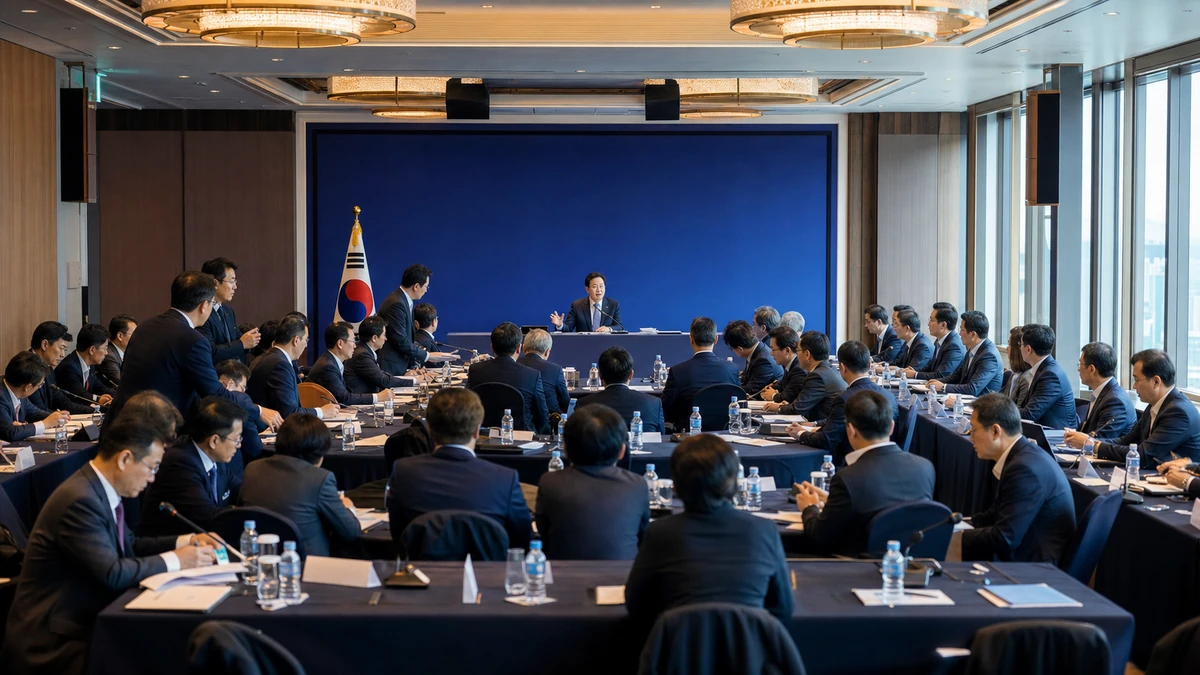
A party workshop with implications far beyond one hotel ballroom
South Korea’s ruling Democratic Party used a closed-door lawmaker workshop in Seoul this week to send a public message: The Lee Jae-myung administration wants its second year in office to be defined less by slogans and more by execution.
On its face, the gathering might have looked routine — a party seminar, the kind of strategy session politicians everywhere hold before a busy legislative stretch. But in South Korea’s highly disciplined party system, these events can serve as something closer to a governing roadmap. When lawmakers from the governing party meet to align priorities, discuss committee tactics and repeat the language of unity, it is often a sign that the administration is preparing to turn campaign promises and policy concepts into actual law, budget decisions and institutional change.
That is why political attention in Seoul has focused not just on the fact that the Democratic Party convened its lawmakers Thursday at the Dragon City hotel in Yongsan, but on what the workshop revealed about the coming months in the National Assembly, South Korea’s parliament. According to South Korean media reports, party leaders used the meeting to discuss the Lee government’s core policy agenda for its second year and to map out strategy for the second half of the 22nd National Assembly.
For American readers, the closest parallel may be a combined retreat of congressional leaders, committee chairs and White House allies at a moment when a president’s governing coalition decides it needs to show results. But the South Korean context matters. Unlike the United States, where divided government and weaker party discipline often slow legislative coordination, South Korea’s parliamentary politics can move more quickly when the governing party has a substantial bloc of seats and a strong incentive to act in concert with the executive branch.
That appears to be the message the Democratic Party wanted to project. The workshop’s central themes were “one team” and a “working National Assembly” — phrases that in Korean politics carry a practical meaning. They suggest not only unity for its own sake, but a plan to reduce friction between the party, the government and the presidential office so legislation can move faster through committees, floor votes and budget negotiations.
In other words, this was not merely political theater. It was a signal that the ruling camp wants the second half of the current Assembly to function as the implementation phase of the Lee administration.
Why ‘one team’ matters in South Korean politics
One of the clearest takeaways from the workshop was the governing party’s insistence on message discipline and institutional alignment. Acting party leader and floor leader Han Byung-do said the gathering was a chance for the party, the government and the presidential office to act as one and reaffirm the responsibility of a governing party while completing legislation tied to people’s livelihoods by the end of the year, according to reports.
That language may sound familiar to anyone who follows politics in Washington, where administrations routinely call for their allies on Capitol Hill to “get on the same page.” But the Korean phrase often rendered as “party-government-presidential office” cooperation carries its own political weight. It refers to a coordinated governing triangle: the ruling party in the legislature, cabinet ministries and the presidential office, historically known as Cheong Wa Dae, or the Blue House, even though the current presidency has worked from Yongsan. In Korean political shorthand, the phrase suggests a tightly linked governing apparatus rather than separate centers of power.
The Democratic Party’s emphasis on that model matters for two reasons. First, it is meant to reassure supporters and markets that the Lee administration can move from political transition to policy execution. South Korea’s government faces pressures familiar to many advanced economies: slowing growth concerns, industrial competition, household cost anxieties and demands for institutional reform. A government that cannot turn priorities into legislation risks looking stalled.
Second, the unity message is also aimed inward. South Korean parties, like American ones, are rarely free from factional competition. Internal rivalries can intensify ahead of leadership contests or party conventions, and the Democratic Party has not been immune. Repeating the phrase “one team” in that environment is a way of saying that internal maneuvering should not interfere with governing.
That does not mean the party is free of disagreement, nor does it mean every bill will move easily. But it does tell lawmakers, bureaucrats and interest groups what the leadership wants the public to believe: that the ruling side intends to act with enough cohesion to push its priorities through the Assembly’s procedural hurdles.
For foreign investors, diplomats and policy watchers, this kind of choreography can be more consequential than it appears. In South Korea, the legislative calendar is not just a domestic political story. It affects how quickly the country can implement industrial policy, revise criminal justice rules, fund large-scale state projects and respond to social concerns that matter to voters.
The meaning of a ‘working National Assembly’
The second major phrase emerging from the workshop was “a working National Assembly.” In Korean politics, that expression is both a slogan and a critique. It reflects public frustration with a legislature often accused of spending too much time on partisan fights and too little on passing bills that affect daily life.
When ruling party officials say they want a “working” parliament, they are trying to claim the political high ground of competence. The implication is straightforward: less gridlock, fewer theatrical clashes and more measurable results. In practice, that usually means moving bills through standing committees with greater urgency, controlling the legislative agenda more tightly and placing pressure on lawmakers to show output.
That framing can be politically potent. South Korean voters, much like American voters, often say they are tired of dysfunction and want government to deliver concrete improvements. But the phrase also creates expectations. If the Democratic Party promises a parliament focused on work rather than conflict, it will eventually have to prove that the work produces something voters can feel — lower burdens, more efficient services, stronger economic prospects or cleaner institutions.
Here, too, the comparison with Washington is useful but imperfect. In the United States, “getting things done” often means building bipartisan coalitions or using narrow budget rules to skirt obstruction. In South Korea, where party discipline is generally stronger and committee structures play a central role, the pressure point is often not whether the governing party can get its own members in line, but whether it can balance speed with legitimacy.
That balance will matter in the second half of the Assembly. Rushing legislation can create backlash if the opposition, legal community or civic groups argue that major changes were not adequately vetted. Moving too slowly, on the other hand, risks undercutting the very competence narrative the ruling party is trying to build.
According to party statements relayed by South Korean media, lawmakers also discussed detailed legislative tasks and strategy. The significance of that is less about any single bill already being decided than about a broader governing posture taking shape: the Democratic Party is trying to present the next stretch of parliamentary work as a disciplined campaign for policy delivery, not an open-ended debate about first principles.
Criminal justice reform returns to the foreground
Among the most sensitive items reportedly discussed at the workshop was a follow-up issue tied to South Korea’s long-running debate over prosecutorial reform: whether to eliminate prosecutors’ supplemental investigation authority and how to revise criminal procedure rules to strengthen the effectiveness of police investigations.
For readers outside Korea, this may sound technical. It is not. The dispute goes to the heart of how criminal cases are investigated, who controls evidence-gathering and what safeguards shape the balance between state power and individual rights.
South Korea has spent years wrestling with the role of prosecutors, who historically held unusually broad influence over both investigations and indictments. Reformers have argued that too much concentrated power in the prosecution service can invite politicization and weaken accountability. Critics of rapid reform, meanwhile, warn that stripping prosecutors of authority too aggressively could create gaps in case quality, oversight and public trust.
The specific issue discussed at the workshop — supplemental investigation authority — concerns whether prosecutors can direct or conduct additional investigative steps after receiving a case. Supporters of curbing that power generally argue that if police are to take primary responsibility for investigations, then the system should reflect that clearly rather than preserving overlapping authority that could dilute accountability. Opponents argue that prosecutors need some residual power to ensure cases are complete, coherent and legally sound before indictment decisions are made.
This is not unlike debates in the United States over the power of prosecutors, police discretion and institutional checks within the criminal justice system, though the legal structures are different. In both countries, the underlying question is similar: How do you divide authority among law enforcement institutions without sacrificing fairness, efficiency or public confidence?
The fact that Democratic Party lawmakers on the Assembly’s Legislation and Judiciary Committee reportedly held a breakout discussion on this issue is significant. That committee is one of the most influential in South Korea’s legislature, especially on matters involving legal design, court-related issues and justice administration. If party members there are coordinating around changes to the Criminal Procedure Act, it suggests judicial and prosecutorial reform may remain a major legislative front in the months ahead.
Still, caution is warranted. What has been reported so far points to discussion and strategic alignment, not a finalized law or an enacted reform package. In a country where criminal justice changes can quickly become politically charged, the details of any bill — and the pace at which it moves — will matter enormously.
Livelihood bills, industrial policy and the politics of speed
The Democratic Party’s workshop was not focused only on legal reform. Reports also indicate that lawmakers discussed so-called livelihood legislation and ways to support the swift progress of government-backed “mega projects.” Those two categories may sound disconnected, but politically they are meant to reinforce one another.
In Korean political language, “livelihood” bills generally refer to measures presented as directly affecting everyday life — the cost of living, household security, public services, labor conditions, social welfare or small-business burdens. Politicians of all stripes use the term because it signals practical governance rather than ideological abstraction. It is the Korean equivalent of promising kitchen-table results.
“Mega projects,” by contrast, are large-scale national initiatives tied to growth, infrastructure, technology or strategic industry. In the current global economy, that can include initiatives linked to semiconductors, advanced manufacturing, energy transition or regional development. South Korea, like the United States, has embraced more explicit industrial policy in recent years as competition with China intensifies, supply chains are rethought and governments seek to secure domestic advantages in critical technologies.
The political logic of pairing these two agendas is clear. Livelihood bills can offer shorter-term, voter-visible benefits. Mega projects promise long-term national competitiveness and economic momentum. Put together, they allow a governing party to argue that it is addressing both immediate public anxieties and the country’s future position in high-stakes sectors.
That may be especially important for the Lee administration as it enters its second year. A first year in office often centers on appointments, agenda-setting and symbolic breaks from the previous government. A second year is when presidents and prime ministers increasingly face the harder question: What, exactly, has changed in ways ordinary people can notice?
In this respect, South Korea’s current politics echo a familiar pattern in the United States. Administrations often try to connect big industrial ambitions — semiconductor manufacturing, infrastructure build-outs, green energy supply chains — to middle-class concerns about jobs, wages and regional opportunity. The details differ, but the political challenge is the same: making large state strategy feel relevant to daily life.
If the Democratic Party succeeds in combining those themes legislatively, it could give the Lee government a stronger claim to policy momentum. If it overreaches or appears to prioritize speed over scrutiny, it could hand critics an argument that the ruling camp is using its parliamentary advantage to force through an agenda without sufficient debate.
Internal unity may be as important as opposition tactics
No assessment of this workshop would be complete without considering the intra-party dimension. South Korean media have noted that the event came as internal tensions were rising ahead of a party convention. That timing matters because governing parties often face their greatest vulnerabilities not only from the opposition, but from their own competing factions, future leadership hopefuls and ideological camps.
For the Democratic Party, then, the workshop served at least two purposes at once. Publicly, it was about legislative strategy and support for the administration. Internally, it was about discipline — a reminder that whatever rivalries may be playing out behind the scenes, the party leadership wants lawmakers to project unity at a consequential moment in the governing cycle.
That is another dynamic American readers will recognize. A party can control formal levers of power and still struggle if internal camps pull in different directions. Presidents in Washington frequently discover that managing allies can be harder than attacking opponents. The same basic truth applies in Seoul.
The difference is that in South Korea, where political branding often hinges on whether a government appears decisive or unstable, visible disunity can be especially costly. It can affect public confidence, media framing and even perceptions abroad about whether the administration has enough control to follow through on economic or institutional promises.
That helps explain why the rhetoric of unity was so prominent at the workshop. Repeating “one team” is not simply motivational language. It is an attempt to prevent domestic party competition from being interpreted as governing weakness.
Whether that effort works will depend on what happens next in the Assembly. If lawmakers stay aligned on timelines, committee strategy and message discipline, the workshop may later be seen as the moment the ruling camp shifted decisively into implementation mode. If disputes emerge over priorities, sequencing or politically risky reforms, the workshop could look more like an aspirational reset than a true turning point.
Why this matters beyond South Korea
For international readers, a ruling-party workshop in Seoul may seem niche compared with summit diplomacy, North Korea tensions or trade battles. But in many ways, parliamentary strategy is where those larger stories become real.
South Korea is not just a pop-culture powerhouse or a frontline U.S. ally. It is also one of the world’s most important technology economies, a major exporter, a critical player in semiconductor supply chains and a country whose domestic governance choices can shape everything from industrial investment to legal predictability. When the ruling party signals how it plans to run parliament, it is also signaling how quickly the country may be able to translate executive priorities into institutional reality.
That is particularly relevant at a moment when governments across the world are being judged on capacity — the ability not merely to announce goals, but to execute them. South Korea’s political system is often praised for speed and efficiency, especially when compared with the chronic stalemate that can define U.S. governance. But speed has its own risks. Fast-moving legislation can sharpen opposition, deepen concerns about due process and create implementation problems if details are not fully worked through.
That tension sits at the center of what the Democratic Party appears to be attempting. The workshop suggested a ruling party eager to use the second half of the Assembly to accelerate legislation tied to the Lee administration’s agenda, from livelihood issues to major national projects to politically sensitive criminal justice reform. It also showed a party aware that to do so successfully, it must keep its own ranks aligned and persuade the public that “a working National Assembly” means results, not just rhetoric.
The next test will not be the language of party gatherings, but the content and durability of the bills that follow. Can the governing camp move quickly without sacrificing legislative quality? Can it push controversial justice reforms without intensifying fears of institutional imbalance? Can it deliver both near-term relief and long-term economic strategy in a way ordinary voters feel?
Those are the questions now hanging over South Korea’s parliament. And they are why what happened in a Seoul hotel this week matters far more than the word “workshop” might suggest.
Comments
Post a Comment