South Korea’s Summer Rains Bring a Familiar Vacation Dilemma: How to Enjoy Gangwon’s Mountains and Beaches When Lightning Is Part of the Forecast
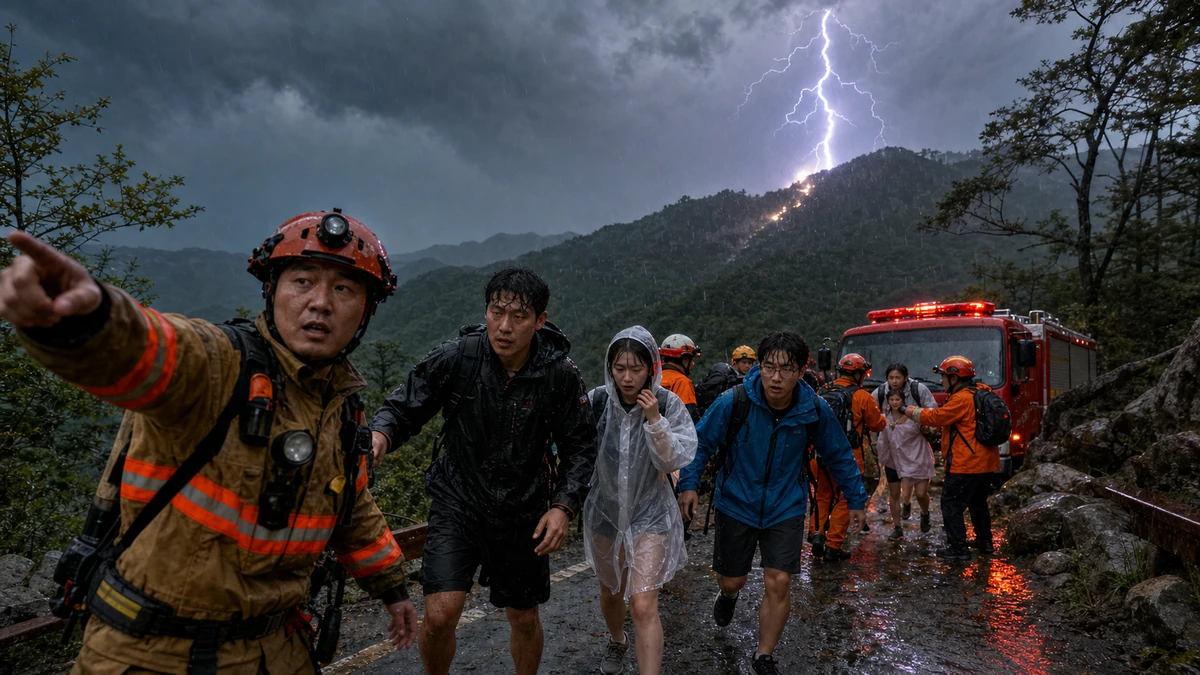
A summer getaway warning from one of South Korea’s busiest outdoor regions
As South Korea enters the heart of its summer rainy season, fire officials in Gangwon Province are urging residents and travelers to take lightning risk more seriously — a reminder that in one of the country’s most popular warm-weather destinations, a beautiful day outdoors can change quickly.
The advisory, issued Friday by the Gangwon State Fire Headquarters, may sound at first like routine seasonal guidance. But in the South Korean context, it carries broader weight. Gangwon, a mountainous province along the country’s northeastern coast, is one of the places many Koreans head when they want a break from dense city life. It offers a mix that would be familiar to American travelers: rugged hiking country, rivers and valleys, beach towns, camping areas and surf spots, all within a region that sees heavy summer tourism.
That means a warning about lightning is not just a weather footnote. It is a public safety message aimed at the rhythms of everyday life in Korea during the summer, when school breaks, weekend travel and outdoor recreation all converge during a season known for unstable skies.
South Korea’s monsoon period, known locally as jangma, typically brings stretches of rain, humidity and fast-changing conditions. For Americans, the closest parallel may be the way Gulf Coast residents think about sudden summer thunderstorms, or the way mountain communities in states like Colorado treat afternoon lightning as a routine but serious threat. In Korea, the danger is compressed into a smaller geographic area with dense travel patterns and crowded recreational sites. A beach can go from packed to hazardous in minutes. A mountain trail can become dangerous before hikers fully register the shift.
Officials say that is exactly why the public should pay attention now. Lightning, unlike heavy rain that builds as an obvious inconvenience, often arrives as a short, intense hazard capable of causing injuries, fires and infrastructure damage in a matter of seconds.
The numbers show lightning is not a rare event in Gangwon
According to data cited by the Korea Meteorological Administration, 6,100 lightning strikes were observed in Gangwon last year. August alone accounted for 1,870 of those incidents, making it the peak month.
Those figures matter because they suggest lightning is not an isolated or freak occurrence in the province. It is a recurring seasonal feature. For a region defined in part by outdoor leisure and tourism, that makes lightning not just a meteorological concern but a planning issue for families, business owners, local governments and visitors.
The county of Cheorwon recorded the most strikes, at 1,122, followed by Hongcheon with 1,000 and Hoengseong with 604. On paper, those may look like statistics meant for specialists. In practice, they help illustrate a much more basic point: lightning risk in Gangwon is spread across different kinds of communities, from inland rural areas to mountain zones and places connected to vacation travel.
For American readers, it may help to think of Gangwon not as a single resort area but as a broad region with multiple identities. It includes parts that function like mountain recreation hubs, others that resemble beach vacation corridors and still others rooted in farming and small-town life. A lightning-heavy season touches all of them differently. For homeowners, it can mean electrical damage or fire risk. For tourists, it can mean sudden exposure on a trail, in an open field, on a golf course or near the water. For local officials, it means translating abstract weather data into advice people will actually follow.
That is part of what makes the fire headquarters’ warning notable. It is not framed as alarmist messaging. Instead, it is an effort to make a common but sometimes underestimated hazard more visible before the busiest part of summer recreation fully unfolds.
Recent incidents show how quickly lightning can turn dangerous
The advisory comes with real examples behind it.
In August of last year, a home fire broke out in Hongcheon after lightning reportedly entered an electrical distribution panel. One person was injured. The case illustrates a point often lost in public discussions about lightning: the danger does not end outdoors. A strike can trigger secondary damage through wiring, appliances and electrical systems, turning a weather event into a structural emergency.
Another case was even more direct. In June 2023, five men in their 20s to 40s were injured in a lightning-related accident at Seorak Beach in Yangyang County and were taken to hospitals. Yangyang has become one of South Korea’s better-known beach and surfing destinations, especially among younger travelers drawn to an image of laid-back coastal escape. In recent years, it has been promoted as a stylish East Sea destination where urban residents can trade Seoul’s pace for a long weekend of waves, cafes and ocean views.
That setting is part of why the incident resonated. Beaches are often associated with openness, freedom and leisure. But that same openness can become a liability when weather shifts rapidly. The problem is not unique to Korea. In the United States, lightning strikes at beaches, lakes and open athletic fields have long been a familiar seasonal hazard. What the Yangyang case underscored is that the same logic applies in one of South Korea’s most photogenic summer spaces.
Together, the Hongcheon and Yangyang incidents offer a broader lesson. Lightning danger in Gangwon is not confined to remote mountaintops or rare extreme weather days. It can affect a private residence. It can affect beachgoers. It can affect travelers who may not think of themselves as being in a particularly risky environment at all.
That makes prevention especially important. By the time thunder is overhead or a strike has hit nearby, the window for safe decision-making can narrow fast.
Why this matters in Gangwon’s outdoor culture
To understand why the warning matters beyond weather reporting, it helps to understand Gangwon’s place in South Korean life. For many Koreans, the province represents a version of nature that is both accessible and aspirational. It is where people go to hike in dramatic mountain scenery, relax in valleys and streams, camp, fish, play golf or spend time along the coast. In a country where much of the population lives in dense urban areas, especially around the Seoul metropolitan region, Gangwon occupies an outsized place in the national imagination as an outdoor escape.
That role becomes even more important in summer. Families travel during school breaks. Friend groups plan beach trips. Office workers use weekends to get out of the city. Surfers head east. Hikers return to trails. Golf, a major recreational activity in South Korea, continues through humid months even as weather volatility rises. In other words, the very activities that make Gangwon attractive are the ones most exposed to lightning.
Fire officials specifically warned that lightning accidents often occur during outdoor activities such as hiking, golfing, fishing and surfing. Each of those activities comes with its own risk profile, but all share something in common: exposure in open or elevated spaces, limited shelter and a tendency for participants to stay outside longer than conditions may safely allow.
That pattern is hardly unique to Korea. An American audience will recognize it from golf course delays in Florida, boaters being called off lakes in the Midwest or hikers in the Rockies being urged to descend before afternoon storms. What is different in South Korea is the intensity of use in relatively compact recreation zones. A single beach, mountain trailhead or valley campground can draw large crowds, meaning weather warnings have to reach a lot of people quickly and clearly.
There is also a cultural element. South Korea’s domestic travel culture is highly organized but fast-moving. Weekend tourism can be intense, with people eager to make the most of a short window away from work. That can create subtle pressure to push through uncertain conditions rather than cut plans short. Officials are effectively reminding the public that lightning is one of those threats that does not reward optimism.
Jangma is more than “rainy season” — and tourists often underestimate it
For non-Korean readers, the term jangma may sound like a straightforward synonym for monsoon or rainy season. In practice, it describes a part of the Korean summer that can feel unpredictable, sticky and highly localized. There can be gray, drizzly days, but also sudden downpours, breaks of sun, bursts of heat and storm activity that develops with little warning to casual observers.
That matters because travelers often plan around rain but not necessarily around lightning. A forecast showing showers may prompt people to bring an umbrella or reschedule a picnic. It does not always prompt them to rethink a hike, a surf session or a round of golf. The fire headquarters’ message appears intended to close that gap: not all wet-weather inconvenience is equal, and lightning belongs in a more serious category.
There is a broader public safety principle behind that approach. Disaster response in South Korea, as in many countries, increasingly emphasizes prevention and risk communication rather than simply emergency response after something goes wrong. In the case of lightning, that philosophy is especially relevant. Because strikes occur suddenly and can injure people instantly, the most effective intervention is often a behavioral one made beforehand: check conditions, leave early, find shelter, suspend the activity.
That is why the advisory can be read as more than a weather note. It reflects an effort to push safety awareness into the routines of seasonal life. In tourism-dependent areas, the quality of that communication matters. A destination does not become less attractive because it warns visitors clearly about risk. If anything, it becomes more credible. Travelers tend to trust places that help them understand local conditions instead of assuming scenery speaks for itself.
For foreign visitors, that lesson is practical. South Korea is often marketed internationally through its cities, food, pop culture and historic sites, but its outdoor destinations are increasingly part of the country’s appeal. Anyone exploring coastal or mountain regions during summer needs to treat local safety information as part of the travel experience, not background noise.
Different parts of Gangwon face different kinds of exposure
The regional breakdown in lightning observations also points to an important nuance: not all risk looks the same across Gangwon.
Cheorwon, Hongcheon and Hoengseong each recorded high levels of lightning activity, but they are not identical environments. Some areas are more rural and agricultural. Some are strongly linked to mountain recreation. Others function as residential or mixed-use communities that still receive seasonal visitors. The implication is that lightning preparedness cannot be one-size-fits-all.
For residents, that may mean paying closer attention to home electrical safety, unplugging vulnerable electronics during storms when appropriate and understanding how quickly conditions can change. For local operators — campground owners, beach managers, golf facilities and tour businesses — it means having clear procedures for suspending activities and directing people to shelter. For travelers, it means checking weather at the local level rather than assuming that one forecast applies evenly across the province.
American readers may recognize a comparable challenge in large recreation states where weather differs sharply by terrain. A forecast for a coastal county in California does not necessarily reflect mountain conditions inland. The same is true in South Korea, even within a geographically smaller region. Mountains, valleys and coastal stretches create their own patterns of exposure, and lightning can exploit those differences.
The statistics themselves do not dictate individual behavior, but they do serve as a map of awareness. They tell people where vigilance should be higher and why a regional advisory deserves attention rather than dismissal.
The larger message: Summer travel and safety go together
At its core, the warning from Gangwon fire authorities is not a plea to avoid the outdoors. It is almost the opposite. The message is that summer travel, hiking, surfing, fishing and beachgoing remain part of what makes the season enjoyable — but only if people treat weather as an active part of the environment rather than a backdrop.
That distinction matters in a place like Gangwon, where natural beauty is the attraction. The province’s appeal lies precisely in its combination of mountains, streams and coastline. Yet those same landscapes can magnify the consequences of misreading conditions. A ridge offers spectacular views but also exposure. A beach feels expansive but provides little protection. A valley seems peaceful until a storm system moves in overhead.
There is a social meaning to the advisory as well. It reflects how South Korean authorities increasingly frame public safety as a shared civic habit. Warnings are not only about what emergency services will do if something happens. They are also about what ordinary people can do before a situation becomes an emergency. In this case, that includes being willing to interrupt leisure, leave exposed areas and treat thunder and lightning as action signals, not scenery.
The details cited by officials are straightforward: 6,100 lightning strikes observed in Gangwon last year, the highest monthly count in August, and recent incidents involving both a house fire and multiple injuries at a beach. But the broader takeaway is just as clear. In one of South Korea’s defining summer destinations, weather awareness has become part of responsible travel.
For Americans, that may sound familiar. It is the same lesson repeated every summer in storm-prone vacation regions across the United States: a good trip is not just about where you go, but about how seriously you take local conditions once you get there. Gangwon’s warning places that idea in a Korean setting, where monsoon-season leisure and weather risk are tightly intertwined.
As the rainy season settles in, the choice facing residents and visitors is not whether to enjoy Gangwon’s outdoors. It is whether to do so with the kind of caution that turns a short-lived threat into a manageable one. That is the real point of the advisory — not fear, but preparation.
Comments
Post a Comment