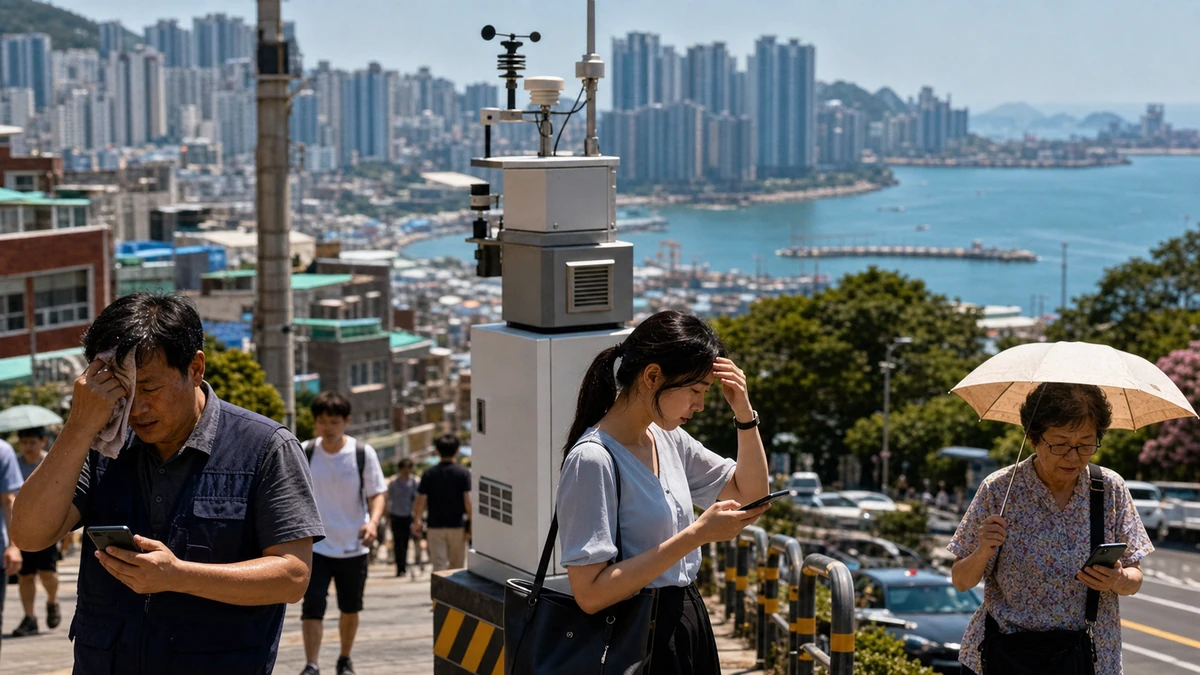
A coastal city reframes summer heat as a public health risk
Busan, South Korea’s second-largest city, is rolling out a summer alert system that treats extreme heat less like a routine weather update and more like a neighborhood-level health warning. The Busan Institute of Health and Environment said it will operate the service from July through September, using real-time temperature readings gathered from 27 urban air-monitoring stations across the city.
That may sound like a modest administrative change, but it reflects a broader shift in how cities are responding to dangerous summer temperatures. Instead of asking residents to rely on a general forecast for an entire metropolitan area, Busan is trying to tell people what conditions are like where they actually live, work and move around during the day. In practical terms, that means a resident deciding whether to walk to a market, a construction worker planning outdoor labor, or a parent figuring out whether it is safe for a child or an older relative to be outside can get more localized information.
For American readers, the closest comparison may be the way many U.S. cities now issue neighborhood air-quality alerts, cooling center notices or flash-flood warnings that recognize how risk varies block by block. Busan’s program takes that logic and applies it to heat. The message is simple: extreme heat is not only an inconvenience, and it is not merely a matter of whether the forecast says it will be hot today. It is a real-time health threat that can affect hydration, sleep, mobility, work safety and even whether routine errands become dangerous.
That framing matters in South Korea, where summers have grown hotter and more humid, and where densely built urban neighborhoods can trap heat in ways that make one part of a city feel substantially more punishing than another. Busan, a major port city known to many Americans as a film festival destination and, more recently, as the setting of the zombie thriller “Train to Busan,” is also a city of hills, coastline, apartment districts, industrial areas and crowded commercial zones. A single citywide number cannot fully capture how heat is felt across those varied environments.
By positioning its alert service as a health tool rather than just a weather bulletin, Busan is joining a growing number of governments worldwide that are rethinking what summer preparedness looks like in an era of rising temperatures.
Why local temperatures matter more than a citywide forecast
The heart of Busan’s new service is its use of real-time temperature data from 27 urban monitoring stations. That detail is more important than it may first appear. In many cities, residents are accustomed to hearing one forecast high for the day, as if the entire metropolitan area shares the same conditions. But urban heat rarely works that way.
Anyone who has crossed from a waterfront breeze into a traffic-heavy commercial district, or from a shaded neighborhood street into a concrete plaza with no trees, understands the difference intuitively. Urban planners and public health officials have a term for part of this phenomenon: the urban heat island effect, where buildings, asphalt and limited greenery cause some areas to absorb and retain more heat than others. A coastal district may be uncomfortable, while an inland zone ringed by pavement and high-rise buildings can feel punishing.
Busan’s service tries to reflect that reality. Rather than treating heat as something distant and abstract—another item in the nightly forecast—it makes the danger more immediate. This is not just what is happening somewhere in the region. It is what is happening near you, right now.
That distinction can influence behavior. Public health experts have long argued that warnings are most effective when people understand them as personally relevant. If someone hears only that “the city” is hot, the information may register as background noise, especially in a season when heat is expected. But if the signal is tied to the person’s own living area, commute or destination, it can prompt action: delaying a walk, carrying more water, changing work schedules, seeking indoor cooling, or checking on an older family member.
In the United States, a similar issue has become more visible as cities from Phoenix to New York have mapped heat vulnerability by neighborhood, not just by county or region. Busan’s approach fits that same global trend. The value is not simply in collecting data. It is in translating that data into decisions ordinary people can make before heat exposure becomes a medical problem.
And that is the key public health point. Heat illness often develops not because people never heard it would be hot, but because they underestimated the intensity, timing or local variation of the danger. Real-time, place-based information can narrow that gap.
Three channels, one goal: Get the warning to people before the heat does
The Busan Institute of Health and Environment said it will deliver heat information through three channels: a public health and environmental information system, 16 outdoor air-environment signal lights, and mobile alert messages sent through KakaoTalk’s notification service, often called AlimTalk in South Korea.
For readers outside Korea, KakaoTalk is the country’s dominant messaging app, something like a combination of text messaging, WhatsApp and a digital utility platform. Many Koreans use it not only to chat with friends and family but also to receive notices from businesses, schools and public agencies. That makes it a powerful tool for emergency communication. When Busan says residents can receive heat advisories and a link to check current temperatures on their phones, it is tapping into an app that is already woven into daily life for millions of people.
That is a significant design choice. One of the persistent failures in public safety communication is the assumption that making information available is the same as making it accessible. It is not. A website helps people who think to check it. A street-level sign helps those who happen to pass by. A phone message reaches people where they already are—on the move, commuting, working outdoors or looking after children.
The 16 signal lights serve a different purpose. The institute describes them as air-environment information signal systems, but their real strength is simplicity. Like traffic lights or color-coded public warning boards, they give people a quick visual cue without requiring them to stop and read a detailed bulletin. For something as immediate as heat, that speed matters. A commuter leaving a subway station or a pedestrian on a busy street does not need an essay. They need a fast signal that tells them conditions are dangerous enough to change behavior.
The public information system, meanwhile, provides a more detailed option for residents who want to check local temperature trends or make plans before heading out. Taken together, the three channels show a layered strategy that public health professionals often recommend: don’t rely on one platform, because different people receive information in different ways.
That is especially important in a city with a diverse population that includes older adults, students, office workers, tourists and outdoor laborers. The ideal warning system is not just accurate. It is visible, understandable and timed to the moments when people can still do something with it.
In Korea, heat is increasingly treated as a health issue, not just a seasonal annoyance
The Busan program also says something about how South Korea is adapting to hotter summers. In many places, extreme heat was long treated as little more than discomfort—something to complain about, endure and escape with air conditioning if possible. That attitude is changing as heat waves become more frequent, more intense and more clearly linked to illness and death.
South Korea, like the United States, has had to confront the reality that heat can be deadly even without the dramatic visuals associated with storms, floods or wildfires. It can be especially dangerous for older adults, people with chronic illnesses, those who work outside, people living alone, and households with limited access to cooling. It also places stress on hospitals, emergency responders and city infrastructure.
Busan’s framing of the service underscores that point. The city is not presenting the alerts as lifestyle convenience or simple weather trivia. It is effectively saying that knowing the temperature in your immediate living area is part of managing health risk. That can include decisions about outdoor exercise, delivery work, construction shifts, school activities, travel timing and care for vulnerable family members.
There is also a cultural dimension worth explaining for readers unfamiliar with Korea. In South Korea, local governments and public agencies often play an active role in distributing practical daily-life information, especially through digital platforms that are widely used across the population. Public alerts about weather, air quality and transportation disruptions are common, and mobile-phone-based public communication is often faster and more integrated than many Americans might expect from city agencies at home.
That does not mean such systems reach everyone equally. Officials themselves acknowledge an important limitation: multiple channels do not automatically guarantee equal access. Some people will read phone alerts immediately. Others may notice only the street signals. Some may never check the public website unless prompted. The challenge, in Busan as in any major city, is making sure the information reaches the people most at risk, not only the most digitally connected.
Still, the shift in philosophy is clear. Heat is being treated as part of urban health management. The city measures it, communicates it and expects residents and institutions to respond accordingly.
What residents can do with the alerts once they receive them
The practical value of a warning system depends on what people do next. Busan officials emphasize that the alerts are most useful when they lead to immediate choices: adjusting the time of an outing, cutting back outdoor activity, taking more frequent breaks, drinking water, or moving into cooler indoor spaces.
That may sound obvious, but the real challenge with heat is that people often continue with ordinary routines until the body forces them to stop. Heat can build gradually. A person walking, exercising or working outside may not recognize the danger quickly enough, especially in humid conditions that reduce the body’s ability to cool itself through sweat.
For households, the alerts can also become a shared safety tool. A younger family member who receives a mobile notification can check in with an older parent or grandparent. Someone heading to work can rethink the timing of a commute. Parents can reconsider midday sports or outdoor play. Small scheduling decisions—leaving earlier, waiting until evening, shortening time outdoors—can lower risk.
Workplaces and schools can use the same information in a more organized way. An employer may decide to shift outdoor tasks, add breaks or encourage hydration. A storefront owner may prepare a cooler rest area for customers and workers. A school or community center may postpone an outdoor event. None of those steps requires a major new system. They simply require timely information that feels credible and local enough to act on.
Busan officials are not suggesting that a temperature alert replaces medical judgment. If someone shows signs of heat exhaustion or heat stroke, professional medical help is still essential. But public health often works best before a crisis escalates. A phone alert or visible signal can function as an early nudge, warning people to change course before symptoms begin.
For Americans reading this from cities that have endured record-setting heat in recent summers, the lesson will sound familiar. The most effective heat policy is often less dramatic than a disaster response. It is about making information timely, specific and easy to use in everyday life.
A local Korean story with global significance
On one level, Busan’s program is a local government service announcement. On another, it is part of a much larger story about how cities around the world are learning to live with extreme heat. From Europe to the United States to East Asia, local authorities are increasingly recognizing that broad forecasts are not enough when residents need to know what conditions are like where they actually are.
That is why a story from Busan carries relevance beyond South Korea. The city’s approach combines real-time environmental monitoring, public communication infrastructure and a health-centered framework. It offers a case study in how municipal governments can connect weather data to human behavior quickly enough to matter.
In the American context, this intersects with debates over climate adaptation, public health messaging and digital equity. Cities can install sensors and dashboards, but if people do not see the information in time—or do not understand why it matters—the public benefit is limited. Busan’s three-channel system is a reminder that communication strategy is part of infrastructure.
There is also a broader message about what counts as health policy. Many people think of health interventions as hospital care, insurance coverage, medication or emergency response. But some of the most effective protections happen earlier and elsewhere: in the street design that adds shade, in workplace rules that limit heat exposure, in cooling centers that stay open late, and in alerts that tell people danger is building before they step outside. Busan’s service belongs to that category.
For now, the city says the alert program will run through September, covering the hottest stretch of the season. Residents can use the public information system, watch for the signal lights and receive mobile notices that include heat advisory information and links to current temperatures. The aim is straightforward: help people treat heat as a real and immediate risk in their own neighborhood, not as an abstract summer headline.
That may be the most important takeaway from this Korean story. In an era of hotter summers, the first line of defense is often not a dramatic technological breakthrough. It is knowing, in real time, how hot it is where you are—and being willing to change the day’s plans because of it.
The bigger test comes after the alert is sent
If Busan’s system works as intended, its success will not be measured only by how many messages are delivered or how many people click a temperature link. The deeper question is whether the alerts become part of daily decision-making across the city. Do residents start checking neighborhood heat conditions the way they might check traffic? Do employers respond quickly enough to protect outdoor workers? Do families use the warnings to look after elderly relatives? Those are harder outcomes to track, but they are the ones that matter most.
Public officials everywhere struggle with the same problem: issuing a warning is the easy part; changing behavior is harder. People ignore alerts when they come too often, when they seem too general, or when they do not trust that the warning applies to them personally. Busan’s localized model appears designed to overcome that fatigue by making heat information more specific and more immediately relevant.
That is why this is more than a technology story. It is a story about how cities communicate risk in the climate era. Busan is betting that when residents can see extreme heat as a threat in their own daily sphere—not somewhere else in the city, not later in the day, not in a broad weather graphic—they are more likely to act before the danger becomes an emergency.
For a world growing hotter by the summer, that is a lesson many cities will be watching closely.
Comments
Post a Comment