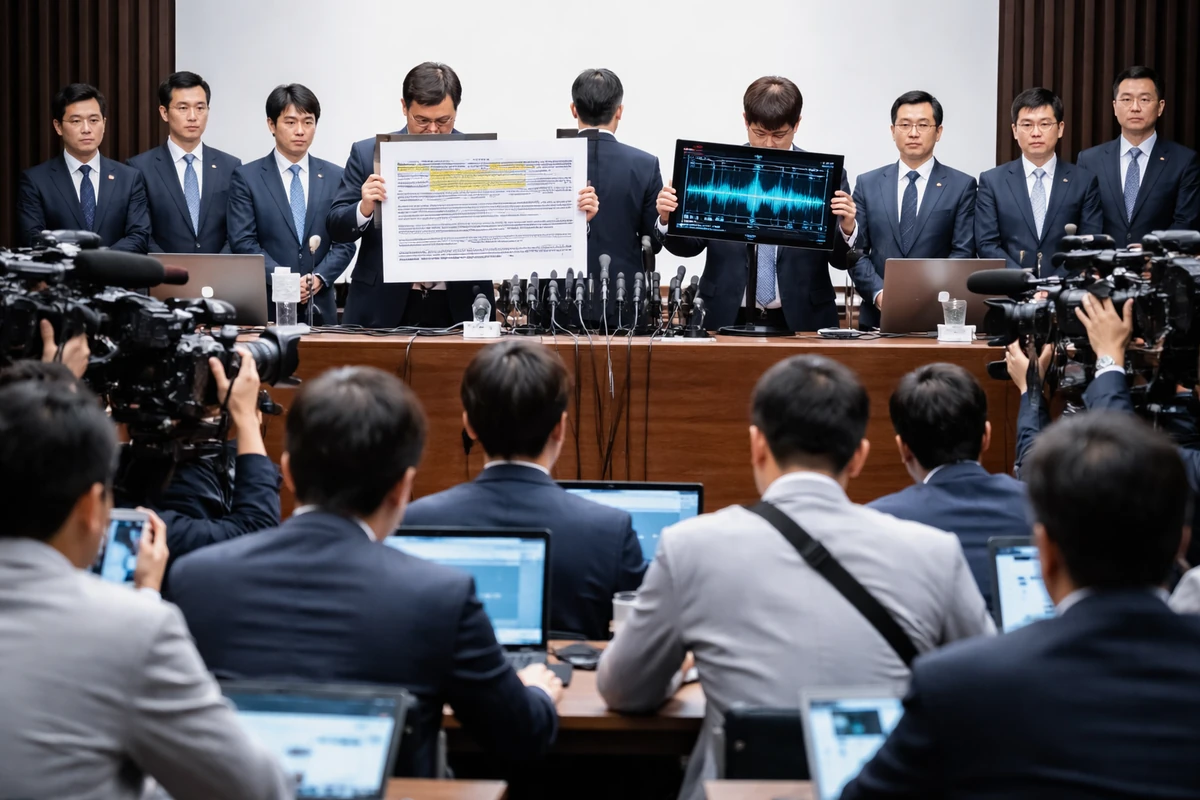
A political firestorm with familiar roots
South Korea’s ruling party has opened a new front in one of the country’s oldest and most explosive political battles: whether prosecutors have too much power, and whether that power has been used selectively against political figures. The latest spark is the release of an audio recording that the governing camp says shows investigators tried to shape or manipulate testimony in a case tied to President Lee Jae-myung. That is an extraordinary allegation in any democracy. In South Korea, where battles over corruption investigations, presidential power and prosecutorial independence have repeatedly shaken governments, it lands with particular force.
The disclosure, made March 30 by the ruling party and amplified as a major political headline in South Korea, is significant not simply because it concerns Lee, one of the country’s most polarizing political figures. It matters because it goes to a deeper question that has haunted Korean politics for years: Can the public trust prosecutors to investigate powerful people without political bias?
For American readers, the closest point of comparison may be the way debates over the Justice Department, special counsels or politically charged investigations can become broader arguments about the credibility of institutions. But South Korea’s situation has its own distinct history. Prosecutors there have traditionally held unusually broad authority, combining investigative and charging powers in ways that critics say make the office especially vulnerable to politicization. Over the past decade, virtually every major political camp has accused prosecutors of overreach when under scrutiny and praised them when they target rivals.
That is the backdrop to the latest clash. The ruling party is not just accusing investigators of making mistakes. It is framing the recording as evidence that a case involving the president may have been built through a distorted or improperly guided witness statement. Opposition figures and prosecutors, or those aligned with them, are likely to answer that the recording may be incomplete, selectively presented or politically interpreted. At this stage, the public knows that a recording has been released and that it is being treated as a political bombshell. What the recording actually proves, legally and factually, remains unsettled.
Even so, the political consequences may arrive long before any courtroom conclusion. In South Korea, as in the United States, the first battle in a scandal is often over narrative: who gets to explain a complicated controversy in a way ordinary voters can understand. The ruling party is trying to tell a simple story — that the president was pursued through a tainted investigative process. Its opponents are likely to argue that the government is attacking legal institutions to protect itself. Once that kind of frame takes hold, the actual evidence can struggle to catch up.
Why an audio clip matters so much in South Korean politics
On the surface, the dispute centers on a recording reportedly linked to Park Sang-yong and allegations that testimony in an investigation involving Lee was manipulated. But in South Korea, recorded conversations, text messages and leaked documents often become powerful political weapons even before courts determine their evidentiary value. They serve not just as evidence, but as symbols.
That is especially true in a media environment where political crises move quickly and where partial disclosures can shape public opinion within hours. A recording, even one that is fragmentary, creates the impression of intimacy and authenticity. Voters hear voices, tone and pauses. They do not just read accusations; they feel as though they are listening in on the machinery of power. That can be politically devastating, even if later legal review shows the clip is ambiguous or incomplete.
Still, lawyers and judges tend to ask different questions from politicians. Was the audio edited? Is the original preserved? Under what circumstances was it recorded? Who is speaking, and in what role? Is the clip representative of the full conversation? Does it align with documents, timelines and other witness accounts? Those questions can determine whether a recording becomes legally consequential or remains mainly a political talking point.
That gap between political meaning and legal meaning is central to this episode. The ruling party’s apparent strategy is to use the recording to widen scrutiny beyond any single statement and toward the structure of the investigation itself. In other words, the argument is not merely that someone said something problematic. It is that the entire process of gathering testimony may have been tilted toward a predetermined outcome.
That distinction matters. In modern criminal justice systems, testimony is judged not only by what was said, but by how it was obtained. If a witness was pressured, led, selectively quoted or guided toward a preferred narrative, the reliability of the statement can be called into question. And if the public comes to believe that happened in a case involving a sitting president, the fallout extends far beyond one prosecution. It raises doubts about whether state power is being exercised neutrally at all.
South Koreans are especially sensitive to that question because the country’s democracy, though robust and competitive, still carries institutional memories of authoritarian rule, politicized justice and governments that used state organs aggressively against opponents. Today’s South Korea is a very different nation — globally connected, deeply democratic and intensely pluralistic — but those memories still inform how voters interpret conflicts involving prosecutors, presidents and political retaliation.
The deeper issue is not one recording, but the prosecution system itself
If the public debate stopped at whether the recording is “real” or “damning,” it would miss the larger point. The more consequential issue is the architecture of prosecutorial power in South Korea. For years, reformers have argued that prosecutors have amassed too much authority over investigations, indictments and the timing of politically sensitive cases. Conservatives and some institutional defenders, meanwhile, have argued that prosecutors remain essential for pursuing corruption and checking abuses by those in office.
This is not an abstract debate. It has defined major political struggles in recent South Korean administrations. Prosecutorial reform has repeatedly emerged as a signature issue, only to become tangled in partisan warfare. Every side claims to support fairness. Every side accuses the other of wanting to weaken law enforcement only when it becomes politically inconvenient.
For Americans, a rough analogy would be if debates over the FBI, federal prosecutors and politically sensitive criminal investigations were rolled into one prolonged institutional struggle that also touched campaign politics, executive legitimacy and constitutional reform. In South Korea, those questions are often compressed into a single confrontation.
The ruling party’s latest accusation appears designed to revive the argument that reform is not just desirable, but urgent. If investigators really steered testimony with a political objective, reformers can say the problem is systemic, not episodic. That could breathe new life into long-running proposals involving tighter control over prosecutorial discretion, greater transparency in interrogations, stricter rules on public disclosures during investigations and further redistribution of investigative authority.
But the risk for the government is equally clear. If the recording turns out to be less conclusive than advertised — or if legal review finds that the interaction reflected ordinary, lawful investigative conduct rather than coercion or fabrication — then the ruling party may be accused of weaponizing incomplete evidence to discredit institutions investigating the powerful. What begins as a call for reform could be recast as an effort at political self-protection.
That is why the stakes are so high. This is not simply about winning one day’s news cycle. It is about who gets to define the credibility crisis: prosecutors or politicians. If voters conclude prosecutors acted improperly, the government gains the moral language of institutional correction. If voters conclude the government is bullying the justice system, the opposition gains the language of democratic restraint.
Lee Jae-myung’s presidency and the burden of political polarization
Any controversy involving Lee carries unusual weight because he has long been one of South Korea’s most divisive and closely watched politicians. To supporters, he is a combative reformer who takes on entrenched elites. To critics, he is a deeply controversial figure whose legal and ethical troubles cannot simply be dismissed as partisan attacks. That split helps explain why the current dispute is likely to harden opinion before it changes many minds.
Lee’s political rise has unfolded alongside relentless legal and political scrutiny, making him a natural focal point for broader arguments about fairness and power. In that sense, the current dispute is about more than his personal fate. It has become a proxy for a bigger argument over whether South Korea’s institutions can function consistently when the person at the center is so politically charged.
That pattern is not unfamiliar in democracies under strain. In the United States, cases involving former presidents or presidential candidates often stop being only legal matters and instead become contests over legitimacy, process and selective enforcement. South Korea faces a similar dynamic, but with its own institutional texture. The presidency is powerful, party discipline is often sharper, and political crises can move rapidly from the courtroom to the National Assembly to the streets.
The ruling party appears to understand that this fight is as much emotional as legal. By focusing on the possibility of manipulated testimony, it is appealing not only to Lee loyalists but also to voters who may not love the president yet still worry about fairness in the justice system. It is a smart political target. People who disagree on ideology can still agree that investigations should not be rigged.
Opposition parties, however, have an equally potent line of attack. They can argue that no president should use partisan muscle to discredit investigations that touch his own political orbit. They can cast themselves as defenders of institutional independence, even if they, too, have criticized prosecutors in other moments. In a polarized environment, consistency often matters less than timing and persuasion.
The result is a familiar democratic paradox: both sides are likely to claim they are protecting the rule of law. One side says the law was twisted for political ends. The other says political leaders are twisting public anger to weaken legal accountability. To undecided voters, the winner may not be the side with the most sweeping rhetoric, but the one that appears calmer, more factual and less self-interested.
What this could mean for elections, governance and policy
The timing of the controversy is politically important. Late-March agenda setting in South Korea often overlaps with maneuvering tied to local elections, party nominations, regional development promises and broader legislative strategy. When a legal controversy involving the president suddenly dominates headlines in that environment, it can reshape what campaigns talk about and what voters hear.
For the ruling party, the incentives are obvious. If it can convince the public that earlier investigations into Lee were politically designed from the start, it may energize supporters, rally wavering allies and reframe criticism of the president as evidence of institutional abuse. It could also reintroduce prosecutorial reform as a unifying cause, turning a defensive controversy into an offensive governing agenda.
There is another tactical possibility as well: incremental disclosure. If the governing camp releases more material over time, rather than all at once, the issue could evolve from a single headline into a sustained political campaign. That approach can be effective in modern politics because it stretches out attention, invites speculation and repeatedly forces opponents to react. But it is also risky. If later disclosures fail to add substance, the strategy can look manipulative.
The opposition’s incentives are just as clear. It can argue that the ruling party’s evidence has been cherry-picked, that the broader investigative record tells a different story and that the government is pressuring independent institutions for short-term political gain. It can also try to shift the public’s focus away from legal intrigue and back to bread-and-butter concerns such as the economy, household finances, housing and regional development.
That may be crucial. Korean voters, like American voters, can become exhausted by permanent scandal. A dramatic fight over prosecutorial conduct may animate party bases, but middle-of-the-road voters often want proof, not theater. If they sense that political actors are exploiting the issue while neglecting inflation, jobs or local concerns, they may punish whoever seems most consumed by the fight.
In that sense, this controversy could shape more than the debate over justice reform. It could influence the larger mood of governance. Does the administration appear focused and disciplined, or aggrieved and combative? Does the opposition appear principled, or opportunistic and defensive? Political momentum can turn on tone as much as evidence.
The legal path will move slower than the political one
One of the most important points for outside readers to understand is that political uproar does not automatically produce legal clarity. A recording can dominate headlines and still leave many core questions unanswered for months. That is especially true in cases involving allegations of manipulated testimony, because those claims usually depend on context rather than isolated words.
Legal evaluation would likely center on several issues: whether the recording is authentic and complete; whether it has been edited or selectively excerpted; how and when it was made; whether the speakers had official roles in the investigative process; and whether the conversation, read alongside the full case file, indicates improper inducement or simply aggressive but lawful investigative behavior. None of those questions can be resolved by rhetoric alone.
This is where political time and legal time diverge. Politicians move on urgency. Courts move on verification. News cycles reward confidence. Legal systems reward caution. That mismatch often frustrates the public, which wants a clean answer to a messy problem. But in controversies like this, the most honest conclusion early on is often the least satisfying one: the implications are serious, but the record is incomplete.
Several broad scenarios are possible. The ruling party could release additional material that strengthens public suspicion and increases pressure for legislative or institutional reform. Prosecutors or opposition figures could present fuller context that blunts the force of the allegation and turns the story into a cautionary tale about selective leaks. Or the matter could settle into a drawn-out gray zone, where neither side wins a decisive verdict and public trust erodes further.
That third outcome may be the most damaging. Democracies can survive fierce conflict, but they struggle when citizens cease to believe that neutral rules apply equally. If people come away from this episode convinced that investigations are politically tailored, trust in prosecutors declines. If they conclude that elected leaders can casually discredit law enforcement whenever it is convenient, trust in government declines. Either way, the common denominator is institutional damage.
What American readers should watch next
From abroad, it can be tempting to view South Korean political clashes as unusually dramatic versions of partisan scandal. But that would miss what makes this story worth following. South Korea is one of America’s closest allies, a major democratic power in Asia and a country whose internal political stability matters well beyond its borders. The way it handles disputes over prosecutorial independence, presidential legitimacy and institutional reform offers a window into the pressures facing democracies far beyond the Korean Peninsula.
The immediate questions are straightforward. Will the ruling party release more of the recording or related materials? Will prosecutors or other institutions respond with documentation, legal explanation or rebuttal? Will lawmakers use the controversy to push concrete reform proposals, or merely to score points? And perhaps most important: will voters see this as a genuine accountability issue or as yet another chapter in a familiar partisan war?
There is also a deeper question about South Korea’s democratic maturation. The country has built a remarkable modern state, transformed itself into a cultural powerhouse and consolidated vibrant electoral competition. Yet it continues to wrestle with how powerful institutions should be constrained, how legal processes should be insulated from political combat and how leaders should be judged when law and politics become inseparable in the public imagination.
Those tensions are not uniquely Korean. Americans know them well. But South Korea’s version is shaped by its own history of rapid democratization, strong presidencies and recurring efforts to reform institutions that many citizens see as necessary yet suspect. That is why an audio recording, even before its legal value is fully tested, can become a national event.
For now, the central fact is not that a final truth has emerged. It is that a fresh round of doubt has entered the system. The ruling party’s release of the recording has done more than generate a headline. It has revived a foundational argument over whether justice in South Korea is administered impartially or weaponized politically. Until that question is answered convincingly, the controversy is unlikely to remain just about one tape, one case or even one president.
Comments
Post a Comment