
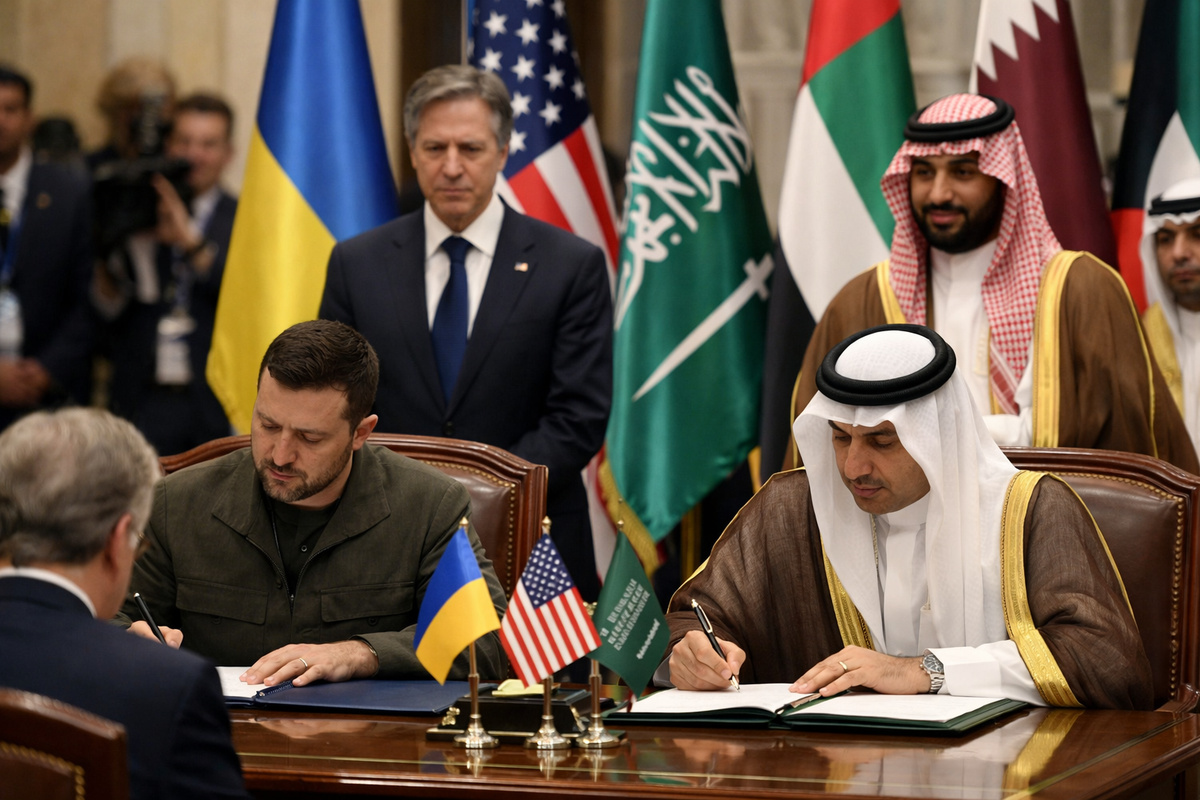
Ukraine looks beyond Washington for long-term security
Ukraine’s decision to sign a 10-year defense agreement with a Gulf Arab state is about much more than another bilateral deal announced in the middle of a grinding war. It is, at its core, a signal that Kyiv is trying to build a broader survival strategy as uncertainty grows around the pace and durability of U.S. security commitments.
For American readers, the easiest comparison may be this: Imagine a longtime U.S. ally that still depends heavily on Washington, but no longer feels it can plan its future around Capitol Hill votes alone. That ally would not necessarily be abandoning the United States. But it would be shopping for backup — not just for weapons, but for financing, reconstruction, intelligence ties and political cover. That is the broader meaning of Ukraine’s new long-term pact with a Gulf partner.
The time frame matters. A 10-year agreement is not designed only for the next offensive, the next Russian missile barrage or the next budget fight in Congress. It suggests a deeper ambition: to build a framework for deterrence, state resilience and eventual reconstruction long after the war’s current phase ends. In other words, Kyiv is trying to secure not only the means to keep fighting, but the means to keep functioning as a state.
That distinction is crucial. Since Russia’s full-scale invasion, much of the Western conversation around Ukraine has focused on near-term military needs — artillery shells, air defenses, training pipelines and emergency aid packages. But as the conflict has dragged on, Ukraine’s needs have expanded. A country at war needs more than ammunition. It needs predictable financing, investment confidence, functioning infrastructure, diplomatic legitimacy and evidence to its own people that it will not be left alone in the long run.
That is where a Gulf state can matter, even if it does not become a direct combat participant. In today’s geopolitics, security is no longer defined solely by NATO-style troop commitments. It can also be shaped by long-term funding pledges, intelligence cooperation, humanitarian assistance, technology partnerships and political guarantees that increase the cost of future aggression. A deal like this may not look like the U.S.-Japan alliance or NATO’s Article 5, but that does not make it insignificant.
The announcement also reflects a reality that Washington cannot ignore: Ukraine still sees the United States as the central pillar of its security, but it is no longer willing to wait passively while American politics determine the tempo of its future. That is not a rejection of the U.S. role. It is a hedge against American unpredictability.
The real backdrop is U.S. hesitation, not Gulf ambition alone
If there is one point that deserves emphasis, it is this: the most important fact about the agreement may be the political vacuum it is trying to fill. The pact is noteworthy not simply because a Gulf state chose to engage Ukraine for the long term, but because Kyiv felt the need to lock in support elsewhere while the U.S. security picture remained uncertain.
American support for Ukraine has never been a single, clean promise. It has been a layered package of military aid, intelligence sharing, training, financial support, diplomatic backing and future reconstruction planning. That package has been substantial, but also vulnerable to political delays, partisan fights, election-year messaging and broader public fatigue with a long war overseas. From Kyiv’s perspective, the problem is not only how much support Washington ultimately provides. The problem is whether that support can be counted on, scheduled and integrated into long-term national planning.
That is a familiar issue to many Americans who have watched budget standoffs in Washington affect everything from government shutdown threats to military spending debates. Ukraine, however, is trying to fight and rebuild under those conditions. It is difficult to sustain a war effort when each major aid package arrives amid public drama and uncertain timing. Predictability can matter as much as volume.
Seen through that lens, the 10-year defense pact is a diplomatic tool designed to create predictability on paper, even if the military details remain limited or phased in over time. Long-term agreements can reassure investors, strengthen domestic morale and signal to adversaries that the country in question will not simply run out of partners.
There is also an audience beyond Ukraine’s immediate backers. By signing such a deal, Kyiv is telling Europe, the United States and the broader international community that it is not merely a recipient of Western charity. It is acting like a state that is actively constructing a diversified security network. That message matters in wartime, when perception can be almost as important as force levels. Countries considering investment, humanitarian engagement or diplomatic alignment may take such signals into account.
For Washington, the message is more complicated. On one hand, U.S. officials may welcome burden-sharing and broader international engagement in support of Ukraine. On the other hand, if Kyiv increasingly turns to the Gulf, that could gradually dilute Washington’s unique role as the principal organizer of Ukraine’s external support architecture. The United States is unlikely to see that as a direct threat, but it does underscore a broader shift: Ukraine is becoming a global diplomatic issue, not just a trans-Atlantic one.
Why the Gulf has strategic reasons to say yes
From an American perspective, it may be tempting to view Gulf countries primarily through the lens of oil, sovereign wealth funds and U.S. military basing. But that stereotype misses how much the Gulf’s leading states have expanded their foreign-policy ambitions over the past decade. They are no longer content to be seen only as energy exporters or check writers. Increasingly, they want recognition as mediators, investors and strategic actors in major global crises.
That is one reason a long-term agreement with Ukraine could appeal to them. For Gulf governments, such a pact can reinforce an image they have carefully cultivated in recent years: a set of states that can talk to the West, maintain channels with Russia, manage ties across the Middle East and place themselves at key diplomatic crossroads. In American terms, they are trying to be more than wealthy regional powers. They want to be indispensable middle powers.
That ambition has shown up before. Gulf states have played visible roles in prisoner exchanges, humanitarian coordination, investment diplomacy and conflict mediation in places ranging from Sudan to Afghanistan. Even when they do not resolve wars, they often gain stature by serving as conveners, intermediaries or financiers. A long-term Ukraine deal fits that pattern. It allows a Gulf state to move from offering a venue or a humanitarian gesture to becoming a more durable stakeholder in a major European conflict.
There are practical benefits as well. Ukraine’s eventual reconstruction is likely to become one of the biggest rebuilding efforts in the world, touching sectors such as energy, ports, railroads, logistics, digital government, housing and agriculture. Gulf sovereign wealth funds and state-backed firms have both capital and experience in long-horizon infrastructure investing. Entering early through a defense and strategic partnership could position Gulf actors for preferred access when reconstruction contracts and investment frameworks expand.
That does not mean a Gulf state is preparing to flood Ukraine with arms or commit itself to a NATO-style defense obligation. In fact, the opposite is more likely. Gulf capitals typically prefer flexible arrangements that increase influence without trapping them in rigid military commitments. They also have to balance ties with the United States, Europe, Russia and regional players such as Iran. Any support to Ukraine will likely be calibrated with that balancing act in mind.
Still, calibrated does not mean trivial. If a Gulf state provides financial guarantees, reconstruction financing, intelligence cooperation, humanitarian support or political backing, that can still help Ukraine significantly. Modern war is not sustained only by front-line firepower. It is sustained by cash flow, logistics, insurance, diplomacy, technology and confidence that external support systems will remain intact.
For Gulf leaders, the agreement may also carry reputational value. In a world where energy powers are often criticized for transactional diplomacy, supporting Ukraine over the long term can present a different image: not just as merchants of oil or gas, but as partners in stabilizing an embattled state. That image, especially in European and American policy circles, has real strategic currency.
A wider sign that war diplomacy is moving beyond Europe
The war in Ukraine began as a direct challenge to Europe’s security order, but its consequences have long since spilled far beyond the continent. Grain exports, shipping routes, energy prices, sanctions enforcement, weapons procurement and refugee flows have tied the conflict to the Middle East, Africa and the Indo-Pacific. In that sense, a Gulf-Ukraine defense pact is not an odd detour. It is evidence of how global the conflict has become.
For decades, American audiences have tended to think of war alliances in fairly traditional terms: formal military blocs, troop deployments, air bases and treaty commitments. But the diplomacy surrounding Ukraine suggests a different model is gaining importance. Today’s conflict support networks are built from blended packages — security assistance, financing, insurance, reconstruction planning, humanitarian aid, cyber cooperation and diplomatic signaling.
That change matters because it expands the field of meaningful players. A country does not need to send fighter jets or battalions to influence the strategic environment. It can matter by backing a central bank, underwriting an energy grid, financing a grain corridor, providing satellite-linked systems, helping repair ports or anchoring investor confidence. In a war of attrition, the side that can preserve state capacity often gains as much as the side that gains a few miles of territory.
Ukraine appears to understand this. By reaching to the Gulf, it is broadening the geography of its war diplomacy. It is saying, in effect, that Europe alone will not define the terms of Ukraine’s endurance. Neither will Washington alone. The support map is widening, and that in itself can create strategic value.
Russia is likely to notice that. Moscow has often benefited from the assumption that Western fatigue would eventually work in its favor — that elections, budget fights and public weariness would slow the flow of aid and reduce the cohesion of Ukraine’s backers. If Kyiv can diversify support beyond the usual Euro-Atlantic channels, Russia’s time-based strategy becomes less straightforward. Diversification does not erase military realities on the ground, but it can complicate the Kremlin’s expectation that patience favors Moscow.
None of this means the Gulf pact automatically changes the battlefield balance. The details still matter enormously. A defense agreement can range from a robust framework with financing and implementation mechanisms to a more symbolic political declaration with broad language and limited operational content. Analysts will need to see whether the pact includes concrete provisions related to procurement, training, intelligence, air defense support, reconstruction finance or emergency assistance triggers.
But even before those details are fully clear, the diplomatic meaning is significant. It shows that the center of gravity in war diplomacy is broadening beyond the institutions and capitals most Americans first associate with the Ukraine conflict.
The economic stakes: energy, infrastructure and market confidence
Any long-term agreement between Ukraine and a Gulf state also carries an economic dimension that Americans should not overlook. The Gulf is not just a political region. It is one of the world’s central hubs for energy capital, sovereign investment and large-scale project finance. Ukraine, meanwhile, represents one of the world’s most consequential future reconstruction stories.
That intersection alone has implications. Even if the pact does not immediately alter oil prices or global shipping patterns, it may shape how markets think about Ukraine’s long-term viability. Investors, lenders and insurers are not just asking whether Ukraine can defend itself this month. They are asking whether the country can remain governable, financeable and rebuildable over the next decade. Long-term outside commitments can help answer that question.
There is a reason economists and strategic planners increasingly discuss “state sustainability” alongside military defense. A modern state under attack needs electricity, rail networks, ports, digital public services, banking continuity and food logistics. If those systems collapse, military resistance becomes harder to maintain. If they are stabilized, even imperfectly, a country can continue functioning and fighting.
That makes the reconstruction angle especially important. Ukraine’s postwar needs are expected to be enormous: repairing power grids, modernizing transportation corridors, rebuilding cities, restoring industrial sites and creating more resilient decentralized energy systems. Gulf capital is well suited to large, long-duration projects of that sort. Sovereign wealth funds, infrastructure platforms and energy investors in the region have experience deploying money across strategic sectors with long payoff horizons.
There is also a direct energy connection. Since Russia’s invasion, Europe has scrambled to diversify energy supplies and rethink energy security. Gulf states have benefited in some ways from that reordering, but they also have reason to support a more stable European neighborhood. A more resilient Ukraine, especially one that rebuilds energy infrastructure and logistics links, becomes part of a wider effort to reduce the systemic shocks that war can cause in energy and commodity markets.
For American readers, think of it as the difference between emergency disaster aid and a long-term redevelopment bond package. The first keeps the lights on for a week. The second can shape whether a place recovers at all. Ukraine needs both. What a Gulf pact may offer is a bridge between immediate wartime needs and the architecture of eventual recovery.
Of course, markets will not respond to symbolism alone. Investors will watch for implementation, legal protections, financing mechanisms and political durability. A headline about a 10-year pact may create optimism, but confidence ultimately depends on whether the agreement produces measurable follow-through. Still, in global finance, political commitment can be a valuable asset in itself, especially when attached to wealthy states with ample reserves.
What this means for the United States and its allies
For the United States, the emergence of a Gulf security partner for Ukraine presents both an opportunity and a warning. The opportunity is obvious: if more countries with serious financial resources and diplomatic reach become invested in Ukraine’s survival, the burden on Washington could become more sustainable. American officials have repeatedly urged allies and partners to do more. A major Gulf commitment would fit that logic.
The warning is subtler. If Ukraine increasingly seeks long-term guarantees from outside the traditional Western alliance system, that reflects a credibility problem. Not necessarily a collapse of U.S. influence, but a recognition in Kyiv that American support, while still central, is not as predictable as it once seemed. That perception carries consequences. Once allies begin building parallel support structures, the United States loses some leverage over timing, coordination and strategic framing.
This does not mean Washington has failed or that it is being replaced. The U.S. remains indispensable to Ukraine in ways no Gulf state can match, especially in military capability, intelligence depth and alliance leadership. But indispensability is not the same as exclusivity. And the more uncertain U.S. politics appear, the more space opens for other actors to matter.
There is also a broader lesson about the future of alliances. Americans often think of security in binary terms: either a country is inside a treaty alliance or it is on its own. The Ukraine case suggests a more layered world is emerging, one where countries stitch together overlapping guarantees from multiple partners. Some provide weapons. Others provide money. Others provide diplomatic legitimacy or reconstruction support. The end result may not resemble the Cold War alliance map, but it can still be strategically meaningful.
For Europe, the Gulf agreement should also be a reminder that external support competition is becoming global. If European capitals want to remain central to Ukraine’s future, they will need to offer not just rhetorical solidarity but durable financial, industrial and security frameworks. The Gulf’s entry into this space may spur that effort — or expose how slow it has been.
Ultimately, the significance of the deal will depend on execution. If it remains mostly symbolic, its effect will be limited to political messaging. If it develops into a structured package of financing, reconstruction planning, intelligence links and sustained strategic support, it could become an important piece of Ukraine’s long war strategy.
Either way, the announcement captures a larger truth about this phase of the conflict. Ukraine is no longer fighting only for more missiles, more shells or more headlines in Washington. It is fighting for something more durable: a network of commitments that can carry the country through a prolonged war and into whatever peace follows. That search is now extending well beyond Europe’s traditional security map — and that alone makes this agreement worth watching.


0 Comments